Structure of Atom — Explained
Detailed Explanation
The journey to understanding the structure of an atom is a fascinating tale of scientific inquiry, marked by successive models that refined our perception of these fundamental building blocks of matter. From the early philosophical ideas to the sophisticated quantum mechanical model, each step has brought us closer to the intricate reality of the atom.
Conceptual Foundation: Evolution of Atomic Models
- Dalton's Atomic Theory (1808): — John Dalton proposed that matter consists of indivisible atoms, all atoms of a given element are identical, atoms of different elements are different, and atoms combine in simple whole-number ratios to form compounds. While revolutionary, it failed to explain subatomic particles.
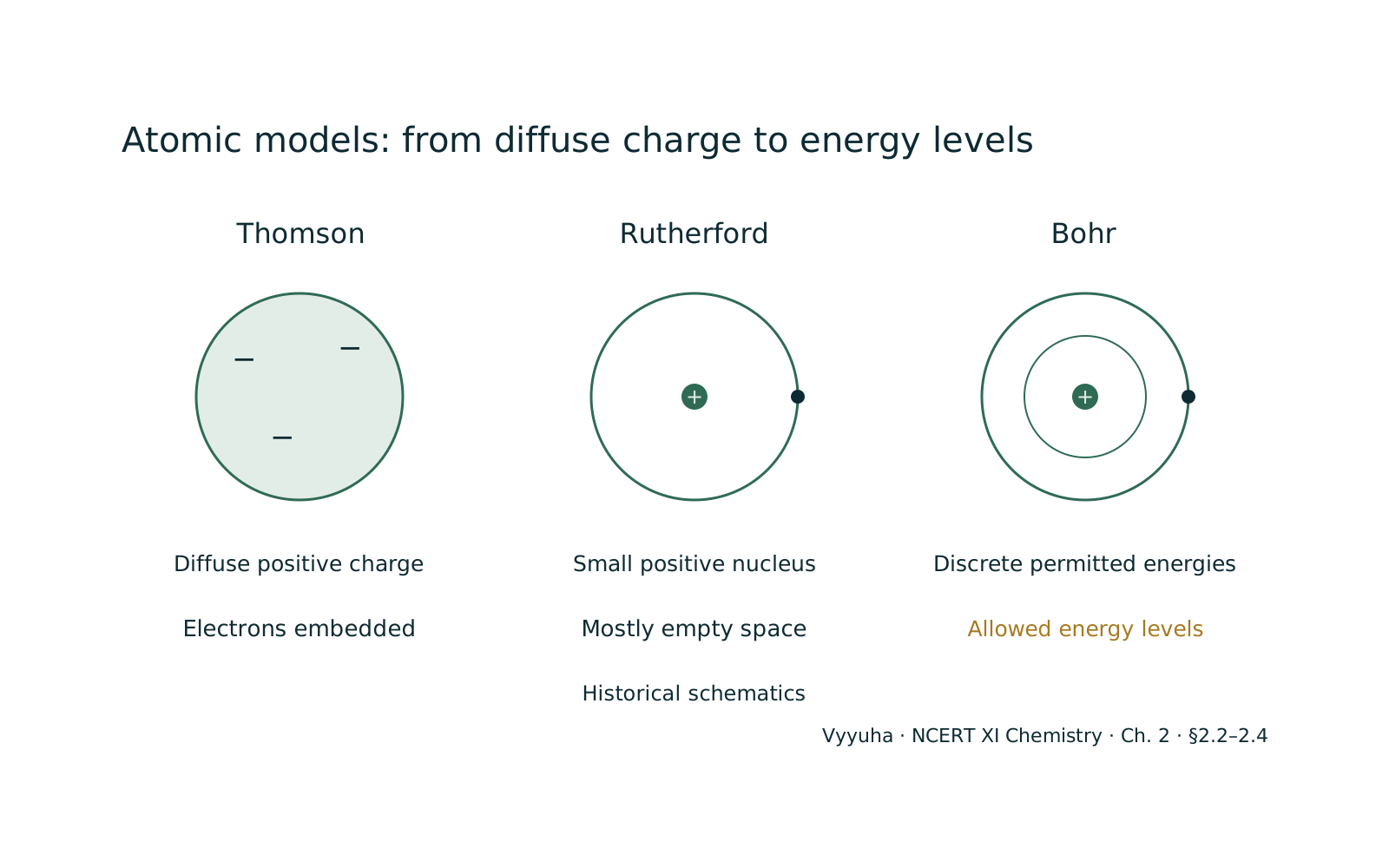
- Thomson's Plum Pudding Model (1897): — J.J. Thomson's discovery of the electron led him to propose that an atom is a uniform sphere of positive charge with negatively charged electrons embedded in it, much like plums in a pudding. This model explained the overall neutrality of atoms but lacked a central nucleus.
- Rutherford's Nuclear Model (1911): — Ernest Rutherford's famous alpha-particle scattering experiment disproved Thomson's model. He observed that most alpha particles passed straight through a thin gold foil, but a small fraction were deflected at large angles, and a very few even bounced back. This led to the conclusion that:
Most of the atom is empty space. There is a tiny, dense, positively charged nucleus at the center, containing almost all the mass of the atom. Electrons revolve around the nucleus in circular paths. The size of the nucleus is extremely small compared to the atom ( m vs m). * Limitations: It couldn't explain the stability of the atom (revolving electrons should continuously lose energy and spiral into the nucleus) or the line spectra of elements.
- Bohr's Model of the Hydrogen Atom (1913): — Niels Bohr addressed the limitations of Rutherford's model by incorporating Planck's quantum theory. His postulates for the hydrogen atom were:
* Electrons revolve around the nucleus in specific, fixed circular paths called orbits or stationary states, without radiating energy. * Each orbit is associated with a definite energy. The energy of an electron in an orbit does not change with time.
* Electrons can only occupy orbits for which the angular momentum is an integral multiple of (quantization of angular momentum): , where (principal quantum number).
* Energy is absorbed when an electron jumps from a lower energy orbit to a higher energy orbit, and emitted when it jumps from a higher to a lower energy orbit. The energy difference is given by .
* Derivations (Key Formulas): * Radius of n-th orbit: (for H-like species) * Energy of n-th orbit: (for H-like species) * Velocity of electron: $v_n = 2.
18 imes 10^6 imes Z/n ext{ m/s}^+^{2+}$). * Limitations: Failed for multi-electron atoms, couldn't explain the splitting of spectral lines in magnetic (Zeeman effect) or electric (Stark effect) fields, and didn't account for the wave nature of electrons.
Quantum Mechanical Model of the Atom
The limitations of Bohr's model led to the development of the quantum mechanical model, which is based on two fundamental concepts:
- Dual Nature of Matter (de Broglie, 1924): — Louis de Broglie proposed that all matter, not just light, exhibits both particle and wave properties. The wavelength () associated with a particle of mass () moving with velocity () is given by , where is Planck's constant. This explained why electrons in Bohr's orbits didn't radiate energy – they existed as standing waves.
- Heisenberg's Uncertainty Principle (1927): — Werner Heisenberg stated that it is impossible to simultaneously determine with absolute precision both the position and momentum of a subatomic particle like an electron. Mathematically, . This implies that we cannot define a precise orbit for an electron, but rather a region of probability where it is likely to be found.
These principles led to the Schrödinger Wave Equation (1926), a mathematical equation that describes the wave-like behavior of electrons in atoms. The solutions to this equation are called **wave functions ()**, and the square of the wave function () gives the probability of finding an electron at a particular point in space. This probabilistic region is called an atomic orbital.
Quantum Numbers
To describe the state of an electron in an atom, a set of four quantum numbers is used:
- **Principal Quantum Number ():**
Determines the main energy level or shell of the electron. Can have positive integer values: (K, L, M, ... shells). * Higher means higher energy and larger average distance from the nucleus. * Maximum number of electrons in a shell is .
- **Azimuthal (Angular Momentum) Quantum Number ():**
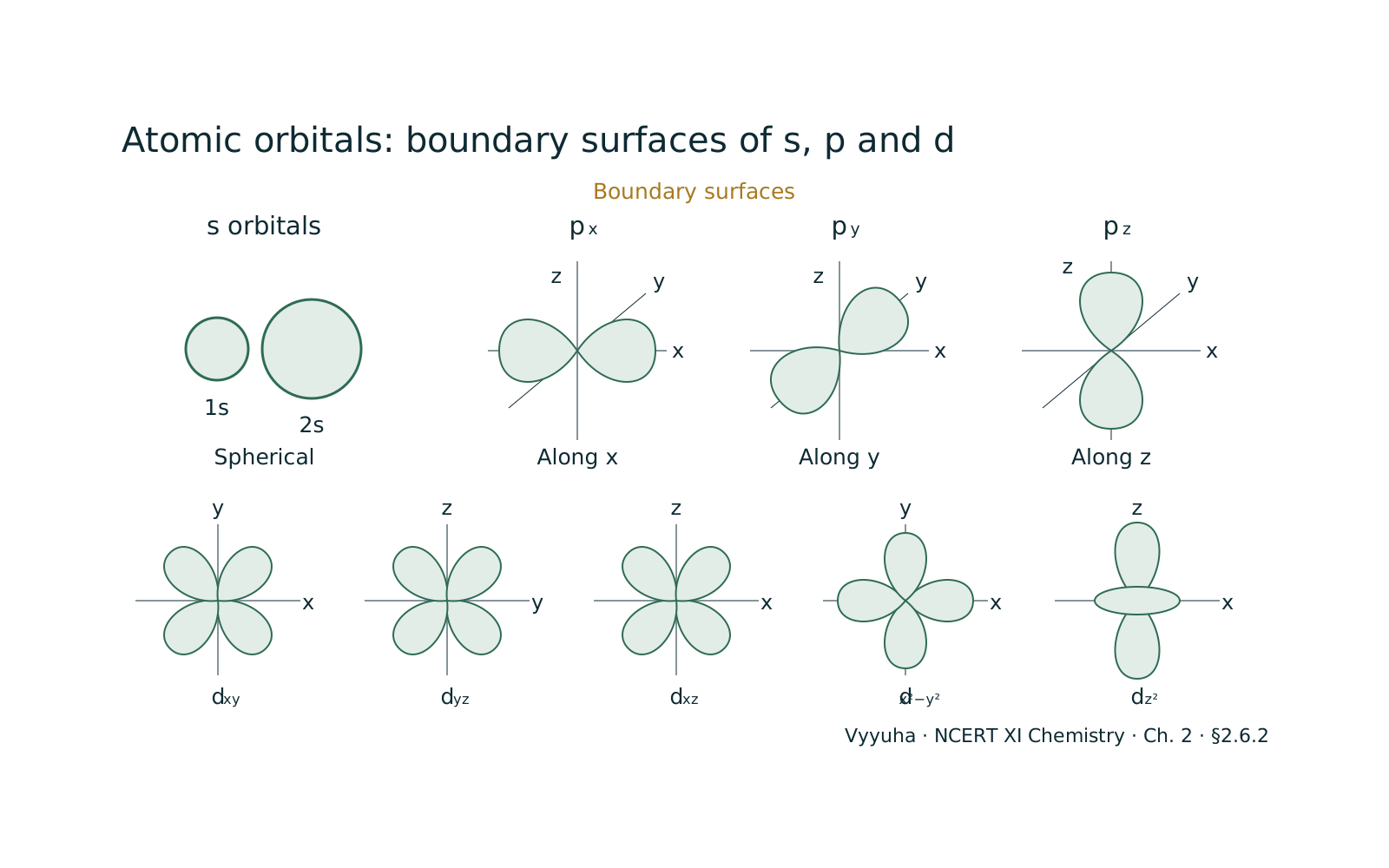
Determines the shape of the orbital and the subshell within a main shell. Can have integer values from to . * corresponds to s-subshell (spherical shape). * corresponds to p-subshell (dumbbell shape). * corresponds to d-subshell (more complex shapes). * corresponds to f-subshell (even more complex shapes). * Number of orbitals in a subshell is . * Maximum number of electrons in a subshell is .
- **Magnetic Quantum Number ():**
Determines the orientation of the orbital in space. Can have integer values from to , including . * For (s-subshell), (1 s-orbital). * For (p-subshell), (3 p-orbitals: ). * For (d-subshell), (5 d-orbitals).
- **Spin Quantum Number ():**
Describes the intrinsic angular momentum (spin) of the electron. Can have only two values: (spin up) or (spin down). * Each orbital can hold a maximum of two electrons with opposite spins.
Rules for Filling Electrons in Orbitals
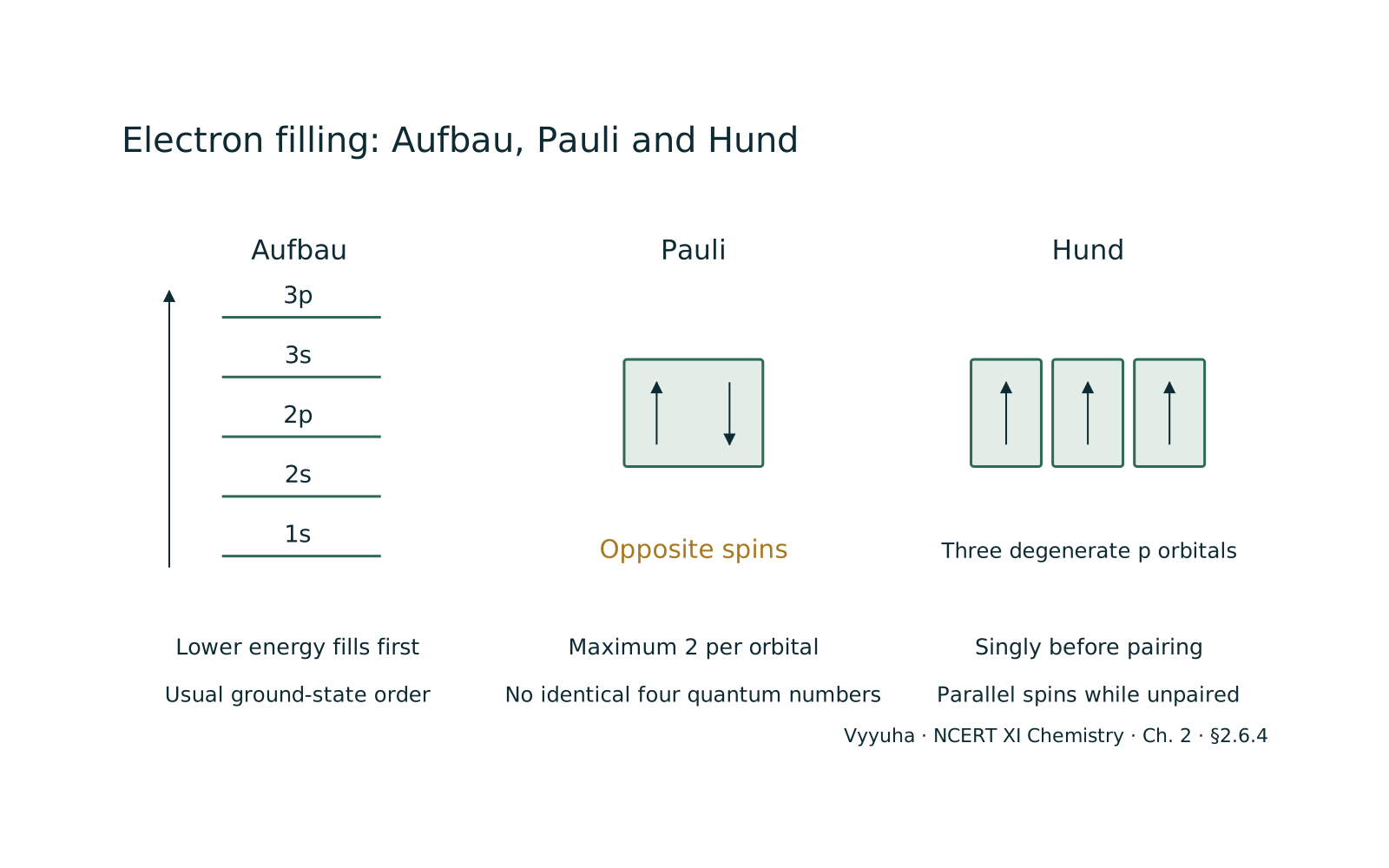
- Aufbau Principle: — Electrons fill orbitals in order of increasing energy. The order is generally determined by the rule: orbitals with lower values are filled first. If two orbitals have the same value, the one with lower is filled first. (e.g., (n=4, l=0, n+l=4) is filled before (n=3, l=2, n+l=5)).
- Pauli Exclusion Principle: — No two electrons in an atom can have the same set of all four quantum numbers. This means an orbital can hold a maximum of two electrons, and these two electrons must have opposite spins.
- Hund's Rule of Maximum Multiplicity: — For degenerate orbitals (orbitals of the same energy, e.g., ), electrons will first singly occupy each orbital with parallel spins before any orbital is doubly occupied. This maximizes the total spin and stability.
Electron Configuration
Electron configuration is the distribution of electrons of an atom or molecule in atomic or molecular orbitals. It provides a shorthand notation, e.g., , indicating the number of electrons in each subshell.
Atomic Spectra
When atoms are excited (e.g., by heat or electricity), their electrons jump to higher energy levels. When these excited electrons fall back to lower energy levels, they emit light of specific wavelengths, creating an emission spectrum (line spectrum).
Conversely, when white light passes through a gas, certain wavelengths are absorbed, creating an absorption spectrum with dark lines. The hydrogen spectrum, with its distinct series (Lyman, Balmer, Paschen, Brackett, Pfund), was crucial in validating Bohr's model.
The Rydberg formula describes the wavelengths of these spectral lines:
Real-World Applications
Understanding atomic structure is vital for:
- Spectroscopy: — Identifying elements in unknown samples (e.g., forensic science, astronomy).
- Lasers: — Based on stimulated emission of light from excited atoms.
- Nuclear Energy: — Involves manipulating the nucleus (protons and neutrons).
- Medical Imaging: — MRI (Magnetic Resonance Imaging) utilizes the spin of atomic nuclei.
- Material Science: — Designing new materials with specific electronic properties.
Common Misconceptions
- Orbit vs. Orbital: — An 'orbit' in Bohr's model is a fixed, well-defined circular path. An 'orbital' in the quantum mechanical model is a three-dimensional region of space where the probability of finding an electron is high. Orbitals do not imply fixed paths.
- Electrons as tiny planets: — While a useful analogy for early models, electrons behave as waves and particles simultaneously, and their exact position cannot be known, unlike planets.
- Energy levels are equally spaced: — The energy difference between successive shells decreases as increases (). The gap between and is much larger than between and .
- Aufbau principle is absolute: — There are exceptions to the Aufbau principle, particularly for transition metals (e.g., Cr, Cu), due to the extra stability associated with half-filled or completely filled d-orbitals.
NEET-Specific Angle
For NEET, a strong grasp of atomic structure is indispensable. Questions frequently test:
- Quantum numbers: — Assigning quantum numbers, determining possible sets, calculating the number of orbitals/electrons in a shell/subshell.
- Electron configuration: — Writing configurations for atoms and ions, identifying exceptions (Cr, Cu), and understanding their magnetic properties (paramagnetic/diamagnetic).
- Atomic spectra: — Applying the Rydberg formula, identifying series, calculating energy/wavelength of transitions.
- Basic atomic models: — Understanding the postulates and limitations of Bohr's model, and the fundamental principles of the quantum mechanical model.
- Isotopes, Isobars, Isotones: — Definitions and examples.
Mastering these concepts requires not just memorization but a deep conceptual understanding and the ability to apply principles to solve numerical and theoretical problems.
Often confused with
Side-by-side differences the NEET paper likes to test.
| Aspect | Structure of Atom | Bohr's Model vs. Quantum Mechanical Model |
|---|---|---|
| Electron Path | Electrons revolve in fixed, well-defined circular orbits. | Electrons exist in three-dimensional probability regions called orbitals; no fixed path can be determined. |
| Nature of Electron | Treated electrons primarily as particles. | Treats electrons as having dual wave-particle nature (de Broglie hypothesis). |
| Precision | Assumes simultaneous precise knowledge of position and momentum. | Incorporates Heisenberg's Uncertainty Principle; simultaneous precise determination of position and momentum is impossible. |
| Applicability | Only applicable to hydrogen and hydrogen-like species (single electron systems). | Applicable to multi-electron atoms, explaining complex spectra and chemical bonding. |
| Quantum Numbers | Only one quantum number ($n$) was explicitly used to define energy levels. | Uses four quantum numbers ($n, l, m_l, m_s$) to describe the complete state of an electron. |
| Spectral Phenomena | Could not explain Zeeman or Stark effects. | Successfully explains Zeeman and Stark effects, as well as fine structure of spectral lines. |
The transition from Bohr's model to the Quantum Mechanical Model represents a fundamental shift from a classical, deterministic view of the atom to a probabilistic, quantum view. Bohr's model, while a crucial stepping stone, was limited to single-electron systems and couldn't explain complex atomic phenomena.
The Quantum Mechanical Model, built on wave-particle duality and uncertainty, provides a more accurate and comprehensive description of electron behavior in all atoms, defining electrons by their probability distributions in orbitals rather than fixed orbits, and utilizing a complete set of quantum numbers.
Why it is tested: For NEET, understanding these differences is crucial for conceptual questions. Students must know why the quantum mechanical model superseded Bohr's model, highlighting the limitations of the earlier model and the advancements brought by quantum mechanics. Questions often probe the postulates and failures of Bohr's model versus the principles and successes of the modern model, particularly regarding electron behavior and spectral phenomena.
Questions students ask
6 answered on this topic.
What is the primary difference between an orbit and an orbital?
In the context of atomic structure, an 'orbit' refers to the fixed, well-defined circular path around the nucleus that electrons were thought to follow in Bohr's model. It's a classical concept. An 'orbital,' on the other hand, is a quantum mechanical concept.
It represents a three-dimensional region of space around the nucleus where there is a high probability (typically 90-95%) of finding an electron. Unlike orbits, orbitals do not imply a fixed trajectory, acknowledging the wave-particle duality and Heisenberg's Uncertainty Principle.
Electrons in orbitals are described by wave functions, not classical paths.
Why does Bohr's model fail for multi-electron atoms?
Bohr's model was highly successful for the hydrogen atom and hydrogen-like species (those with only one electron). However, it failed for multi-electron atoms because it did not account for electron-electron repulsions.
In atoms with multiple electrons, the electrons exert repulsive forces on each other, which significantly affects their energy levels and orbital shapes. Bohr's model also couldn't explain the splitting of spectral lines in magnetic (Zeeman effect) or electric (Stark effect) fields, nor did it incorporate the wave nature of electrons, which is crucial for understanding electron behavior in complex atoms.
What is the significance of the four quantum numbers?
The four quantum numbers () collectively describe the unique state of an electron in an atom. The principal quantum number () defines the electron's main energy level and size of the orbital.
The azimuthal quantum number () determines the shape of the orbital and the subshell. The magnetic quantum number () specifies the orientation of the orbital in space. Finally, the spin quantum number () describes the intrinsic angular momentum or 'spin' of the electron.
Together, these numbers provide a complete 'address' for each electron, adhering to the Pauli Exclusion Principle.
Are there any exceptions to the Aufbau principle or Hund's rule?
Yes, there are exceptions, particularly for elements like Chromium (Cr) and Copper (Cu). According to the Aufbau principle, Cr should have a configuration of , but its actual configuration is .
Similarly, Cu should be , but it's . These exceptions occur because half-filled () and completely filled () subshells possess extra stability due to symmetrical distribution of electrons and exchange energy.
Hund's rule itself is rarely violated, as it describes the most stable arrangement for degenerate orbitals.
How does the de Broglie hypothesis relate to the stability of Bohr's orbits?
De Broglie's hypothesis proposed that electrons, like light, have a dual wave-particle nature. When applied to Bohr's orbits, it suggested that electrons exist as standing waves around the nucleus. For an electron to form a stable standing wave in an orbit, the circumference of the orbit must be an integral multiple of the electron's de Broglie wavelength ().
If this condition is not met, the wave would interfere destructively and collapse. This concept provided a quantum mechanical justification for Bohr's postulate of stationary orbits where electrons do not radiate energy, as standing waves are stable and do not lose energy.
What is the difference between isotopes, isobars, and isotones?
These terms describe atoms with specific relationships in their subatomic particle counts. Isotopes are atoms of the same element (same atomic number, Z, meaning same number of protons) but with different mass numbers (A, meaning different number of neutrons).
For example, Carbon-12 and Carbon-14. Isobars are atoms of different elements (different Z) that have the same mass number (A). For example, Argon-40 and Calcium-40. Isotones are atoms of different elements (different Z) that have the same number of neutrons (N = A - Z).
For example, Carbon-14 (6 protons, 8 neutrons) and Nitrogen-15 (7 protons, 8 neutrons).