Position and Displacement
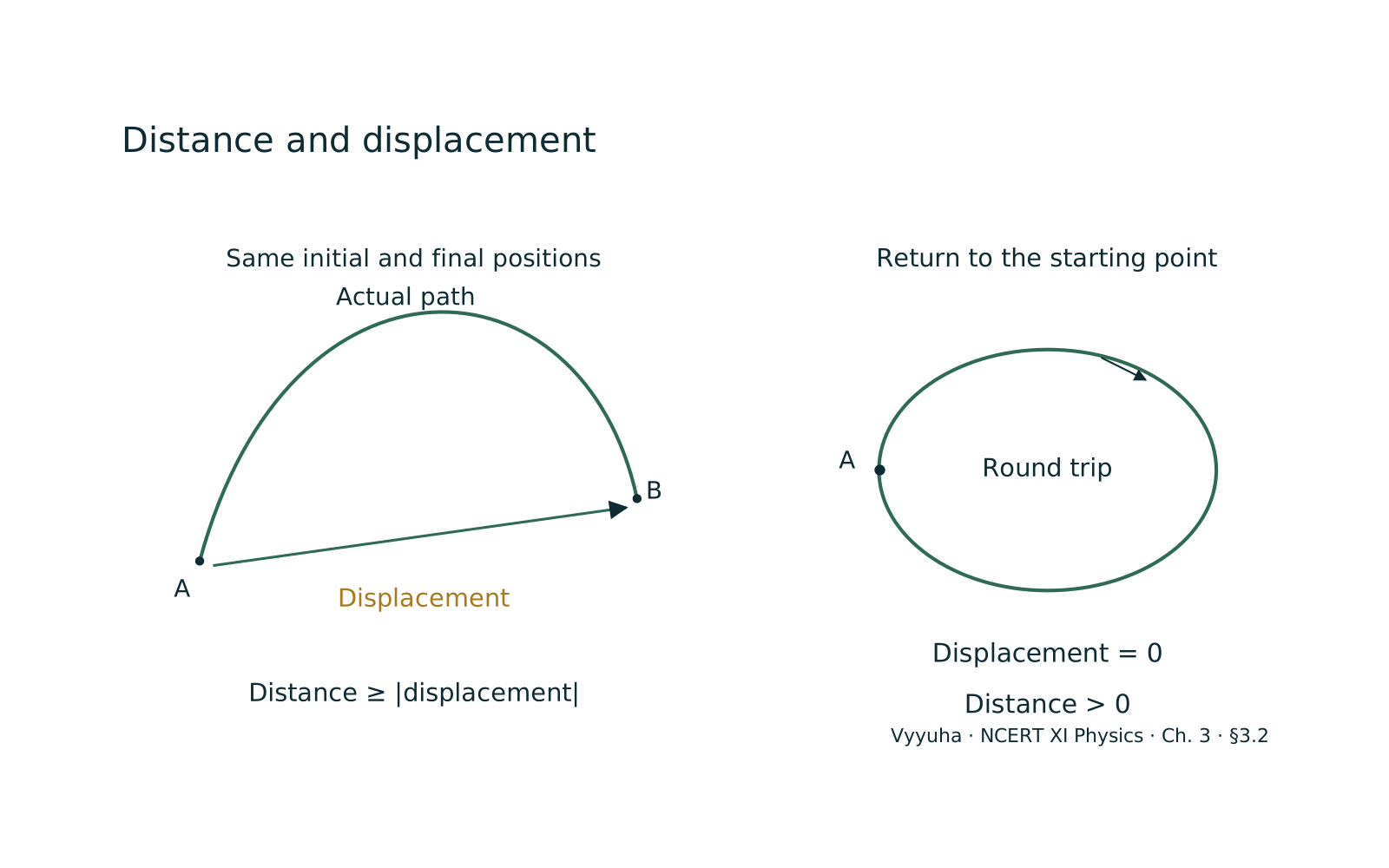
In physics, the concepts of position and displacement are fundamental to describing motion. Position refers to the location of an object with respect to a chosen reference point, often called the origin, within a specific coordinate system. It is a vector quantity, meaning it possesses both magnitude and direction. Displacement, on the other hand, is defined as the change in an object's position. …
Quick Summary
Position is the location of an object relative to a chosen reference point, called the origin, within a coordinate system. It is a vector quantity, meaning it has both magnitude and direction. For one-dimensional motion, the sign (+ or -) indicates direction.
Displacement is the change in an object's position, calculated as the straight-line vector from the initial position to the final position. It is also a vector quantity, independent of the actual path taken.
If an object returns to its starting point, its displacement is zero. Distance, in contrast, is a scalar quantity representing the total length of the path covered and is always positive. The magnitude of displacement is always less than or equal to the distance traveled.
Understanding these foundational concepts is vital for kinematics, as they set the stage for defining velocity and acceleration and solving problems related to motion.
Full explanation
The study of motion, known as kinematics, begins with defining the fundamental concepts of position and displacement. These terms, while seemingly simple, carry precise meanings in physics that are critical for accurately describing how objects move.
1. Conceptual Foundation: The Need for a Reference Frame
Before we can talk about where something is, we must first establish 'where' we are measuring from. This is the concept of a reference frame. A reference frame is essentially a coordinate system (like an x-axis, or x-y plane, or x-y-z space) with a designated origin (the zero point) and a set of directions.
Without a reference frame, statements about position or motion are meaningless. For example, saying 'the car is at 10 meters' is incomplete. Is it 10 meters from the tree, from your house, or from the starting line?
The choice of origin and positive direction is arbitrary but crucial for consistency within a problem. Once chosen, all positions and displacements are measured relative to this established frame.
For motion in a straight line (one-dimensional motion), we typically use a single axis, often the x-axis. The origin is usually denoted as . Points to one side of the origin are assigned positive values, and points to the other side are assigned negative values. For instance, if we define 'right' as the positive direction, then means 5 meters to the right of the origin, and means 3 meters to the left of the origin.
2. Position: Locating an Object
Position ( or in 1D) is a vector quantity that specifies the location of an object relative to the origin of a chosen coordinate system. In one dimension, position is simply a scalar value with a sign indicating direction. For example, if an object is at point A, its position might be . If it moves to point B, its position might be . If it moves to point C on the other side of the origin, its position might be .
Key characteristics of position:
- Vector Quantity: — It has both magnitude (the distance from the origin) and direction (indicated by the sign in 1D or by components in higher dimensions).
- Relative: — Always defined with respect to a chosen origin.
- Instantaneous: — Describes the location at a specific moment in time.
3. Displacement: Change in Position
Displacement ( or in 1D) is defined as the change in an object's position. It is the straight-line vector drawn from the initial position to the final position, irrespective of the path taken between these two points.
Mathematically, if an object moves from an initial position to a final position , its displacement is given by:
Let's consider an example: An object starts at and moves to . Its displacement is . The positive sign indicates the displacement is in the positive direction.
Now, suppose the object starts at and moves back to . Its displacement is . The negative sign indicates the displacement is in the negative direction.
Key characteristics of displacement:
- Vector Quantity: — It has both magnitude (the straight-line distance between initial and final points) and direction (from initial to final point).
- Path Independent: — Only depends on the initial and final positions, not on the actual path traversed.
- Can be Zero: — If an object returns to its starting point, its final position is the same as its initial position, resulting in zero displacement, even if it traveled a significant distance.
4. Distinction from Distance
It is crucial to differentiate displacement from distance. Distance is a scalar quantity that refers to the total length of the path covered by an object during its motion. Unlike displacement, distance is always positive and is path-dependent.
Consider an object moving from point A to point B, then from B to C, and finally from C back to A.
- Distance: — The total length of the path . This will be a positive value.
- Displacement: — Since the object starts at A and ends at A, its final position is identical to its initial position. Therefore, its net displacement is zero.
Example: A person walks 5 meters east, then 3 meters west.
- Initial position: — Let's say .
- After 5m east: — Position .
- After 3m west (from $x_1$): — Final position .
- Total Distance: — .
- Total Displacement: — (2 meters east).
This example clearly illustrates that distance and displacement are generally different, with displacement being less than or equal to distance (). They are equal only when the object moves in a single straight line without changing direction.
5. Real-World Applications
- Navigation: — GPS systems calculate displacement (straight-line distance and direction) between two points, even if the actual driving path is winding.
- Sports: — In a race, the distance covered is the track length, but if a runner completes a lap on a circular track, their displacement is zero.
- Engineering: — Designing structures or planning robot movements requires precise understanding of both total path length (for material usage, wear and tear) and net change in position (for functionality).
6. Common Misconceptions
- Displacement is always positive: — No, displacement can be positive, negative, or zero, depending on the direction of the change in position relative to the chosen positive direction.
- Displacement is the same as distance: — Only true if the motion is in a single straight line without any change in direction. Otherwise, distance is greater than the magnitude of displacement.
- Displacement considers the path: — No, displacement is path-independent; it only cares about the start and end points.
7. NEET-Specific Angle
For NEET, questions on position and displacement often appear as foundational concepts within kinematics. You might encounter:
- Direct calculations: — Given initial and final positions, calculate displacement. Given a path, calculate distance.
- Graphical interpretation: — Analyzing position-time graphs to determine displacement, distance, or identify changes in direction.
- Conceptual questions: — Distinguishing between scalar and vector quantities, or between distance and displacement in various scenarios (e.g., circular motion, back-and-forth motion).
- Integration with other concepts: — These concepts are prerequisites for understanding velocity (rate of change of displacement) and acceleration (rate of change of velocity). A solid grasp here prevents errors in more complex kinematic problems. Pay close attention to sign conventions for direction in 1D motion and vector addition principles for higher dimensions (though NEET primarily focuses on 1D or simple 2D scenarios for these basic concepts).
Key Concepts
In one-dimensional motion, an object's position is typically represented by a single coordinate, say .…
Displacement is the vector difference between the final and initial positions: . The…
This concept highlights the fundamental difference between the total path length (distance, scalar) and the…
Often confused with
Side-by-side differences the NEET paper likes to test.
| Aspect | Position and Displacement | Distance |
|---|---|---|
| Definition | Change in an object's position, a straight-line vector from initial to final point. | Total length of the actual path covered by an object. |
| Type of Quantity | Vector (has magnitude and direction) | Scalar (has only magnitude) |
| Path Dependence | Independent of the path taken; depends only on initial and final positions. | Dependent on the actual path taken by the object. |
| Sign/Value | Can be positive, negative, or zero. | Always positive (or zero if no motion). |
| Magnitude Comparison | Magnitude of displacement is always less than or equal to distance ($|\Delta \vec{r}| \le \text{Distance}$). | Distance is always greater than or equal to the magnitude of displacement. |
| Example | If you walk 5m East and then 5m West, your displacement is 0m. | If you walk 5m East and then 5m West, your distance is 10m. |
Displacement and distance are two distinct concepts crucial for describing motion. Displacement is a vector quantity representing the net change in an object's position, focusing solely on the start and end points, making it path-independent.
It can be positive, negative, or zero. Distance, conversely, is a scalar quantity that measures the total length of the actual path traversed, making it path-dependent and always positive. The magnitude of displacement is always less than or equal to the distance traveled, with equality only occurring during straight-line motion without a change in direction.
Why it is tested: For NEET, understanding the precise difference between displacement and distance is fundamental. Questions often test this distinction, especially in scenarios involving changes in direction or circular motion. A clear grasp prevents common errors in calculating kinematic quantities and interpreting motion graphs.
Questions students ask
5 answered on this topic.
What is the primary difference between position and displacement?
Position is the specific location of an object relative to a chosen reference point (origin) at a particular instant. It tells us 'where' the object is. Displacement, on the other hand, is the change in an object's position. It tells us 'how much' and 'in what direction' the object's location has shifted from its initial point to its final point. Position is an absolute location at a moment, while displacement is a relative change over an interval.
Can displacement ever be greater than distance?
No, the magnitude of displacement can never be greater than the distance traveled. Displacement is the shortest straight-line path between two points. Distance is the actual path length covered. In the best-case scenario, when an object moves in a straight line without changing direction, the magnitude of its displacement will be equal to the distance traveled.
In all other cases (e.g., curved paths, back-and-forth motion), the distance traveled will be greater than the magnitude of the displacement.
If an object moves in a circle and completes one full revolution, what is its displacement?
If an object completes one full revolution on a circular path, its final position is identical to its initial position. Since displacement is defined as the change in position (), and in this case , the displacement of the object is zero. However, the distance traveled would be the circumference of the circle (, where R is the radius).
Why is it important to choose a reference frame and origin?
Choosing a reference frame and origin is absolutely crucial because position and displacement are relative quantities. Without a defined starting point (origin) and a consistent set of directions (coordinate system), any description of an object's location or movement would be ambiguous or meaningless. It provides a common ground for measurement and ensures that all observations and calculations are consistent and comparable within a given problem or scenario.
Is position a scalar or vector quantity? What about displacement?
Both position and displacement are vector quantities. This means they both possess magnitude (a numerical value indicating 'how much' or 'how far') and direction. For example, a position of '' implies 5 meters in the positive direction from the origin. A displacement of '' implies a change of 10 meters in the negative direction. The direction component is essential for a complete description of these quantities.
Revise in 30 seconds
- Position ($x$ or $\vec{r}$): — Location relative to origin. Vector quantity (magnitude & direction).
- Displacement ($\Delta x$ or $\Delta \vec{r}$): — Change in position. . Vector quantity. Path-independent.
- Distance: — Total path length covered. Scalar quantity. Always positive. Path-dependent.
- Relationship: — .
- Origin: — Reference point ().
- Sign Convention: — Crucial for 1D vectors (e.g., + for right/North, - for left/South).
D.I.S.T.A.N.C.E. is 'Total Path', always positive. D.I.S.P.L.A.C.E.M.E.N.T. is 'Start to End', can be zero.