Motion in a Straight Line
Motion in a straight line, often referred to as rectilinear motion, describes the movement of an object along a single spatial dimension. In this fundamental branch of kinematics, we analyze the position, displacement, distance, speed, velocity, and acceleration of a particle or point object without considering the forces causing the motion. The trajectory of the object is strictly a straight line…
Quick Summary
Motion in a straight line, or rectilinear motion, is the simplest form of movement where an object travels along a single dimension. Key concepts include position, which defines an object's location relative to an origin; distance, the total path length covered (a scalar); and displacement, the net change in position from start to end (a vector).
Speed is the rate of distance covered, while velocity is the rate of displacement, including direction. Acceleration describes the rate of change of velocity. For uniformly accelerated motion, three fundamental kinematic equations relate initial velocity (), final velocity (), acceleration (), time (), and displacement (): , , and .
Graphical analysis (position-time, velocity-time, acceleration-time graphs) provides visual insights, where slopes and areas yield other kinematic quantities. Relative velocity helps describe the motion of one object with respect to another, crucial for understanding scenarios like two trains approaching each other.
Mastering these basics is fundamental for NEET physics.
Full explanation
Kinematics is the branch of mechanics that describes the motion of points, bodies, and systems of bodies without considering the forces that cause them to move. Motion in a straight line, or rectilinear motion, is the simplest form of kinematics, focusing on movement along a single spatial axis. This foundational topic is critical for NEET aspirants as it introduces core concepts and problem-solving methodologies applicable across all areas of physics.
1. Conceptual Foundation: The Particle Model and Frame of Reference
To simplify the analysis of motion, we often treat objects as 'point objects' or 'particles'. A point object is an idealized object with mass but negligible size. This approximation is valid when the size of the object is much smaller than the distance it travels or the scale of the observation. For instance, a car traveling on a long highway can be considered a point object.
Motion is always relative. To describe an object's motion, we need a 'frame of reference'. This is a coordinate system (e.g., x-axis for 1D motion) and a clock, relative to which we measure position, time, and other kinematic quantities. An observer at rest relative to this frame describes the motion. For straight-line motion, we typically use a one-dimensional coordinate system, like the x-axis, with an origin (x=0) and a positive direction.
2. Key Principles and Definitions
- Position ($x$): — The location of an object at a particular instant relative to the origin. It's a vector quantity, but in 1D, its direction is simply indicated by its sign (e.g., +x or -x). Units: meters (m).
- Path Length (Distance): — The total length of the actual path covered by an object during its motion. It's a scalar quantity and is always non-negative. Units: meters (m).
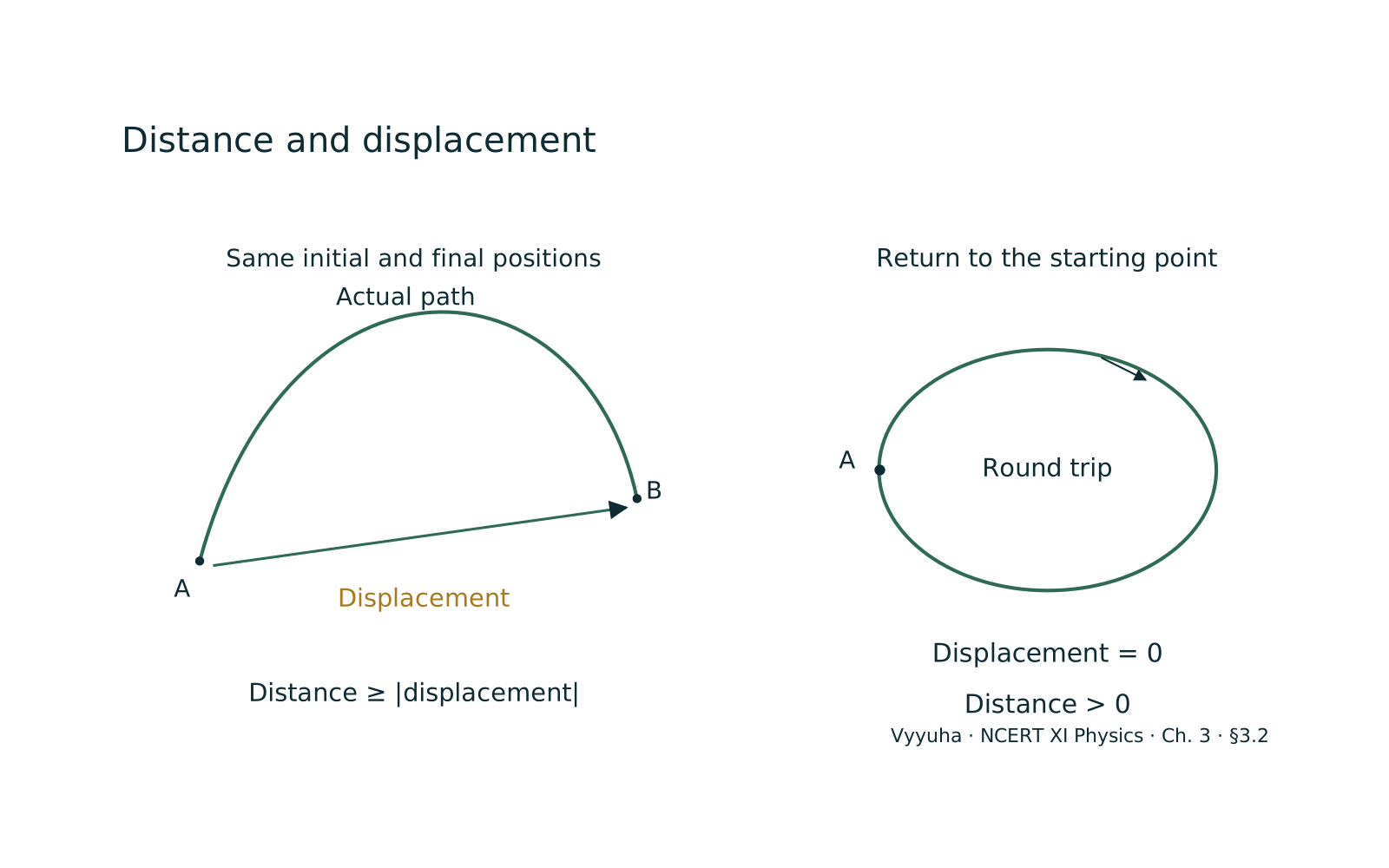
- Displacement ($\Delta x$): — The change in position of an object. It is the vector connecting the initial position () to the final position (). . Displacement can be positive, negative, or zero. Units: meters (m).
* Key Distinction: Distance is the total path covered, while displacement is the net change in position. If an object moves from A to B and then back to A, its distance covered is , but its displacement is zero.
- Average Velocity ($\vec{v}_{avg}$): — The ratio of total displacement to the total time interval. It's a vector quantity.
- Average Speed ($s_{avg}$): — The ratio of total path length (distance) to the total time interval. It's a scalar quantity.
- Instantaneous Velocity ($\vec{v}$): — The velocity of an object at a specific instant of time. It is the limit of average velocity as the time interval approaches zero. Mathematically, it's the derivative of position with respect to time.
- Instantaneous Speed: — The magnitude of the instantaneous velocity. It is always non-negative.
- Average Acceleration ($\vec{a}_{avg}$): — The ratio of the change in velocity to the time interval over which the change occurs. It's a vector quantity.
- Instantaneous Acceleration ($\vec{a}$): — The acceleration of an object at a specific instant of time. It is the limit of average acceleration as the time interval approaches zero. Mathematically, it's the derivative of velocity with respect to time, or the second derivative of position with respect to time.
3. Equations of Motion for Uniformly Accelerated Motion
When an object moves with constant acceleration, a set of powerful equations, known as the kinematic equations, can be used to relate its initial velocity (), final velocity (), acceleration (), time (), and displacement (). These are derived assuming motion along a straight line and constant acceleration.
Let be the initial velocity at , and be the final velocity at time . Let be the constant acceleration, and be the displacement during time .
- Velocity-Time Relation: — From the definition of acceleration, .
- Displacement-Time Relation: — The average velocity is . Since , substituting :
- Velocity-Displacement Relation: — From and , substitute :
- Displacement in $n^{\text{th}}$ second ($s_n$): — This is the displacement covered only during the second (e.g., between and ).
Derivations (Conceptual Overview):
- From Calculus:
* . If , then . If at , then . So, .
* . If is constant, . If at , then . So, . * .
If is constant, .
- From Graphical Analysis:
* Velocity-Time Graph: For constant acceleration, the v-t graph is a straight line. The slope of the v-t graph gives acceleration (). The area under the v-t graph gives displacement ().
Using geometric shapes (rectangle and triangle) under the v-t graph, one can derive . * Position-Time Graph: For constant velocity, the x-t graph is a straight line. For constant acceleration, it's a parabola.
The slope of the x-t graph gives instantaneous velocity. * Acceleration-Time Graph: For constant acceleration, the a-t graph is a horizontal straight line. The area under the a-t graph gives the change in velocity ().
4. Relative Velocity in One Dimension
Relative velocity describes the velocity of an object with respect to another object. If object A is moving with velocity and object B with velocity (both measured with respect to a common ground frame), then:
- Velocity of A relative to B:
- Velocity of B relative to A:
Note that . When dealing with 1D motion, we use signs to denote direction. For example, if a car A moves at and car B moves at (both in the positive direction), then . If car B moves at (in the negative direction), then .
5. Real-World Applications
- Free Fall: — Objects falling under gravity near the Earth's surface experience nearly constant acceleration ( downwards). This is a classic case of uniformly accelerated motion in a straight line (vertical). The kinematic equations apply directly, with (if upward is positive) or (if downward is positive).
- Vehicle Dynamics: — Analyzing the acceleration, braking distance, and stopping time of cars, trains, or other vehicles moving along a straight path.
- Rocket Launch (initial phase): — The initial vertical ascent of a rocket can be approximated as 1D motion with varying acceleration, but segments can be analyzed with constant acceleration.
6. Common Misconceptions
- Distance vs. Displacement: — Students often confuse these. Remember, distance is total path, displacement is net change in position. A round trip has zero displacement but non-zero distance.
- Speed vs. Velocity: — Speed is magnitude only; velocity includes direction. An object can have constant speed but changing velocity (e.g., circular motion, though not 1D). In 1D, if direction changes, velocity changes.
- Average vs. Instantaneous: — Average quantities are over an interval; instantaneous quantities are at a specific moment.
- Sign Conventions: — Crucial for 1D motion. Consistently define a positive direction. If velocity and acceleration have the same sign, the object is speeding up. If they have opposite signs, it's slowing down (decelerating).
- Zero Velocity vs. Zero Acceleration: — An object can have zero velocity momentarily (e.g., at the peak of its trajectory in free fall) but still have non-zero acceleration (gravity). Conversely, an object can have constant velocity (non-zero) but zero acceleration.
7. NEET-Specific Angle
NEET questions on motion in a straight line often test conceptual clarity, graphical interpretation, and problem-solving using kinematic equations. Expect problems involving:
- Calculating average speed/velocity for multi-stage journeys.
- Interpreting position-time, velocity-time, and acceleration-time graphs to find other quantities (slope, area).
- Applying kinematic equations to free fall, braking problems, or objects moving with constant acceleration.
- Relative velocity scenarios, especially involving two objects moving towards or away from each other.
- Problems requiring the use of calculus for non-uniform acceleration (though less common for basic NEET, it's good to be aware).
Mastering this chapter requires a strong grasp of definitions, careful application of sign conventions, and proficiency in both algebraic and graphical problem-solving techniques. Pay close attention to units and vector directions.
Key Concepts
While both measure 'how far' an object has moved, they are fundamentally different. Distance is a scalar,…
These terms are often used interchangeably in everyday language but have distinct meanings in physics.…
These are the workhorse equations for solving problems involving constant acceleration in a straight line.…
Often confused with
Side-by-side differences the NEET paper likes to test.
| Aspect | Motion in a Straight Line | Distance and Displacement |
|---|---|---|
| Definition | Total path length covered by an object. | Net change in position from initial to final point. |
| Nature | Scalar quantity (magnitude only). | Vector quantity (magnitude and direction). |
| Value | Always positive or zero. | Can be positive, negative, or zero. |
| Dependence | Depends on the actual path taken. | Depends only on initial and final positions. |
| Relationship | Distance $\ge$ |Displacement| | |Displacement| $\le$ Distance |
Distance quantifies the total ground an object has covered, irrespective of its direction, making it a scalar. It's always a non-negative value. Displacement, conversely, is a vector quantity that specifies the straight-line change in an object's position from its starting point to its ending point, including its direction.
It can be positive, negative, or zero, depending on the final position relative to the initial. For instance, a round trip results in zero displacement but a non-zero distance.
Why it is tested: NEET relevance: Differentiating between distance and displacement is fundamental for conceptual clarity and is frequently tested in problems involving average speed vs. average velocity, or scenarios where an object changes direction. Misunderstanding these can lead to incorrect calculations for average velocity or total distance.
| Aspect | Motion in a Straight Line | Speed and Velocity |
|---|---|---|
| Definition | Rate of change of distance. | Rate of change of displacement. |
| Nature | Scalar quantity (magnitude only). | Vector quantity (magnitude and direction). |
| Value | Always positive or zero. | Can be positive, negative, or zero. |
| Change | Changes only if magnitude of motion changes. | Changes if magnitude or direction of motion changes. |
| Relationship | Average speed $\ge$ |Average velocity| | |Instantaneous velocity| = Instantaneous speed |
Speed measures how fast an object is moving, defined as the distance covered per unit time, and is a scalar quantity, always non-negative. Velocity, on the other hand, is a vector quantity that describes both how fast an object is moving and in what direction, defined as displacement per unit time.
An object can have constant speed but varying velocity if its direction changes (though not in pure 1D motion without reversing). For instantaneous values, speed is simply the magnitude of velocity. However, for average values, average speed is generally greater than or equal to the magnitude of average velocity.
Why it is tested: NEET relevance: This distinction is crucial for problems involving average calculations over complex paths and for understanding the implications of acceleration. Questions often involve scenarios where an object's speed is constant but its velocity changes (e.g., turning around), or vice-versa, requiring a clear understanding of their vector/scalar nature.
Questions students ask
6 answered on this topic.
What is the difference between distance and displacement in straight-line motion?
In straight-line motion, distance is the total length of the path covered by the object, regardless of its direction. It's a scalar quantity and is always positive. Displacement, on the other hand, is the change in the object's position, measured as the straight-line distance from the initial to the final point, including direction.
It's a vector quantity and can be positive, negative, or zero. For example, if you walk 5m forward and then 2m backward, your distance is 7m, but your displacement is 3m forward.
Can an object have zero velocity but non-zero acceleration?
Yes, absolutely. A classic example is an object thrown vertically upwards. At the very peak of its trajectory, just before it starts falling back down, its instantaneous velocity is momentarily zero. However, the acceleration due to gravity () is still acting downwards throughout its flight, including at the peak. So, at that instant, velocity is zero, but acceleration is downwards.
How do I interpret the slope of a position-time graph?
The slope of a position-time (x-t) graph represents the instantaneous velocity of the object. A steeper slope indicates a greater speed. A positive slope means the object is moving in the positive direction, while a negative slope means it's moving in the negative direction. A horizontal line (zero slope) indicates the object is at rest (zero velocity). A curved line indicates changing velocity, hence acceleration.
What does a negative acceleration mean in straight-line motion?
Negative acceleration doesn't always mean the object is slowing down. It simply means the acceleration vector points in the negative direction as per your chosen coordinate system. If the object's velocity is positive and acceleration is negative, then it is indeed slowing down (decelerating). However, if the object's velocity is already negative (moving in the negative direction) and the acceleration is also negative, then the object is actually speeding up in the negative direction.
When can average speed be equal to the magnitude of average velocity?
Average speed is equal to the magnitude of average velocity only when the object moves in a straight line without changing its direction throughout the entire time interval. If the object changes direction, even if it returns to its starting point, the total distance covered will be greater than the magnitude of its displacement (which could be zero), making the average speed greater than the magnitude of average velocity.
How do I deal with problems involving objects moving in opposite directions for relative velocity?
When objects move in opposite directions, their relative speed is the sum of their individual speeds. For instance, if car A moves east at and car B moves west at , and you define east as positive, then is positive and is negative. The velocity of A relative to B is . This means they are approaching or separating at a rate equal to the sum of their speeds. Always be consistent with your chosen positive and negative directions.
Revise in 30 seconds
- Position ($x$): — Location relative to origin (vector in 1D, sign indicates direction).
- Distance: — Total path length (scalar, always ).
- Displacement ($\Delta x$): — Change in position () (vector, can be or ).
- Speed: — Rate of distance covered (scalar, always ).
- Velocity ($\vec{v}$): — Rate of displacement ( or ) (vector, can be or ).
- Acceleration ($\vec{a}$): — Rate of change of velocity ( or ) (vector, can be or ).
- **Kinematic Equations (constant ):**
* * * * (displacement in second)
- Relative Velocity (1D): — . If same direction, subtract speeds. If opposite, add speeds (careful with signs).
- Graphs:
* x-t slope = ; v-t slope = . * v-t area = ; a-t area = .
SUVAT for Kinematics: S - Displacement U - Initial Velocity V - Final Velocity A - Acceleration T - Time
Remember the equations by linking these letters: Very Useful Always To know: Some Understand To All Things: Very Useful Always Simple: