Taxonomic Hierarchy
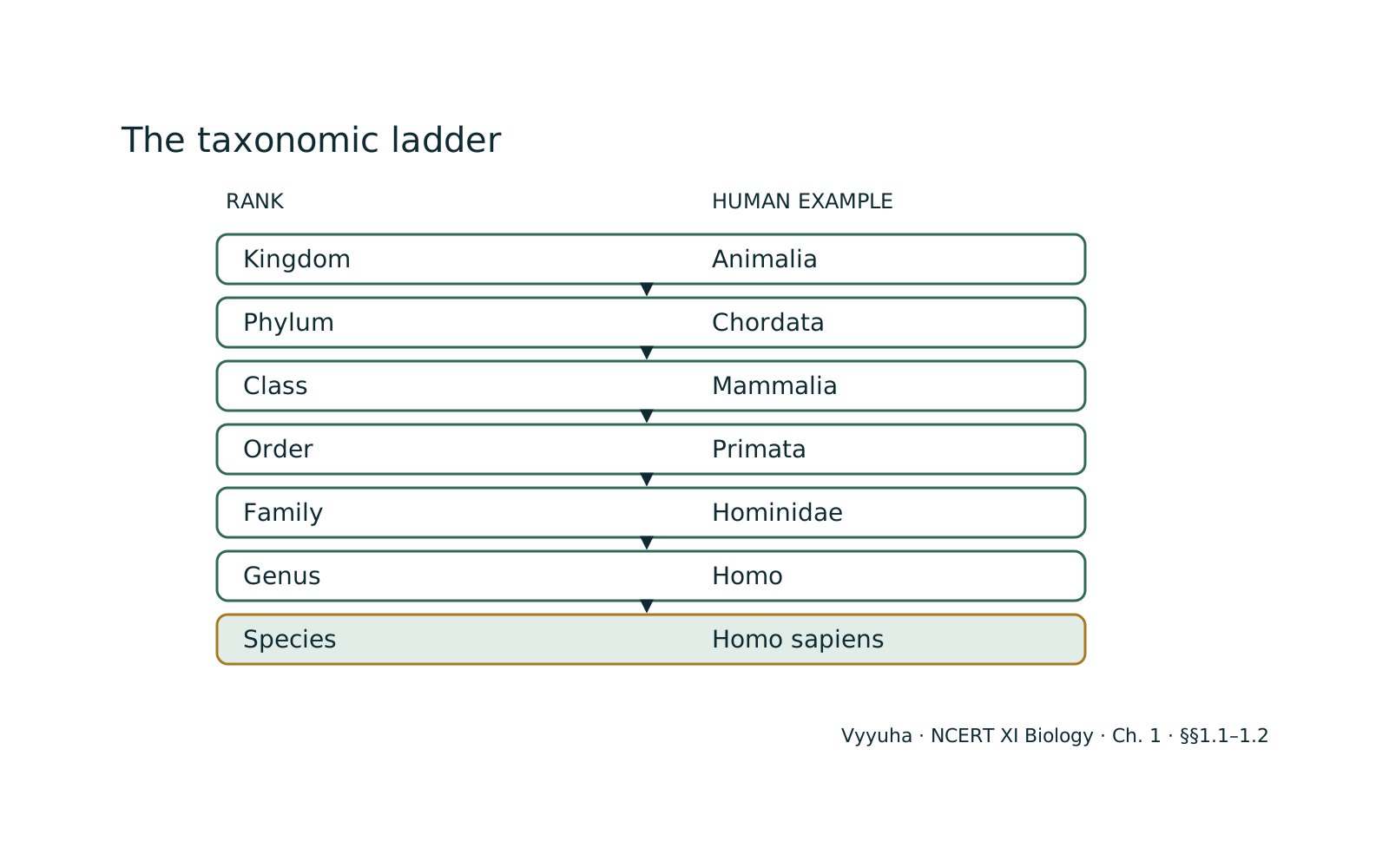
Taxonomic hierarchy refers to the systematic arrangement of organisms into a graded series of groups or ranks, based on their similarities and differences, starting from the most inclusive (Kingdom) to the most exclusive (Species). This hierarchical system, primarily attributed to Carolus Linnaeus, provides a standardized framework for classifying and naming organisms, facilitating communication a…
Quick Summary
Taxonomic hierarchy is a structured system for classifying living organisms into a series of graded ranks or categories. This system, largely formalized by Carolus Linnaeus, arranges organisms from the most inclusive to the most exclusive groups based on shared characteristics.
The seven main obligate ranks, in descending order, are Kingdom, Phylum (or Division for plants/fungi), Class, Order, Family, Genus, and Species. Each rank is called a taxon. As one moves down the hierarchy from Kingdom to Species, the number of organisms in each group decreases, but the similarity and shared specific characteristics among them increase significantly.
Conversely, moving up the hierarchy increases the number of organisms and decreases their specific shared traits. This hierarchical arrangement provides a universal language for biologists, aids in identifying and naming organisms, and helps in understanding the evolutionary relationships and biodiversity on Earth.
It's a dynamic system, constantly refined with new scientific discoveries, especially genetic data.
Full explanation
The vast diversity of life on Earth necessitates a systematic approach to organize, name, and understand organisms. This is where taxonomic hierarchy plays a pivotal role. It is a fundamental concept in the field of taxonomy, which is the branch of biology concerned with the classification, nomenclature, and identification of organisms.
The term 'hierarchy' implies a graded series of steps or ranks, where each step represents a category of organisms, arranged from the most inclusive to the most exclusive.
Conceptual Foundation: Why Classify?
Before the advent of modern biology, humans classified organisms based on utilitarian purposes – whether they were edible, poisonous, or useful for medicine. However, as human knowledge expanded, the need for a more scientific and universally accepted system became apparent. The primary goals of biological classification are:
- Identification: — To accurately recognize and distinguish between different organisms.
- Nomenclature: — To provide a unique and universally accepted name for each organism.
- Classification: — To arrange organisms into groups based on their similarities and differences, reflecting their evolutionary relationships.
- Understanding Relationships: — To infer evolutionary pathways and common ancestry among diverse life forms.
- Facilitating Study: — To manage and study the immense biodiversity more efficiently.
The taxonomic hierarchy provides the structural framework to achieve these goals. It allows biologists worldwide to communicate unambiguously about specific organisms and their relationships.
Key Principles and Laws: The Linnaean System
The modern taxonomic hierarchy largely stems from the work of Carolus Linnaeus, an 18th-century Swedish botanist. Linnaeus introduced a system of classification that was revolutionary for its time, primarily due to its simplicity and consistency.
His system, often referred to as the Linnaean hierarchy, established a fixed set of ranks and popularized binomial nomenclature (giving each species a two-part scientific name, e.g., Homo sapiens). While Linnaeus's original system was based primarily on morphological similarities, modern taxonomy incorporates genetic, biochemical, ecological, and evolutionary data to refine these classifications.
The standard taxonomic ranks, in descending order of inclusiveness, are:
- Kingdom: — The highest and most inclusive rank, grouping together organisms that share only very broad fundamental characteristics. Examples include Animalia, Plantae, Fungi, Protista, and Monera (or Bacteria and Archaea in a three-domain system).
- Phylum (for animals) / Division (for plants and fungi): — A major subdivision within a Kingdom, grouping organisms with a common body plan or fundamental organization. For instance, Phylum Chordata includes all vertebrates, while Division Angiospermae includes all flowering plants.
- Class: — A group of related Orders. For example, Class Mammalia within Phylum Chordata includes all mammals, characterized by mammary glands, hair, etc.
- Order: — A group of related Families. For instance, Order Primates within Class Mammalia includes monkeys, apes, and humans.
- Family: — A group of related Genera that share more common characteristics than those in an Order. For example, Family Hominidae within Order Primates includes humans and great apes.
- Genus: — A group of closely related Species that are thought to have evolved from a common ancestor. Organisms within a genus are morphologically and genetically very similar. For example, Homo is the genus for modern humans and their close extinct relatives.
- Species: — The most specific and fundamental unit of classification. A species is generally defined as a group of organisms that can naturally interbreed and produce fertile offspring. Members of a species share the most specific characteristics and are reproductively isolated from other species. For example, Homo sapiens refers specifically to modern humans.
Mnemonic for Remembering the Sequence:
Many students use mnemonics to remember the order of ranks. A common one is: King Philip Came Over For Good Soup (Kingdom, Phylum, Class, Order, Family, Genus, Species).
Characteristics at Each Level:
As one moves from a higher rank (like Kingdom) to a lower rank (like Species):
- The number of organisms in the taxon decreases.
- The number of common characteristics shared by organisms within the taxon increases.
- The specificity of the shared characteristics increases.
- The relatedness among organisms within the taxon increases.
Conversely, moving from Species to Kingdom:
- The number of organisms increases.
- The number of common characteristics decreases.
- The specificity of shared characteristics decreases.
- The relatedness among organisms decreases.
Real-World Applications:
- Biodiversity Conservation: — By classifying organisms, scientists can identify endangered species, understand their ecological roles, and implement targeted conservation strategies.
- Agriculture and Medicine: — Identifying pests, pathogens, and beneficial organisms is crucial. For example, knowing the species of a pathogen allows for specific treatments or control measures.
- Evolutionary Studies: — The hierarchical system inherently reflects evolutionary relationships, with more closely related organisms grouped together. This aids in constructing phylogenetic trees and understanding the history of life.
- Ecological Research: — Classifying organisms helps in studying food webs, community structures, and ecosystem dynamics.
Common Misconceptions:
- Fixed vs. Dynamic Nature: — Students often perceive the taxonomic hierarchy as a rigid, unchanging structure. In reality, it is dynamic and constantly being refined as new data (especially genetic data) emerges. Classifications can change, and new ranks (like Domain, Subspecies, etc.) are sometimes introduced.
- Species as the Only 'Real' Unit: — While species is often considered the fundamental unit, all taxonomic ranks are human constructs designed to organize diversity. The concept of 'species' itself can be complex and debated (e.g., in asexual organisms or hybrids).
- Confusion between Ranks: — Mixing up the order of ranks or misidentifying which rank is more inclusive than another is a common error.
- Common Name vs. Scientific Name: — Common names vary geographically and can refer to multiple species, leading to confusion. Scientific names, based on binomial nomenclature within the hierarchy, are universal and unambiguous.
NEET-Specific Angle:
For NEET aspirants, a thorough understanding of taxonomic hierarchy is non-negotiable. Questions frequently test:
- The correct sequence of taxonomic ranks.
- Characteristics of organisms at different taxonomic levels.
- Examples of organisms belonging to specific taxa (e.g., identifying the family of cats or the phylum of starfish).
- The relationship between common characteristics and taxonomic rank (i.e., increasing similarity as you go down the hierarchy).
- The definition of a species.
- The contributions of Linnaeus.
Mastering this topic requires not just memorization of the ranks but a conceptual grasp of how organisms are grouped and why, along with a good set of illustrative examples from both the plant and animal kingdoms.
Key Concepts
The species is often considered the basic unit of classification. It represents a group of individuals that…
A genus is a group of closely related species that are believed to have evolved from a common ancestor.…
A family is a taxonomic rank that groups together several related genera. Organisms within a family share…
Often confused with
Side-by-side differences the NEET paper likes to test.
| Aspect | Taxonomic Hierarchy | Artificial vs. Natural Classification Systems |
|---|---|---|
| Basis of Classification | Artificial Classification System | Natural Classification System (Taxonomic Hierarchy) |
| Number of Characteristics | Based on one or a few easily observable morphological characteristics (e.g., habitat, color, number of stamens). | Based on a large number of morphological, anatomical, cytological, biochemical, physiological, and genetic characteristics. |
| Reflects Relationships | Does not reflect natural affinities or evolutionary relationships between organisms. | Reflects natural affinities and evolutionary (phylogenetic) relationships among organisms. |
| Stability | Often leads to unrelated organisms being grouped together and closely related ones separated, making it less stable. | More stable and predictive, as it groups organisms based on a comprehensive understanding of their shared ancestry. |
| Predictive Value | Low predictive value; knowing one characteristic doesn't tell much about others. | High predictive value; knowing an organism's position in the hierarchy allows prediction of many other characteristics. |
| Examples | Linnaeus's early sexual system for plants (based only on number of stamens and pistils); Aristotle's classification of animals into land, water, and air dwellers. | Modern taxonomic hierarchy (Kingdom, Phylum, Class, etc.) that incorporates phylogenetic data. |
While artificial classification systems rely on a limited number of superficial characteristics, often for practical purposes, natural classification systems, like the taxonomic hierarchy, aim for a comprehensive grouping based on a multitude of shared traits and evolutionary relationships.
The taxonomic hierarchy is a natural system because it strives to reflect the true biological affinities and common ancestry of organisms, making it more robust, stable, and predictive. Artificial systems are simpler but often misleading regarding biological relatedness, whereas natural systems provide a deeper, more accurate understanding of life's diversity.
Why it is tested: For NEET, understanding the distinction is crucial because the taxonomic hierarchy is a natural system. Questions might test why the Linnaean hierarchy, in its modern form, is considered a natural system, or contrast its principles with simpler, artificial grouping methods. It reinforces the idea that classification is not arbitrary but based on scientific evidence reflecting evolutionary history.
Questions students ask
5 answered on this topic.
What is the primary purpose of taxonomic hierarchy?
The primary purpose of taxonomic hierarchy is to organize the vast diversity of life into a logical, standardized, and universally accepted system. This system allows scientists worldwide to classify, name, and identify organisms efficiently.
It helps in understanding the evolutionary relationships between different species, facilitates communication among biologists, and provides a framework for studying biodiversity, conservation, and ecological interactions.
Without such a system, studying and discussing the millions of known species would be chaotic and inconsistent.
How does the number of common characteristics change as you move down the taxonomic hierarchy?
As you move down the taxonomic hierarchy, from higher ranks like Kingdom to lower ranks like Species, the number of common characteristics shared by the organisms within each group significantly increases.
For example, all organisms in the Kingdom Animalia share very broad characteristics (e.g., heterotrophic, multicellular). However, within the Family Felidae (cats), the shared characteristics are much more specific (e.
g., retractable claws, specific dental formula). At the species level, Panthera leo (lion), the shared characteristics are highly specific, defining that particular species.
Can taxonomic classifications change?
Yes, taxonomic classifications are not static; they are dynamic and subject to change. The Linnaean system was initially based on morphological similarities. However, with advancements in molecular biology, genetics, and bioinformatics, scientists now have access to a wealth of genetic and biochemical data.
This new information often reveals previously unknown evolutionary relationships, leading to revisions in the classification of organisms. For example, the classification of bacteria and archaea has undergone significant changes with the introduction of the 'Domain' rank above Kingdom.
What is the difference between Phylum and Division?
Phylum and Division are essentially equivalent taxonomic ranks, but their usage depends on the kingdom of organisms being classified. 'Phylum' is the term traditionally used for classifying organisms within the Kingdom Animalia.
For example, Chordata is a phylum. 'Division,' on the other hand, is the term traditionally used for classifying organisms within the Kingdom Plantae and Kingdom Fungi. For example, Angiospermae is a division.
In modern botanical codes, 'phylum' is increasingly accepted for plants as well, but 'division' remains common.
Why is 'species' considered the most fundamental unit of classification?
Species is considered the most fundamental unit because it represents a group of organisms that are naturally capable of interbreeding and producing fertile offspring. This biological species concept emphasizes reproductive isolation from other groups, making it a relatively distinct and naturally occurring unit in nature.
While higher ranks are human constructs based on shared characteristics, the species concept attempts to define a natural population unit. It is the most specific rank, where organisms share the greatest number of common and defining characteristics.
Revise in 30 seconds
- Taxonomic Hierarchy: — Systematic arrangement of organisms into ranks.
- Ranks (Descending): — Kingdom Phylum/Division Class Order Family Genus Species.
- Mnemonic: — King Philip Came Over For Good Soup.
- Species: — Basic unit; interbreed to produce fertile offspring.
- Genus: — Group of related species.
- Family: — Group of related genera.
- Order: — Group of related families.
- Class: — Group of related orders.
- Phylum (Animals)/Division (Plants): — Group of related classes.
- Kingdom: — Most inclusive rank.
- Similarity: — Increases from Kingdom to Species.
- Number of organisms: — Decreases from Kingdom to Species.
- Binomial Nomenclature: — Genus + species epithet (e.g., Homo sapiens).
To remember the descending order of taxonomic ranks: King Philip Came Over For Good Soup. (Kingdom, Phylum, Class, Order, Family, Genus, Species)