Taxonomic Categories
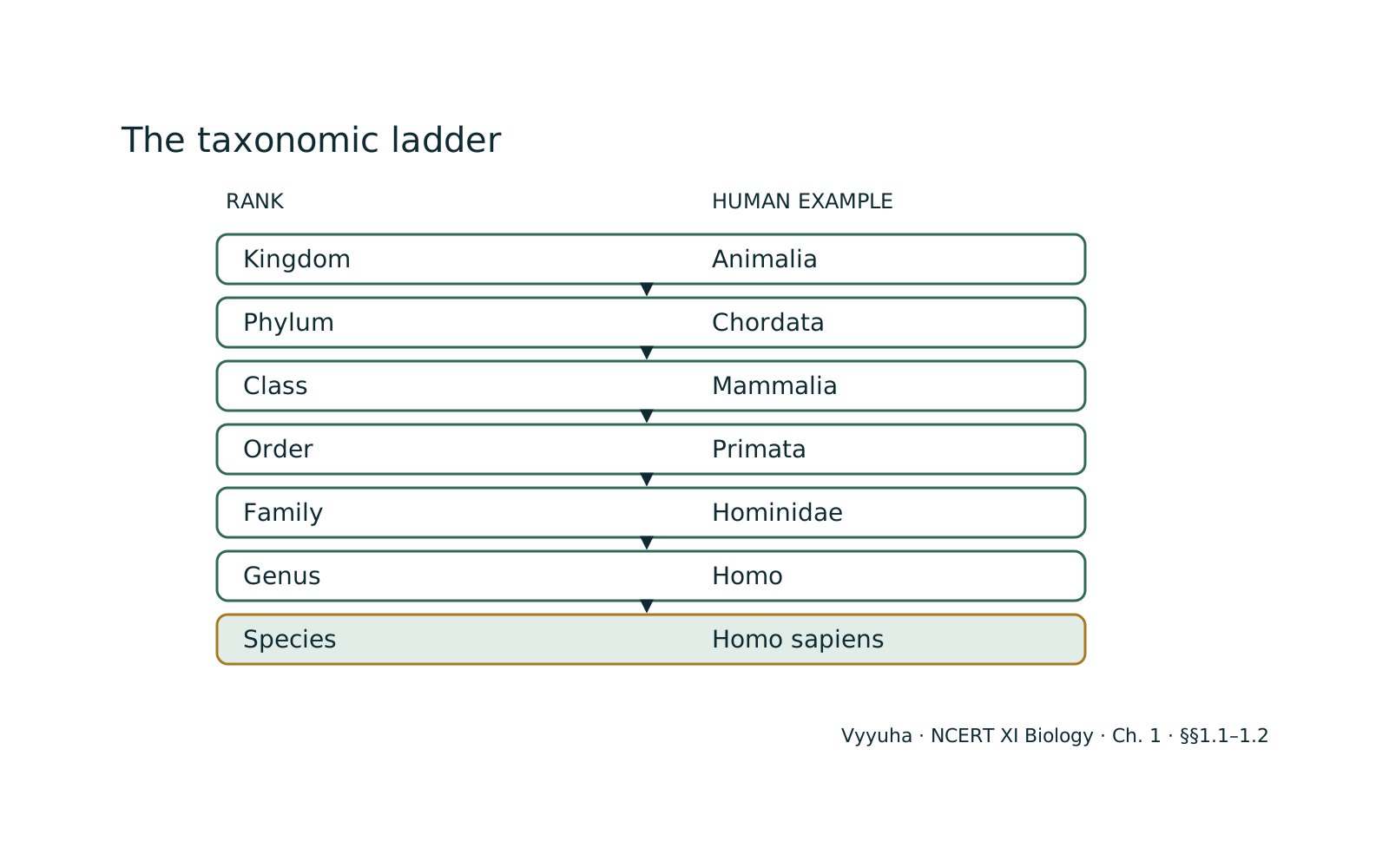
Taxonomic categories represent the distinct steps in the hierarchical classification of organisms, where each step signifies a rank or a unit of classification. These categories are not merely arbitrary groupings but reflect varying degrees of similarities and evolutionary relationships among organisms. The system is designed to organize the vast diversity of life into a logical, universally under…
Quick Summary
Taxonomic categories are the distinct ranks or levels in the hierarchical classification system used to organize the vast diversity of living organisms. This system, largely developed by Carolus Linnaeus, arranges organisms from the broadest, most inclusive groups to the most specific, exclusive ones.
The seven obligate categories, in descending order, are Kingdom, Phylum (or Division for plants), Class, Order, Family, Genus, and Species. Each category represents a step where organisms share progressively more common characteristics as one moves down the hierarchy.
Species is the fundamental unit, defined by organisms capable of interbreeding and producing fertile offspring. The purpose of this structured classification is to facilitate identification, study, and communication about organisms globally, reflecting their evolutionary relationships and aiding in biodiversity management and conservation efforts.
Understanding this hierarchy is crucial for comprehending the organization of life.
Full explanation
The living world is incredibly diverse, with millions of species inhabiting every corner of our planet. To make sense of this immense variety, biologists employ a systematic approach known as classification.
At the heart of this system lie 'taxonomic categories,' which are the fundamental units or ranks used to organize organisms into a logical, hierarchical structure. This hierarchy was largely formalized by Carolus Linnaeus, often referred to as the 'Father of Taxonomy,' and is therefore known as the Linnaean hierarchy.
Conceptual Foundation: The Need for Classification
Without a structured system, studying and communicating about the vast number of organisms would be chaotic. Classification provides several critical benefits:
- Organization: — It brings order to the diversity of life, making it easier to study and understand relationships.
- Identification: — It helps in identifying unknown organisms by comparing their characteristics with known classified groups.
- Communication: — It provides a universal language for biologists worldwide, ensuring that when they refer to a specific organism, everyone understands which one is being discussed.
- Evolutionary Insights: — It reflects evolutionary relationships, showing how different groups of organisms are related through common ancestry.
- Conservation: — It aids in assessing biodiversity and identifying species that might be endangered, guiding conservation efforts.
Key Principles of Taxonomic Categories:
Taxonomic categories are arranged in a descending sequence, from the broadest and most inclusive category (Kingdom) to the most specific and exclusive (Species). As we move down the hierarchy, the number of common characteristics shared by organisms within a category increases, while the number of organisms decreases. Conversely, moving up the hierarchy means fewer shared characteristics but a greater number of organisms.
Each category is a 'rank' or 'level' in the hierarchy. A 'taxon' (plural: taxa) refers to a group of organisms at any given taxonomic level. For example, 'Mammalia' is a taxon at the Class level, and 'Primates' is a taxon at the Order level.
The Seven Obligate Categories (Linnaean Hierarchy):
There are seven major taxonomic categories that are universally recognized. These are often remembered using mnemonics like 'Kids Prefer Cheese Over Fried Green Spinach' or 'King Philip Came Over For Good Soup.'
- Species (सबसे छोटी इकाई - Basic Unit):
* Definition: A group of individual organisms with fundamental similarities, capable of interbreeding naturally to produce fertile offspring. This is the lowest and most specific taxonomic category.
* Characteristics: Members of a species share a common gene pool, exhibit similar morphological, anatomical, physiological, and biochemical characteristics, and are reproductively isolated from other species.
* Example: Homo sapiens (humans), Mangifera indica (mango), Solanum tuberosum (potato), Panthera leo (lion).
- Genus (वंश):
* Definition: A group of closely related species that share more common characteristics compared to species of other genera. Genera are thought to have evolved from a common ancestor. * Characteristics: Species within a genus are morphologically similar but are reproductively distinct. * Example: Panthera (includes P. leo - lion, P. tigris - tiger, P. pardus - leopard), Solanum (includes S. tuberosum - potato, S. melongena - brinjal, S. nigrum - black nightshade).
- Family (कुल):
* Definition: A group of related genera that share some common features, though fewer than those shared by species within a genus. * Characteristics: Families are distinguished based on both vegetative and reproductive features in plants, and on general morphological and anatomical features in animals. * Example: Family Felidae (cats) includes genera Panthera and Felis. Family Solanaceae (potato family) includes genera Solanum, Petunia, and Datura.
- Order (गण):
* Definition: A collection of related families exhibiting a few similar characteristics. These similarities are generally less pronounced than those defining a family. * Characteristics: Orders are typically identified based on a few key distinguishing features that unite several families.
* Example: Order Carnivora (carnivores) includes families Felidae (cats) and Canidae (dogs). Order Sapindales (soapberry order) includes families Anacardiaceae (cashew family) and Sapindaceae (soapberry family).
- Class (वर्ग):
* Definition: A group of related orders. The similarities among organisms in a class are even more general. * Characteristics: Classes are broader groupings, often based on major structural or functional characteristics. * Example: Class Mammalia (mammals) includes orders like Primates, Carnivora, Rodentia. Class Dicotyledoneae (dicots) includes orders like Sapindales, Rosales.
- Phylum (संघ) / Division (प्रभाग):
* Definition: A group of related classes. In the animal kingdom, this category is called Phylum, while in the plant kingdom (and fungi, algae), it is called Division. * Characteristics: This is a very broad category, uniting organisms with fundamental body plans or organizational levels.
* Example: Phylum Chordata (animals with a notochord) includes classes like Mammalia, Aves, Reptilia, Amphibia, Pisces. Division Angiospermae (flowering plants) includes classes Dicotyledoneae and Monocotyledoneae.
- Kingdom (जगत):
* Definition: The highest and broadest taxonomic category, encompassing all organisms that share a few fundamental characteristics. It is the most inclusive group. * Characteristics: Organisms within a kingdom share very general characteristics, such as cell type (prokaryotic/eukaryotic), mode of nutrition (autotrophic/heterotrophic), and body organization (unicellular/multicellular).
* Example: Kingdom Animalia (all animals), Kingdom Plantae (all plants), Kingdom Fungi, Kingdom Protista, Kingdom Monera (now often split into Bacteria and Archaea).
Sub-categories and Intermediate Categories:
To make classification more precise, taxonomists often use intermediate categories like sub-species, sub-genus, sub-family, super-order, sub-class, etc. These provide finer distinctions within the main categories, especially when dealing with large and diverse groups.
Real-World Applications:
- Agriculture: — Understanding taxonomic relationships helps in breeding disease-resistant crops or identifying pests and their natural predators.
- Medicine: — Classifying pathogens (bacteria, viruses, fungi) is crucial for diagnosis, treatment, and vaccine development. For example, knowing the genus and species of a bacterium helps in prescribing the correct antibiotic.
- Biodiversity Conservation: — Accurate classification is essential for cataloging species, identifying biodiversity hotspots, and monitoring endangered species. It allows for targeted conservation efforts.
- Bioprospecting: — Identifying and classifying new species can lead to the discovery of novel compounds with pharmaceutical or industrial applications.
Common Misconceptions:
- Category vs. Taxon: — Students often confuse the term 'category' (the rank, e.g., 'species' as a level) with 'taxon' (the actual group of organisms at that rank, e.g., Homo sapiens). A category is an abstract rank, while a taxon is a concrete group of organisms placed at that rank.
- Fixed Nature of Categories: — While the major categories are fixed, the placement of organisms within them can sometimes be debated or revised as new genetic and morphological evidence emerges. Taxonomy is a dynamic field.
- Species Definition: — The biological species concept (interbreeding to produce fertile offspring) is widely used but has limitations, especially for asexual organisms or fossil species. Other species concepts exist (morphological, phylogenetic).
NEET-Specific Angle:
For NEET, a strong understanding of the hierarchy and the defining characteristics of each category is paramount. Students must be able to:
- Recall the sequence of categories (Kingdom to Species) and vice-versa.
- Identify the basic unit of classification (Species).
- Differentiate between Phylum and Division.
- Recognize examples of organisms and their classification at various levels (e.g., lion, tiger, cat all belong to family Felidae; potato, brinjal, makoi belong to genus Solanum).
- Understand the general trend of shared characteristics and number of organisms as one moves up or down the hierarchy.
- Be aware of the specific endings for plant families (e.g., -aceae), orders (e.g., -ales), and classes (e.g., -phyceae for algae, -opsida for plants) as these are often tested.
Mastering these categories is foundational for understanding the entire unit of 'Diversity in the Living World' and forms the basis for studying specific plant and animal groups.
Key Concepts
The species concept is pivotal in taxonomy. It defines a group of individuals that are morphologically…
A genus is a collection of closely related species that are believed to have evolved from a common ancestor.…
The family category groups together several related genera that share a few common characteristics. These…
Often confused with
Side-by-side differences the NEET paper likes to test.
| Aspect | Taxonomic Categories | Taxonomic Category vs. Taxon |
|---|---|---|
| Nature | An abstract rank or level in the classification hierarchy. | A concrete group of organisms placed at a specific taxonomic rank. |
| Representation | Represents a conceptual slot or position (e.g., 'species', 'genus'). | Represents a specific group of organisms (e.g., *Homo sapiens*, *Panthera*). |
| Universality | The categories themselves (Kingdom, Phylum, etc.) are universal ranks. | The actual groups of organisms (taxa) vary across different life forms. |
| Example | Species, Genus, Family, Order, Class, Phylum, Kingdom. | *Homo sapiens*, *Panthera*, Felidae, Primates, Mammalia, Chordata, Animalia. |
The distinction between a taxonomic category and a taxon is crucial for clarity in biology. A 'category' refers to the general rank or level in the classification system, such as 'species' or 'family.' It's a conceptual placeholder.
In contrast, a 'taxon' is the actual group of organisms that occupies that specific category. For instance, 'species' is a category, but Homo sapiens is a taxon at the species level. Understanding this difference ensures precise communication and avoids confusion when discussing the classification of life.
Why it is tested: NEET relevance: This distinction is frequently tested in conceptual questions to check a student's fundamental understanding of taxonomic terminology. Misunderstanding can lead to errors in interpreting classification schemes.
Questions students ask
5 answered on this topic.
Why is 'species' considered the basic unit of classification?
Species is considered the basic unit because it represents a group of organisms that are fundamentally similar, can naturally interbreed, and produce fertile offspring. This reproductive isolation from other groups makes it a distinct and stable unit. While higher categories group organisms based on broader similarities, species defines a group with the most intimate biological connections and a shared gene pool, making it the most natural and definable unit in the taxonomic hierarchy.
What is the difference between a 'category' and a 'taxon'?
A 'category' is an abstract rank or level in the taxonomic hierarchy, such as 'species,' 'genus,' or 'family.' It's a conceptual slot. A 'taxon' (plural: taxa), on the other hand, is a concrete group of organisms that has been assigned to a particular category. For example, 'species' is a category, but Homo sapiens is a taxon at the species level. 'Family' is a category, but 'Felidae' (the cat family) is a taxon at the family level.
How do we decide which organisms belong to the same 'family'?
Organisms are grouped into the same 'family' based on a set of shared, relatively stable characteristics, which are fewer than those shared within a genus but more than those shared within an order. For plants, both vegetative (e.
g., stem, leaf structure) and reproductive (e.g., floral parts, fruit type) features are crucial. For animals, general morphological features, anatomical structures, and sometimes genetic similarities are considered.
The goal is to group closely related genera that likely share a more recent common ancestor.
What is the significance of the hierarchical arrangement of taxonomic categories?
The hierarchical arrangement is significant because it reflects the varying degrees of relatedness among organisms. It starts with broad groups (Kingdom) sharing very few common features and progressively narrows down to highly specific groups (Species) sharing many common features and a close evolutionary history. This structure allows for systematic study, easy identification, and provides insights into evolutionary pathways, making the vast diversity of life manageable and understandable.
Can an organism belong to more than one taxonomic category?
No, an individual organism belongs to exactly one taxon at each specific taxonomic rank. For example, a human belongs to the species Homo sapiens, the genus Homo, the family Hominidae, and so on. It cannot simultaneously belong to two different species or two different genera. However, a taxon at a lower level (e.g., a species) is always part of a taxon at a higher level (e.g., a genus), which is then part of a family, and so forth, illustrating the nested nature of the hierarchy.
Revise in 30 seconds
- Hierarchy: — Kingdom → Phylum/Division → Class → Order → Family → Genus → Species
- Species: — Basic unit, interbreeding individuals, fertile offspring.
- Genus: — Group of related species.
- Family: — Group of related genera.
- Order: — Group of related families.
- Class: — Group of related orders.
- Phylum (Animals) / Division (Plants): — Group of related classes.
- Kingdom: — Broadest category, groups related phyla/divisions.
- Taxon: — A group of organisms at any rank.
- Trend: — As you go from Species to Kingdom, common characteristics decrease, number of organisms increases.
To remember the taxonomic hierarchy from Kingdom to Species: King Philip Came Over For Good Soup.