General Characteristics
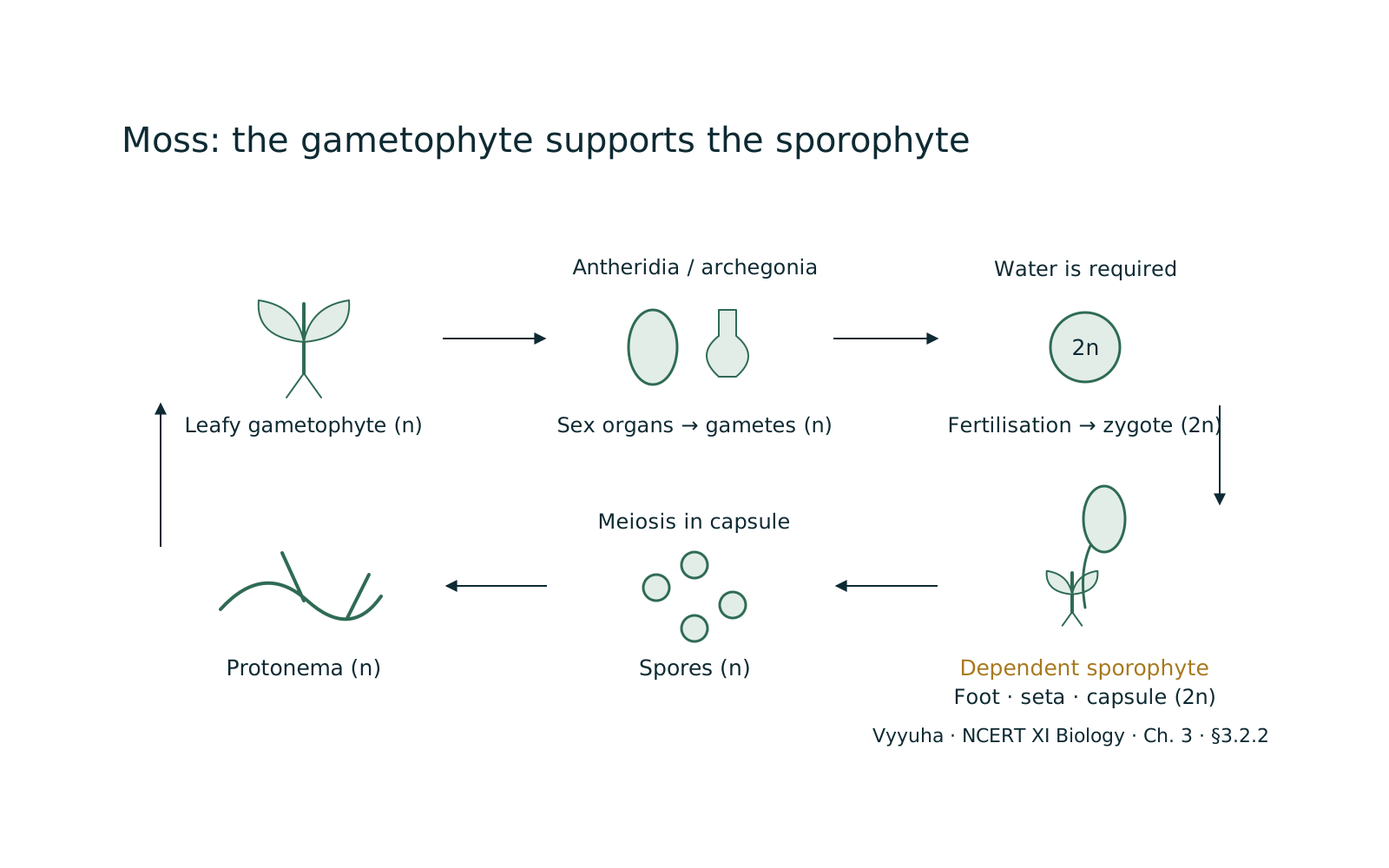
Bryophytes represent a fascinating and crucial transitional group in the plant kingdom, bridging the gap between aquatic algae and terrestrial vascular plants. Characterized by their non-vascular nature, they exhibit a dominant gametophytic generation, which is the independent, photosynthetic plant body, and a sporophytic generation that is nutritionally dependent on the gametophyte. Their general…
Quick Summary
Bryophytes are non-vascular land plants, often called 'amphibians of the plant kingdom' due to their dependence on water for sexual reproduction. They thrive in moist, shady habitats. Their plant body is simple, lacking true roots, stems, and leaves; instead, they possess rhizoids for anchorage and simple stem-like and leaf-like structures.
The life cycle exhibits alternation of generations, with the haploid gametophyte being the dominant, independent, and photosynthetic phase. The diploid sporophyte is short-lived, non-photosynthetic, and nutritionally dependent on the gametophyte, typically comprising a foot, seta, and capsule.
Sexual reproduction involves flagellated sperm swimming to an egg within the archegonium, forming a zygote that develops into the sporophyte. Asexual reproduction occurs via fragmentation, budding, or gemmae.
Ecologically, they are pioneers, prevent soil erosion, and contribute to peat formation, especially Sphagnum, which has high water retention capacity.
Full explanation
Bryophytes, a diverse group encompassing mosses, liverworts, and hornworts, represent a pivotal evolutionary step in the plant kingdom, marking the transition from aquatic to terrestrial life. Their general characteristics reflect adaptations to land while retaining a strong dependence on water, earning them the moniker 'amphibians of the plant kingdom'.
1. Habitat and Distribution:
Bryophytes predominantly thrive in damp, humid, and shaded environments. They are commonly found on moist soil, rocks, tree trunks, and even in aquatic or semi-aquatic conditions. Their preference for moist habitats is directly linked to their reproductive strategy, which necessitates a film of water for sperm motility.
Despite this, some species exhibit remarkable resilience, surviving in arid conditions by entering a dormant state and rapidly rehydrating when moisture becomes available. They are globally distributed, from polar regions to tropical rainforests, showcasing their adaptability within their specific ecological niches.
2. Plant Body Organization:
One of the most defining characteristics of bryophytes is their relatively simple plant body, which lacks true roots, stems, and leaves. This is a significant distinction from vascular plants (Pteridophytes, Gymnosperms, Angiosperms).
* Thalloid vs. Leafy: The plant body can be either thalloid (undifferentiated, flattened, dorsiventral structure, e.g., many liverworts like Marchantia) or leafy (erect, with stem-like axis and leaf-like appendages, e.
g., mosses like Funaria). The 'leaves' are simple, typically one cell thick, and lack vascular tissue. * Rhizoids: Instead of true roots, bryophytes possess multicellular or unicellular filamentous structures called rhizoids.
Their primary function is anchorage to the substratum, not efficient absorption of water and minerals, which is largely absorbed directly through the general surface of the plant body. * Absence of Vascular Tissue: Bryophytes are non-vascular plants.
They lack specialized conducting tissues – xylem for water transport and phloem for food transport. This absence limits their size, forcing them to remain small and grow close to the ground, facilitating cell-to-cell diffusion for nutrient and water distribution.
3. Dominant Gametophytic Generation:
The life cycle of bryophytes is characterized by an 'alternation of generations', where two distinct multicellular stages, the gametophyte and the sporophyte, alternate. Crucially, the gametophyte (n) is the dominant, independent, and photosynthetic phase. It is the green, leafy or thalloid plant that we typically recognize as a bryophyte. The gametophyte produces gametes (sex cells).
4. Dependent Sporophytic Generation:
In contrast to the dominant gametophyte, the sporophyte (2n) is short-lived, non-photosynthetic, and entirely or partially dependent on the gametophyte for nutrition and physical support. It remains attached to the gametophyte throughout its existence. The sporophyte typically differentiates into three parts: a 'foot' (embedded in the gametophyte for nutrient absorption), a 'seta' (stalk), and a 'capsule' (sporangium) which produces haploid spores through meiosis.
5. Reproduction:
Bryophytes exhibit both asexual and sexual modes of reproduction. * Asexual Reproduction: This occurs through fragmentation, budding (e.g., in moss protonema), or by specialized structures like gemmae (e.
g., in Marchantia). Gemmae are green, multicellular, asexual buds that develop in small receptacles called gemma cups on the gametophyte. They detach from the parent plant and germinate to form new gametophytes.
* Sexual Reproduction: This is oogamous, involving a large, non-motile female gamete (egg) and smaller, motile male gametes (sperm). The sex organs are multicellular and jacketed (protected by sterile cells).
* Antheridium: The male sex organ, typically club-shaped, produces numerous biflagellate (two flagella) antherozoids (sperm). * Archegonium: The female sex organ, flask-shaped, contains a single egg.
It has a swollen basal part called the venter and a slender neck. * Fertilization: Water is absolutely essential for fertilization. The antherozoids are released from the antheridium and swim through the water film to reach the archegonium, where they fuse with the egg to form a diploid zygote.
6. Embryo Development:
The zygote, formed within the archegonium, undergoes mitotic divisions to develop into a multicellular embryo, which then differentiates into the sporophyte. This retention of the embryo within the female gametophyte is a significant evolutionary advancement, protecting the developing sporophyte and providing it with initial nourishment.
7. Spore Dispersal and Germination:
Upon maturation, the sporophyte's capsule releases haploid spores. These spores are typically wind-dispersed. Under favorable conditions (moisture, light), the spores germinate to form a filamentous, branched, green structure called a 'protonema' (in mosses) or directly into a thalloid gametophyte (in liverworts). The protonema then develops buds, which grow into the mature leafy gametophyte.
8. Ecological and Evolutionary Significance:
Bryophytes play crucial ecological roles. They are often pioneer species, colonizing barren rocks and contributing to soil formation. They prevent soil erosion, reduce the impact of falling rain, and absorb and retain water, thus acting as important components of forest ecosystems.
Sphagnum (peat moss) is particularly significant, forming vast peat bogs that are vital carbon sinks and provide fuel and packing material. Evolutionarily, bryophytes represent the earliest land plants, demonstrating adaptations like a cuticle (to prevent desiccation), stomata (in some sporophytes), and protected reproductive organs, paving the way for the diversification of more complex terrestrial flora.
Common Misconceptions:
- Bryophytes have true roots, stems, and leaves: — Incorrect. They have root-like rhizoids, stem-like axes, and leaf-like appendages, but these lack the complex vascular organization of true organs.
- Bryophytes are vascular plants: — Incorrect. They are non-vascular, relying on diffusion for transport, which limits their size.
- Sporophyte is independent: — Incorrect. The sporophyte is dependent on the gametophyte for nutrition and support.
- Water is only needed for growth: — Incorrect. Water is critically required for the movement of male gametes during sexual reproduction.
Key Concepts
Bryophytes exhibit a distinct alternation of generations, a life cycle pattern where a haploid gametophyte…
A defining characteristic of bryophytes is the absence of true vascular tissues (xylem and phloem). Xylem is…
The absolute requirement of water for sexual reproduction is a hallmark of bryophytes. The male gametes,…
Often confused with
Side-by-side differences the NEET paper likes to test.
| Aspect | General Characteristics | Algae and Pteridophytes |
|---|---|---|
| Habitat | Primarily aquatic (Algae) | Terrestrial (moist, shady) but water needed for reproduction (Bryophytes) |
| Plant Body | Thalloid, undifferentiated (Algae) | Thalloid or leafy; no true roots, stems, leaves (Bryophytes) |
| Vascular Tissue | Absent (Algae) | Absent (Bryophytes) |
| Dominant Phase | Gametophyte (Algae, though variable) | Gametophyte (Bryophytes) |
| Sporophyte | Often unicellular or simple, not distinct (Algae) | Dependent on gametophyte, differentiated (foot, seta, capsule) (Bryophytes) |
| Embryo | Absent (Algae) | Present, retained within archegonium (Bryophytes) |
| Water for Fertilization | Essential (Algae) | Essential (Bryophytes) |
| Evolutionary Position | Ancestral, aquatic (Algae) | First land plants, transitional (Bryophytes) |
Bryophytes represent an evolutionary intermediate between algae and pteridophytes. Unlike algae, bryophytes show adaptations for terrestrial life, such as a protected embryo and multicellular sex organs, but they retain the algal dependence on water for fertilization.
They differ from pteridophytes by lacking true vascular tissues and having a dominant gametophytic generation, whereas pteridophytes possess vascular tissues and a dominant sporophytic generation. This comparison highlights bryophytes' unique position as the 'amphibians of the plant kingdom', showcasing early terrestrial adaptations alongside persistent aquatic requirements.
Why it is tested: NEET relevance: Understanding these differences is crucial for classifying plants and tracing evolutionary trends. Questions often compare characteristics across plant groups, testing knowledge of key features like vascularity, dominant life cycle phase, and reproductive strategies.
Questions students ask
6 answered on this topic.
Why are bryophytes called the 'amphibians of the plant kingdom'?
Bryophytes are termed 'amphibians of the plant kingdom' because, despite living on land, they are absolutely dependent on water for sexual reproduction. Their male gametes (antherozoids) are flagellated and need a film of water to swim and reach the female gamete (egg) for fertilization. This ecological requirement for water, similar to amphibians that live on land but return to water to breed, is a defining characteristic that limits their distribution to moist and shady habitats.
What is the dominant phase in the life cycle of a bryophyte?
The dominant phase in the life cycle of a bryophyte is the gametophyte. This is the independent, photosynthetic, and typically green plant body that we commonly observe. It is haploid (n) and produces gametes. In contrast, the sporophyte, which is diploid (2n) and produces spores, is short-lived and nutritionally dependent on the gametophyte, remaining attached to it throughout its development.
Do bryophytes have true roots, stems, and leaves?
No, bryophytes do not possess true roots, stems, and leaves. Instead, they have simpler analogous structures. They anchor themselves to the substratum using filamentous structures called rhizoids, which are not true roots as they lack vascular tissue and primarily function in anchorage rather than absorption. Their plant body may have a stem-like axis and leaf-like appendages, but these also lack the complex vascular organization found in higher plants.
How do bryophytes reproduce asexually?
Bryophytes employ several methods for asexual reproduction. Common methods include fragmentation, where a part of the plant body breaks off and develops into a new individual. Budding is another method, particularly seen in the protonema stage of mosses. Additionally, some bryophytes, like liverworts (e.g., Marchantia), produce specialized multicellular, green asexual buds called gemmae, which develop in gemma cups, detach, and grow into new gametophytes.
What is the ecological significance of bryophytes?
Bryophytes play vital ecological roles. They are often pioneer species, colonizing barren rocks and contributing to the initial stages of soil formation. They help prevent soil erosion by forming dense mats and reduce the impact of rainfall.
Due to their high water-holding capacity, especially Sphagnum (peat moss), they are crucial in maintaining soil moisture and creating peat bogs, which are significant carbon sinks and habitats for various organisms.
They also serve as indicators of environmental health.
What is the main difference between the gametophyte and sporophyte in bryophytes?
The main difference lies in their ploidy level, independence, and function. The gametophyte is haploid (n), independent, photosynthetic, and represents the dominant phase, responsible for producing gametes. The sporophyte, on the other hand, is diploid (2n), nutritionally dependent on the gametophyte, non-photosynthetic, and is responsible for producing spores through meiosis. The sporophyte is typically short-lived and structurally simpler, consisting of a foot, seta, and capsule.
Revise in 30 seconds
- Amphibians of Plant Kingdom — Need water for fertilization.
- Habitat — Moist, shady places.
- Plant Body — Gametophyte (n) is dominant, independent, photosynthetic.
- No True Organs — Lacks true roots, stems, leaves. Has rhizoids for anchorage.
- Non-vascular — No xylem or phloem.
- Sporophyte (2n) — Dependent on gametophyte; differentiated into foot, seta, capsule.
- Reproduction — Asexual (fragmentation, gemmae, budding in protonema); Sexual (oogamous, antheridia produce biflagellate antherozoids, archegonia produce egg).
- Zygote (2n) — Develops into sporophyte.
- Spores (n) — Produced by meiosis in capsule, germinate to form protonema (mosses) or thallus (liverworts).
To remember Bryophyte characteristics: Bryophytes Require Year-round Outside Puddles, Having Young Through Eggs & Spores.
- Bryophytes: The name itself.
- Require Year-round Outside Puddles: Need water for fertilization (amphibians).
- Having Young: Reproduction.
- Through Eggs & Spores: Sexual (gametes) and asexual (spores) reproduction.
Additional points to link:
- Green Gametophyte Grows Great (Dominant Gametophyte).
- Sporophyte Stays Small & Supported (Dependent Sporophyte).
- No Nice Network (Non-vascular).