Plant Kingdom
- 1AlgaeClassification of Algae · Reproduction in Algae · Economic ImportanceHigh yield
- 2BryophytesGeneral Characteristics · Classification and ExamplesHigh yield
- 3PteridophytesGeneral Characteristics · Classification and ExamplesHigh yield
- 4GymnospermsGeneral Characteristics · Classification and ExamplesHigh yield
- 5AngiospermsGeneral Characteristics · Classification into FamiliesHigh yield
- 6Plant Life Cycles and Alternation of GenerationsHigh yield
The Plant Kingdom, or Kingdom Plantae, encompasses all eukaryotic, multicellular, photosynthetic organisms that possess a rigid cell wall primarily composed of cellulose. These organisms are characterized by their autotrophic mode of nutrition, meaning they synthesize their own food using light energy through photosynthesis. A defining feature across most plant groups is the phenomenon of alternat…
Quick Summary
The Plant Kingdom comprises eukaryotic, multicellular, photosynthetic organisms with cellulose cell walls. They are autotrophs, forming the base of most food chains. A defining characteristic is the alternation of generations, involving a haploid gametophyte and a diploid sporophyte phase.
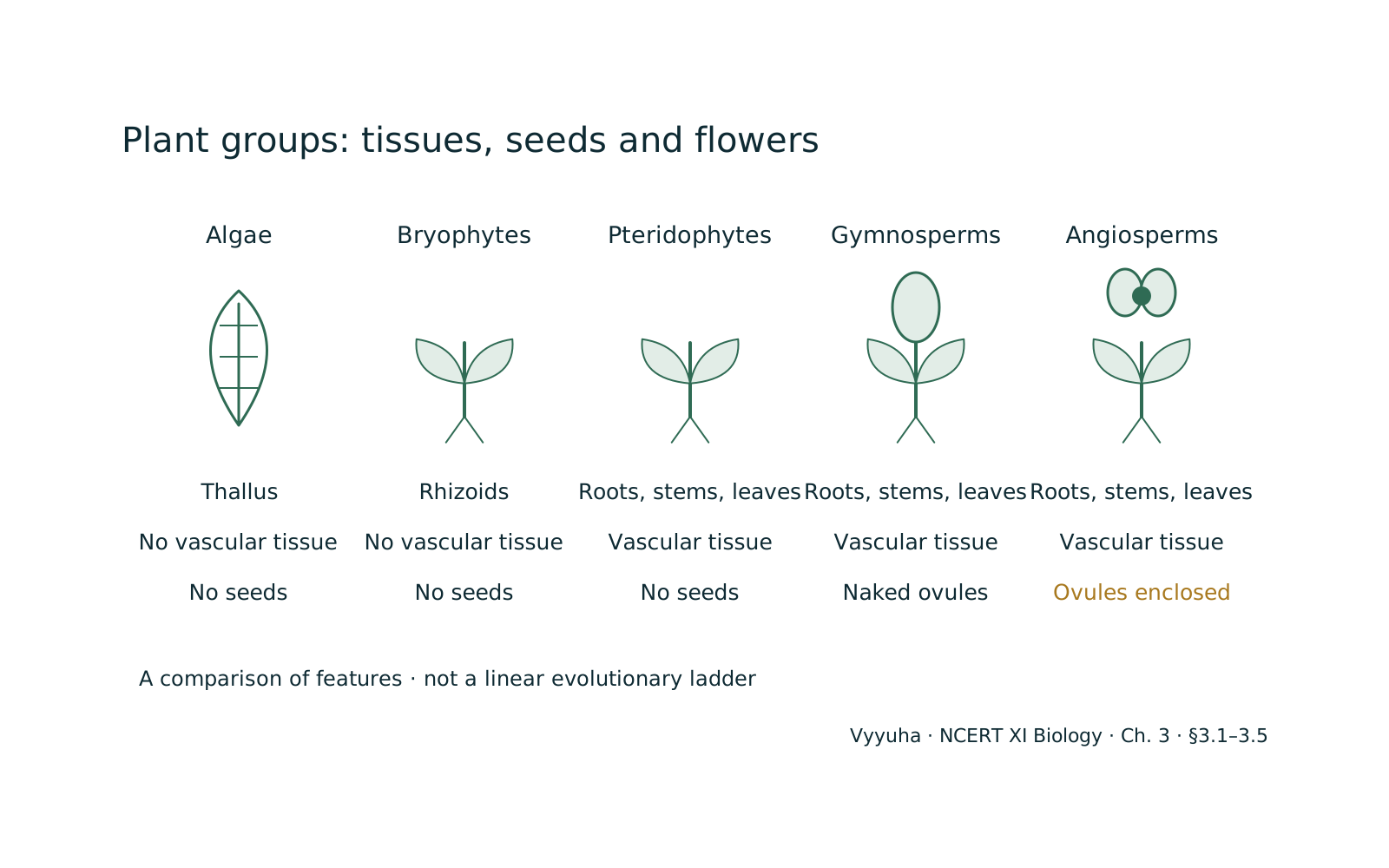
The kingdom is broadly classified into Algae, Bryophytes, Pteridophytes, Gymnosperms, and Angiosperms, representing an evolutionary progression in complexity and adaptation to terrestrial life. Algae are simple, mostly aquatic, and thalloid.
Bryophytes (mosses, liverworts) are the 'amphibians of the plant kingdom,' requiring water for reproduction, with a dominant gametophyte. Pteridophytes (ferns) are the first vascular land plants, with a dominant sporophyte.
Gymnosperms (conifers) have 'naked seeds' and are well-adapted to drier conditions. Angiosperms (flowering plants) are the most advanced, with enclosed seeds within fruits and double fertilization, dominating most terrestrial environments.
Understanding these groups requires focusing on their unique structural, reproductive, and life cycle features for NEET.
Full explanation
The Plant Kingdom, or Kingdom Plantae, represents a diverse assemblage of eukaryotic, multicellular, photosynthetic organisms. Their study is fundamental to understanding terrestrial ecosystems, food webs, and the evolution of life on Earth.
The classification within this kingdom has evolved significantly, moving from artificial systems based on superficial morphological characters to natural systems based on overall similarities, and finally to phylogenetic systems that reflect evolutionary relationships.
I. Conceptual Foundation and Classification Systems:
Historically, classification systems for plants have progressed through several stages:
- Artificial Systems: — Based on one or a few superficial morphological characters, such as habit, color, number, and shape of leaves. For example, Linnaeus's system was based on the number and arrangement of stamens and carpels. These systems were easy to use but did not reflect natural relationships and often separated closely related species.
- Natural Systems: — Based on natural affinities among organisms, considering external and internal features (ultrastructure, anatomy, embryology, phytochemistry). These systems provide a more comprehensive understanding of relationships. Bentham and Hooker's classification of flowering plants is a notable example.
- Phylogenetic Systems: — Based on evolutionary relationships between organisms. These systems assume that organisms belonging to the same taxa have a common ancestor. Modern phylogenetic classification uses molecular data (DNA, RNA) to establish these relationships, often represented in cladograms.
II. Key Principles: Alternation of Generations and Life Cycles:
One of the most characteristic features of the Plant Kingdom is the 'alternation of generations', where the life cycle involves two distinct multicellular phases: a haploid gametophyte and a diploid sporophyte. These phases alternate in producing each other.
- Gametophyte: — The haploid (n) generation that produces gametes (sex cells) by mitosis. These gametes fuse during fertilization to form a diploid zygote.
- Sporophyte: — The diploid (2n) generation that develops from the zygote. It produces haploid spores by meiosis. These spores germinate to form new gametophytes.
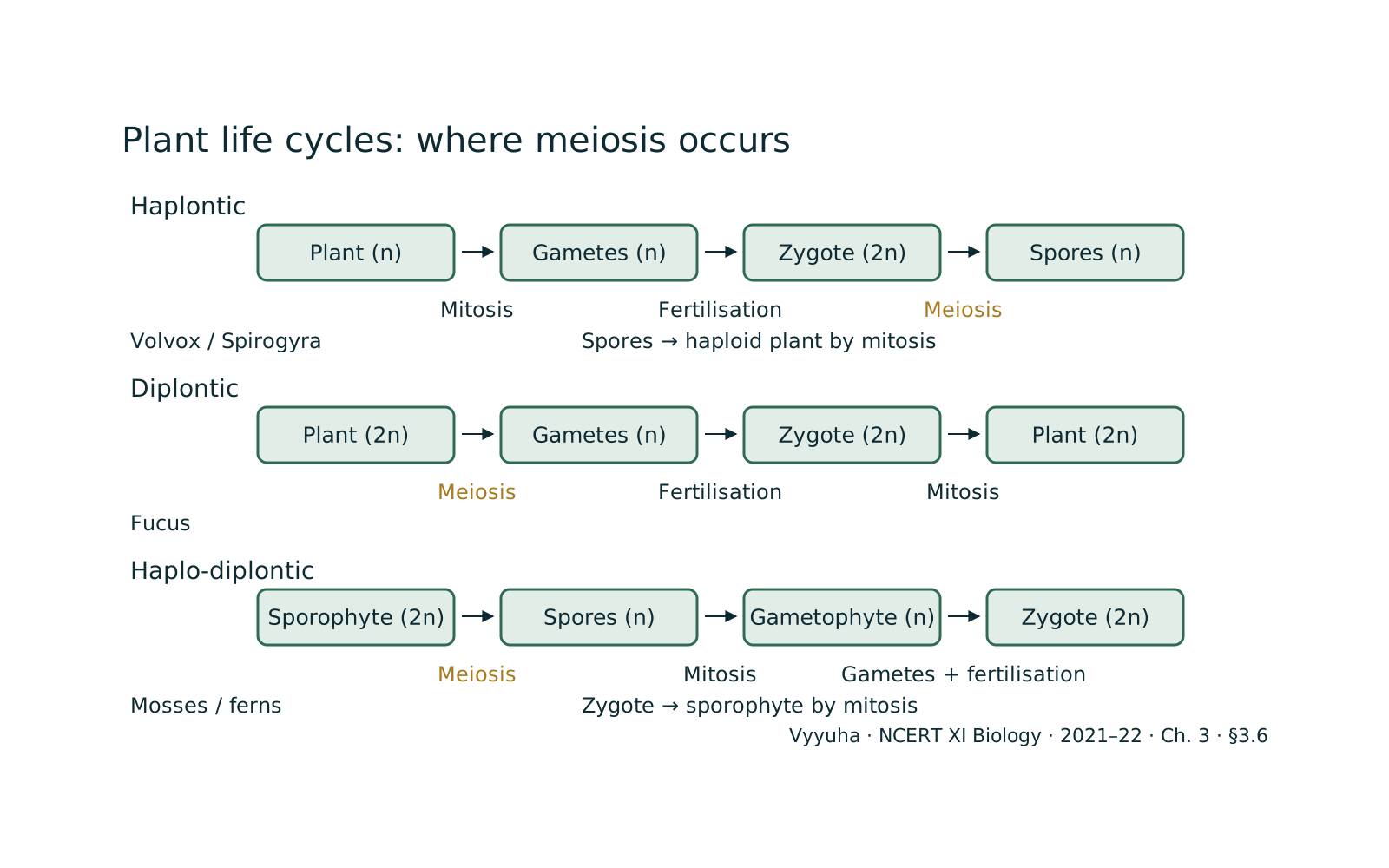
Based on the dominance and independence of these phases, three main types of life cycles are observed:
- Haplontic Life Cycle: — The dominant phase is the free-living haploid gametophyte. The sporophytic phase is represented only by the one-celled zygote, which undergoes meiosis to produce haploid spores. Found in many algae (e.g., \textit{Volvox}, \textit{Spirogyra}, some species of \textit{Chlamydomonas}).
- Diplontic Life Cycle: — The dominant phase is the free-living diploid sporophyte. The gametophytic phase is represented by the haploid gametes, which are formed by meiosis in the sporophyte. Fertilization restores the diploid phase. Found in all seed-bearing plants (Gymnosperms and Angiosperms) and some algae (e.g., \textit{Fucus}).
- Haplo-diplontic Life Cycle: — Both gametophyte and sporophyte are multicellular and often free-living, though one may be dominant. This intermediate condition is characteristic of Bryophytes (dominant gametophyte, partially dependent sporophyte) and Pteridophytes (dominant sporophyte, independent but short-lived gametophyte). Some algae (e.g., \textit{Ectocarpus}, \textit{Polysiphonia}, kelps) also exhibit this type.
III. Major Divisions of the Plant Kingdom:
A. Algae:
- General Characteristics: — Simple, thalloid (body not differentiated into root, stem, leaf), largely aquatic (freshwater and marine), photosynthetic. Lack true roots, stems, and leaves. Reproduction is vegetative (fragmentation), asexual (spores), and sexual (isogamous, anisogamous, oogamous).
- Classification: — Divided into three main classes based on pigments, stored food, and cell wall composition:
* Chlorophyceae (Green Algae): Dominant pigments chlorophyll a and b. Stored food is starch. Cell wall of cellulose. Mostly freshwater. Examples: \textit{Chlamydomonas}, \textit{Volvox}, \textit{Ulothrix}, \textit{Spirogyra}, \textit{Chara}.
* Phaeophyceae (Brown Algae): Dominant pigments chlorophyll a, c, and fucoxanthin. Stored food is laminarin or mannitol. Cell wall of cellulose and algin. Mostly marine. Examples: \textit{Ectocarpus}, \textit{Dictyota}, \textit{Laminaria}, \textit{Sargassum}, \textit{Fucus}.
* Rhodophyceae (Red Algae): Dominant pigments chlorophyll a, d, and phycoerythrin. Stored food is floridean starch. Cell wall of cellulose, pectin, and phycocolloids. Mostly marine, often found in deeper waters due to phycoerythrin's ability to absorb blue light.
Examples: \textit{Polysiphonia}, \textit{Porphyra}, \textit{Gracilaria}, \textit{Gelidium}.
B. Bryophytes (Mosses and Liverworts):
- General Characteristics: — First land plants, but still dependent on water for sexual reproduction (sperm are flagellated). Called 'amphibians of the plant kingdom'. Plant body is more differentiated than algae, but still thallus-like or leafy and erect. Lack true roots, stems, and leaves; possess rhizoids. Dominant phase is the haploid gametophyte. Sporophyte is parasitic on the gametophyte.
- Reproduction: — Sexual reproduction involves antheridia (male sex organ producing antherozoids) and archegonia (female sex organ producing a single egg). Zygote develops into a sporophyte (foot, seta, capsule). Spores are produced by meiosis in the capsule.
- Examples: — \textit{Marchantia} (liverwort), \textit{Funaria} (moss), \textit{Sphagnum} (peat moss).
C. Pteridophytes (Ferns and Horsetails):
- General Characteristics: — First terrestrial plants to possess vascular tissues (xylem and phloem). Plant body differentiated into true roots, stems, and leaves. Dominant phase is the diploid sporophyte, which is free-living and photosynthetic. Gametophyte (prothallus) is small, inconspicuous, and usually short-lived, but independent.
- Reproduction: — Spores are produced in sporangia, which are subtended by leaf-like appendages called sporophylls. Spores germinate to form the prothallus. Sexual reproduction requires water for sperm transfer. Most are homosporous (produce one type of spore), but some are heterosporous (produce two types of spores: microspores and megaspores, e.g., \textit{Selaginella}, \textit{Salvinia}). Heterospory is a precursor to seed habit.
- Examples: — \textit{Selaginella}, \textit{Equisetum} (horsetail), \textit{Dryopteris} (fern), \textit{Adiantum} (walking fern).
D. Gymnosperms:
- General Characteristics: — 'Naked seeds' – ovules are not enclosed by an ovary wall and remain exposed both before and after fertilization. Woody, perennial plants (trees, shrubs). Possess well-developed vascular tissues. Dominant phase is the sporophyte. Gametophytes are highly reduced and retained within the sporangia.
- Reproduction: — Heterosporous, producing microspores (develop into pollen grains) and megaspores (develop into female gametophyte/embryo sac). Pollen grains are carried by wind to the ovules. Fertilization does not require external water. Zygote develops into an embryo, and the ovule into a seed.
- Examples: — \textit{Pinus} (pine), \textit{Cycas} (cycad), \textit{Ginkgo} (Maidenhair tree), \textit{Sequoia} (redwood).
E. Angiosperms (Flowering Plants):
- General Characteristics: — 'Enclosed seeds' – ovules are enclosed within an ovary, which develops into a fruit after fertilization. Most diverse and successful plant group. Possess flowers, which are specialized reproductive structures. Dominant phase is the sporophyte. Gametophytes are extremely reduced (male gametophyte is pollen grain, female gametophyte is embryo sac).
- Reproduction: — Unique features include double fertilization (one male gamete fuses with egg to form zygote, another fuses with central cell to form endosperm) and the formation of fruit. Pollination is often mediated by animals, wind, or water. Classified into Monocotyledons and Dicotyledons based on the number of cotyledons in the seed.
- Examples: — All flowering plants, from grasses to roses to mango trees.
IV. Real-World Applications and Ecological Roles:
- Primary Producers: — Plants form the base of nearly all terrestrial and many aquatic food webs, converting solar energy into chemical energy through photosynthesis, providing food and oxygen for heterotrophs.
- Economic Importance: — Source of food (cereals, fruits, vegetables), timber, fibers (cotton, jute), medicines (quinine, digitalis), fuel (wood, fossil fuels derived from ancient plants), spices, oils, rubber, and ornamental value.
- Ecological Services: — Prevent soil erosion, regulate climate, contribute to the water cycle, provide habitat for wildlife, and sequester carbon dioxide.
V. Common Misconceptions:
- All plants are green and photosynthetic: — While most are, some parasitic plants (e.g., dodder) lack chlorophyll and obtain nutrients from host plants. Also, some algae are not green.
- Fungi are plants: — Fungi were once classified with plants due to their sessile nature and cell walls, but they are heterotrophic and have chitin in their cell walls, placing them in a separate kingdom.
- All algae are simple, unicellular organisms: — While many are, some algae (e.g., kelps) are large and multicellular, exhibiting significant differentiation.
- Bryophytes are fully adapted to land: — They are terrestrial but still require water for fertilization, limiting their distribution to moist, shaded areas.
VI. NEET-Specific Angle:
For NEET, a deep understanding of the distinguishing features of each plant group is crucial. Focus on:
- Life Cycles: — Be able to identify haplontic, diplontic, and haplo-diplontic cycles and associate them with specific examples from each group. Understand the dominant phase in each group.
- Key Structures: — Recognize the presence/absence of vascular tissue, true roots/stems/leaves, seeds, and flowers in each group.
- Reproduction: — Understand the modes of reproduction (vegetative, asexual, sexual), the role of water in fertilization, and unique reproductive features like heterospory and double fertilization.
- Pigments and Stored Food: — Especially for algae, know the characteristic pigments and storage products for each class.
- Examples: — Memorize at least 2-3 characteristic examples for each major group and their subclasses/orders where applicable (e.g., liverworts vs. mosses, monocots vs. dicots).
- Evolutionary Trends: — Trace the evolutionary advancements from algae to angiosperms, focusing on adaptations to terrestrial life (vascular tissue, seed habit, fruit formation).
Key Concepts
This fundamental concept describes the life cycle of plants where there is a regular succession of two…
Heterospory is an evolutionary advancement characterized by the production of two morphologically and…
Double fertilization is a unique and defining characteristic of angiosperms (flowering plants). It involves…
Often confused with
Side-by-side differences the NEET paper likes to test.
| Aspect | Plant Kingdom | Bryophytes vs. Pteridophytes |
|---|---|---|
| Dominant Plant Body | Gametophyte (haploid, n) | Sporophyte (diploid, 2n) |
| Vascular Tissue | Absent (non-vascular) | Present (first vascular plants) |
| True Roots, Stems, Leaves | Absent (possess rhizoids, thallus-like or leafy structures) | Present (differentiated into true roots, stems, and leaves) |
| Sporophyte Dependence | Dependent on the gametophyte for nutrition and support | Independent and free-living |
| Gametophyte (Prothallus) | Prominent, free-living, photosynthetic | Small, inconspicuous, usually short-lived, but independent |
| Requirement for Water in Fertilization | Essential for sperm transfer | Essential for sperm transfer |
Bryophytes and Pteridophytes represent early evolutionary steps in plant adaptation to land, but they differ significantly. Bryophytes are non-vascular with a dominant gametophytic phase, and their sporophyte is dependent on the gametophyte.
They lack true roots, stems, and leaves. Pteridophytes, on the other hand, are the first vascular plants, with a dominant, independent sporophytic phase and true roots, stems, and leaves. Both groups still require water for sexual reproduction, highlighting their transitional nature in terrestrial colonization.
Why it is tested: For NEET, understanding these differences is crucial for tracing the evolutionary progression of plants. Questions often focus on identifying the dominant generation, the presence or absence of vascular tissue, and the degree of independence of the sporophyte and gametophyte in each group. Examples of each group and their unique reproductive features (e.g., heterospory in some pteridophytes) are also frequently tested.
Questions students ask
6 answered on this topic.
What is the primary basis for classifying organisms into the Plant Kingdom?
The primary basis for classifying organisms into the Plant Kingdom revolves around several key characteristics: their autotrophic mode of nutrition via photosynthesis, the presence of a rigid cell wall primarily composed of cellulose, and their eukaryotic and typically multicellular organization.
Additionally, the life cycle often exhibits alternation of generations, involving distinct haploid gametophytic and diploid sporophytic phases. These fundamental features collectively distinguish plants from other kingdoms like Animalia, Fungi, and Protista.
Explain the concept of 'alternation of generations' in plants.
Alternation of generations is a unique life cycle pattern in plants where two distinct multicellular forms, a haploid gametophyte (n) and a diploid sporophyte (2n), alternate. The gametophyte produces gametes by mitosis, which fuse to form a zygote.
The zygote develops into the sporophyte, which then produces haploid spores by meiosis. These spores germinate to form new gametophytes, completing the cycle. The relative dominance and independence of these two phases vary across different plant groups, reflecting evolutionary adaptations.
Why are Bryophytes called the 'amphibians of the plant kingdom'?
Bryophytes are termed 'amphibians of the plant kingdom' because, much like amphibians in the animal kingdom, they are adapted to live on land but still require water for a crucial part of their life cycle – sexual reproduction.
Their flagellated antherozoids (sperm) need a film of water to swim to the archegonium and fertilize the egg. This dependence on water limits their distribution to moist, shaded habitats, even though they possess adaptations for terrestrial existence like a cuticle and rhizoids.
What is the significance of heterospory in Pteridophytes?
Heterospory, the production of two different types of spores (microspores and megaspores) by the same plant, is a significant evolutionary step observed in some pteridophytes like \textit{Selaginella} and \textit{Salvinia}.
Microspores germinate into male gametophytes, and megaspores into female gametophytes. This phenomenon is considered a precursor to the seed habit seen in gymnosperms and angiosperms, as it involves the retention of the megaspore within the sporangium on the parent sporophyte for a period, providing protection and nourishment to the developing female gametophyte and embryo.
What is 'double fertilization' and in which plant group is it observed?
Double fertilization is a unique and characteristic feature of Angiosperms (flowering plants). It involves two separate fusion events: one male gamete fuses with the egg cell to form a diploid zygote, which develops into the embryo.
The second male gamete fuses with the diploid central cell (containing two polar nuclei) to form a triploid primary endosperm nucleus (PEN), which develops into the endosperm. The endosperm provides nourishment to the developing embryo.
This process ensures that nutrients are only invested in viable embryos.
How do Gymnosperms differ from Angiosperms in terms of their seeds?
The primary difference lies in the enclosure of their seeds. Gymnosperms are characterized by 'naked seeds,' meaning their ovules are not enclosed within an ovary wall and remain exposed on the surface of sporophylls, both before and after fertilization.
In contrast, Angiosperms, or flowering plants, have 'enclosed seeds.' Their ovules are contained within an ovary, which develops into a fruit after fertilization, providing protection and aiding in seed dispersal.
This enclosure is a key evolutionary advancement in angiosperms.
Revise in 30 seconds
- Plant Kingdom: — Eukaryotic, multicellular, photosynthetic, cellulose cell wall, alternation of generations.
- Algae: — Thalloid, aquatic. Classes:
- \textit{Chlorophyceae} (Green): Chl a, b; Starch; Cellulose wall. Ex: \textit{Volvox}, \textit{Spirogyra}. - \textit{Phaeophyceae} (Brown): Chl a, c, fucoxanthin; Laminarin/Mannitol; Cellulose + Algin wall. Ex: \textit{Laminaria}, \textit{Fucus}. - \textit{Rhodophyceae} (Red): Chl a, d, phycoerythrin; Floridean starch; Cellulose + Pectin wall. Ex: \textit{Polysiphonia}, \textit{Gelidium}.
- Bryophytes: — 'Amphibians of plant kingdom'. Dominant gametophyte (n). Sporophyte (2n) parasitic. No true vascular tissue, roots, stems, leaves. Water needed for fertilization. Ex: \textit{Marchantia}, \textit{Funaria}.
- Pteridophytes: — First vascular plants. Dominant sporophyte (2n). Gametophyte (n) free-living but small (prothallus). True roots, stems, leaves. Homosporous/Heterosporous. Water needed for fertilization. Ex: \textit{Ferns}, \textit{Selaginella}.
- Gymnosperms: — 'Naked seeds'. Ovules not enclosed. No fruits. Well-developed vascular tissue. Dominant sporophyte. Ex: \textit{Pinus}, \textit{Cycas}.
- Angiosperms: — Flowering plants. Enclosed seeds within fruits. Double fertilization. Dominant sporophyte. Monocots/Dicots. Ex: All flowering plants.
- Life Cycles:
- Haplontic: Most Algae. - Diplontic: Gymnosperms, Angiosperms, \textit{Fucus}. - Haplo-diplontic: Bryophytes, Pteridophytes, \textit{Ectocarpus}, \textit{Polysiphonia}.
To remember the order of plant evolution and key features:
All Boys Play Golf All Day
- Algae: Aquatic, simple, no true organs.
- Bryophytes: 'Amphibians', dominant Gametophyte, no vascular tissue.
- Pteridophytes: First Vascular, dominant Sporophyte, true organs.
- Gymnosperms: Naked seeds, no fruits.
- Angiosperms: Flowers, Fruits, Double fertilization.
(V = Vascular, S = Sporophyte, G = Gametophyte, N = Naked, F = Flowers/Fruits, D = Double)