Azimuthal and Magnetic Quantum Numbers — Explained
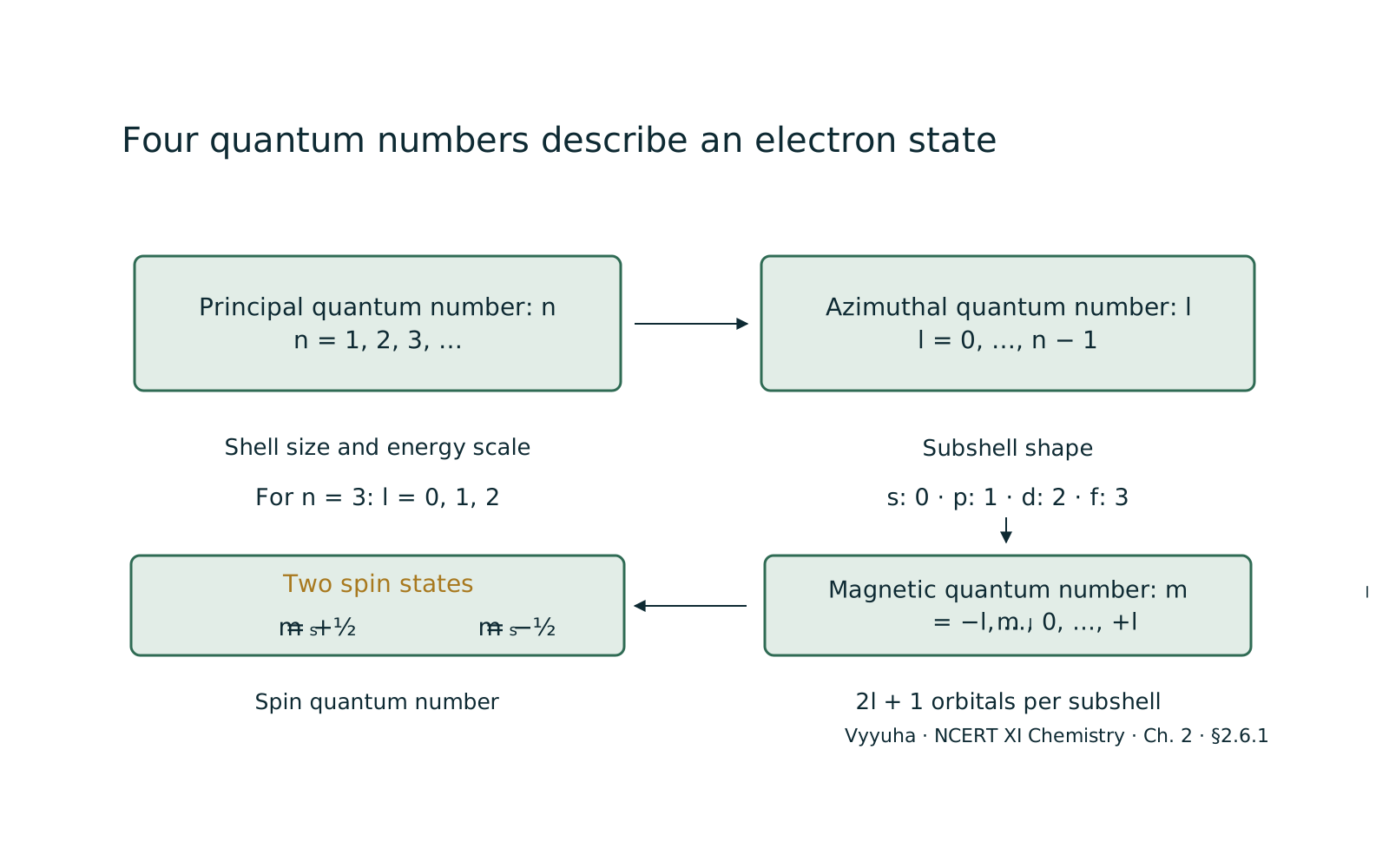
Detailed Explanation
The quantum mechanical model of the atom, primarily based on the Schrödinger wave equation, revolutionized our understanding of electron behavior. Unlike the Bohr model, which described electrons in fixed orbits, the quantum mechanical model uses wave functions () to describe the probability of finding an electron in a particular region of space, defining what we call an atomic orbital.
The solutions to the Schrödinger equation for a hydrogen atom naturally yield a set of quantum numbers that characterize these orbitals and the electrons within them. Among these, the Azimuthal and Magnetic Quantum Numbers play critical roles in defining the shape and spatial orientation of atomic orbitals.
Conceptual Foundation: Origin from Schrödinger Equation
When the Schrödinger equation is solved for a single electron in a central potential (like the hydrogen atom), the wave function can be separated into radial and angular parts. The angular part of the solution gives rise to the Azimuthal and Magnetic Quantum Numbers. These numbers are not arbitrary but emerge directly from the mathematical constraints imposed on the wave function to be physically meaningful (e.g., single-valued, continuous, finite).
The Azimuthal Quantum Number ($l$)
Also known as the orbital angular momentum quantum number or subsidiary quantum number, is intrinsically linked to the angular momentum of the electron. In classical physics, an orbiting particle possesses angular momentum. In quantum mechanics, this angular momentum is quantized, meaning it can only take specific discrete values. The magnitude of the orbital angular momentum is given by the formula:
Key Principles and Values:
- Range of $l$ — For a given Principal Quantum Number , the possible values of range from to . This means that for , can only be . For , can be or . For , can be or , and so on.
- Subshell Designation — Each value of corresponds to a specific type of subshell, which is denoted by a letter:
* : s-subshell (from 'sharp') * : p-subshell (from 'principal') * : d-subshell (from 'diffuse') * : f-subshell (from 'fundamental') * Higher values () correspond to g, h, etc., subshells, though these are rarely encountered in typical atomic chemistry.
- Orbital Shape — The primary physical significance of is that it determines the shape of the atomic orbital.
* **s-orbitals ()**: These are spherically symmetrical. The electron probability density is highest at the nucleus and decreases with distance, but it's uniform in all directions. As increases (e.
g., 1s, 2s, 3s), the s-orbital becomes larger and contains radial nodes. * **p-orbitals ()**: These have a dumbbell shape, with two lobes on opposite sides of the nucleus and a nodal plane passing through the nucleus.
There are three p-orbitals for any given . * **d-orbitals ()**: These have more complex shapes, typically cloverleaf-like (four lobes) or a dumbbell with a donut shape around the middle.
There are five d-orbitals for any given . * **f-orbitals ()**: These are even more complex, with multiple lobes, and there are seven f-orbitals for any given .
- Energy within a Shell — In multi-electron atoms, the energy of an orbital within a given principal shell () is also influenced by . For a given , orbitals with lower values generally have lower energy (e.g., , ). This is due to varying degrees of penetration and shielding effects, where electrons in orbitals with lower values penetrate closer to the nucleus, experiencing less shielding and thus a stronger effective nuclear charge.
The Magnetic Quantum Number ($m_l$)
Also known as the orbital magnetic quantum number, describes the spatial orientation of an atomic orbital. It quantizes the component of the orbital angular momentum along a specific direction, conventionally taken as the z-axis. The z-component of angular momentum is given by .
Key Principles and Values:
- Range of $m_l$ — For a given value of , the possible integer values of range from through to . This means there are possible values of for a given .
- Number of Orbitals in a Subshell — The number of values directly corresponds to the number of distinct orbitals within a given subshell. For example:
* If (s-subshell), can only be . There is s-orbital. * If (p-subshell), can be . There are p-orbitals (e.g., ). * If (d-subshell), can be . There are d-orbitals. * If (f-subshell), can be . There are f-orbitals.
- Spatial Orientation — Each unique value corresponds to a specific orientation of the orbital in three-dimensional space. For instance, the three p-orbitals () are identical in shape and energy but are oriented along the x, y, and z axes, respectively. Similarly, the five d-orbitals have specific orientations, such as and .
- Degeneracy — In the absence of an external magnetic field, all orbitals within a given subshell (i.e., having the same and values but different values) are degenerate, meaning they have the same energy. For example, the three orbitals () are degenerate.
Real-World Applications and NEET-Specific Angle
- Atomic Structure and Periodicity — Understanding and is fundamental to constructing electron configurations, which explain the chemical properties and periodic trends of elements. The filling of subshells () dictates the block an element belongs to in the periodic table.
- Spectroscopy — The selection rules for atomic transitions (e.g., in atomic emission or absorption spectroscopy) are governed by changes in quantum numbers, including . For instance, for an electron to absorb or emit a photon, its value must change by ().
- Zeeman Effect — The magnetic quantum number gets its name from the Zeeman effect. When an atom is placed in an external magnetic field, the degeneracy of orbitals with the same but different values is lifted. The external magnetic field interacts with the orbital magnetic moment of the electron, causing orbitals with different spatial orientations ( values) to have slightly different energies. This leads to the splitting of spectral lines into multiple closely spaced lines, providing direct experimental evidence for the existence of .
- Molecular Bonding — The shapes and orientations of atomic orbitals (determined by and ) are critical for understanding how atoms form chemical bonds. Overlap of specific orbitals (e.g., s-s, s-p, p-p) leads to sigma and pi bonds, and the geometry of molecules is directly related to the hybridization of these orbitals.
Common Misconceptions
- $n$ determines energy, $l$ determines shape, $m_l$ determines orientation. — While largely true, remember that in multi-electron atoms, also influences energy due to penetration and shielding. For hydrogen, energy depends only on .
- Orbitals are fixed paths. — Orbitals are not fixed paths like planetary orbits; they represent regions of space where the probability of finding an electron is high. The electron's exact position and momentum cannot be simultaneously known (Heisenberg's Uncertainty Principle).
- $l$ values start from 1. — No, values start from . This is a common mistake, especially when relating to .
- $m_l$ values are always positive. — No, values range from to , including .
In summary, the Azimuthal and Magnetic Quantum Numbers provide the crucial details about the spatial distribution and orientation of electrons within an atom, moving beyond simple energy levels to describe the intricate architecture of atomic orbitals. This understanding is foundational for all of chemistry.
Often confused with
Side-by-side differences the NEET paper likes to test.
| Aspect | Azimuthal and Magnetic Quantum Numbers | Principal Quantum Number ($n$) |
|---|---|---|
| Symbol | $l$ | $n$ |
| Determines | Orbital shape, subshell type, magnitude of orbital angular momentum | Main energy level, average distance from nucleus, primary energy of electron |
| Allowed Values | Integers from $0$ to $n-1$ | Positive integers ($1, 2, 3, \ldots$) |
| Number of Values | $n$ possible values for a given $n$ | No direct limit, but higher $n$ means higher energy |
| Impact on Energy (Multi-electron atoms) | Influences energy within a shell (e.g., $2s < 2p$) | Primary determinant of energy |
The Azimuthal Quantum Number () refines the description provided by the Principal Quantum Number (). While defines the overall energy shell and approximate size, delves into the specific subshell within that shell, dictating the orbital's shape and contributing to its energy in multi-electron atoms. Essentially, gives the 'floor' of the electron, and specifies the 'type of apartment' on that floor, each with a distinct shape and subtle energy difference.
Why it is tested: NEET relevance: Understanding the interplay between $n$ and $l$ is crucial for predicting electron configurations, orbital energies, and explaining the periodic table's structure. Questions often involve identifying allowed quantum number sets or determining the number of orbitals/electrons in a given shell/subshell based on $n$ and $l$.
| Aspect | Azimuthal and Magnetic Quantum Numbers | Magnetic Quantum Number ($m_l$) |
|---|---|---|
| Symbol | $l$ | $m_l$ |
| Determines | Orbital shape, subshell type, magnitude of orbital angular momentum | Spatial orientation of an orbital, z-component of orbital angular momentum |
| Allowed Values | Integers from $0$ to $n-1$ | Integers from $-l$ to $+l$ (including $0$) |
| Number of Values | $n$ possible values for a given $n$ | $(2l+1)$ possible values for a given $l$ |
| Physical Effect | Defines s, p, d, f subshells and their characteristic shapes | Distinguishes individual orbitals within a subshell (e.g., $p_x, p_y, p_z$), responsible for Zeeman effect |
The Azimuthal Quantum Number () defines the fundamental shape of a subshell, while the Magnetic Quantum Number () specifies how those shapes are oriented in three-dimensional space. For instance, tells us we have a p-subshell with a dumbbell shape, but tells us there are three such dumbbell-shaped orbitals, each pointing along a different axis. describes the 'type' of orbital, whereas describes its 'direction'.
Why it is tested: NEET relevance: Distinguishing between $l$ and $m_l$ is crucial for understanding orbital degeneracy, the number of orbitals in a subshell, and how external magnetic fields can affect atomic energy levels. Questions often test the ability to correctly assign quantum numbers to specific orbitals or determine the total number of orbitals/electrons based on these values.
Questions students ask
6 answered on this topic.
What is the primary difference between the Azimuthal and Magnetic Quantum Numbers?
The Azimuthal Quantum Number () primarily describes the shape of an atomic orbital and defines the subshell (s, p, d, f) an electron occupies. It also determines the magnitude of the orbital angular momentum.
In contrast, the Magnetic Quantum Number () describes the spatial orientation of an orbital within a given subshell. For example, defines a p-subshell with a dumbbell shape, while distinguish the three p-orbitals () by their orientation along the axes.
How do the values of $l$ and $m_l$ relate to the Principal Quantum Number ($n$)?
The values of are constrained by . For a given , can take any integer value from up to . This means that for , only is possible. For , can be or . The values of are, in turn, constrained by . For a given , can take any integer value from through to . This hierarchical relationship () ensures that the quantum numbers consistently describe the electron's state.
Why are there different shapes for s, p, d, and f orbitals?
The different shapes arise from the mathematical solutions to the angular part of the Schrödinger wave equation, which are characterized by the Azimuthal Quantum Number (). Each value corresponds to a unique angular probability distribution.
For (s-orbitals), the angular probability is uniform, leading to a spherical shape. For (p-orbitals), the angular probability is concentrated along specific axes, resulting in dumbbell shapes.
Higher values lead to more complex angular distributions and thus more intricate orbital shapes.
What is the significance of the $(2l+1)$ rule for $m_l$?
The rule signifies the number of degenerate orbitals within a specific subshell (defined by ). Each unique integer value of from to corresponds to a distinct spatial orientation for an orbital. Therefore, gives the total count of these distinct orientations, which are the individual orbitals that make up that subshell. For example, for (p-subshell), there are orbitals ().
Can an electron have $n=2$ and $l=2$?
No, an electron cannot have and . The rule for the Azimuthal Quantum Number states that can only take integer values from to . If , the maximum possible value for is . Therefore, for , only (2s subshell) and (2p subshell) are allowed. An subshell (a d-subshell) only becomes possible when (e.g., 3d, 4d, etc.).
How does an external magnetic field affect the magnetic quantum number?
An external magnetic field interacts with the orbital magnetic moment of an electron, which is associated with its orbital angular momentum. This interaction causes orbitals with different spatial orientations (i.
e., different values) to experience slightly different energies. This phenomenon is known as the Zeeman effect. Consequently, the degeneracy of orbitals within a subshell (which normally have the same energy) is lifted, and spectral lines associated with electron transitions split into multiple lines, each corresponding to a specific value.