Principal Quantum Number
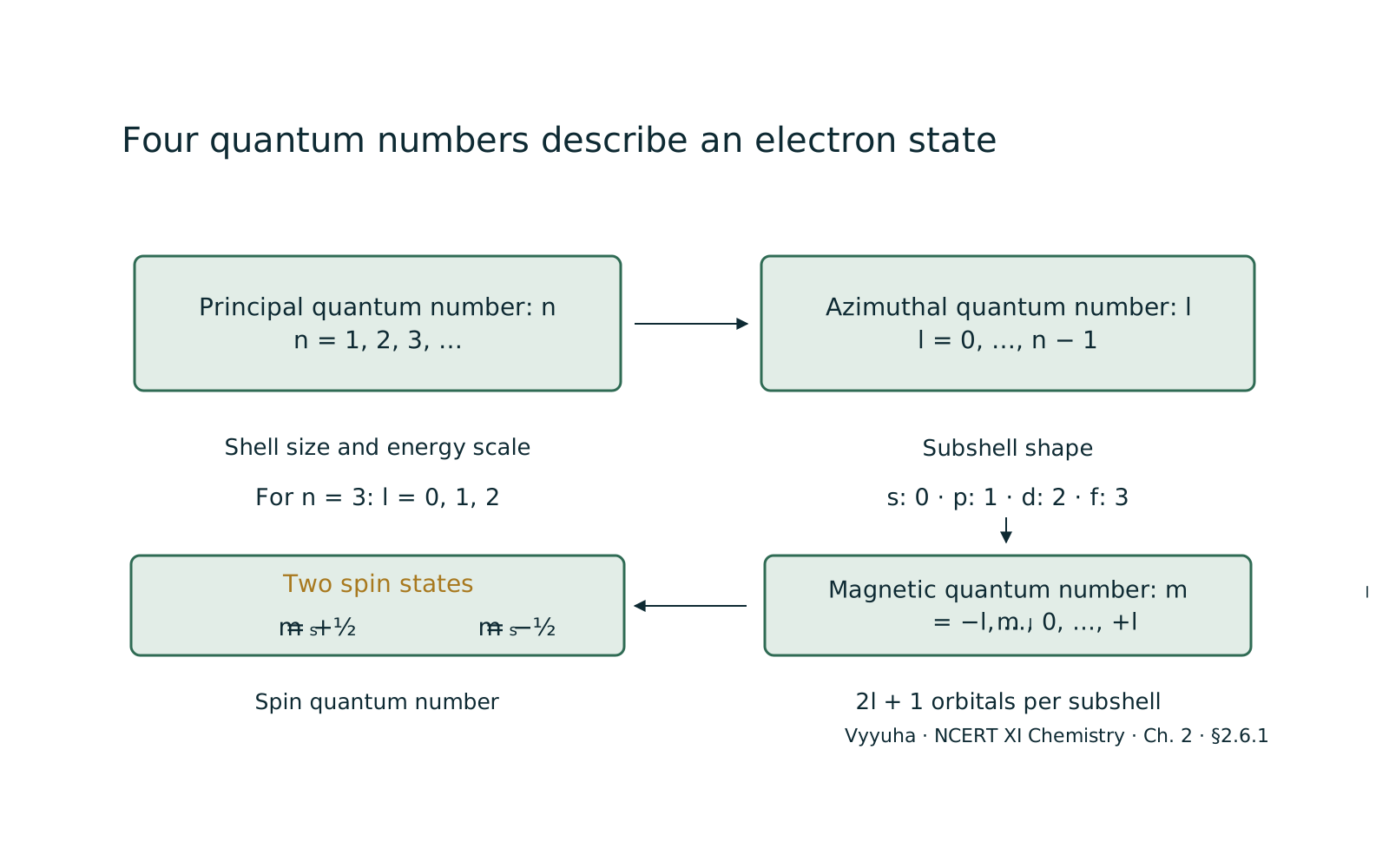
The Principal Quantum Number, denoted by 'n', is one of the four quantum numbers used to describe the unique quantum state of an electron in an atom. It is a positive integer () that primarily dictates the main energy level or shell in which an electron resides. A higher value of 'n' signifies a higher energy level, a larger average distance of the electron from the nucleus, an…
Quick Summary
The Principal Quantum Number, 'n', is a fundamental integer () that defines an electron's main energy level or 'shell' within an atom. It is the primary determinant of an electron's energy and the average size of the orbital it occupies.
Higher 'n' values correspond to higher energy, larger orbitals, and greater average distance from the nucleus. For a hydrogenic atom, energy is given by , showing an inverse square dependence on 'n'.
Each shell (K for , L for , M for ) can accommodate a maximum of electrons, distributed among orbitals. While 'n' dictates energy and size, the shape of an orbital is determined by the azimuthal quantum number 'l'.
Understanding 'n' is crucial for predicting atomic properties and electron configurations.
Full explanation
The Principal Quantum Number (PQN), symbolized as 'n', is the first and most fundamental of the four quantum numbers that collectively describe the unique quantum state of an electron in an atom. Its introduction marked a significant departure from classical mechanics, providing a quantized framework for understanding electron behavior within atomic orbitals.
\n\nConceptual Foundation:\nBefore the advent of quantum mechanics, atomic models like Rutherford's planetary model failed to explain atomic stability and discrete emission spectra. Bohr's model, a semi-classical approach, introduced the concept of quantized energy levels, where electrons could only exist in specific, stable orbits without radiating energy.
Bohr assigned an integer 'n' to each orbit, directly correlating it with the electron's energy and distance from the nucleus. While Bohr's model was successful for hydrogen, it couldn't explain multi-electron atoms or the fine structure of spectral lines.
\n\nThe true quantum mechanical understanding of 'n' emerged from the solution of the Schrödinger wave equation. When the time-independent Schrödinger equation is solved for a hydrogenic atom (an atom with only one electron, like H, He, Li), three quantum numbers naturally arise from the mathematical solutions (wave functions): the principal quantum number (n), the azimuthal or angular momentum quantum number (l), and the magnetic quantum number (m_l).
The principal quantum number 'n' is directly associated with the radial part of the wave function, which describes the electron's probability distribution as a function of distance from the nucleus.\n\nKey Principles and Laws:\n1.
Quantization of Energy: The most direct implication of 'n' is the quantization of electron energy. For a hydrogenic atom, the energy of an electron in a given shell is primarily determined by 'n' and can be calculated using the formula:
18 \times 10^{-18}E_n$ becomes less negative, meaning the electron has higher energy and is less tightly bound to the nucleus.
\n2. Quantization of Size: 'n' also dictates the average size or radial extent of an electron's orbital. Higher 'n' values correspond to larger orbitals, meaning the electron spends more time, on average, further away from the nucleus.
This directly impacts the atomic radius. For hydrogenic atoms, the radius of the orbit is given by:
This shows a direct square dependence on 'n'.\n3. Allowed Values: The principal quantum number 'n' can only take positive integer values: . There is no upper limit in theory, but in practice, electrons in ground state atoms occupy shells up to or for the heaviest elements.
Each integer value of 'n' corresponds to a specific 'electron shell' or 'main energy level'. These shells are often designated by capital letters: K-shell for , L-shell for , M-shell for , N-shell for , and so on.
\n4. Number of Orbitals and Electrons per Shell: For a given principal quantum number 'n', the total number of subshells is equal to 'n'. The total number of orbitals within a shell is given by .
Since each orbital can accommodate a maximum of two electrons (according to Pauli's Exclusion Principle), the maximum number of electrons that can occupy a shell is . For example, for (L-shell), there are orbitals (one 2s and three 2p orbitals), and thus it can hold a maximum of electrons.
\n\nDerivations (Conceptual):\nThe principal quantum number 'n' arises naturally from the boundary conditions imposed on the wave function when solving the Schrödinger equation in spherical coordinates.
The radial part of the wave function, , depends on 'n' and 'l'. The quantization of energy and size are direct consequences of these mathematical solutions, which restrict the possible values of 'n' to positive integers.
\n\nReal-World Applications:\n* Spectroscopy: The discrete lines observed in atomic emission and absorption spectra are direct evidence of quantized energy levels determined by 'n'. When an electron transitions between two energy levels (e.
g., from to ), it emits or absorbs a photon of specific energy, corresponding to a specific wavelength of light. This forms the basis of various analytical techniques. \n* Periodic Table: The arrangement of elements in the periodic table is fundamentally linked to the principal quantum number.
Elements in the same period (row) generally have their outermost electrons in the same principal energy shell. The filling of electron shells and subshells, guided by 'n' and other quantum numbers, explains the recurring chemical properties of elements.
\n* Chemical Reactivity: The number of electrons in the outermost shell (valence shell), determined by the highest 'n' value occupied by electrons, dictates an atom's chemical reactivity and bonding behavior.
Atoms tend to achieve a stable electron configuration, often by gaining, losing, or sharing electrons in their valence shell.\n\nCommon Misconceptions:\n* 'n' determines all properties: While 'n' is primary, it doesn't solely determine all electron properties.
The azimuthal quantum number 'l' defines the shape of the orbital, and the magnetic quantum number 'm_l' defines its orientation. All four quantum numbers are needed for a complete description.\n* Orbitals are fixed paths: Quantum mechanics describes orbitals as regions of probability where an electron is most likely to be found, not as definite, planetary-like orbits.
\n* Energy levels are equally spaced: The energy difference between successive shells () decreases as 'n' increases. For example, the energy gap between and is much larger than between and .
\n\nNEET-Specific Angle:\nNEET questions on the Principal Quantum Number often test its fundamental implications: \n1. Energy and Size: Questions might ask which electron has higher energy or occupies a larger orbital based on its 'n' value.
\n2. Number of Orbitals/Electrons: Calculations involving (number of orbitals) and (maximum electrons) for a given shell are common. \n3. Shell Designation: Identifying the shell (K, L, M, etc.
) corresponding to a given 'n'. \n4. Allowed Values: Simple questions about the permissible values of 'n'. \n5. Relationship with other Quantum Numbers: Understanding that 'n' limits the possible values of 'l' (l can range from 0 to ).
\n6. Ionization Energy: How 'n' affects the ease of removing an electron. A higher 'n' means the electron is further from the nucleus and less tightly bound, requiring less energy to remove. \nMastering these aspects is crucial for scoring well on quantum number questions in NEET.
Key Concepts
The Principal Quantum Number 'n' is the primary factor determining an electron's energy level. As 'n'…
The Principal Quantum Number 'n' directly influences the average distance of an electron from the nucleus,…
The Principal Quantum Number 'n' dictates the total number of subshells, orbitals, and maximum electrons…
Often confused with
Side-by-side differences the NEET paper likes to test.
| Aspect | Principal Quantum Number | Azimuthal Quantum Number (l) |
|---|---|---|
| Symbol | n | l |
| Primary Property Described | Main energy level/shell, orbital size, electron energy | Shape of the orbital, orbital angular momentum, subshell |
| Allowed Values | Positive integers: $1, 2, 3, \dots$ | Integers from $0$ to $n-1$ |
| Shell/Subshell Designation | K, L, M, N shells | s, p, d, f subshells |
| Dependence | Independent (fundamental) | Dependent on 'n' (l cannot be greater than $n-1$) |
The Principal Quantum Number 'n' dictates the electron's main energy level and the overall size of the orbital, essentially defining the electron shell. It takes positive integer values ().
In contrast, the Azimuthal Quantum Number 'l' describes the shape of the orbital and the subshell (s, p, d, f) within a given shell. Its values range from to , meaning 'l' is directly limited by 'n'.
While 'n' gives the general location and energy, 'l' provides more specific details about the orbital's geometry.
Why it is tested: NEET relevance: Understanding the distinct roles of 'n' and 'l' is crucial for correctly assigning quantum numbers, predicting orbital properties, and interpreting electron configurations. Questions often involve identifying valid sets of quantum numbers or relating them to orbital characteristics.
Questions students ask
5 answered on this topic.
What is the primary significance of the Principal Quantum Number (n)?
The Principal Quantum Number (n) primarily determines two crucial aspects of an electron's state in an atom: its main energy level and the average size or radial extent of the orbital it occupies. A higher 'n' value indicates a higher energy level, meaning the electron is less tightly bound to the nucleus.
It also signifies a larger orbital, implying the electron is, on average, further away from the nucleus. This fundamental role makes 'n' central to understanding atomic structure and electron behavior.
What are the allowed values for the Principal Quantum Number?
The Principal Quantum Number 'n' can only take positive integer values, starting from 1. So, and so on. There are no fractional or zero values allowed for 'n'. Each integer value corresponds to a distinct electron shell or main energy level, often designated by capital letters like K (for ), L (for ), M (for ), etc.
How does 'n' relate to the number of orbitals and electrons in a shell?
For a given principal quantum number 'n', the total number of orbitals within that shell is given by . For example, if , there are orbitals (one 2s and three 2p orbitals). Since each orbital can hold a maximum of two electrons (due to the Pauli Exclusion Principle), the maximum number of electrons that can occupy a shell is . So, for , the L-shell can hold a maximum of electrons.
Does 'n' affect the shape of an orbital?
No, the Principal Quantum Number 'n' does not directly determine the shape of an orbital. The shape of an orbital is determined by the Azimuthal (or Angular Momentum) Quantum Number, 'l'. For instance, all s-orbitals (l=0) are spherical, p-orbitals (l=1) are dumbbell-shaped, and d-orbitals (l=2) have more complex shapes, regardless of their 'n' value. 'n' primarily influences the size and energy of these orbitals.
Why is the energy of an electron negative according to the formula $E_n = -R_H \frac{Z^2}{n^2}$?
The negative sign in the energy formula indicates that the electron is bound to the nucleus. This means energy must be supplied to remove the electron from the atom (i.e., to ionize it). By convention, an electron infinitely far from the nucleus and at rest is considered to have zero energy.
Any electron within the atom is at a lower energy state than this 'free' electron, hence its energy is negative. As 'n' increases, the energy becomes less negative, approaching zero, signifying that the electron is less tightly bound and closer to being free.
Revise in 30 seconds
- Symbol: — 'n'\n- Allowed Values: Positive integers ()\n- Primary Role: Determines main energy level (shell) and orbital size.\n- Energy: Higher 'n' = higher energy (less stable). For H-atom: .\n- Size: Higher 'n' = larger orbital (further from nucleus). For H-atom: .\n- Shell Names: (K), (L), (M), (N).\n- Number of Orbitals in a Shell: \n- Maximum Electrons in a Shell: \n- Relation to 'l': can range from to .
Nice Elephants Sing Out Loudly: \nN - Principal Quantum Number\nE - Energy (main determinant)\nS - Size (main determinant)\nO - Orbitals ( per shell)\nL - Limits 'l' ()