Shapes of Atomic Orbitals — Explained
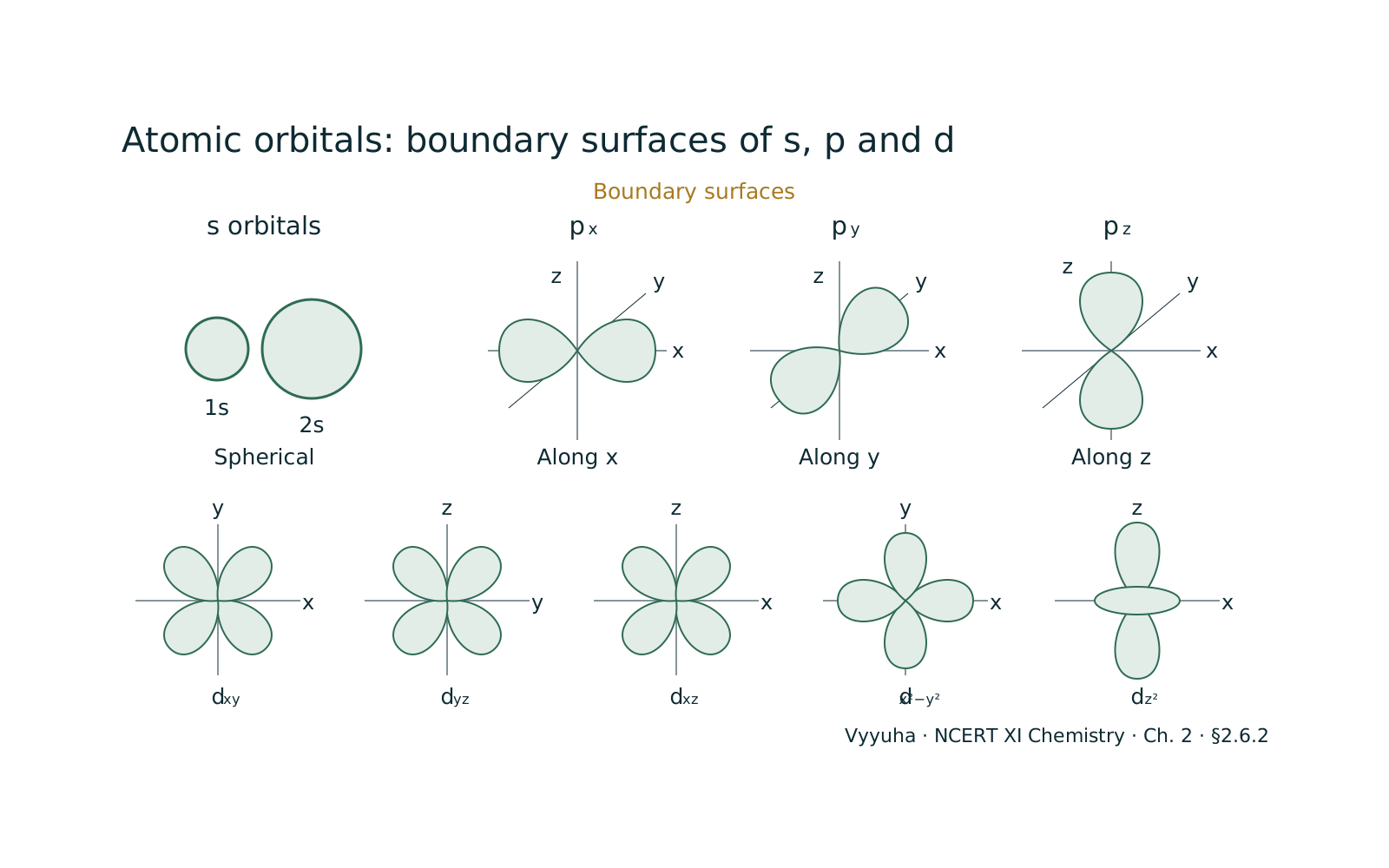
Detailed Explanation
The concept of atomic orbitals is central to understanding the electronic structure of atoms, which in turn dictates their chemical behavior. Unlike the classical Bohr model, which depicted electrons orbiting the nucleus in fixed, planetary paths, the quantum mechanical model, primarily based on the Schrödinger wave equation, describes electrons as having wave-particle duality.
This means electrons do not follow definite trajectories but exist as probability distributions in three-dimensional space around the nucleus. These probability distributions, when visualized, give rise to the characteristic shapes of atomic orbitals.
Conceptual Foundation: Quantum Numbers and Orbital Shapes
The shapes of atomic orbitals are intrinsically linked to the set of quantum numbers that arise from the solutions to the Schrödinger equation for a hydrogen atom (or hydrogen-like atoms). These quantum numbers define the energy, size, shape, and spatial orientation of an orbital:
- Principal Quantum Number ($n$) — This integer () primarily determines the energy level and the average distance of the electron from the nucleus. Higher values correspond to higher energy levels and larger orbitals. It also dictates the maximum number of subshells and orbitals within a shell.
- Azimuthal (Angular Momentum) Quantum Number ($l$) — This integer () defines the shape of the orbital and the angular momentum of the electron. Each value of corresponds to a specific type of subshell, denoted by letters:
* s subshell (spherical shape) * p subshell (dumbbell shape) * d subshell (cloverleaf or double dumbbell shape) * f subshell (more complex shapes)
- Magnetic Quantum Number ($m_l$) — This integer () determines the spatial orientation of the orbital. For a given , there are possible values of , meaning orbitals of that shape, each oriented differently in space.
- Spin Quantum Number ($m_s$) — This describes the intrinsic angular momentum (spin) of an electron, having values of or . It does not affect the shape or energy of the orbital but is crucial for electron configuration (Pauli's exclusion principle).
Key Principles: Probability Density and Boundary Surfaces
The wave function, , itself doesn't have a direct physical meaning. However, its square, , represents the probability density of finding an electron at a particular point in space. When we talk about the 'shape' of an orbital, we are actually referring to a boundary surface that encloses a region of space (typically 90-95% probability) where the electron is most likely to be found.
It's crucial to understand that the electron can, in principle, be found anywhere outside this boundary surface, but the probability decreases rapidly with distance from the nucleus.
Types of Atomic Orbitals and Their Shapes
1. s-Orbitals ($l=0$)
- Shape — Spherically symmetrical. This means the probability of finding the electron is the same in all directions at a given distance from the nucleus. The nucleus is at the center of the sphere.
- Orientation — Only one orientation () for any s-orbital.
- Size — The size of an s-orbital increases with increasing principal quantum number . So, a orbital is larger than a orbital, and a orbital is larger than a orbital.
- Nodes — s-orbitals have spherical nodes (radial nodes). The number of radial nodes is given by . For an s-orbital (), the number of radial nodes is . For example, has radial nodes, has radial node, and has radial nodes.
2. p-Orbitals ($l=1$)
- Shape — Dumbbell-shaped. Each p-orbital consists of two lobes on opposite sides of the nucleus, with a nodal plane passing through the nucleus.
- Orientation — For , there are possible orientations, corresponding to . These are conventionally designated as and orbitals, oriented along the x, y, and z axes, respectively.
- Nodal Plane — Each p-orbital has one planar node (angular node) passing through the nucleus. The number of angular nodes is equal to . For p-orbitals, , so there is one angular node. The total number of nodes is .
- Energy — All three p-orbitals () within a given principal shell () have the same energy in an isolated atom (degenerate).
3. d-Orbitals ($l=2$)
- Shape — More complex. For , there are possible orientations, corresponding to . These are:
* : These three orbitals have a cloverleaf shape, with four lobes lying in the xy, yz, and zx planes, respectively, and the lobes are oriented between the axes. * : This orbital also has a cloverleaf shape, but its four lobes lie along the x and y axes. * : This orbital has a unique shape, consisting of two lobes along the z-axis and a donut-shaped ring (torus) around the z-axis in the xy-plane.
- Nodal Planes — Each d-orbital has two planar nodes (angular nodes) passing through the nucleus (). The total number of nodes is .
- Energy — All five d-orbitals within a given principal shell () are degenerate in an isolated atom.
4. f-Orbitals ($l=3$)
- Shape — Even more complex. For , there are possible orientations. These shapes are very intricate, often described as having eight lobes or combinations of lobes and nodal cones. They are rarely depicted in introductory chemistry due to their complexity.
- Nodal Planes — Each f-orbital has three planar nodes (angular nodes) passing through the nucleus (). The total number of nodes is .
Nodes in Atomic Orbitals
A node is a region in space where the probability of finding an electron is zero (). There are two types of nodes:
- Radial Nodes (Spherical Nodes) — These are spherical surfaces where the probability of finding an electron is zero. The number of radial nodes is given by the formula: .
- Angular Nodes (Planar Nodes) — These are planes or conical surfaces passing through the nucleus where the probability of finding an electron is zero. The number of angular nodes is given by the formula: .
Total Number of Nodes: The sum of radial and angular nodes is .
Example: For a orbital:
- .
- Number of radial nodes = .
- Number of angular nodes = .
- Total nodes = .
Real-World Applications and Significance
Understanding orbital shapes is fundamental to various chemical concepts:
- Chemical Bonding — The overlap of atomic orbitals forms molecular orbitals, which are the basis of chemical bonds (e.g., sigma and pi bonds). The directional nature of p and d orbitals explains the specific geometries of molecules.
- Molecular Geometry — VSEPR theory and hybridization, which predict molecular shapes, rely on the spatial orientation of atomic orbitals.
- Spectroscopy — The absorption and emission of light by atoms involve transitions of electrons between different energy levels and orbitals. The selection rules for these transitions are related to the angular momentum of the orbitals.
- Periodic Trends — The filling of orbitals explains the periodic properties of elements, such as ionization energy, electron affinity, and atomic size.
Common Misconceptions
- Orbitals are not fixed paths — Electrons do not 'orbit' the nucleus in a classical sense. Orbitals represent probability distributions, not trajectories.
- Boundary surfaces are not rigid walls — The boundary surface enclosing 90-95% probability is a convention. The electron can still be found outside this region, albeit with lower probability.
- Shapes are static — The shapes are time-averaged representations of electron density. The electron is constantly moving and its exact position cannot be known simultaneously with its momentum (Heisenberg's Uncertainty Principle).
- Energy and shape are independent — While primarily determines energy and primarily determines shape, they are interconnected. For multi-electron atoms, the energy of an orbital also depends on its shape (due to electron-electron repulsion and shielding effects, leading to the rule).
NEET-Specific Angle
For NEET, a strong grasp of:
- The relationship between quantum numbers () and orbital characteristics (size, shape, orientation).
- The specific shapes of and orbitals, including their spatial orientations.
- The concept and calculation of radial, angular, and total nodes.
- The degeneracy of orbitals in hydrogenic atoms versus multi-electron atoms.
- How orbital shapes influence bonding and molecular geometry.
Questions often involve identifying the correct orbital shape, determining the number of nodes for a given orbital, or relating quantum numbers to the number of orbitals of a specific type. Visualizing these shapes is key to solving many problems.
Often confused with
Side-by-side differences the NEET paper likes to test.
| Aspect | Shapes of Atomic Orbitals | Orbit (Bohr Model) |
|---|---|---|
| Concept | Atomic Orbital (Quantum Mechanical Model) | Orbit (Bohr Model) |
| Nature | Three-dimensional region of space, probabilistic (electron cloud) | Two-dimensional, fixed circular path (definite trajectory) |
| Electron Location | Region of high probability of finding an electron | Electron moves in a precisely defined path |
| Shape | Defined by azimuthal quantum number ($l$), can be spherical, dumbbell, cloverleaf, etc. | Always circular |
| Orientation | Defined by magnetic quantum number ($m_l$), can have different spatial orientations | No concept of spatial orientation beyond the plane of the circle |
| Maximum Electrons | Each orbital can hold a maximum of 2 electrons (Pauli's exclusion principle) | Each orbit (shell) can hold $2n^2$ electrons |
| Foundation | Based on Schrödinger wave equation, Heisenberg's Uncertainty Principle | Based on classical mechanics and Planck's quantum hypothesis (for energy quantization) |
The distinction between an 'orbit' and an 'orbital' is fundamental to understanding the evolution of atomic models. Bohr's 'orbit' was a classical, deterministic concept, picturing electrons moving in fixed, circular paths.
In stark contrast, the quantum mechanical 'orbital' is a probabilistic, three-dimensional region where an electron is most likely to be found, reflecting its wave-like nature and the inherent uncertainty in its position and momentum.
Orbitals possess specific shapes and spatial orientations dictated by quantum numbers, which are absent in the simpler Bohr model. This shift from definite paths to probability distributions is a cornerstone of modern chemistry.
Why it is tested: For NEET, understanding this difference is crucial for conceptual clarity. Questions often test the fundamental principles of the quantum mechanical model versus the Bohr model, especially regarding electron localization and the nature of electron energy states. It helps in distinguishing correct statements about atomic structure and avoiding common misconceptions.
Questions students ask
5 answered on this topic.
What is the fundamental difference between an 'orbit' in the Bohr model and an 'orbital' in the quantum mechanical model?
In the Bohr model, an 'orbit' was a well-defined, two-dimensional circular path around the nucleus where an electron was assumed to travel with a fixed energy. It was a classical concept. In contrast, an 'orbital' in the quantum mechanical model is a three-dimensional region of space around the nucleus where there is a high probability (typically 90-95%) of finding an electron.
It's a probabilistic concept, arising from the wave nature of electrons, and does not imply a fixed path. Orbitals describe electron density distributions rather than precise trajectories.
Why do s-orbitals have a spherical shape, while p-orbitals are dumbbell-shaped?
The shape of an orbital is determined by the azimuthal quantum number (). For s-orbitals, . This means the electron's angular momentum is zero, and its probability distribution is independent of direction, leading to a spherical shape.
For p-orbitals, . This non-zero angular momentum gives the electron a directional preference, resulting in a dumbbell shape with two lobes oriented along a specific axis and a nodal plane passing through the nucleus.
The mathematical solutions to the Schrödinger equation for these values naturally yield these distinct probability distributions.
How do the quantum numbers $n, l,$ and $m_l$ specifically determine the characteristics of an orbital?
The principal quantum number () dictates the main energy level and the average size of the orbital; higher means larger size and higher energy. The azimuthal quantum number () determines the shape of the orbital (s, p, d, f) and the number of angular nodes ().
The magnetic quantum number () specifies the spatial orientation of the orbital in three-dimensional space. For example, describes a orbital (dumbbell shape), and indicates its three possible orientations ().
Together, they uniquely define an orbital's properties.
What are nodes in atomic orbitals, and how do we calculate their number?
Nodes are regions within an orbital where the probability of finding an electron is zero. There are two types: radial (spherical) nodes and angular (planar or conical) nodes. Radial nodes are spherical surfaces, and their number is calculated as .
Angular nodes are planes or cones passing through the nucleus, and their number is equal to . The total number of nodes in any orbital is given by . For instance, a orbital () has radial nodes and angular nodes, totaling nodes.
Why are $d_{x^2-y^2}$ and $d_{z^2}$ orbitals shaped differently from $d_{xy}, d_{yz}, d_{zx}$?
All five d-orbitals () are solutions to the Schrödinger equation, but their spatial orientations and exact probability distributions differ. The orbitals have four lobes lying between the respective axes.
However, the orbital has its four lobes lying directly along the x and y axes. The orbital is unique; it has two lobes along the z-axis and a donut-shaped ring (torus) in the xy-plane.
This difference arises from the specific mathematical forms of their wave functions, which dictate how the electron density is distributed in space for different values when .