Atomic Models

Atomic models are theoretical constructs developed over time to describe the internal structure of an atom, aiming to explain its observed properties and behavior. These models have evolved significantly as new experimental evidence emerged, leading to a progressively more refined understanding of the atom's composition, the arrangement of its subatomic particles (protons, neutrons, and electrons)…
Quick Summary
Atomic models are conceptual frameworks describing the internal structure of atoms, evolving with experimental evidence. Dalton's theory (early 1800s) proposed atoms as indivisible spheres, a foundational but limited idea.
J.J. Thomson's 'plum pudding' model (1904) depicted a positive sphere with embedded electrons, explaining electron discovery but failing to account for concentrated positive charge. Ernest Rutherford's nuclear model (1911), based on his alpha-scattering experiment, established a tiny, dense, positively charged nucleus with electrons orbiting it.
While revolutionary, it couldn't explain atomic stability or line spectra. Niels Bohr's model (1913) introduced quantization, stating electrons occupy specific, stable energy levels without radiating energy.
Transitions between these levels explain discrete line spectra. Bohr's model successfully predicted hydrogen's spectrum but failed for multi-electron atoms and couldn't explain phenomena like the Zeeman effect.
Each model built upon its predecessor, addressing limitations and contributing to our current quantum mechanical understanding.
Full explanation
The concept of the atom, the fundamental building block of matter, has undergone a profound evolution over centuries. Early philosophical ideas gave way to scientific theories, which in turn were refined and replaced as experimental techniques advanced. Atomic models are essentially theoretical frameworks that attempt to describe the internal structure of an atom, explaining its observed chemical and physical properties.
Conceptual Foundation: The Need for Atomic Models
Before the 19th century, the atom was largely a philosophical concept. The groundbreaking work of John Dalton provided the first scientific atomic theory, establishing the atom as a distinct, indivisible particle.
However, subsequent discoveries, particularly the identification of subatomic particles like electrons and protons, necessitated a more detailed understanding of the atom's internal architecture. How were these charged particles arranged?
Why were atoms electrically neutral? Why did they emit light in specific patterns? These questions drove the development of various atomic models.
1. Dalton's Atomic Theory (1808)
Though not a 'model' in the sense of internal structure, Dalton's theory laid the groundwork for modern atomic theory. Its key postulates were:
- Matter consists of indivisible atoms.
- Atoms of the same element are identical in mass and properties.
- Atoms of different elements differ in mass and properties.
- Atoms combine in simple whole-number ratios to form compounds.
- Atoms cannot be created or destroyed in a chemical reaction.
Limitations: Dalton's theory failed to account for the existence of subatomic particles (electrons, protons, neutrons), isotopes, and isobars. It also couldn't explain the nature of chemical bonding or the electrical properties of matter.
2. Thomson's Plum Pudding Model (1904)
Following the discovery of the electron by J.J. Thomson in 1897, it became clear that atoms were not indivisible. Thomson proposed a model to incorporate this new subatomic particle.
Postulates:
- An atom consists of a uniformly positively charged sphere.
- Negatively charged electrons are embedded within this sphere, much like plums in a pudding or seeds in a watermelon.
- The total positive charge is equal to the total negative charge, making the atom electrically neutral.
Experimental Evidence: The discovery of cathode rays (streams of electrons) and their deflection by electric and magnetic fields provided evidence for the existence of negatively charged particles within atoms.
Limitations: Thomson's model could not explain the results of Rutherford's alpha-particle scattering experiment, which demonstrated a highly concentrated positive charge within the atom.
3. Rutherford's Nuclear Model (1911)
Ernest Rutherford, along with his students Hans Geiger and Ernest Marsden, conducted the famous alpha-particle scattering experiment, which revolutionized the understanding of atomic structure.
Alpha-Particle Scattering Experiment:
- Setup: — A beam of high-energy alpha particles (helium nuclei, ) was directed at a thin gold foil (approximately 100 nm thick). A circular fluorescent zinc sulfide screen was placed around the foil to detect the scattered alpha particles.
- Observations:
Most alpha particles passed straight through the gold foil undeflected (about 99.9%). A small fraction of alpha particles were deflected by small angles. * A very few alpha particles (about 1 in 20,000) were deflected by large angles, even bouncing back almost 180 degrees.
- Conclusions:
The 'straight-through' observation implied that most of the atom is empty space. The small deflections suggested a concentrated positive charge within the atom, repelling the positively charged alpha particles. * The large-angle deflections and 'bouncing back' indicated that the positive charge and almost the entire mass of the atom are concentrated in an extremely small, dense region at the center, which Rutherford called the 'nucleus'.
Postulates of Rutherford's Nuclear Model:
- The atom consists of a tiny, dense, positively charged nucleus at its center, which contains nearly all the mass of the atom.
- The electrons revolve around the nucleus in circular paths, similar to planets orbiting the sun. This is why it's also called the 'planetary model'.
- The nucleus is surrounded by electrons, and the total negative charge of the electrons balances the total positive charge of the nucleus, making the atom electrically neutral.
- Most of the space in an atom is empty.
Limitations:
- Stability of the atom: — According to classical electromagnetic theory (Maxwell's equations), an accelerating charged particle (like an electron orbiting the nucleus) should continuously radiate energy. If electrons continuously lose energy, their orbits should shrink, and they should spiral into the nucleus, causing the atom to collapse. This contradicts the observed stability of atoms.
- Line spectra: — Rutherford's model could not explain the discrete line spectra observed for elements. If electrons could orbit at any radius, they should emit a continuous spectrum of light, not distinct lines.
- Electron distribution: — It did not specify the distribution of electrons around the nucleus or their energy levels.
4. Bohr's Model of the Hydrogen Atom (1913)
Niels Bohr addressed the limitations of Rutherford's model by incorporating Planck's quantum theory. His model was specifically developed for the hydrogen atom and hydrogen-like species (single-electron systems).
Postulates:
- Quantized Orbits (Stationary States): — Electrons revolve around the nucleus in specific, fixed circular orbits called stationary states or energy levels. While in these orbits, electrons do not radiate energy, and their energy remains constant.
- Quantized Angular Momentum: — An electron can only revolve in those orbits for which its angular momentum is an integral multiple of , where is Planck's constant. Mathematically, , where (principal quantum number).
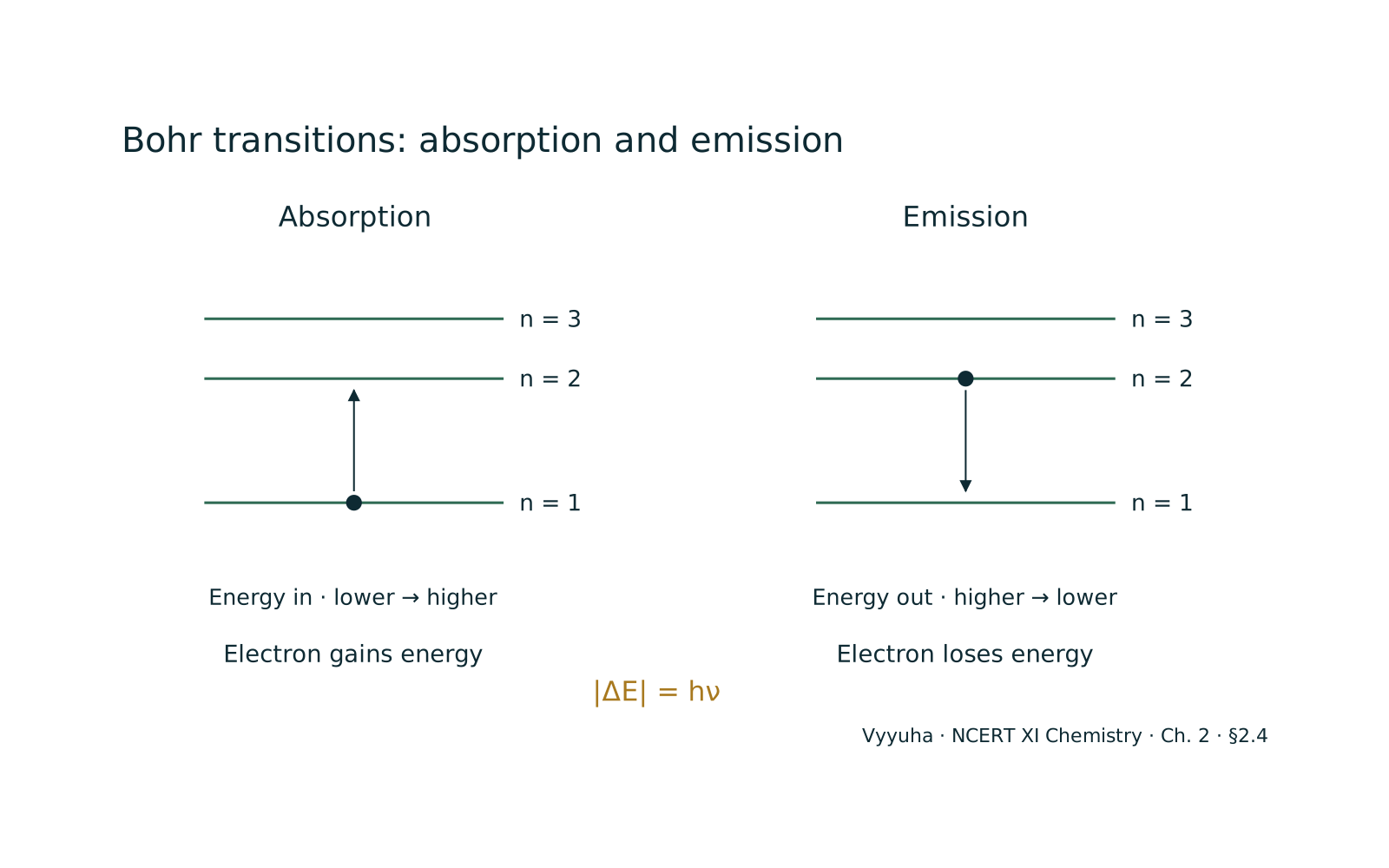
- Energy Transitions: — Energy is absorbed or emitted only when an electron jumps from one stationary orbit to another. When an electron jumps from a lower energy orbit () to a higher energy orbit (), energy is absorbed. When it jumps from a higher energy orbit () to a lower energy orbit (), energy is emitted in the form of a photon. The energy of the emitted/absorbed photon is given by , where is the frequency of the radiation.
Derivations (Key Formulas for Hydrogen-like Species):
Bohr's model successfully derived expressions for the radius of the orbit, the energy of the electron, and the velocity of the electron.
- **Radius of the orbit ():**
- **Energy of the electron in the orbit ():**
- **Velocity of the electron in the orbit ():**
Explanation of Line Spectra (Rydberg Formula):
When an electron transitions from an outer orbit () to an inner orbit (), the energy difference is emitted as a photon. The wavenumber () of the emitted radiation is given by:
Limitations of Bohr's Model:
- Applicability: — It could only explain the spectra of hydrogen and hydrogen-like species (e.g., ) that have only one electron. It failed for multi-electron atoms.
- Intensity of spectral lines: — It could not explain the relative intensities of the spectral lines.
- Fine structure: — It could not explain the splitting of spectral lines into finer lines when observed with high-resolution spectroscopes.
- Zeeman and Stark effects: — It failed to explain the splitting of spectral lines in the presence of a magnetic field (Zeeman effect) or an electric field (Stark effect).
- Wave nature of electron: — It did not consider the wave nature of electrons (de Broglie hypothesis) or the Heisenberg Uncertainty Principle.
- Orbits vs. Orbitals: — It treated electrons as particles moving in well-defined circular orbits, which is inconsistent with the quantum mechanical view of electron probability distributions (orbitals).
NEET-Specific Angle
For NEET, a deep understanding of Bohr's model is crucial. You must be able to:
- Recall the postulates of each model.
- Understand the experimental evidence that led to each model (especially Rutherford's experiment).
- Identify the limitations of each model, as these often lead to the development of the next model.
- Apply Bohr's formulas for radius, energy, and velocity to solve numerical problems for hydrogen and hydrogen-like species. Pay close attention to units (eV, J, Å, m).
- Use the Rydberg formula to calculate wavelengths or wavenumbers for spectral transitions in hydrogen. Remember the series (Lyman , Balmer , etc.).
- Distinguish between the classical and quantum mechanical approaches to atomic structure, understanding why Bohr's quantization was a revolutionary step.
While the quantum mechanical model is the most accurate, Bohr's model provides a foundational understanding of quantized energy levels and is frequently tested for its quantitative aspects.
Key Concepts
This experiment was pivotal in disproving Thomson's model and establishing the nuclear model. Rutherford…
Bohr's model introduced the revolutionary idea that electrons in an atom can only occupy specific, discrete…
Bohr's model successfully explained the various spectral series observed for hydrogen, which arise from…
Often confused with
Side-by-side differences the NEET paper likes to test.
| Aspect | Atomic Models | Rutherford's Nuclear Model vs. Bohr's Atomic Model |
|---|---|---|
| Electron Behavior | Electrons orbit the nucleus like planets, with no restriction on their orbits or energy. | Electrons exist only in specific, discrete, stable orbits (stationary states) with quantized energy and angular momentum. |
| Energy Emission/Absorption | Electrons continuously radiate energy while orbiting, leading to atomic instability (classical view). | Electrons do not radiate energy in stationary orbits. Energy is absorbed/emitted only during transitions between orbits. |
| Atomic Stability | Could not explain the stability of atoms (electrons should spiral into the nucleus). | Successfully explained atomic stability by postulating non-radiating stationary states. |
| Spectral Explanation | Predicted a continuous spectrum for atoms, contradicting observed line spectra. | Successfully explained the discrete line spectra of hydrogen and hydrogen-like species. |
| Quantization | Did not incorporate the concept of energy or angular momentum quantization. | Introduced the revolutionary concept of quantized energy levels and angular momentum. |
| Applicability | A general model for any atom, but fundamentally flawed in its classical approach. | Primarily successful for single-electron systems (hydrogen and hydrogen-like ions). |
Rutherford's model was a crucial step, establishing the nuclear nature of the atom, but it was based on classical physics and failed to explain atomic stability and discrete spectra. Bohr's model, building on Rutherford's, incorporated quantum principles by postulating quantized electron orbits and energy levels.
This allowed it to successfully explain the stability of atoms and the line spectra of hydrogen, marking a significant departure from classical physics. However, Bohr's model still had limitations, particularly with multi-electron atoms and more complex spectral phenomena, paving the way for the quantum mechanical model.
Why it is tested: For NEET, understanding these differences is critical for conceptual questions. Students must grasp why Bohr's model was an improvement over Rutherford's, specifically regarding atomic stability and spectral explanation, and also recognize the limitations that led to further developments.
Questions students ask
5 answered on this topic.
What was the main drawback of Thomson's atomic model?
The primary drawback of Thomson's 'plum pudding' model was its inability to explain the results of Rutherford's alpha-particle scattering experiment. Thomson's model predicted that alpha particles should pass through the atom with minimal deflection, as the positive charge was thought to be uniformly distributed.
However, Rutherford's experiment showed that a small fraction of alpha particles were deflected at large angles, and some even bounced back, indicating a highly concentrated positive charge and mass at the atom's center, which was inconsistent with Thomson's diffuse positive sphere.
Why did Rutherford's model fail to explain the stability of an atom?
Rutherford's model proposed that electrons orbit the nucleus like planets around the sun. According to classical electromagnetism, any charged particle undergoing acceleration (like an electron in a circular orbit) should continuously emit electromagnetic radiation, thereby losing energy.
If electrons continuously lost energy, their orbits would gradually shrink, and they would eventually spiral into the positively charged nucleus, causing the atom to collapse. Since atoms are known to be stable, Rutherford's model could not account for this fundamental observation.
What is the significance of Bohr's quantization of angular momentum?
Bohr's postulate that an electron's angular momentum is quantized () was revolutionary. It meant that electrons could not orbit the nucleus at just any radius or with any energy.
Instead, they were restricted to specific, discrete orbits, each corresponding to a fixed energy level. This quantization directly explained why atoms emit and absorb light only at specific wavelengths (line spectra) and why electrons do not continuously lose energy and spiral into the nucleus, thus addressing the stability issue of Rutherford's model.
How did Bohr's model explain the line spectrum of hydrogen?
Bohr's model explained the hydrogen line spectrum by proposing that electrons exist in discrete energy levels or stationary orbits. When an electron absorbs energy, it jumps from a lower energy level to a higher one (excitation).
When it returns to a lower energy level, it emits the excess energy as a photon of light. The energy difference between these specific energy levels is fixed, resulting in photons of specific frequencies (and thus specific wavelengths), which correspond to the observed discrete lines in the hydrogen spectrum.
The Rydberg formula derived from Bohr's model accurately predicted these wavelengths.
What are the main limitations of Bohr's atomic model?
Despite its successes, Bohr's model had several limitations. It could only explain the spectra of single-electron species like hydrogen, , and , failing for multi-electron atoms.
It couldn't explain the fine structure of spectral lines (splitting into multiple lines), the Zeeman effect (splitting in a magnetic field), or the Stark effect (splitting in an electric field). Furthermore, it treated electrons as particles in well-defined orbits, contradicting the later understanding of their wave-particle duality and the Heisenberg Uncertainty Principle, which suggests electron positions cannot be precisely known.
Revise in 30 seconds
- Dalton: — Indivisible spheres.
- Thomson: — Plum pudding, positive sphere with embedded electrons.
- Rutherford: — Nuclear model, tiny dense positive nucleus, electrons orbit. Limitations: stability, line spectra.
- Bohr: — Quantized orbits (), no energy radiation in orbits.
- Angular Momentum: —
- Radius: — Å
- Energy: — eV
- Velocity: — m/s
- Rydberg Formula: —
- Spectral Series: — Lyman (, UV), Balmer (, Visible), Paschen (, IR).
To remember the order of atomic models and their key features:
Don't Think Really Bad Questions
- Dalton: Divisible? No, Dense spheres.
- Thomson: Tiny electrons in Thick positive pudding.
- Rutherford: Really empty space, Really small nucleus, Really unstable orbits.
- Bohr: Bound electrons in Basic quantized orbits, Bright line spectra.
- Quantum: Quite complex, Quantum numbers, Quantum mechanics (the next step beyond Bohr).