General Characteristics
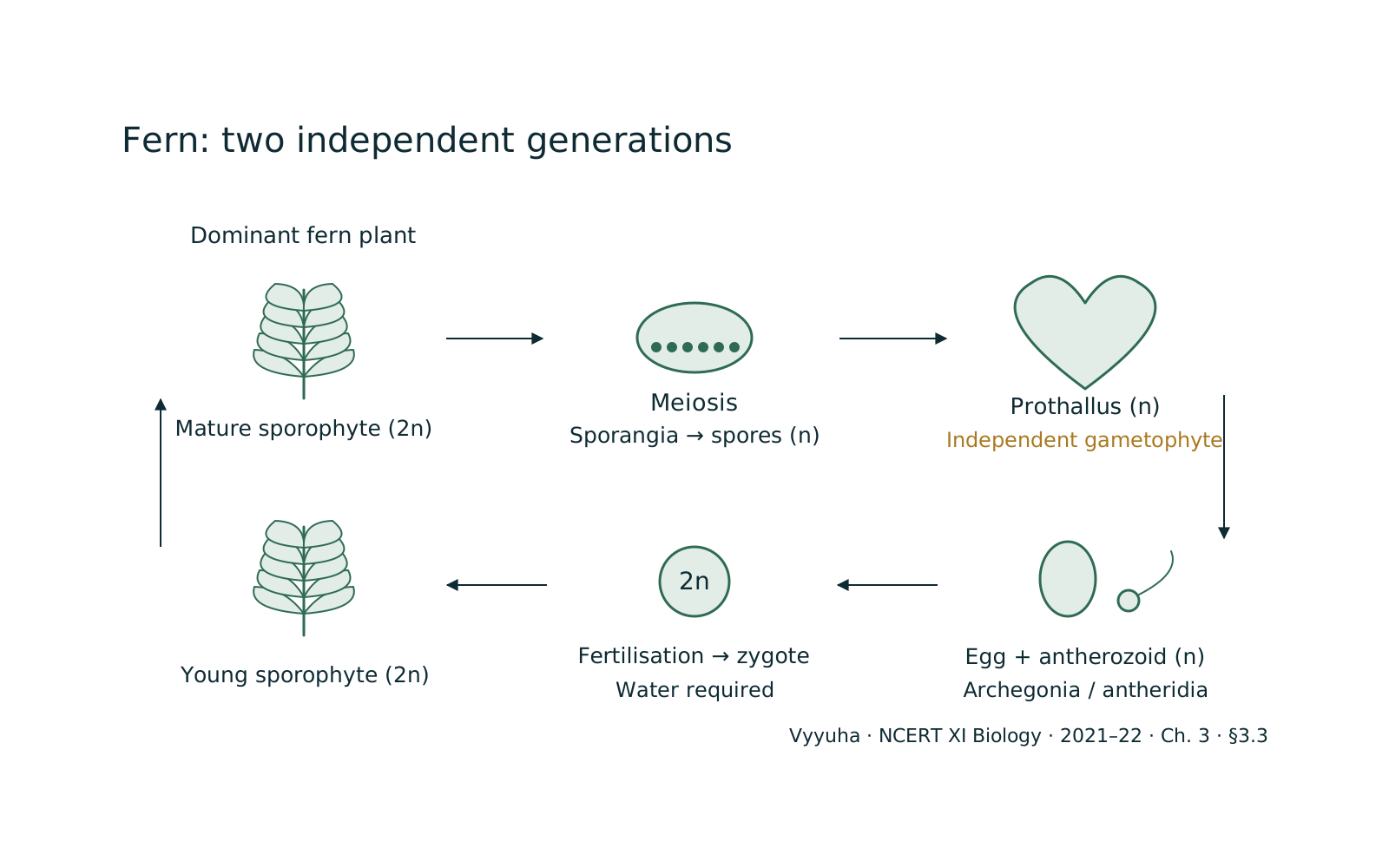
Pteridophytes represent a pivotal group in plant evolution, characterized as the first true terrestrial plants to possess a well-differentiated vascular system, comprising xylem and phloem. This innovation allowed for efficient transport of water and nutrients, enabling them to grow taller and colonize diverse land habitats more effectively than their bryophyte ancestors. Their life cycle exhibits…
Quick Summary
Pteridophytes, commonly known as ferns and their allies, represent the first group of terrestrial plants to evolve a true vascular system (xylem and phloem). This innovation allowed them to grow taller and colonize land more effectively than non-vascular bryophytes.
The dominant plant body is the diploid sporophyte, which is well-differentiated into true roots, stems (often rhizomes), and leaves (fronds). Reproduction occurs via spores produced in sporangia, often clustered into sori on the underside of fronds.
These spores germinate into small, independent, haploid gametophytes (prothalli) that bear antheridia (male) and archegonia (female). Fertilization is water-dependent, as flagellated male gametes require water to swim to the egg.
Pteridophytes exhibit alternation of generations, with a dominant sporophyte and a smaller, independent gametophyte. They can be homosporous (producing one type of spore) or heterosporous (producing microspores and megaspores), with heterospory being an important evolutionary step towards seed habit.
Full explanation
Pteridophytes, commonly known as ferns and their allies, represent a crucial evolutionary step in the plant kingdom. They are often referred to as 'vascular cryptogams' because they possess a well-developed vascular system (xylem and phloem) but reproduce by spores rather than seeds.
This group includes diverse forms such as horsetails (Equisetum), clubmosses (Lycopodium, Selaginella), and true ferns (Dryopteris, Adiantum). Their general characteristics provide a comprehensive understanding of their biology and ecological significance.
Conceptual Foundation: The Pioneers of Terrestrial Vascular Life
Pteridophytes are the first truly terrestrial plants to evolve a vascular system. Before them, bryophytes (mosses and liverworts) were the dominant land plants, but their lack of vascular tissue limited their size and restricted them to very moist environments.
The evolution of xylem for water transport and phloem for nutrient transport was a revolutionary adaptation. It allowed Pteridophytes to grow taller, access more sunlight, and explore drier habitats, although their reproductive cycle still retains a dependency on water.
Key Principles and Structural Features:
- Habitat: — Pteridophytes typically thrive in cool, damp, shady places, though some are adapted to sandy soils or even aquatic conditions. Their requirement for water during fertilization is a primary reason for this preference.
- Plant Body (Sporophyte Dominance): — The dominant and conspicuous plant body in Pteridophytes is the sporophyte. This is a diploid (2n) phase, meaning its cells contain two sets of chromosomes. Unlike bryophytes where the gametophyte is dominant, here the sporophyte is independent, photosynthetic, and well-differentiated into true roots, stems, and leaves.
* Roots: These are typically adventitious roots, meaning they arise from the stem rather than from a radicle. They anchor the plant and absorb water and minerals. * Stem: The stem can be either an upright aerial shoot or, more commonly, an underground rhizome.
Rhizomes are horizontal stems that help in vegetative propagation and storage. * Leaves (Fronds): Pteridophyte leaves are often called fronds. They can be small (microphylls) with a single vein, as seen in Lycopodium and Selaginella, or large (macrophylls) with a complex venation system, characteristic of true ferns.
Macrophylls are considered evolutionarily more advanced.
- Vascular Tissue: — The presence of xylem and phloem is the defining characteristic. Xylem conducts water and minerals, while phloem transports food. This efficient transport system allows for larger plant sizes and better adaptation to terrestrial life.
- Reproduction and Life Cycle (Alternation of Generations): — Pteridophytes exhibit a heteromorphic alternation of generations, where the sporophyte (diploid) and gametophyte (haploid) are morphologically distinct and independent.
* Sporophyte: The mature sporophyte produces spores by meiosis within specialized structures called sporangia. These sporangia are often grouped into sori (singular: sorus) on the underside of the leaves (fronds) in ferns, sometimes protected by a flap of tissue called an indusium.
* Spores: Spores are typically haploid (n). Upon germination in a suitable moist environment, a spore develops into a small, independent, photosynthetic gametophyte. * Gametophyte (Prothallus): The gametophyte is usually a small, multicellular, free-living, photosynthetic thalloid structure, often heart-shaped and green.
It bears the sex organs: * Antheridia: Male sex organs that produce flagellated antherozoids (sperms). * Archegonia: Female sex organs that produce a single egg. * Fertilization: Water is essential for the antherozoids to swim to the archegonia and fertilize the egg.
This water dependency is a major limiting factor for their distribution. * Zygote and Embryo: The fusion of sperm and egg forms a diploid zygote. The zygote develops into a multicellular embryo, which then matures into a new sporophyte, completing the cycle.
- Homospory vs. Heterospory:
* Homosporous Pteridophytes: Most Pteridophytes are homosporous, meaning they produce only one type of spore. This spore germinates to produce a bisexual gametophyte (prothallus) that bears both antheridia and archegonia (e.
g., most ferns, Lycopodium). * Heterosporous Pteridophytes: A significant evolutionary advancement seen in some Pteridophytes (e.g., Selaginella, Salvinia, Marsilea) is heterospory. They produce two different types of spores: * Microspores: Smaller spores that germinate to form male gametophytes (microprothalli), which bear only antheridia.
* Megaspores: Larger spores that germinate to form female gametophytes (macroprothalli), which bear only archegonia. This condition is considered a precursor to seed habit, as the female gametophyte is retained on the parent sporophyte for varying periods.
Evolutionary Significance and NEET-Specific Angle:
Pteridophytes are crucial for understanding plant evolution. They represent the transition from non-vascular to vascular plants and from a gametophyte-dominant to a sporophyte-dominant life cycle. The evolution of heterospory within this group is particularly important as it lays the groundwork for seed development in gymnosperms and angiosperms. NEET questions often focus on:
- Identifying the dominant phase (sporophyte).
- The presence and function of vascular tissue.
- The water requirement for fertilization.
- Distinguishing between homosporous and heterosporous forms and providing examples.
- The structure of sporangia, sori, and indusia.
- The characteristics of the gametophyte (prothallus).
Common Misconceptions:
- Confusing with Bryophytes: — Students often confuse Pteridophytes with Bryophytes. The key distinction is the presence of vascular tissue and a dominant sporophyte in Pteridophytes, which are absent in Bryophytes.
- Seed Plants: — Despite having a well-developed plant body, Pteridophytes are not seed plants. They reproduce by spores.
- Gametophyte Size: — The gametophyte is often overlooked or underestimated. While small, it is an independent, free-living, photosynthetic entity, unlike the dependent gametophyte in seed plants.
- Water Dependency: — While they have vascular tissue, the absolute requirement of external water for sperm motility means they are still restricted to moist habitats for successful reproduction, a point often missed.
Understanding these characteristics is fundamental for grasping the evolutionary journey of plants and for excelling in NEET biology.
Key Concepts
In Pteridophytes, the sporophyte (2n) is the main plant body you observe, like a fern. It's not just dominant…
Pteridophytes exhibit a clear alternation between a diploid sporophyte and a haploid gametophyte. What's…
Heterospory, seen in genera like *Selaginella* and *Salvinia*, is a critical evolutionary development. It…
Often confused with
Side-by-side differences the NEET paper likes to test.
| Aspect | General Characteristics | Bryophytes |
|---|---|---|
| Dominant Plant Body | Gametophyte (haploid, n) | Sporophyte (diploid, 2n) |
| Vascular Tissue | Absent (non-vascular) | Present (xylem and phloem) |
| Differentiation of Plant Body | Thalloid or poorly differentiated into stem-like, leaf-like structures; no true roots. | Well-differentiated into true roots, stem, and leaves. |
| Sporophyte Nature | Dependent on gametophyte for nutrition and support. | Independent and free-living. |
| Habitat Preference | Strictly moist and shady environments. | Mostly moist and shady, but can colonize slightly drier areas due to vascular tissue. |
| Examples | Mosses (Funaria), Liverworts (Marchantia) | Ferns (Dryopteris), Horsetails (Equisetum), Clubmosses (Lycopodium) |
The fundamental distinction between Bryophytes and Pteridophytes lies in their evolutionary advancements towards terrestrial life. Bryophytes represent an earlier, less adapted stage, characterized by a dominant gametophyte, absence of vascular tissue, and a sporophyte completely dependent on the gametophyte.
Pteridophytes, on the other hand, showcase a significant leap with their dominant, independent sporophyte, well-differentiated true organs, and the crucial development of a vascular system, enabling them to grow larger and explore more diverse habitats, though still tied to water for reproduction.
Why it is tested: For NEET, understanding these differences is crucial for questions on plant classification, evolutionary trends, and identifying key features of each group. Questions often test the dominant phase, presence/absence of vascular tissue, and the nature of the sporophyte and gametophyte in both groups. This comparison helps in placing Pteridophytes correctly in the evolutionary lineage of plants.
Questions students ask
5 answered on this topic.
What is the primary distinguishing feature of Pteridophytes compared to Bryophytes?
The most significant distinguishing feature of Pteridophytes from Bryophytes is the presence of a well-developed vascular system, consisting of xylem and phloem, in the sporophyte phase. This vascular tissue allows for efficient transport of water, minerals, and nutrients, enabling Pteridophytes to grow larger and colonize more diverse terrestrial habitats.
Bryophytes, on the other hand, are non-vascular and rely on simple diffusion for transport, limiting their size and restricting them to moist environments.
Why are Pteridophytes often called 'vascular cryptogams'?
Pteridophytes are termed 'vascular cryptogams' because they possess a true vascular system (xylem and phloem) for conduction, which makes them 'vascular.' The term 'cryptogams' refers to plants that reproduce by spores and do not produce seeds or flowers, meaning their reproductive organs are 'hidden' or inconspicuous compared to phanerogams (seed plants). This combination accurately describes their evolutionary position.
Explain the concept of sporophyte dominance in Pteridophytes.
Sporophyte dominance in Pteridophytes means that the diploid (2n) sporophyte generation is the larger, more complex, independent, and long-lived phase of the plant's life cycle. It is the familiar fern plant with true roots, stems, and leaves. The haploid (n) gametophyte, while independent, is typically small, short-lived, and less conspicuous. This represents a significant evolutionary shift from Bryophytes, where the gametophyte is the dominant phase.
What is the significance of heterospory in Pteridophytes?
Heterospory, the production of two different types of spores (microspores and megaspores), is a crucial evolutionary step observed in some Pteridophytes like Selaginella. Microspores develop into male gametophytes, and megaspores into female gametophytes.
This differentiation is considered a precursor to seed habit because it involves the retention of the megaspore (and subsequently the female gametophyte) within the sporangium on the parent sporophyte, providing protection and nourishment, a key feature of seed plants.
Why do Pteridophytes still require water for fertilization despite having vascular tissue?
Despite possessing a vascular system for efficient internal transport, Pteridophytes still require an external film of water for successful fertilization. This is because their male gametes (antherozoids) are flagellated and must swim through water to reach the non-motile egg within the archegonium. This dependency on water for gamete transfer is a primitive trait inherited from their algal ancestors and limits their distribution to moist environments.
Revise in 30 seconds
- First Vascular Plants: — Possess xylem and phloem.
- Dominant Phase: — Sporophyte (2n), independent, differentiated into true roots, stem, leaves.
- Gametophyte: — Prothallus (n), small, independent, photosynthetic, bears antheridia & archegonia.
- Reproduction: — By spores, produced in sporangia (often in sori).
- Fertilization: — Water-dependent (flagellated sperms).
- Homosporous: — Most ferns, Lycopodium (one type of spore, bisexual gametophyte).
- Heterosporous: — Selaginella, Salvinia (microspores male gametophyte; megaspores female gametophyte).
- Evolutionary Significance: — Bridge between bryophytes and seed plants; heterospory is precursor to seed habit.
To remember Pteridophyte characteristics: Plants That Evolved Roots, Independent Dominant Organisms, Producing Haploid Youngsters, Through External Swimming.