Stem Modifications
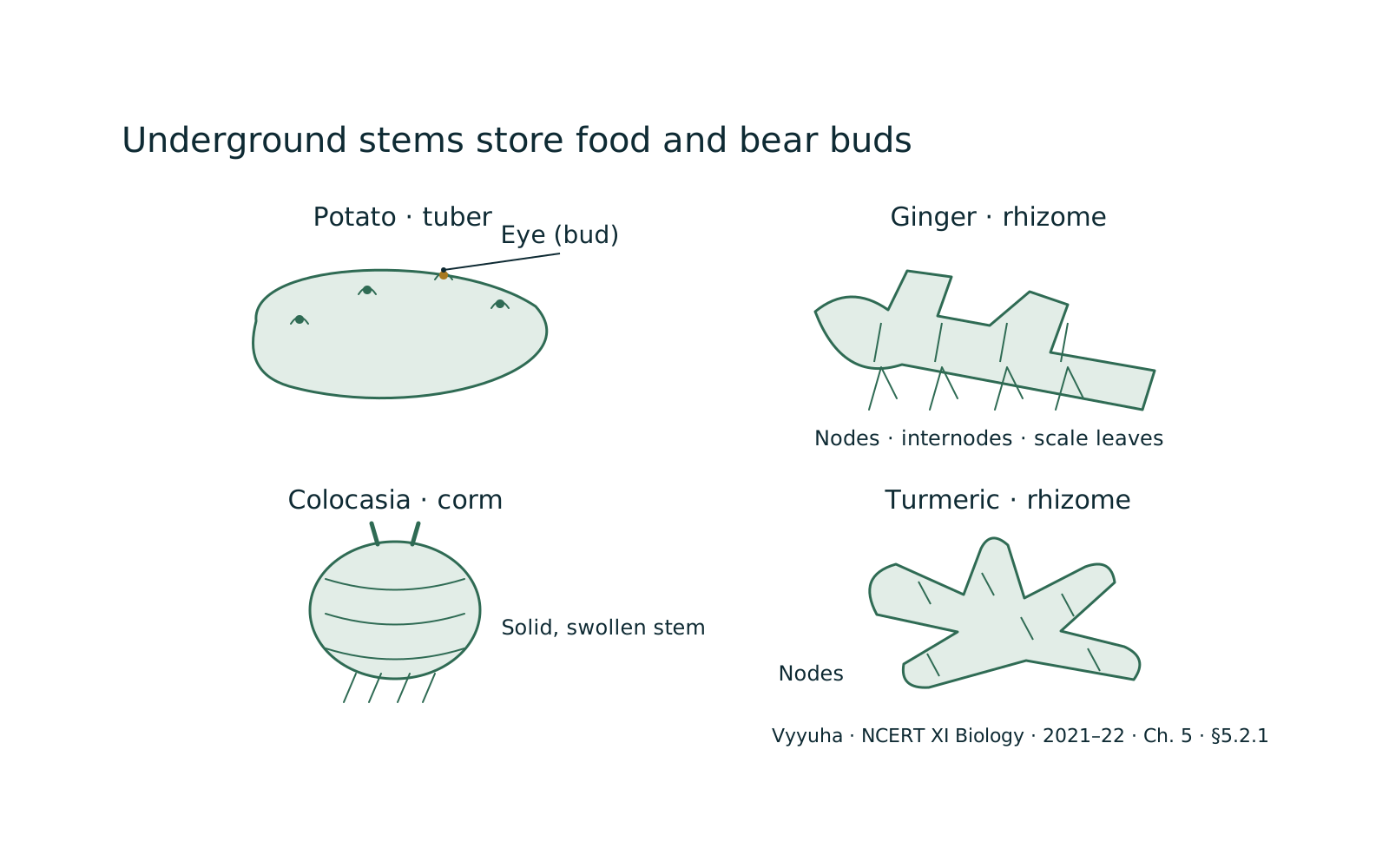
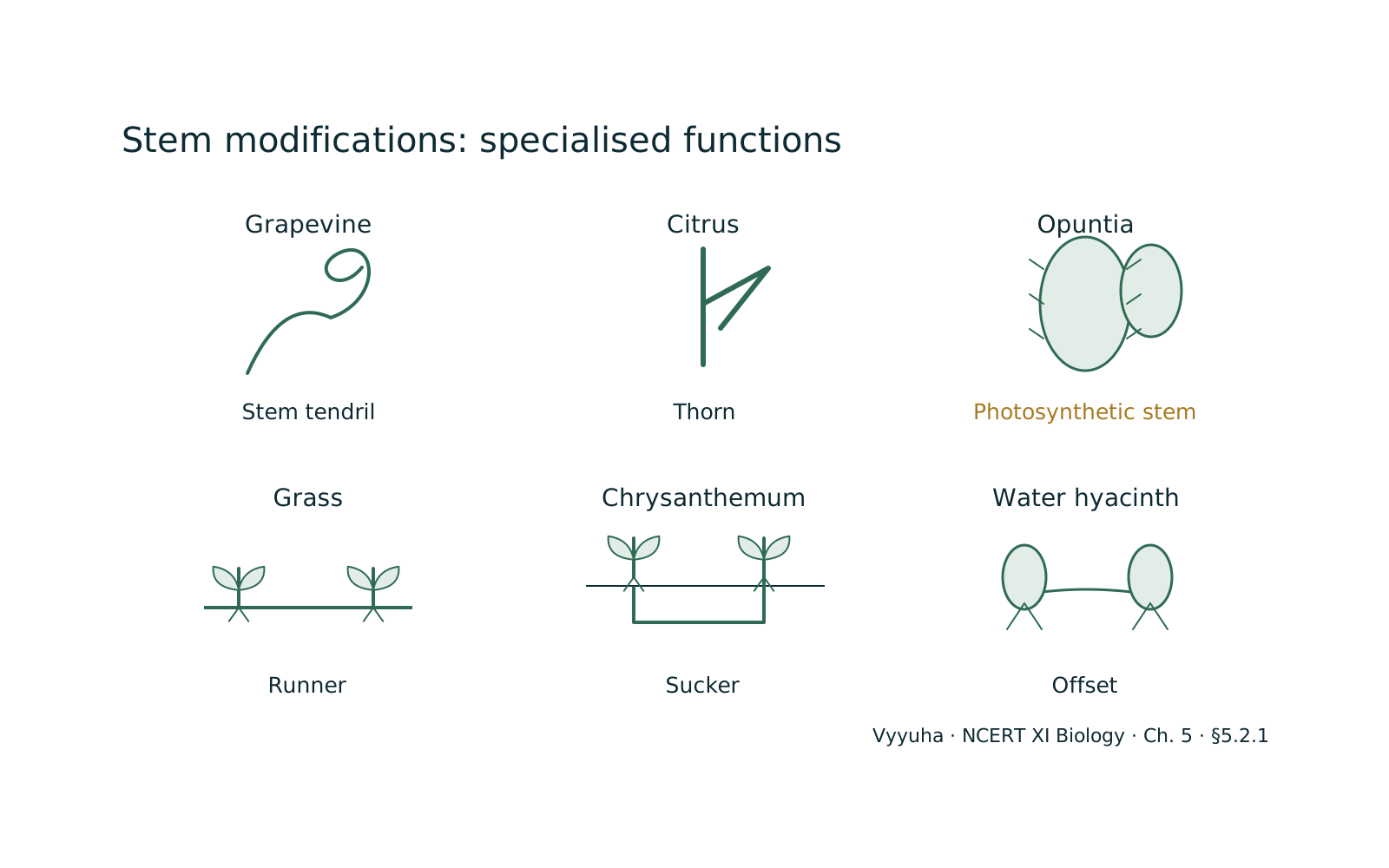
Stem modifications refer to the structural and functional alterations that stems undergo to perform specialized functions beyond their primary roles of support, conduction, and bearing leaves, flowers, and fruits. These adaptations are crucial for the plant's survival in diverse environmental conditions, enabling functions such as perennation, vegetative propagation, food storage, climbing, and pr…
Quick Summary
Stem modifications are structural changes in a plant's stem to perform specialized functions beyond its primary roles. These adaptations are vital for survival, propagation, and resource acquisition in diverse environments.
They are broadly categorized into three types: underground, subaerial, and aerial. Underground modifications like rhizomes (ginger), corms (Colocasia), tubers (potato), and bulbs (onion) primarily store food and facilitate perennation and vegetative propagation.
Subaerial modifications, including runners (grass), stolons (mint), suckers (banana), and offsets (water hyacinth), are mainly involved in rapid vegetative propagation. Aerial modifications encompass structures like stem tendrils (grapevine) for climbing, thorns (citrus) for protection, phylloclades (Opuntia) and cladodes (Asparagus) for photosynthesis, and bulbils (Agave) for vegetative reproduction.
Each modification retains characteristic stem features like nodes and internodes, even in altered forms, confirming their stem identity. Recognizing these adaptations and their specific examples is crucial for NEET.
Full explanation
The stem, a typically aerial and upright part of the plant, is remarkably plastic in its developmental potential, often undergoing profound structural and functional modifications to adapt to specific environmental pressures or to perform specialized tasks.
These modifications are crucial for survival, propagation, and resource acquisition, extending beyond the stem's primary roles of support, conduction, and bearing reproductive structures. We can broadly categorize stem modifications into three main types based on their location: underground, subaerial, and aerial.
I. Underground Stem Modifications
These stems grow beneath the soil surface, primarily serving functions like food storage and perennation (survival through unfavorable conditions) and vegetative propagation. Despite their subterranean location, they retain characteristic stem features such as nodes, internodes, scale leaves, and axillary buds.
- Rhizome:
* Description: A fleshy, non-green, usually prostrate (horizontal) underground stem that grows parallel to the soil surface. It possesses distinct nodes and internodes, with scale leaves at the nodes and axillary buds in their axils.
Adventitious roots typically arise from the lower surface of the nodes. * Function: Primarily stores food (starch, proteins) and acts as an organ of perennation, allowing the plant to survive adverse conditions.
It also facilitates vegetative propagation, as segments of the rhizome with buds can develop into new plants. * Examples: Ginger (Zingiber officinale), Turmeric (Curcuma longa), Canna, Ferns. * Adaptive Significance: Enables survival during dormancy and efficient clonal reproduction.
- Corm:
* Description: A condensed, swollen, spherical or flattened, unbranched underground stem that grows vertically. It is characterized by distinct nodes and internodes, covered by dry, membranous scale leaves.
Axillary buds are present at the nodes, and adventitious roots arise from its base. * Function: Stores food (starch) and water, serving as a perennating organ. New corms (cormels) can develop from axillary buds, aiding in vegetative propagation.
* Examples: Colocasia (Arvi), Gladiolus, Crocus (Saffron), Amorphophallus (Suran). * Adaptive Significance: Provides a compact storage unit for energy and water, allowing the plant to regrow rapidly when conditions become favorable.
- Tuber:
* Description: A swollen, fleshy, spherical or irregular tip of an underground stem branch. Unlike rhizomes and corms, tubers do not have adventitious roots directly arising from them (though the plant itself has roots).
They possess 'eyes,' which are actually nodes bearing one or more axillary buds and small scale leaves. * Function: Exclusively for food storage (starch) and vegetative propagation. Each 'eye' can sprout into a new plant.
* Examples: Potato (Solanum tuberosum). * Adaptive Significance: Highly efficient for storing large quantities of carbohydrates and for rapid asexual reproduction.
- Bulb:
* Description: A highly condensed, disc-shaped underground stem with a terminal bud and several fleshy, concentric scale leaves (modified leaves) that store food. Adventitious roots arise from the base of the disc-like stem.
The outer scale leaves are usually dry and protective (tunic). * Function: Primarily food storage and perennation. Lateral buds (cloves in garlic, bulbils in onion) can develop into new plants. * Examples: Onion (Allium cepa), Garlic (Allium sativum), Lily, Tulip.
* Adaptive Significance: Offers excellent protection and food reserves for survival and vegetative propagation, especially in plants that experience dormant periods.
II. Subaerial Stem Modifications
These stems grow partially above and partially below the ground, or creep along the soil surface. They are primarily involved in vegetative propagation and sometimes in perennation.
- Runner:
* Description: A slender, prostrate, long, and green stem that creeps horizontally on the soil surface. It develops adventitious roots and a rosette of leaves at each node. The internodes are typically long.
* Function: Rapid vegetative propagation, allowing the plant to spread quickly over a large area. * Examples: Grass (Cynodon dactylon), Oxalis, Strawberry (Fragaria). * Adaptive Significance: Enables efficient colonization of new ground and rapid spread, especially in open habitats.
- Stolon:
* Description: A slender lateral branch that arises from the base of the main stem, grows aerially for some distance, then arches downwards to touch the ground. At the point of contact, it develops adventitious roots and a new shoot, eventually forming a new plant.
* Function: Vegetative propagation. * Examples: Mint (Mentha), Jasmine, Colocasia (in some varieties). * Adaptive Significance: Allows for propagation over a slightly greater distance from the parent plant compared to runners, enabling exploration of new patches of soil.
- Sucker:
* Description: A lateral branch that originates from the underground part of the main stem (axillary bud), grows horizontally beneath the soil for some distance, and then emerges obliquely upwards to produce a new leafy shoot.
It is essentially an underground runner that grows upwards. * Function: Vegetative propagation and perennation. * Examples: Chrysanthemum, Pineapple, Banana (Musa), Bamboo. * Adaptive Significance: Provides a robust method of clonal reproduction, often forming dense clumps of plants, and allows the plant to survive by sending up new shoots from protected underground parts.
- Offset:
* Description: A short, thick, horizontal runner-like stem with one short internode, typically found in aquatic plants. It bears a rosette of leaves above and a cluster of adventitious roots below at its nodes.
* Function: Rapid vegetative propagation in aquatic environments. * Examples: Pistia (Water lettuce), Eichhornia (Water hyacinth). * Adaptive Significance: Enables extremely fast asexual reproduction, leading to rapid colonization of water bodies, which can sometimes be invasive.
III. Aerial Stem Modifications
These modifications occur on the aerial parts of the stem, adapting it for support, protection, photosynthesis, or vegetative propagation.
- Stem Tendril:
* Description: A slender, spirally coiled, sensitive, and leafless structure that helps the plant climb. It develops from an axillary bud or a terminal bud, confirming its stem origin. It coils around a support, providing anchorage.
* Function: Provides support for weak-stemmed plants to climb, allowing them to reach sunlight. * Examples: Cucumber (Cucumis), Pumpkin (Cucurbita), Watermelon, Grapevine (Vitis), Passion flower (Passiflora).
* Adaptive Significance: Allows plants to grow tall without investing in strong, woody stems, conserving energy and resources.
- Thorn:
* Description: A hard, woody, sharp, and pointed structure that develops from an axillary bud. It is a modified stem, not a modified leaf (spine) or stipule (prickle). Thorns are deeply embedded and difficult to detach.
* Function: Protection against herbivory (grazing animals) and sometimes helps in reducing transpiration (e.g., in desert plants). * Examples: Bougainvillea, Citrus (Lemon, Orange), Duranta.
* Adaptive Significance: A strong defensive mechanism against predators, enhancing survival in environments with high herbivore pressure.
- Phylloclade:
* Description: A flattened or cylindrical, succulent, green stem that has taken over the function of photosynthesis. True leaves are often reduced to spines or scales to minimize water loss. It has distinct nodes and internodes.
* Function: Photosynthesis (as leaves are reduced) and water storage (due to succulence). * Examples: Opuntia (Prickly pear cactus), Euphorbia (some species like E. tirucalli). * Adaptive Significance: A key adaptation for xerophytic (desert) plants, allowing them to photosynthesize while significantly reducing surface area for transpiration.
- Cladode:
* Description: Similar to a phylloclade but typically consists of only one or two internodes, appearing leaf-like. It is also green and performs photosynthesis. * Function: Photosynthesis. * Examples: Asparagus, Ruscus. * Adaptive Significance: Similar to phylloclades, but often found in plants where true leaves are small or scale-like, providing additional photosynthetic surface.
- Bulbil:
* Description: A fleshy, enlarged axillary bud that detaches from the parent plant and develops into a new plant. It is a specialized structure for vegetative propagation. * Function: Vegetative propagation. * Examples: Agave, Dioscorea (Yam), Oxalis (some species), Lily (some species). * Adaptive Significance: Allows for efficient asexual reproduction, especially in plants that may not produce viable seeds or need to spread quickly.
Understanding these diverse stem modifications highlights the incredible adaptability of plants and provides critical insights into their evolutionary strategies for survival and reproduction in varied ecological niches. For NEET aspirants, recognizing the specific examples and their corresponding modification types, along with the underlying adaptive reasons, is paramount.
Key Concepts
Both rhizomes and corms are underground stem modifications that primarily serve as storage organs for food…
Phylloclades and cladodes are both green, flattened or cylindrical stem modifications that have taken over…
These four subaerial stem modifications are all specialized for vegetative propagation, allowing plants to…
Often confused with
Side-by-side differences the NEET paper likes to test.
| Aspect | Stem Modifications | Thorn vs. Spine vs. Prickle |
|---|---|---|
| Morphological Origin | Thorn: Modified stem (axillary bud) | Spine: Modified leaf (whole leaf, leaflet, or stipule) |
| Structure & Attachment | Thorn: Woody, sharp, deeply embedded, difficult to detach | Spine: Sharp, can be woody or herbaceous, attached to leaf/stem |
| Examples | Thorn: Citrus, Bougainvillea, Duranta | Spine: Opuntia (leaf), Acacia (stipule), Berberis (leaf) |
| Vascular Connection | Thorn: Has vascular connection to the stem | Spine: Has vascular connection (as part of leaf) |
While thorns, spines, and prickles all serve as protective structures against herbivory, their developmental origins are fundamentally different. Thorns are modified stems, arising from axillary buds, making them structurally robust and deeply integrated with the stem's vascular system.
Spines are modified leaves or parts of leaves, also having a vascular connection. Prickles, however, are merely epidermal outgrowths, lacking any vascular tissue, and are therefore more superficial and easily detachable.
Understanding these distinctions is crucial for accurate morphological identification in botany.
Why it is tested: For NEET, distinguishing between these protective structures is a frequently tested concept. Questions often involve identifying the correct modification based on an example plant or describing the morphological origin. It tests a student's understanding of basic plant anatomy and evolutionary adaptations.
Questions students ask
5 answered on this topic.
What is the primary difference between a rhizome and a corm?
While both rhizomes and corms are underground stem modifications for food storage and perennation, their growth patterns differ significantly. A rhizome grows horizontally beneath the soil surface, often branching, and has distinct nodes and internodes with scale leaves.
Examples include ginger and turmeric. A corm, on the other hand, grows vertically, is highly condensed and swollen, and appears more spherical or flattened. It also has nodes and internodes covered by dry scale leaves.
Examples include Colocasia and Gladiolus. The key distinction lies in their orientation and degree of condensation.
How can one distinguish between a stem tendril and a leaf tendril?
Distinguishing between stem and leaf tendrils requires observing their origin. A stem tendril develops from an axillary bud (e.g., in cucumber, grapevine) or a terminal bud, confirming its stem nature.
It typically arises from the axil of a leaf. A leaf tendril, however, is a modification of a whole leaf (e.g., Lathyrus aphaca) or a part of a leaf, such as the petiole (e.g., Clematis), leaflet (e.g., Pisum sativum), or leaf tip.
The presence of nodes and internodes (even if highly reduced) or its position in the axil of a leaf indicates a stem tendril, while its integration with leaf structure points to a leaf tendril.
What is the adaptive advantage of phylloclades in desert plants?
Phylloclades are crucial adaptations for desert plants (xerophytes) like Opuntia and Euphorbia. In these plants, the true leaves are often reduced to spines or scales to minimize water loss through transpiration.
The flattened or cylindrical, succulent stem (phylloclade) then takes over the primary function of photosynthesis. Its succulent nature allows for water storage, and the reduced surface area-to-volume ratio, coupled with a thick cuticle and sunken stomata, further reduces water loss.
This modification enables the plant to survive and photosynthesize efficiently in arid environments.
Are 'eyes' on a potato truly buds? What is their significance?
Yes, the 'eyes' on a potato tuber are indeed axillary buds, located at the nodes of the modified stem. Each eye typically consists of a cluster of buds, often with a small, rudimentary scale leaf. Their significance lies in vegetative propagation.
When a potato tuber is planted, these axillary buds sprout and develop into new potato plants, genetically identical to the parent plant. This asexual reproduction is a highly efficient way for farmers to cultivate potatoes and for the plant to spread clonally.
Explain the difference between a thorn and a spine.
Thorns and spines both serve protective functions but differ in their morphological origin. A thorn is a modified stem, developing from an axillary bud, making it a deep-seated, woody, and pointed structure (e.
g., Citrus, Bougainvillea). It represents a reduced branch. A spine, on the other hand, is a modified leaf or a part of a leaf, such as a stipule (e.g., Acacia, Ziziphus) or the entire leaf (e.g., Opuntia).
Spines are typically epidermal outgrowths and are often less woody than thorns. Understanding their developmental origin is key to distinguishing them.
Revise in 30 seconds
- Underground Stems:
- Rhizome: Horizontal, food storage, perennation (Ginger, Turmeric) - Corm: Vertical, condensed, food storage, perennation (Colocasia, Gladiolus) - Tuber: Swollen tip, food storage, 'eyes' are buds (Potato) - Bulb: Disc-like stem, fleshy leaves store food (Onion, Garlic)
- Subaerial Stems:
- Runner: Creeping, horizontal, new plants at nodes (Grass, Strawberry) - Stolon: Arches, roots at tip, new plants (Mint, Jasmine) - Sucker: Underground lateral, emerges obliquely (Banana, Chrysanthemum) - Offset: Short, thick, one internode, aquatic (Pistia, Eichhornia)
- Aerial Stems:
- Stem Tendril: Axillary bud, climbing (Grapevine, Cucumber) - Thorn: Axillary bud, protection (Citrus, Bougainvillea) - Phylloclade: Flattened/cylindrical, green stem, photosynthesis, multi-internode (Opuntia, Euphorbia) - Cladode: 1-2 internodes, green stem, photosynthesis (Asparagus, Ruscus) - Bulbil: Fleshy axillary bud, vegetative propagation (Agave, Dioscorea)
To remember the main types of underground stem modifications: Really Cool Tigers Bury.
- Rhizome (Ginger)
- Corm (Colocasia)
- Tuber (Potato)
- Bulb (Onion)