Leaf Venation and Types — Explained
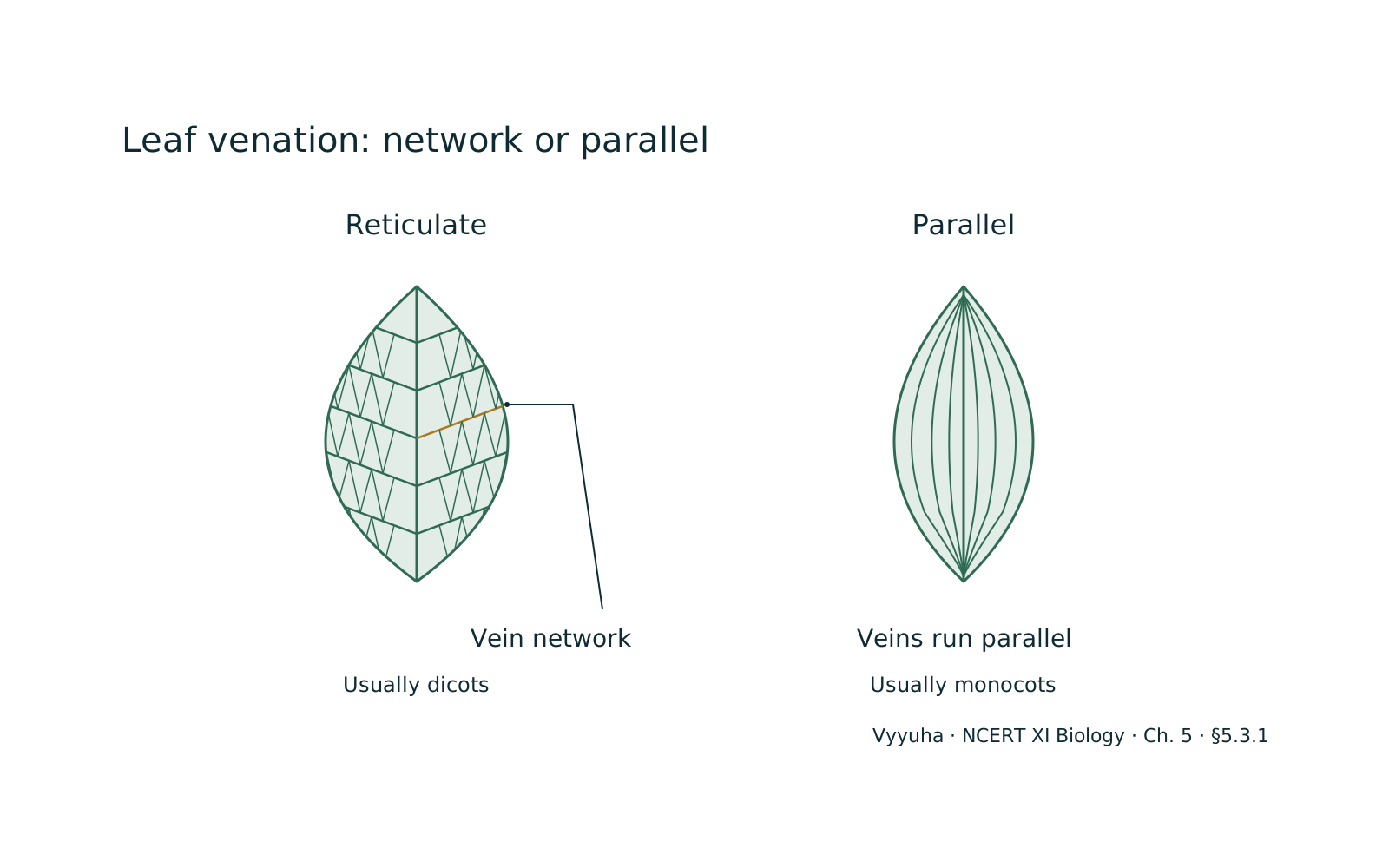
Detailed Explanation
The leaf, a primary photosynthetic organ, relies heavily on an efficient internal transport and support system provided by its venation. Venation, the arrangement of veins and veinlets within the leaf lamina, is a defining morphological characteristic with significant functional and evolutionary implications.
These veins are essentially vascular bundles, containing xylem (for water and mineral transport) and phloem (for food transport), encased within a protective sheath of sclerenchymatous or parenchymatous cells.
Functional Significance of Venation:
- Transport System: — The primary role of veins is to facilitate the efficient transport of water and minerals to the photosynthetic cells (mesophyll) and to export the synthesized sugars (photosynthates) to other parts of the plant. The intricate network ensures that no cell is too far from a supply line or a collection point.
- Mechanical Support: — Veins act as a skeletal framework, providing rigidity and strength to the leaf blade. This support helps the leaf maintain its shape, withstand environmental stresses like wind and rain, and orient itself optimally towards sunlight for maximum photosynthesis.
- Heat Dissipation: — The extensive network of veins also plays a role in heat dissipation through transpiration, helping to regulate leaf temperature.
Types of Venation:
Broadly, venation is classified into two main types: Reticulate and Parallel.
I. Reticulate Venation (Net-like Venation):
In reticulate venation, the veins branch out irregularly and anastomose (join together) to form a complex, interconnected network or web-like pattern throughout the lamina. This type of venation is characteristic of most dicotyledonous plants.
Characteristics:
- Presence of a prominent central vein (midrib) from which lateral veins arise.
- Lateral veins further branch into smaller veinlets, which then form a fine network.
- The veinlets often enclose small areas of mesophyll tissue called areoles.
- The branching is irregular and forms a dense mesh.
Sub-types of Reticulate Venation:
- Pinnate (Unicostate) Reticulate Venation:
In this type, there is a single prominent midrib running from the base to the apex of the leaf. From this midrib, numerous lateral veins arise and proceed towards the margin or apex, branching repeatedly to form a network. 'Unicostate' refers to the presence of a single main vein (the midrib). * Examples: Mango (Mangifera indica), Peepal (Ficus religiosa), Guava (Psidium guajava), China rose (Hibiscus rosa-sinensis).
- Palmate (Multicostate) Reticulate Venation:
* Here, several prominent veins (more than one) arise from a single point at the base of the leaf lamina and diverge outwards. These main veins then branch into smaller veins and veinlets, forming a reticulate pattern.
'Multicostate' indicates the presence of multiple main veins. Sub-divisions of Palmate Reticulate Venation: * Divergent: The main veins diverge from the base towards the margin or apex. Examples: Castor (Ricinus communis), Cotton (Gossypium), Papaya (Carica papaya).
* Convergent: The main veins arise from the base, diverge for some distance, and then converge towards the apex of the leaf. Examples: Zizyphus (Ziziphus mauritiana), Cinnamon (Cinnamomum zeylanicum).
II. Parallel Venation:
In parallel venation, the veins run parallel to each other over the entire length of the leaf blade, without forming a network. The veins typically do not anastomose or, if they do, it's only at the very margins. This type of venation is characteristic of most monocotyledonous plants.
Characteristics:
- Veins run parallel to each other.
- Veinlets are either absent or very few and do not form a complex network.
- Often, there is a prominent midrib, but lateral veins run parallel to it.
Sub-types of Parallel Venation:
- Pinnate (Unicostate) Parallel Venation:
Similar to pinnate reticulate, there is a single prominent midrib. However, in this case, the lateral veins arise from the midrib and run parallel to each other and to the leaf margin, without forming a network. Examples: Banana (Musa paradisiaca), Canna, Ginger (Zingiber officinale).
- Palmate (Multicostate) Parallel Venation:
* Several prominent veins arise from the base of the leaf lamina. These main veins then run parallel to each other, either diverging or converging, but maintaining their parallel arrangement without forming a network.
* Sub-divisions of Palmate Parallel Venation: * Divergent: The main parallel veins diverge from the base towards the margin. Examples: Fan palm (Borassus flabellifer). * Convergent: The main parallel veins arise from the base, run parallel to each other for some distance, and then converge towards the apex.
Examples: Grasses (e.g., Maize - Zea mays), Wheat (Triticum aestivum), Bamboo (Bambusa).
Exceptions and Special Cases:
While reticulate venation is generally associated with dicots and parallel venation with monocots, there are some exceptions:
- Monocots with Reticulate Venation: — Some monocots, like Smilax (Sarsaparilla) and Alocasia, exhibit reticulate venation, which can be a source of confusion for identification.
- Dicots with Parallel Venation: — A few dicots, such as Eryngium and Callophyllum, show parallel venation, though this is much rarer than the reverse exception.
NEET-Specific Angle:
For NEET aspirants, understanding leaf venation is crucial for several reasons:
- Plant Identification and Classification: — Venation is a key morphological feature used to distinguish between monocots and dicots, a fundamental classification in botany. Questions often involve identifying the plant type based on its venation pattern.
- Examples: — Memorizing common examples for each venation type (e.g., mango for pinnate reticulate, maize for palmate convergent parallel) is essential.
- Functional Aspects: — Questions may probe the functional significance of veins (transport, support).
- Exceptions: — Knowledge of exceptions (e.g., Smilax having reticulate venation despite being a monocot) is frequently tested to check deeper understanding and attention to detail.
- Diagram-based Questions: — Diagrams of leaves with different venation patterns might be presented, requiring identification of the type or the plant group it belongs to.
In summary, leaf venation is not merely an aesthetic pattern but a highly organized and functionally critical system that underpins the survival and efficiency of the leaf. Its distinct patterns serve as reliable indicators for plant classification and provide a fascinating insight into plant evolution.
Often confused with
Side-by-side differences the NEET paper likes to test.
| Aspect | Leaf Venation and Types | Reticulate vs. Parallel Venation |
|---|---|---|
| Pattern of Veins | Irregular, interconnected, net-like network of veins and veinlets. | Veins run parallel to each other, either from base to apex or across the leaf, without forming a complex network. |
| Branching | Extensive branching of lateral veins into finer veinlets, forming a mesh. | Little to no branching of lateral veins; they maintain a parallel course. |
| Anastomosis | Veins and veinlets frequently join together (anastomose). | Veins rarely or never anastomose, except sometimes at the very margins. |
| Presence of Areoles | Areoles (small areas of mesophyll enclosed by veinlets) are typically present. | Areoles are generally absent or very poorly defined. |
| Associated Plant Group | Characteristic of most Dicotyledonous plants. | Characteristic of most Monocotyledonous plants. |
| Examples | Mango, Peepal, Hibiscus, Guava, Castor, Papaya. | Maize, Wheat, Grasses, Banana, Bamboo, Canna. |
| Mechanical Support | Provides strong, distributed support due to the interconnected network. | Provides support primarily along the length of the parallel veins. |
The fundamental distinction between reticulate and parallel venation lies in the arrangement and branching of their vascular networks. Reticulate venation, typical of dicots, forms an intricate, net-like pattern with extensive anastomosis, providing robust support and efficient, localized transport.
Parallel venation, characteristic of monocots, features veins running in parallel lines, offering linear support and transport. These differences are crucial for plant identification and understanding the evolutionary divergence between these two major angiosperm groups, despite a few notable exceptions.
Why it is tested: For NEET, understanding the differences between reticulate and parallel venation is fundamental for plant identification, classification, and answering conceptual questions related to monocots and dicots. Questions often involve identifying venation types from diagrams, matching them with plant examples, or explaining their functional significance. Knowledge of exceptions is also frequently tested.
Questions students ask
5 answered on this topic.
What is the primary function of leaf venation?
The primary function of leaf venation is twofold: firstly, to provide an efficient transport system for the leaf. The veins, containing xylem and phloem, ensure that water and minerals reach all photosynthetic cells and that synthesized sugars are transported out.
Secondly, venation offers mechanical support, acting as a skeletal framework that gives rigidity to the leaf blade, helping it maintain its shape, resist tearing, and orient itself optimally towards sunlight for maximum light absorption.
How can I easily distinguish between reticulate and parallel venation?
The easiest way to distinguish between reticulate and parallel venation is by observing the branching pattern of the veins. In reticulate venation, the veins form an irregular, interconnected, net-like network, with smaller veinlets branching off larger ones.
Think of a complex road map. In contrast, parallel venation features veins that run parallel to each other, either from the base to the apex or across the leaf, without forming a complex, anastomosing network.
Imagine straight, parallel lines on a ruled sheet.
Are there any exceptions to the rule that dicots have reticulate venation and monocots have parallel venation?
Yes, while it's a general rule, there are notable exceptions. For instance, some monocotyledonous plants, such as Smilax (sarsaparilla) and Alocasia, exhibit reticulate venation, which is typically found in dicots.
Conversely, a few dicotyledonous plants, like Eryngium and Callophyllum, display parallel venation, though this is less common than monocots showing reticulate patterns. These exceptions are important for NEET as they are often tested to check a student's comprehensive understanding.
What is the difference between unicostate and multicostate venation?
Unicostate and multicostate describe the number of prominent main veins originating from the base of the leaf. In unicostate venation (also known as pinnate), there is only one single, prominent main vein or midrib from which all other lateral veins arise.
Examples include mango (reticulate) or banana (parallel). In multicostate venation (also known as palmate), several prominent main veins arise from a single point at the base of the leaf lamina. These can then either diverge or converge, depending on the specific pattern, as seen in castor (reticulate) or maize (parallel).
What are 'areoles' in the context of leaf venation?
Areoles are the small, irregular, polygonal areas of mesophyll tissue that are enclosed by the network of the finest veinlets in leaves with reticulate venation. These are the smallest units of the leaf blade that are completely surrounded by veins. The presence of areoles indicates a highly efficient vascular supply, ensuring that every part of the photosynthetic tissue is in close proximity to a vein for water and nutrient exchange. They are a characteristic feature of reticulate venation.