Leaf
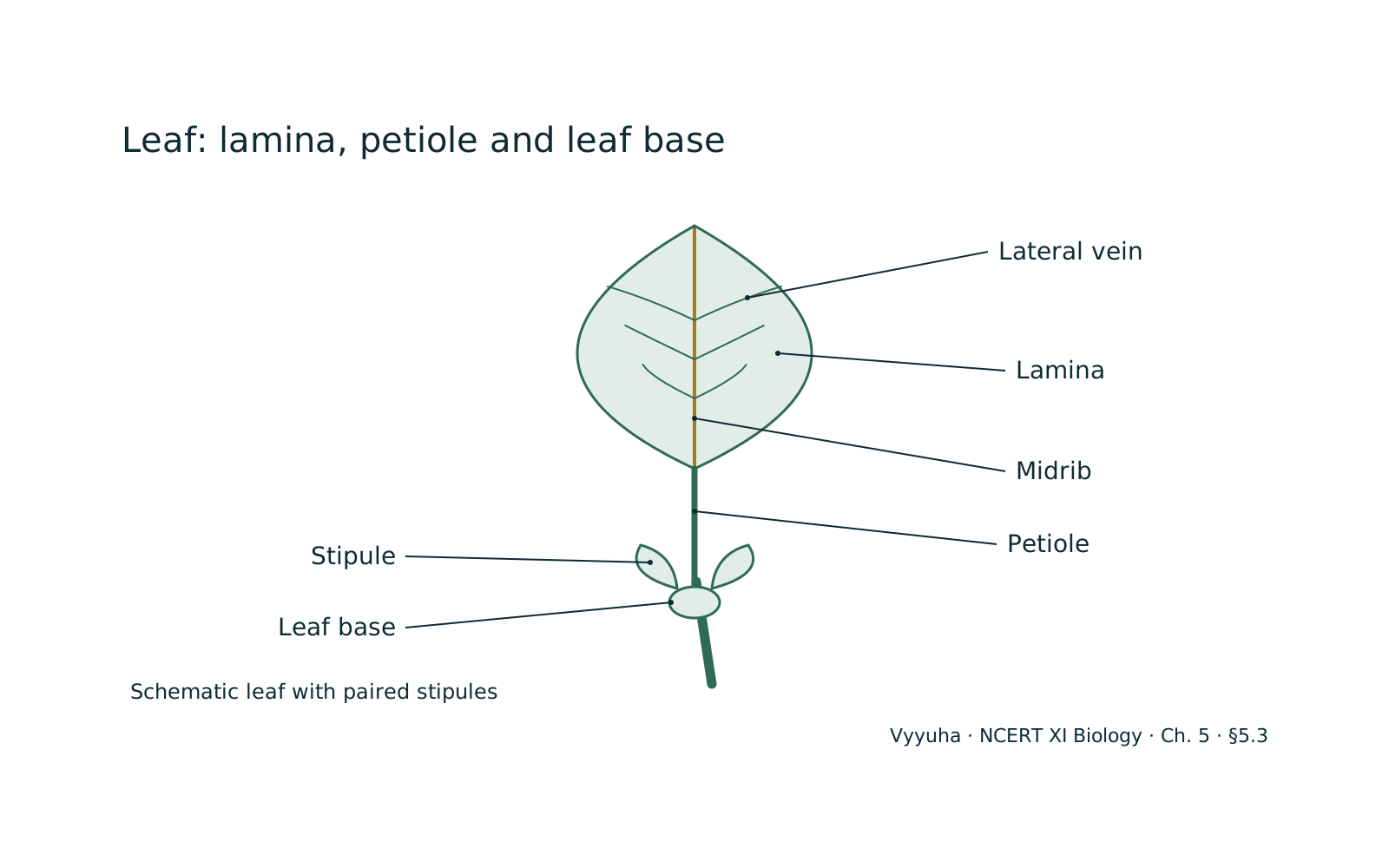
The leaf, a fundamental lateral appendage of the stem, typically develops at the node and bears a bud in its axil. It is generally flattened, green, and specialized for photosynthesis, serving as the primary site for food production in most vascular plants. Its characteristic dorsiventral or isobilateral symmetry, along with its specific venation patterns and epidermal features, are crucial adapta…
Quick Summary
Leaves are the primary photosynthetic organs of most plants, typically green, flattened structures arising from stem nodes. Each leaf usually bears an axillary bud. A typical leaf comprises a leaf base (attaching to the stem, sometimes swollen as a pulvinus or forming a sheath), a petiole (stalk), and a lamina (blade).
The arrangement of veins in the lamina is called venation, categorized into reticulate (dicots) and parallel (monocots). Leaves can be simple (undivided lamina) or compound (lamina divided into leaflets), with compound leaves further classified as pinnate or palmate.
The arrangement of leaves on the stem, known as phyllotaxy, can be alternate, opposite, or whorled, optimizing light capture. Beyond photosynthesis, leaves perform transpiration, gas exchange, and can be modified for storage (fleshy leaves), protection (spines), support (tendrils), or even nutrient acquisition (insectivorous leaves), showcasing remarkable adaptability.
Full explanation
The leaf is a highly specialized, lateral, generally flattened structure borne on the stem, originating from the shoot apical meristem. It is a crucial organ for photosynthesis, transpiration, and gas exchange, playing a pivotal role in the plant's survival and productivity. Understanding its morphology, types, and modifications is fundamental for NEET aspirants.
Conceptual Foundation: Origin and Development
Leaves develop from the primordial cells of the shoot apical meristem, specifically from the leaf primordia. These primordia emerge as small outgrowths on the flanks of the apical dome. Their development is intricately controlled by genetic programs and environmental cues, leading to the diverse forms observed in nature. The arrangement of leaves, known as phyllotaxy, is established during this early developmental phase, ensuring optimal light interception.
Parts of a Typical Leaf
A typical dicotyledonous leaf, often referred to as a dorsiventral leaf, consists of three main parts:
- Leaf Base: — This is the point of attachment of the leaf to the stem. In some plants, especially monocots (like grasses), the leaf base expands into a sheath that partially or wholly covers the stem, known as a sheathing leaf base. In certain leguminous plants, the leaf base becomes swollen, forming a structure called a pulvinus, which is responsible for turgor movements, such as the 'sleep movements' in Mimosa pudica.
- Petiole: — The petiole is the stalk that connects the leaf blade (lamina) to the stem. Its primary function is to hold the lamina out to the light, allowing for efficient photosynthesis. A long, flexible petiole allows the leaf blade to flutter in the wind, cooling the leaf surface and bringing fresh air for gas exchange. Leaves without petioles are called sessile (e.g., Calotropis).
- Lamina (Leaf Blade): — This is the broad, flattened, green part of the leaf, which is the primary site of photosynthesis. The lamina's shape, margin, apex, and surface characteristics vary greatly among different plant species. It contains a network of veins and veinlets that provide structural support and facilitate the transport of water, minerals, and synthesized food.
Venation
Venation refers to the arrangement of veins and veinlets in the lamina. It is broadly classified into two main types:
- Reticulate Venation: — In this type, the veinlets form a network or web-like pattern throughout the lamina. A prominent midrib gives rise to lateral veins, which further branch into finer veinlets. This type of venation is characteristic of dicotyledonous plants (e.g., China rose, Peepal).
- Parallel Venation: — Here, the veins run parallel to each other. They can be parallel to the midrib (e.g., banana) or parallel to each other from the base to the apex of the leaf (e.g., grasses, maize). This type of venation is characteristic of monocotyledonous plants.
Types of Leaves
Leaves are classified based on the incision of their lamina:
- Simple Leaf: — A leaf is considered simple when its lamina is entire (undivided) or, if incised, the incisions do not reach the midrib (in pinnate leaves) or the petiole (in palmate leaves). Examples include mango, guava, and hibiscus.
- Compound Leaf: — In a compound leaf, the incisions of the lamina reach the midrib or the petiole, dividing it into several smaller independent units called leaflets. A bud is present in the axil of the petiole in both simple and compound leaves, but not in the axil of the leaflets.
* Pinnately Compound Leaf: The leaflets are arranged along a common axis called the rachis, which represents the midrib of the leaf. Examples include neem and rose. * Palmately Compound Leaf: The leaflets are attached at a common point, i.e., at the tip of the petiole. Examples include silk cotton and clover. This can be unifoliate (one leaflet), bifoliate (two), trifoliate (three), quadrifoliate (four), or multifoliate (many).
Phyllotaxy
Phyllotaxy is the pattern of arrangement of leaves on the stem or branch. This arrangement is crucial for maximizing light exposure for each leaf. There are three main types:
- Alternate Phyllotaxy: — A single leaf arises at each node in an alternate manner. This is the most common type. Examples include China rose, mustard, and sunflower.
- Opposite Phyllotaxy: — A pair of leaves arises at each node, opposite to each other. This can be:
* Decussate: Successive pairs of leaves are at right angles to each other (e.g., Calotropis, guava). * Superposed: Successive pairs of leaves are directly above each other (e.g., Psidium).
- Whorled Phyllotaxy: — More than two leaves arise at a node and form a whorl or circle. Examples include Alstonia and Nerium.
Modifications of Leaves
Leaves often get modified to perform functions other than photosynthesis, adapting to specific environmental conditions or needs:
- Leaf Tendrils: — Leaves (or parts of leaves) are modified into slender, spirally coiled structures that help the plant climb. Examples: whole leaf in Lathyrus aphaca (wild pea), leaflets in Pisum sativum (garden pea), petiole in Clematis, stipules in Smilax.
- Spines: — Leaves are modified into sharp, pointed structures for protection against herbivores and to reduce water loss through transpiration. Examples: Opuntia (whole leaf), cacti (areoles), Aloe, Agave.
- Fleshy Leaves: — Leaves become thick and fleshy due to the storage of food and water. Examples: Onion (scale leaves store food), garlic, Aloe vera.
- Phyllode: — In some plants, especially those in arid regions, the petiole expands to become green and flattened, performing photosynthesis, while the true leaf blade is reduced or falls off early. This reduces transpiration. Example: Australian Acacia.
- Insectivorous Leaves (Carnivorous Plants): — These leaves are highly modified to trap and digest insects, supplementing the plant's nitrogen supply, especially in nitrogen-deficient soils. Examples:
* Pitcher Plant (Nepenthes, Sarracenia): The leaf lamina is modified into a pitcher-like structure with a lid. Insects are attracted, fall in, and are digested. * Venus Flytrap (Dionaea): The leaf blade forms two hinged lobes with sensitive trigger hairs. When an insect touches these hairs, the lobes snap shut. * Bladderwort (Utricularia): Submerged leaves are modified into small bladders that trap aquatic insects.
- Leaf Hooks: — In some climbing plants, the leaf apex or leaflets are modified into hooks for climbing. Example: Bignonia unguis-cati.
- Leaf Roots: — In some aquatic plants, leaves are modified into roots for buoyancy and absorption. Example: Salvinia.
Functions of Leaves
- Primary Function: Photosynthesis: — The most critical function, converting light energy into chemical energy (food) using chlorophyll, water, and carbon dioxide.
- Transpiration: — The loss of water vapor from the aerial parts of the plant, primarily through stomata on the leaves. This creates a transpirational pull, aiding in water and mineral transport, and also helps in cooling the plant.
- Gas Exchange: — Stomata on the leaf surface regulate the exchange of carbon dioxide and oxygen between the plant and the atmosphere.
- Storage: — Fleshy leaves store food (e.g., onion, garlic) or water (e.g., succulents).
- Protection: — Spines protect against herbivores and excessive water loss.
- Support: — Tendrils help weak-stemmed plants climb.
- Vegetative Propagation: — In some plants (e.g., Bryophyllum), adventitious buds develop on the leaf margin, which can detach and grow into new plants.
NEET-Specific Angle
For NEET, the focus on leaves is primarily morphological. Students must be able to:
- Identify and differentiate between simple and compound leaves, and their sub-types with examples.
- Recognize different types of venation and associate them with monocots/dicots.
- Understand the three main types of phyllotaxy and provide examples for each.
- Crucially, identify various leaf modifications and their corresponding plant examples, along with the specific part of the leaf that is modified. Questions often involve matching plant names with their leaf modifications or identifying the function of a modified leaf. Diagrams are frequently used to test identification skills. Pay special attention to the examples provided for each category, as NEET often tests specific plant examples.
Key Concepts
Venation is the arrangement of veins in the leaf blade, crucial for support and transport. Reticulate…
Phyllotaxy describes how leaves are arranged on a stem, a pattern optimized for light capture. In **alternate…
Compound leaves are those where the leaf blade is divided into separate leaflets. The distinction between…
Often confused with
Side-by-side differences the NEET paper likes to test.
| Aspect | Leaf | Simple Leaf |
|---|---|---|
| Lamina structure | Lamina is entire or, if incised, the incisions do not reach the midrib or petiole. | Lamina is deeply incised, reaching the midrib (rachis) or petiole, dividing it into several leaflets. |
| Leaflets | No separate leaflets; the entire blade is one unit. | Composed of multiple distinct units called leaflets. |
| Axillary bud | An axillary bud is present in the axil of the petiole. | An axillary bud is present in the axil of the entire compound leaf's petiole, but NOT in the axil of individual leaflets. |
| Shedding | The entire leaf (lamina and petiole) sheds as a single unit. | Leaflets may shed individually, or the entire compound leaf may shed as a unit. |
| Examples | Mango, Guava, Hibiscus, Banyan | Neem (pinnately), Silk cotton (palmately), Rose (pinnately) |
The core distinction between a simple and a compound leaf lies in the degree of incision of the lamina. A simple leaf maintains a continuous lamina, even if lobed, whereas a compound leaf's lamina is fully divided into separate leaflets.
This difference is crucial for classification and understanding plant morphology. The presence or absence of an axillary bud in the leaflet axil is a key diagnostic feature, as true leaves (simple or compound) always have an axillary bud at their base, but individual leaflets do not.
Why it is tested: NEET relevance: Differentiating between simple and compound leaves, along with their specific examples, is a frequently tested concept. Questions often involve identifying the type of leaf from a given diagram or plant name, or understanding the structural implications of these differences.
Questions students ask
6 answered on this topic.
What is the primary difference between a simple and a compound leaf?
The fundamental distinction lies in the lamina's structure. In a simple leaf, the lamina is either entirely undivided, or if it has incisions, these cuts do not extend down to the midrib (in pinnate venation) or the petiole (in palmate venation).
Essentially, it remains a single, continuous blade. Conversely, a compound leaf has its lamina deeply incised, reaching the midrib or petiole, thereby dividing the leaf into several distinct, smaller units called leaflets.
An important diagnostic feature is the presence of an axillary bud in the axil of the whole leaf's petiole, but never in the axil of individual leaflets.
How does phyllotaxy help a plant optimize light absorption?
Phyllotaxy, the arrangement of leaves on a stem, is a crucial evolutionary adaptation designed to maximize the exposure of each leaf to sunlight while minimizing self-shading. For instance, in alternate phyllotaxy, leaves are spirally arranged, ensuring that no two leaves are directly above each other, allowing sunlight to reach lower leaves.
In opposite decussate arrangements, successive pairs of leaves are at right angles, creating a 'cross' pattern that also reduces shading. This strategic positioning is vital for efficient photosynthesis, which is the plant's primary energy-producing process.
What is a pulvinus and what is its function?
A pulvinus is a swollen leaf base, particularly prominent in many leguminous plants like Mimosa pudica (touch-me-not plant). Its primary function is to facilitate turgor movements, which are reversible changes in leaf or leaflet position.
These movements can be triggered by light (nyctinastic movements, or 'sleep movements' at night) or touch (thigmonastic movements). The pulvinus contains specialized cells that can rapidly gain or lose water, altering their turgor pressure and causing the leaf or leaflets to fold or unfold.
This mechanism is thought to protect the plant from excessive heat or herbivory.
Explain the significance of venation patterns in leaves.
Venation refers to the arrangement of veins within the leaf lamina, which are essentially vascular bundles. These veins serve two critical functions: structural support and transport. They form a skeletal framework that helps the leaf blade withstand wind and other mechanical stresses.
More importantly, they constitute the plant's plumbing system, transporting water and dissolved minerals from the stem to all parts of the leaf via xylem, and carrying synthesized sugars (food) from the leaf to other plant parts via phloem.
The distinct patterns, reticulate (network-like) in dicots and parallel in monocots, are key taxonomic features and reflect different evolutionary strategies for efficient resource distribution.
Why do some plants have modified leaves like tendrils or spines?
Leaf modifications are evolutionary adaptations that allow plants to survive and thrive in specific environments or perform specialized functions beyond photosynthesis. Tendrils, for example, are slender, coiled structures that help weak-stemmed plants climb for better light exposure, as seen in peas.
Spines, on the other hand, are sharp, pointed modifications that primarily serve as a defense mechanism against herbivores, deterring animals from eating the plant. They also help reduce water loss through transpiration in arid environments, as seen in cacti.
These modifications highlight the incredible plasticity of plant structures in response to ecological pressures.
What is a phyllode, and how does it differ from a typical leaf?
A phyllode is a modified petiole that has become flattened, green, and leaf-like, taking over the photosynthetic function of the leaf blade. This adaptation is commonly found in some species of Australian Acacia.
In these plants, the true leaf blade is either reduced, rudimentary, or falls off early in development. The phyllode's primary advantage is its reduced surface area-to-volume ratio compared to a broad lamina, which significantly minimizes water loss through transpiration in arid or semi-arid conditions.
Thus, while it looks and functions like a leaf, it is morphologically an expanded petiole.
Revise in 30 seconds
- Leaf Parts: — Leaf base (pulvinus, sheathing), Petiole, Lamina.
- Venation: — Reticulate (dicots, network), Parallel (monocots, parallel veins).
- Leaf Types: — Simple (entire lamina), Compound (lamina divided into leaflets).
- Pinnately Compound (leaflets on rachis, e.g., Neem). - Palmately Compound (leaflets at petiole tip, e.g., Silk cotton).
- Phyllotaxy:
- Alternate (one leaf/node, spiral, e.g., China rose, Mustard, Sunflower). - Opposite (two leaves/node, e.g., Guava, Calotropis). - Whorled (more than two leaves/node, e.g., Alstonia, Nerium).
- Modifications:
- Tendrils (support, e.g., Pea). - Spines (protection, water loss, e.g., Opuntia). - Fleshy leaves (storage, e.g., Onion). - Phyllode (photosynthesis by petiole, e.g., Australian Acacia). - Insectivorous (nitrogen, e.g., Nepenthes, Dionaea, Utricularia).
To remember leaf modifications and their examples, think of: 'Pea Trees Stand Out For All Insects Near Deserts.'
- Pea: Tendrils (Support)
- Stand: Spines (Protection, Opuntia)
- Out: Onion (Fleshy leaves, Storage)
- For: Fyllode (Photosynthesis, Australian Acacia)
- All: Alstonia (Whorled Phyllotaxy - general leaf concept)
- Insects: Insectivorous (Nepenthes, Dionaea)
- Near: Neem (Pinnately Compound)
- Deserts: Dicots (Reticulate Venation)