Morphology of Flowering Plants
- 1Root SystemTypes of Root Systems · Modifications of RootsHigh yield
- 2Shoot SystemStem Modifications · Branching PatternsHigh yield
- 3LeafLeaf Venation and Types · Leaf ModificationsHigh yield
- 4InflorescenceTypes of Inflorescence · Cymose and RacemoseHigh yield
- 5FlowerParts of Flower · Aestivation and PlacentationHigh yield
- 6Fruit and SeedTypes of Fruits · Seed StructureHigh yield
Morphology of flowering plants is the scientific study of the external structure and form of angiosperms, encompassing the observation and description of their various organs such as roots, stems, leaves, flowers, fruits, and seeds. This discipline delves into the arrangement, development, and modifications of these parts, providing a foundational understanding of plant architecture. It is crucial…
Quick Summary
Morphology of flowering plants is the study of their external structure, providing insights into their form, function, and classification. The plant body is organized into a root system (underground) and a shoot system (above ground).
Roots anchor the plant, absorb water and minerals, and can be tap, fibrous, or adventitious, often modified for storage or support. The stem, developing from the plumule, bears leaves, flowers, and fruits, facilitating transport and sometimes modified for storage, propagation, or protection.
Leaves, the primary photosynthetic organs, exhibit diverse shapes, venation patterns (reticulate or parallel), and arrangements (phyllotaxy: alternate, opposite, whorled), and can be simple or compound.
They also undergo modifications like tendrils or spines. Flowers, the reproductive structures, are arranged in inflorescences (racemose or cymose) and consist of sepals, petals, stamens, and carpels. Their symmetry (actinomorphic or zygomorphic), ovary position, aestivation (petal arrangement), and placentation (ovule arrangement) are key diagnostic features.
Fertilized ovaries develop into fruits, which can be true, false, or parthenocarpic, enclosing seeds. Seeds, containing an embryo and stored food, are either albuminous or non-albuminous, representing the plant's dispersal and survival unit.
Understanding these basic structures and their modifications is crucial for identifying and classifying angiosperms.
Full explanation
The morphology of flowering plants, or angiosperms, is a fundamental branch of botany that focuses on the external structure and form of these dominant plant groups. It provides the basis for understanding plant identification, classification, and the intricate adaptations that allow plants to thrive in diverse environments.
The plant body of an angiosperm is broadly differentiated into two main systems: the root system, which is typically underground, and the shoot system, which is above ground and comprises the stem, leaves, flowers, fruits, and seeds.
I. The Root System
The root is the underground, non-green part of the plant that primarily absorbs water and minerals from the soil, provides anchorage, and sometimes stores food. Roots typically grow positively geotropically (towards gravity) and negatively phototropically (away from light).
- Types of Root Systems:
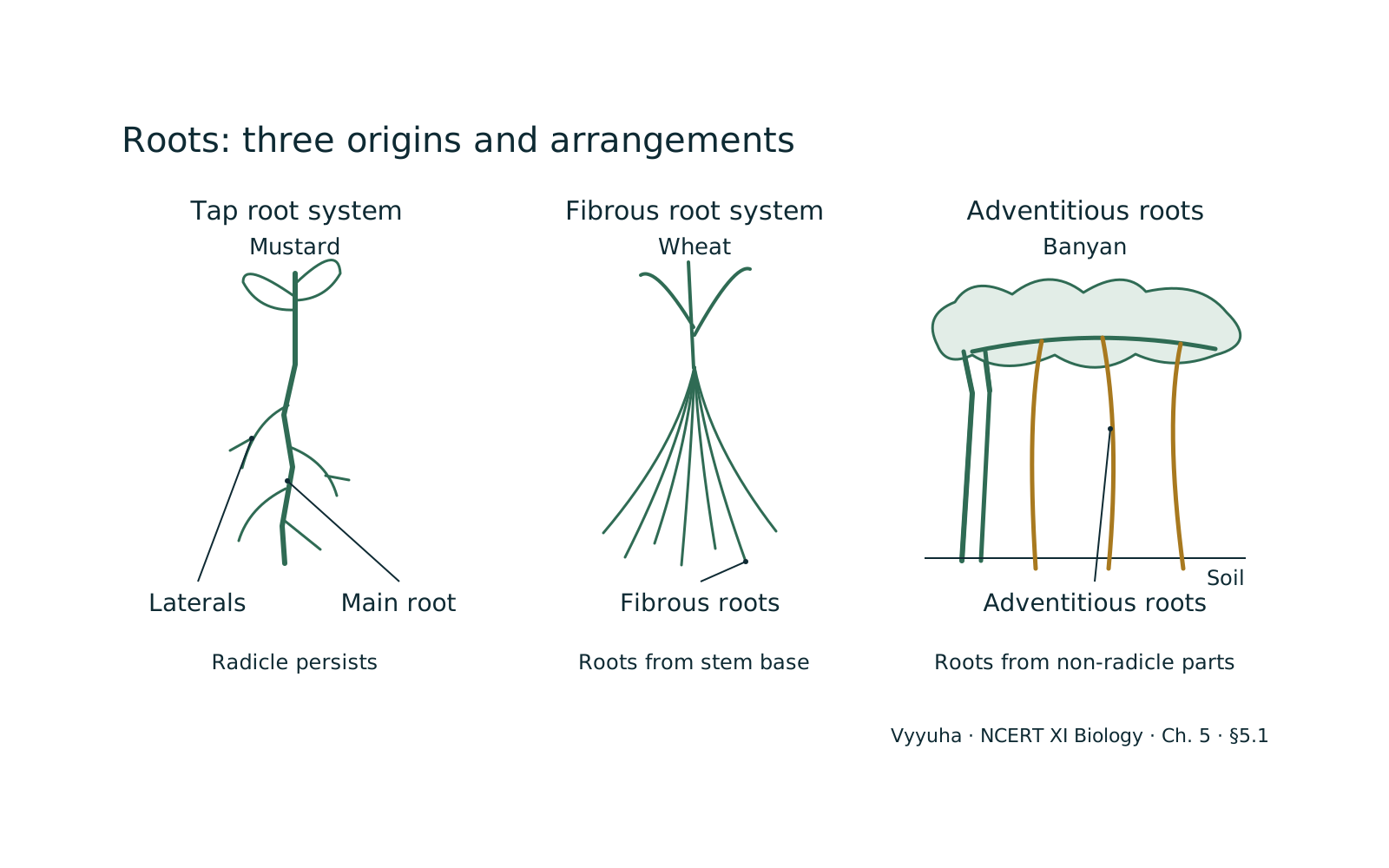
* Tap Root System: Originates from the radicle of the embryo, forming a primary root that grows vertically downwards, giving rise to lateral roots (secondary, tertiary, etc.). Characteristic of dicotyledonous plants (e.
g., mustard, carrot, turnip). Functions include anchorage, absorption, and storage. * Fibrous Root System: Develops from the base of the stem after the primary root is short-lived. Consists of a cluster of thin, fibrous roots spreading out from the stem.
Characteristic of monocotyledonous plants (e.g., wheat, rice, maize). Primarily for anchorage. * Adventitious Root System: Roots that arise from any part of the plant body other than the radicle (e.
g., from stem nodes, branches, leaves). Found in both monocots and dicots. Often modified for support, storage, or other specialized functions (e.g., banyan tree, Monstera).
- Regions of the Root:
* Root Cap: A thimble-like structure covering the root apex, protecting the tender apical meristem as it pushes through the soil. * Region of Meristematic Activity: Located a few millimeters above the root cap, containing actively dividing cells.
* Region of Elongation: Proximal to the meristematic region, where cells rapidly increase in length, responsible for root growth. * Region of Maturation: Proximal to the region of elongation, where cells differentiate and mature.
Root hairs, fine thread-like structures, emerge from epidermal cells in this region, significantly increasing the surface area for water and mineral absorption.
- Modifications of Roots:
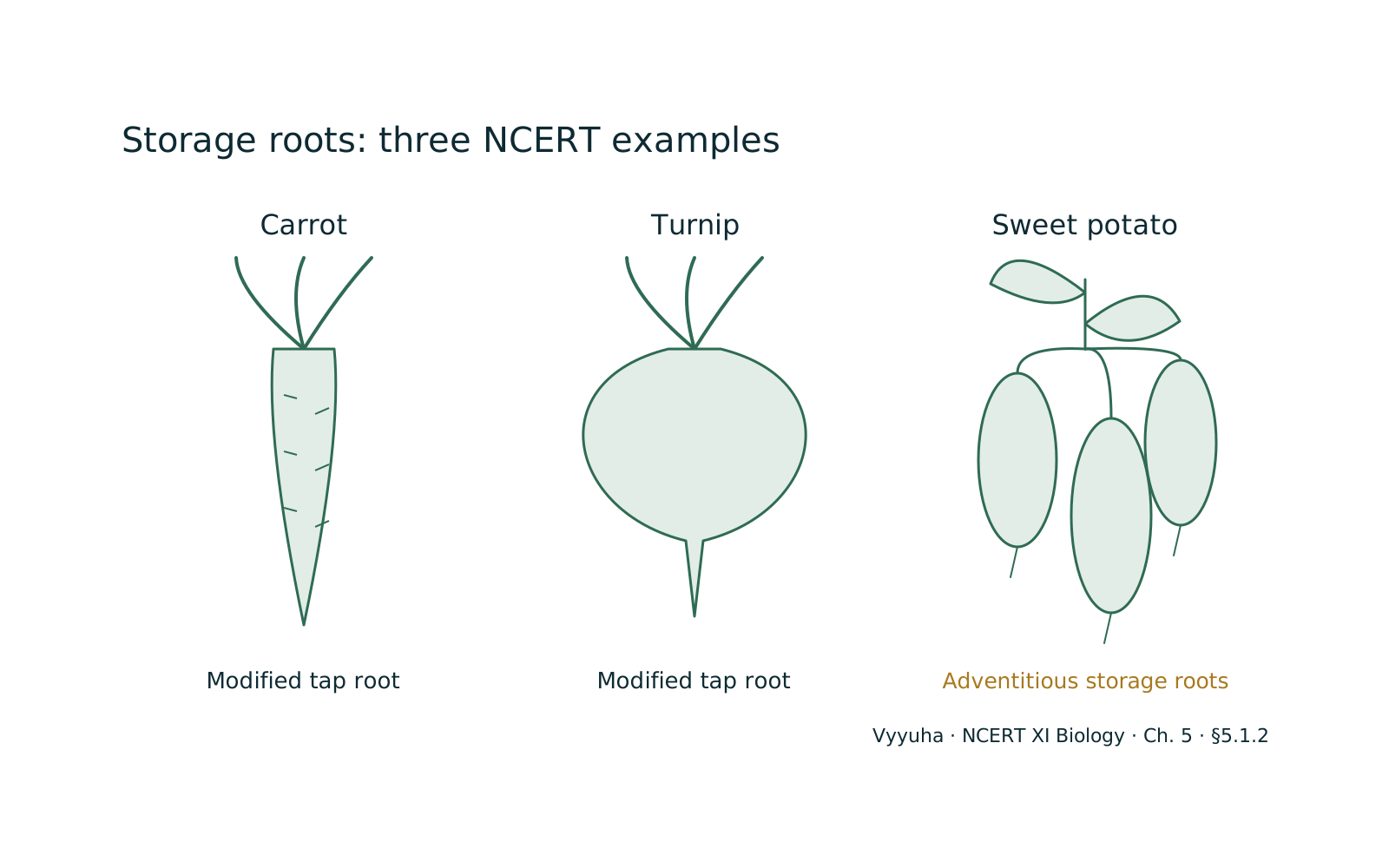
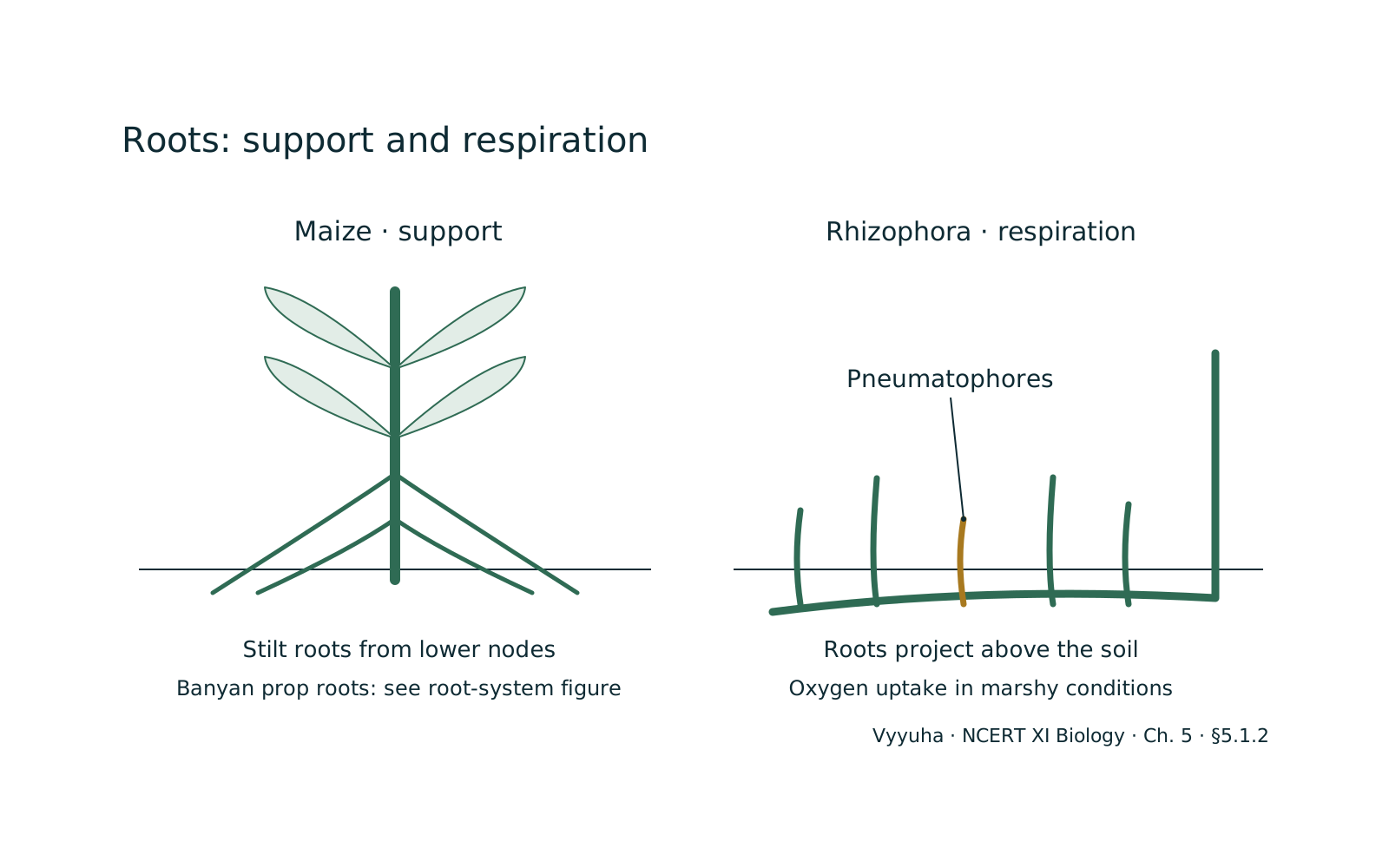
* Storage Roots: Swollen roots storing food (e.g., carrot – conical, turnip – napiform, radish – fusiform, sweet potato – adventitious tuberous root). * Prop Roots: Adventitious roots growing vertically downwards from branches for support (e.
g., banyan tree). * Stilt Roots: Adventitious roots growing obliquely from the lower nodes of the stem, providing support (e.g., maize, sugarcane). * Pneumatophores: Specialized roots growing vertically upwards out of the waterlogged soil, with pores (lenticels) for gaseous exchange (e.
g., Rhizophora in mangroves). * Climbing Roots: For attachment to support (e.g., money plant). * Haustorial/Sucking Roots: Parasitic roots penetrating host tissue to absorb nutrients (e.g., Cuscuta).
II. The Stem System
The stem is the ascending part of the plant axis, bearing branches, leaves, flowers, and fruits. It develops from the plumule of the embryo. Stems are typically positively phototropic and negatively geotropic.
- Characteristics: — Bears nodes (where leaves arise) and internodes (the portion between two nodes), apical (terminal) and axillary (lateral) buds.
- Functions: — Spreading out branches bearing leaves, flowers, and fruits; conducting water and minerals from roots to leaves, and food from leaves to other parts; storage of food; support; protection; vegetative propagation.
- Modifications of Stems:
* Underground Stems (for storage and perennation): * Rhizome: Horizontal, fleshy, underground stem with nodes, internodes, and scale leaves (e.g., ginger, turmeric). * Corm: Vertical, condensed, swollen underground stem (e.
g., Colocasia, saffron). * Tuber: Swollen tips of underground branches, storing food (e.g., potato). * Bulb: Condensed, disc-like stem with fleshy scale leaves storing food (e.g., onion, garlic).
* Sub-aerial Stems (for vegetative propagation): * Runner: Slender, prostrate stem with long internodes, rooting at nodes (e.g., grass, strawberry). * Stolon: Slender lateral branch arising from the base of the main stem, growing aerially for some distance, then arching downwards to touch the ground and produce new plants (e.
g., mint, jasmine). * Offset: Short, thick runner-like branch, found in aquatic plants, producing a rosette of leaves and a tuft of roots at each node (e.g., Pistia, Eichhornia). * Sucker: Lateral branch arising from the underground part of the main stem, growing obliquely upwards to produce a leafy shoot (e.
g., banana, pineapple, chrysanthemum). * Aerial Stem Modifications: * Stem Tendrils: Slender, spirally coiled structures for climbing (e.g., cucumber, pumpkin, grapevines). * Thorns: Hard, pointed, woody structures for protection (e.
g., Citrus, Bougainvillea). * Phylloclade: Flattened or cylindrical green stem, performing photosynthesis (e.g., Opuntia – flattened, Euphorbia – cylindrical). * Cladode: Phylloclade with one or two internodes (e.
g., Asparagus, Ruscus).
III. The Leaf
The leaf is a lateral, generally flattened structure borne on the stem, specialized for photosynthesis. It develops from the shoot apical meristem and is arranged in an acropetal order.
- Parts of a Leaf:
* Leaf Base: The point of attachment to the stem. May be swollen (pulvinus in legumes) or form a sheathing base (in monocots). * Petiole: The stalk connecting the lamina to the stem, helping orient the blade to light. * Lamina (Leaf Blade): The broad, flattened green part of the leaf, containing veins and veinlets.
- Venation: — The arrangement of veins and veinlets in the lamina.
* Reticulate Venation: Veinlets form a network (characteristic of dicots, e.g., pea, mango). * Parallel Venation: Veins run parallel to each other (characteristic of monocots, e.g., grass, banana).
- Types of Leaves:
* Simple Leaf: Lamina is entire or incised, but the incisions do not reach the midrib (e.g., mango, guava). * Compound Leaf: Incisions of the lamina reach the midrib, breaking it into several leaflets. * Pinnately Compound: Leaflets arranged along a common axis (rachis), which represents the midrib (e.g., neem). * Palmately Compound: Leaflets attached at a common point at the tip of the petiole (e.g., silk cotton).
- Phyllotaxy: — The pattern of arrangement of leaves on the stem or branch.
* Alternate: A single leaf arises at each node in an alternate manner (e.g., China rose, mustard, sunflower). * Opposite: A pair of leaves arises at each node and lie opposite to each other (e.g., Calotropis, guava). * Whorled: More than two leaves arise at a node and form a whorl (e.g., Alstonia).
- Modifications of Leaves:
* Leaf Tendrils: For climbing (e.g., pea). * Spines: For protection and reducing water loss (e.g., cacti). * Fleshy Leaves: For food and water storage (e.g., onion, garlic). * Phyllode: Petiole expands to become green and flattened, performing photosynthesis (e.g., Australian Acacia). * Insectivorous Leaves: Modified to trap insects (e.g., pitcher plant, Venus flytrap).
IV. The Inflorescence
The arrangement of flowers on the floral axis is termed inflorescence. It is a specialized shoot where the apical meristem changes to floral meristem.
- Types of Inflorescence:
* Racemose: Main axis continues to grow, and flowers are borne laterally in an acropetal succession (youngest at the top, oldest at the base) (e.g., mustard, radish). * Cymose: Main axis terminates in a flower, hence limited growth. Flowers are borne in a basipetal succession (oldest at the top, youngest at the base) (e.g., Solanum, jasmine). * Special Types: E.g., Hypanthodium (fig), Cyathium (Euphorbia), Verticillaster (Lamiaceae).
V. The Flower
The flower is the reproductive unit of an angiosperm, a modified shoot where the apical meristem transforms into a floral meristem. It consists of four whorls arranged on a swollen end of the pedicel called the thalamus or receptacle.
- Parts of a Flower:
* Calyx: Outermost whorl, composed of sepals. Usually green, protective in bud stage. Sepals can be free (polysepalous) or fused (gamosepalous). * Corolla: Whorl inside the calyx, composed of petals.
Often brightly colored to attract pollinators. Petals can be free (polypetalous) or fused (gamopetalous). * Perianth: When calyx and corolla are not distinct (e.g., lily). * Androecium: Male reproductive whorl, composed of stamens.
Each stamen has a filament and an anther (containing pollen grains). * Cohesion of Stamens: Monoadelphous (filaments united into one bundle, e.g., China rose), Diadelphous (two bundles, e.g., pea), Polyadelphous (more than two bundles, e.
g., Citrus). * Adhesion of Stamens: Epipetalous (stamens attached to petals, e.g., brinjal), Epiphyllous (attached to perianth, e.g., lily). * Gynoecium (Pistil): Female reproductive whorl, composed of one or more carpels.
Each carpel has an ovary (containing ovules), a style, and a stigma. * Carpel Number: Monocarpellary (one carpel), Bicarpellary (two), Multicarpellary (many). * Fusion of Carpels: Apocarpous (free carpels, e.
g., lotus, rose), Syncarpous (fused carpels, e.g., mustard, tomato).
- Symmetry of Flower:
* Actinomorphic (Radial Symmetry): Can be divided into two equal halves by any radial plane passing through the center (e.g., mustard, Datura, chilli). * Zygomorphic (Bilateral Symmetry): Can be divided into two equal halves by only one specific vertical plane (e.g., pea, gulmohar, bean, Cassia). * Asymmetrical/Irregular: Cannot be divided into two equal halves by any plane (e.g., Canna).
- Position of Ovary (on Thalamus):
* Hypogynous: Ovary superior, other floral parts below it (e.g., mustard, China rose, brinjal). * Perigynous: Ovary half-inferior, other floral parts at the same level (e.g., plum, rose, peach). * Epigynous: Ovary inferior, other floral parts above it (e.g., guava, cucumber, ray florets of sunflower).
- Aestivation: — The mode of arrangement of sepals or petals in a floral bud with respect to the other members of the same whorl.
* Valvate: Margins of adjacent members just touch without overlapping (e.g., Calotropis). * Twisted: One margin of the appendage overlaps the next one, and so on (e.g., China rose, cotton, lady's finger). * Imbricate: Margins overlap but not in a particular direction (e.g., Cassia, gulmohar). * Vexillary (Papilionaceous): Largest petal (standard) overlaps two lateral petals (wings), which in turn overlap two smallest anterior petals (keel) (e.g., pea, bean).
- Placentation: — The arrangement of ovules within the ovary.
* Marginal: Placenta forms a ridge along the ventral suture of the ovary, ovules borne on this ridge (e.g., pea). * Axile: Ovules attached to a central axis in a multilocular ovary (e.g., China rose, tomato, lemon).
* Parietal: Ovules develop on the inner wall of the ovary or on peripheral part. Ovary is one-chambered but becomes two-chambered due to false septum formation (e.g., mustard, Argemone). * Free Central: Ovules borne on a central axis, and septa are absent (e.
g., Dianthus, Primrose). * Basal: Placenta develops at the base of the ovary, with a single ovule (e.g., sunflower, marigold).
VI. The Fruit
The fruit is a mature or ripened ovary, developed after fertilization. It is a characteristic feature of flowering plants.
- Types of Fruits:
* True Fruits: Develop only from the ovary (e.g., mango, tomato). * False Fruits: Develop from the ovary along with other floral parts like thalamus (e.g., apple, strawberry, cashew). * Parthenocarpic Fruits: Develop without fertilization (e.g., banana).
- Fruit Classification based on development:
* Simple Fruits: Develop from a monocarpellary or multicarpellary, syncarpous ovary (e.g., mango, pea). * Aggregate Fruits: Develop from a multicarpellary, apocarpous ovary (e.g., custard apple, strawberry). * Multiple/Composite Fruits: Develop from an entire inflorescence (e.g., pineapple, mulberry).
VII. The Seed
The seed is a fertilized ovule, containing an embryo, stored food, and a protective seed coat.
- Parts of a Seed:
* Seed Coat: Outer protective layers (testa and tegmen). * Hilum: Scar on the seed coat where the ovule was attached to the funicle. * Micropyle: Small pore above the hilum, facilitating water absorption during germination. * Embryo: Consists of an embryonal axis and cotyledons. * Cotyledons: Seed leaves, store food (dicots) or transfer food (monocots). * Embryonal Axis: Has a radicle (forms root) and a plumule (forms shoot).
- Types of Seeds:
* Albuminous (Endospermic) Seeds: Retain endosperm for food storage (e.g., wheat, maize, castor). * Non-albuminous (Non-endospermic) Seeds: Endosperm is consumed during embryo development, food stored in cotyledons (e.g., pea, groundnut).
- Monocotyledonous Seed Structure (e.g., maize): — Single cotyledon (scutellum), large endosperm, embryo enclosed by aleurone layer. Plumule and radicle enclosed in protective sheaths (coleoptile and coleorhiza, respectively).
- Dicotyledonous Seed Structure (e.g., pea): — Two cotyledons, no endosperm (or very little), prominent hilum and micropyle.
Common Misconceptions & NEET-Specific Angle:
Students often confuse homologous and analogous structures, or different types of modifications. For NEET, it's crucial to:
- Memorize examples: — Each modification (root, stem, leaf), inflorescence type, aestivation, placentation, and fruit type has specific examples that are frequently asked.
- Understand the 'why': — Why does a stem become a tendril? Why do roots become pneumatophores? It's always an adaptation to function (support, storage, protection, gas exchange, propagation).
- Distinguish similar terms: — E.g., runner vs. stolon vs. offset vs. sucker; simple vs. compound leaf; actinomorphic vs. zygomorphic symmetry.
- Diagram-based questions: — Be able to identify structures from diagrams (e.g., different placentation types, floral parts).
- Floral Formula/Diagram: — While not explicitly morphology, understanding floral parts is a prerequisite.
- Economic importance: — Some modifications or plant parts have economic significance (e.g., storage roots like carrot, potato tubers), which can be indirectly tested.
Key Concepts
Phyllotaxy refers to the specific pattern in which leaves are arranged on the stem or its branches. This…
Aestivation describes the specific manner in which the sepals or petals are arranged in a floral bud,…
Placentation refers to the arrangement of ovules within the ovary. The ovules, which develop into seeds after…
Often confused with
Side-by-side differences the NEET paper likes to test.
| Aspect | Morphology of Flowering Plants | Racemose Inflorescence |
|---|---|---|
| Growth of Main Axis | Indefinite, continues to grow. | Definite, terminates in a flower. |
| Arrangement of Flowers | Acroptetal succession (youngest at apex, oldest at base). | Basipetal succession (oldest at apex, youngest at base). |
| Opening of Flowers | Flowers open from base to apex. | Flowers open from apex to base. |
| Number of Flowers | Potentially indefinite number of flowers. | Limited number of flowers. |
| Examples | Mustard, Radish, Gulmohar. | Jasmine, Solanum, Cotton. |
Racemose and cymose inflorescences represent two fundamental patterns of flower arrangement on a plant's floral axis, primarily differing in the growth habit of the main axis and the sequence of flower opening.
Racemose inflorescences exhibit indeterminate growth, with the main axis continuously elongating and producing flowers laterally in an acropetal order, meaning younger flowers are at the top. This allows for a prolonged flowering period.
Conversely, cymose inflorescences show determinate growth, where the main axis terminates in a flower, thus limiting its growth. Flowers in cymose inflorescences open in a basipetal order, with the oldest flower at the apex.
These distinct patterns are crucial for plant identification and understanding reproductive strategies.
Why it is tested: For NEET, understanding the differences between racemose and cymose inflorescences is highly relevant. Questions frequently test the growth pattern of the floral axis, the arrangement of flowers (acropetal vs. basipetal), and specific examples for each type. Students must be able to recall these characteristics and apply them to identify the correct inflorescence type from a given description or diagram. This distinction is a fundamental concept in plant morphology and taxonomy, often appearing in direct recall or application-based MCQs.
Questions students ask
5 answered on this topic.
What is the primary difference between a tap root system and a fibrous root system?
The primary difference lies in their origin and structure. A tap root system develops directly from the radicle of the embryo, forming a prominent main root that grows deep into the soil, with smaller lateral roots branching off.
It is characteristic of dicotyledonous plants like mustard or carrot. In contrast, a fibrous root system develops from the base of the stem, where the primary root is short-lived and replaced by a cluster of numerous, thin, and uniformly sized roots.
This system is typical of monocotyledonous plants such as wheat or rice, providing a strong anchorage but generally not penetrating as deeply.
How can I differentiate between a stem tendril and a leaf tendril?
Differentiating between stem and leaf tendrils requires observing their origin and associated structures. A stem tendril is a modification of an axillary bud, meaning it arises from the axil of a leaf.
It often appears branched and may bear scale leaves or even small flowers (e.g., cucumber, grapevines). A leaf tendril, on the other hand, is a modification of an entire leaf, a leaflet, or a part of the leaf (like the petiole or stipule).
For instance, in peas, the terminal leaflets are modified into tendrils, while in Lathyrus aphaca, the entire leaf is modified. Look for the presence of an axillary bud at the base of a stem tendril, which will be absent for a leaf tendril.
What is placentation, and why are there different types?
Placentation refers to the arrangement of ovules within the ovary of a flower. The ovules are attached to a cushion-like structure called the placenta. There are various types like marginal, axile, parietal, free central, and basal.
These different arrangements are evolutionary adaptations to ensure efficient protection, development, and dispersal of seeds. The specific type of placentation can be a key diagnostic feature for classifying plant families.
For example, marginal placentation is characteristic of legumes, while axile is common in China rose and tomato. Each type optimizes the positioning of ovules for fertilization and subsequent seed development.
Explain the difference between actinomorphic and zygomorphic flowers.
Actinomorphic and zygomorphic describe the symmetry of a flower. An actinomorphic flower exhibits radial symmetry, meaning it can be divided into two equal halves by any vertical plane passing through its center, much like a star or a wheel.
Examples include mustard and Datura. This type of symmetry often allows pollinators to approach from any angle. A zygomorphic flower, however, possesses bilateral symmetry, meaning it can only be divided into two equal halves by a single specific vertical plane, similar to a human face.
Examples are pea and gulmohar. Zygomorphy is often associated with specialized pollination mechanisms, guiding specific pollinators to a particular entry point.
What is a false fruit, and how does it differ from a true fruit?
A true fruit is a mature or ripened ovary that develops exclusively from the ovary after fertilization, with no other floral parts contributing significantly to its formation. Examples include mango and tomato, where the fleshy part is derived solely from the ovary wall.
In contrast, a false fruit, also known as a pseudocarp, develops not only from the ovary but also from other accessory floral parts like the thalamus, receptacle, or even the perianth. A classic example is the apple, where the edible fleshy part is primarily the swollen thalamus, while the actual fruit (derived from the ovary) is the core containing the seeds.
Strawberries and cashews are other common examples of false fruits.
Revise in 30 seconds
- Root Types: — Tap (dicots), Fibrous (monocots), Adventitious (from non-radicle parts).
- Root Modifications: — Storage (carrot, radish), Prop (banyan), Stilt (maize), Pneumatophores (Rhizophora).
- Stem Modifications: — Underground (rhizome-ginger, corm-Colocasia, tuber-potato, bulb-onion), Sub-aerial (runner-grass, stolon-mint, offset-Pistia, sucker-banana), Aerial (tendril-cucumber, thorn-Citrus, phylloclade-Opuntia).
- Leaf Venation: — Reticulate (dicots), Parallel (monocots).
- Phyllotaxy: — Alternate (China rose), Opposite (guava), Whorled (Alstonia).
- Leaf Modifications: — Tendrils (pea), Spines (cactus), Phyllode (Australian Acacia).
- Inflorescence: — Racemose (acropetal, indefinite growth - mustard), Cymose (basipetal, definite growth - jasmine).
- Flower Symmetry: — Actinomorphic (radial - mustard), Zygomorphic (bilateral - pea).
- Ovary Position: — Hypogynous (superior - mustard), Perigynous (half-inferior - plum), Epigynous (inferior - guava).
- Aestivation: — Valvate (touching - Calotropis), Twisted (overlapping - China rose), Imbricate (irregular overlap - Cassia), Vexillary (standard, wings, keel - pea).
- Placentation: — Marginal (pea), Axile (China rose), Parietal (mustard), Free Central (Dianthus), Basal (sunflower).
- Fruit Types: — True (mango), False (apple), Parthenocarpic (banana).
- Seed Types: — Albuminous (endospermic - maize), Non-albuminous (non-endospermic - pea).
Please Always Make Fresh Butter And Pasta! (For Placentation Types: Parietal, Axile, Marginal, Free central, Basal, And Pasta is just a filler!)