Seed Structure
A seed, in botanical terms, represents a mature ovule containing an embryo, which is typically encased within a protective seed coat and often accompanied by stored food reserves. It is the fundamental unit of reproduction in flowering plants (angiosperms) and conifers (gymnosperms), serving as the primary means of dispersal and perpetuation of the species. Formed after fertilization within the ov…
Quick Summary
A seed is a fundamental reproductive unit in flowering plants, formed from a fertilized ovule. It comprises three main parts: the protective seed coat, the embryo (a miniature plant), and food reserves.
The seed coat shields the embryo from damage and desiccation, often featuring a hilum (attachment scar) and a micropyle (pore for water/gas entry). The embryo consists of an embryonal axis with a radicle (embryonic root), a plumule (embryonic shoot), and one or two cotyledons (seed leaves).
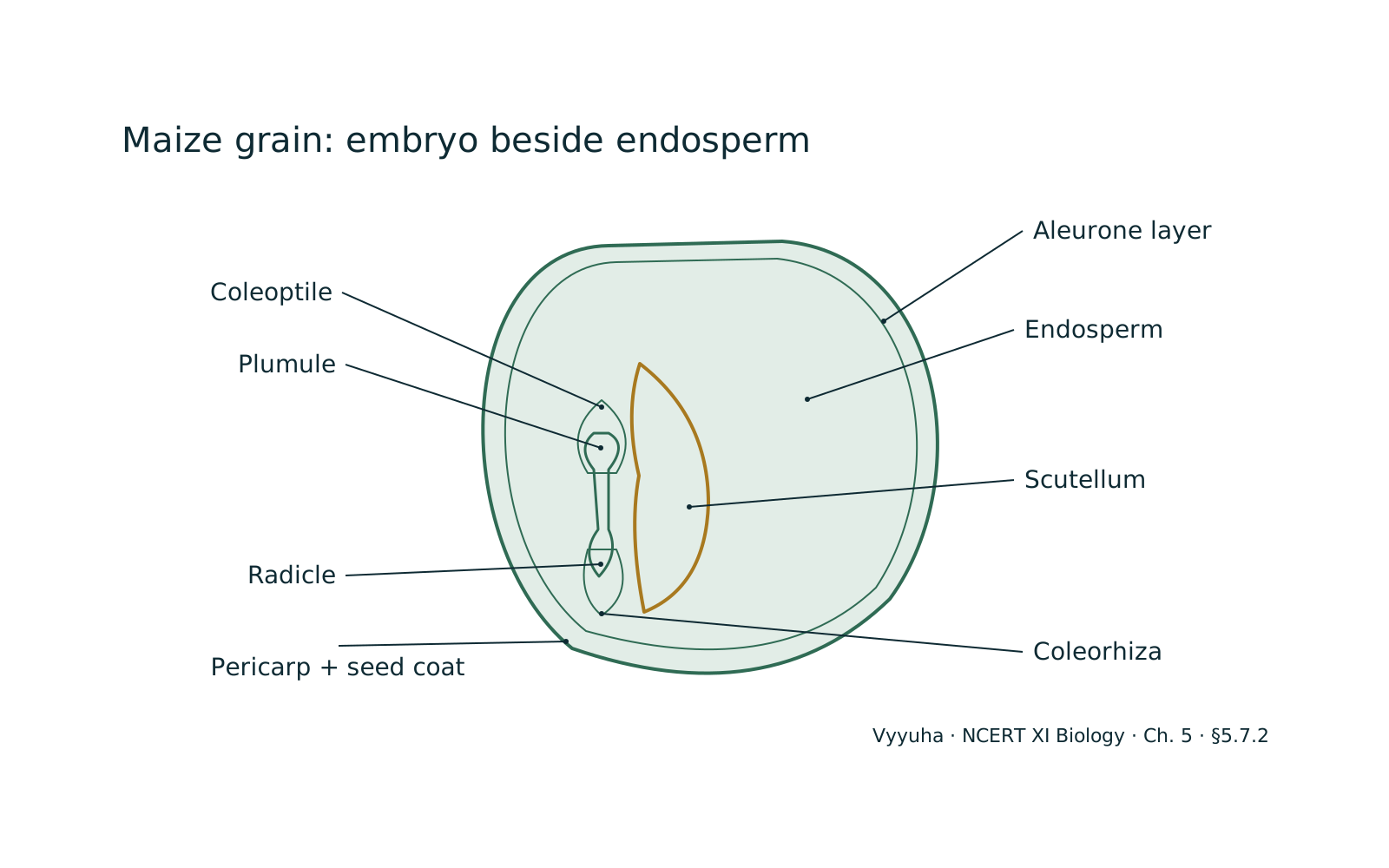
Cotyledons either store food directly (non-endospermic seeds like pea) or absorb it from a separate storage tissue called the endosperm (endospermic seeds like maize). Monocot seeds have one cotyledon (scutellum) and often protective sheaths like the coleoptile (for plumule) and coleorhiza (for radicle), along with an aleurone layer surrounding the endosperm.
Dicot seeds have two cotyledons and lack these sheaths. Seeds are vital for plant propagation, survival, and are a major source of human food.
Full explanation
The seed represents a pinnacle of evolutionary adaptation in higher plants, facilitating their successful colonization of terrestrial environments. It is a fertilized, mature ovule, containing an embryonic plant, stored food material, and a protective coat. This intricate structure is a testament to the plant's strategy for ensuring the survival and dispersal of its offspring.
Conceptual Foundation: Origin and Development
Seeds develop from ovules within the ovary of a flower after successful fertilization. The ovule, initially comprising an integument(s) surrounding a nucellus, which encloses the embryo sac, undergoes profound changes post-fertilization.
The zygote develops into the embryo, the primary endosperm nucleus develops into the endosperm (food storage tissue), and the integuments harden and transform into the protective seed coat. The funicle, which attaches the ovule to the placenta, often leaves a scar called the hilum on the mature seed.
Key Principles: Components of a Seed
Despite the vast diversity in seed morphology, all seeds share three fundamental components:
- Seed Coat (Testa): — This is the outermost protective layer of the seed, derived from the integuments of the ovule. Its primary functions include:
* Protection: Shielding the delicate embryo from mechanical injury, desiccation, and pathogen attack. * Regulation of Germination: The seed coat can be impermeable to water and gases, contributing to seed dormancy, which ensures germination only under favorable conditions.
It may also contain inhibitors that prevent premature germination. * Dispersal: In some cases, the seed coat may possess structures (e.g., wings, hairs) that aid in dispersal by wind, water, or animals.
The seed coat often has a small pore called the micropyle, which was originally the opening through which the pollen tube entered the ovule. In the mature seed, the micropyle facilitates the absorption of water and oxygen, crucial for germination.
The hilum is a scar on the seed coat, marking the point where the ovule was attached to the ovary wall via the funicle.
- Embryo: — This is the miniature, undeveloped plant contained within the seed, representing the future sporophyte. It is the product of the zygote's development. The embryo consists of:
* Embryonal Axis: The central axis from which other embryonic parts arise. * Radicle: The embryonic root, which is the first part to emerge during germination, growing downwards to anchor the plant and absorb water and minerals.
* Plumule: The embryonic shoot, located at the apex of the embryonal axis, which develops into the stem and leaves of the seedling. * Cotyledon(s): These are the 'seed leaves' attached to the embryonal axis.
Their number is a key distinguishing feature between monocotyledonous (one cotyledon) and dicotyledonous (two cotyledons) plants. Cotyledons serve primarily as food storage organs (in non-endospermic seeds) or as organs for absorbing nutrients from the endosperm (in endospermic seeds).
- Food Reserves: — The stored food provides the necessary energy and building blocks for the embryo's initial growth until it can photosynthesize independently. These reserves are typically rich in carbohydrates (starch), lipids (oils), and proteins. The location of these reserves determines the classification of seeds:
* Endospermic (Albuminous) Seeds: In these seeds (e.g., castor, maize, wheat, rice), the endosperm persists as the primary food storage tissue, nourishing the developing embryo. The cotyledons are typically thin and membranous, functioning mainly to absorb nutrients from the endosperm.
* Non-endospermic (Exalbuminous) Seeds: In these seeds (e.g., pea, bean, groundnut), the endosperm is completely consumed by the developing embryo during seed development, and the food reserves are transferred to and stored within the large, fleshy cotyledons.
The mature seed therefore lacks a prominent endosperm.
Detailed Structure: Monocotyledonous vs. Dicotyledonous Seeds
A. Dicotyledonous Seed (e.g., Bean, Pea, Gram):
- Seed Coat: — The outer protective covering, often tough. It has a hilum (scar of attachment) and a micropyle (small pore for water absorption and gas exchange).
- Embryo: — Consists of an embryonal axis and two large, fleshy cotyledons.
* Cotyledons: Store abundant food reserves (starch, protein, oil). They are typically thick and prominent, often filling the entire seed cavity. * Embryonal Axis: The portion of the axis above the cotyledonary attachment is the epicotyl, which terminates in the plumule (future shoot). The portion below the cotyledonary attachment is the hypocotyl, which terminates in the radicle (future root).
B. Monocotyledonous Seed (e.g., Maize, Wheat, Rice):
Monocot seeds are typically endospermic, meaning they retain a significant endosperm for food storage. They possess a single cotyledon.
- Seed Coat: — Often fused with the fruit wall (pericarp), forming a single protective layer, as seen in cereals (caryopsis).
- Endosperm: — Large and prominent, serving as the primary food storage tissue (rich in starch). It is separated from the embryo by a specialized proteinaceous layer called the aleurone layer, which is involved in enzyme secretion during germination.
- Embryo: — Small and located in a groove at one end of the endosperm. It consists of:
* Scutellum: This is the single, shield-shaped cotyledon. Its primary function is to absorb nourishment from the endosperm and transfer it to the growing embryo. * Embryonal Axis: Comprises the radicle and plumule.
* Coleoptile: A protective sheath that encloses the plumule. It emerges first from the soil during germination, protecting the delicate plumule as it pushes through the soil. * Coleorhiza: A protective sheath that encloses the radicle.
It also helps in protecting the radicle as it emerges.
Real-World Applications and Significance:
- Agriculture: — Understanding seed structure is fundamental to agriculture. Knowledge of food reserves helps in predicting nutritional value. Seed coat properties influence storage life and germination success. Seed dormancy mechanisms are manipulated for optimal crop yield.
- Food Security: — Seeds are a primary source of human and animal nutrition, providing carbohydrates, proteins, and oils. Cereals (monocots) and pulses (dicots) form the backbone of global food systems.
- Ecology and Conservation: — Seed dispersal mechanisms, dormancy, and viability are critical for plant population dynamics, ecosystem regeneration, and biodiversity conservation. Seed banks store diverse seeds to preserve genetic resources.
- Biotechnology: — Genetic modification often targets seed characteristics, such as nutrient content, disease resistance, or herbicide tolerance, to improve crop performance.
Common Misconceptions:
- All seeds have endosperm: — This is incorrect. Non-endospermic seeds (like pea, bean) store food in their cotyledons, with the endosperm being consumed during development.
- Cotyledons are true leaves: — While they are 'seed leaves', their primary function is often food storage or absorption, not photosynthesis in the initial stages. True leaves develop from the plumule.
- Seed is just a 'baby plant': — A seed is more complex; it's a 'baby plant' (embryo) with its protective packaging (seed coat) and packed lunch (food reserves).
NEET-Specific Angle:
NEET questions frequently test the identification of seed parts, their functions, and the differences between monocot and dicot seeds. Diagrams of maize and bean seeds are often used. Key terms like hilum, micropyle, radicle, plumule, cotyledon, scutellum, coleoptile, coleorhiza, and aleurone layer are high-yield.
Questions may also involve correlating seed structure with germination requirements or food storage types. A thorough understanding of the structural distinctions and functional roles of each component is essential for scoring well.
Key Concepts
The embryo is the heart of the seed, representing the future plant in a dormant state. It's a highly…
Seeds need a readily available energy source to fuel the embryo's initial growth before it can…
Monocot seeds, particularly those of cereals like maize and wheat, have evolved specialized protective…
Often confused with
Side-by-side differences the NEET paper likes to test.
| Aspect | Seed Structure | Dicotyledonous Seed |
|---|---|---|
| Number of Cotyledons | One (Scutellum) | Two |
| Endosperm | Generally present and large (endospermic), e.g., maize, wheat, rice. Primary food storage. | Generally absent or very reduced (non-endospermic), e.g., pea, bean, gram. Food stored in cotyledons. |
| Seed Coat & Pericarp | Often fused with the fruit wall (pericarp) in cereals (caryopsis). | Distinct seed coat, separate from the fruit wall. |
| Embryo Size | Relatively small, located at one end of the endosperm. | Relatively large, often filling the entire seed cavity. |
| Protective Sheaths | Presence of coleoptile (covering plumule) and coleorhiza (covering radicle). | Absence of coleoptile and coleorhiza. |
| Aleurone Layer | Present, separating endosperm from embryo (proteinaceous layer). | Absent. |
| Examples | Maize, Wheat, Rice, Sorghum, Onion, Lily | Pea, Bean, Gram, Castor, Groundnut, Mango |
Monocot and dicot seeds exhibit fundamental structural differences reflecting their evolutionary paths and germination strategies. Monocot seeds typically possess a single cotyledon (scutellum), a prominent endosperm for food storage, and specialized protective sheaths like the coleoptile and coleorhiza.
Their seed coat is often fused with the fruit wall. In contrast, dicot seeds have two cotyledons, which often serve as the primary food storage organs (making them non-endospermic), and lack the protective sheaths.
These distinctions are critical for identifying plant types and understanding their developmental biology.
Why it is tested: For NEET, understanding the differences between monocot and dicot seed structures is a high-yield topic. Questions frequently ask for identification of parts, functional differences, and examples. It's foundational for understanding plant morphology, anatomy, and reproduction, which are core syllabus components. Distinguishing features like the number of cotyledons, presence/absence of endosperm, and specialized sheaths are common points of inquiry.
Questions students ask
6 answered on this topic.
What is the primary function of the seed coat?
The seed coat, also known as the testa, serves as the primary protective layer of the seed. Its main function is to shield the delicate embryo and its stored food reserves from various external threats.
This includes protection against mechanical injury, desiccation (drying out), and attack by pathogens like fungi and bacteria, as well as insects. It also plays a crucial role in regulating seed dormancy and germination by controlling the entry of water and gases, ensuring the seed germinates only when conditions are favorable for seedling survival.
What is the difference between endospermic and non-endospermic seeds?
The distinction lies in where the food reserves are stored. Endospermic (or albuminous) seeds, like maize or castor, retain a prominent endosperm tissue that stores food for the embryo. The cotyledons in these seeds are usually thin and absorb nutrients from the endosperm.
Non-endospermic (or exalbuminous) seeds, such as pea or bean, have their endosperm completely consumed during embryo development, and the food reserves are instead stored directly within their large, fleshy cotyledons.
The mature seed of a non-endospermic plant therefore lacks a significant endosperm.
What are the main parts of an embryo within a seed?
The embryo, the 'baby plant' within the seed, consists of several key parts. It has an embryonal axis, which is the central stem-like structure. At one end of this axis is the radicle, which will develop into the root.
At the other end is the plumule, which will grow into the shoot (stem and leaves). Attached to the embryonal axis are one or two cotyledons (seed leaves), which either store food or absorb it from the endosperm.
The regions above and below the cotyledonary attachment are called the epicotyl and hypocotyl, respectively.
What is the significance of the micropyle and hilum on a seed?
The micropyle is a small pore or opening in the seed coat. It is significant because it allows for the absorption of water and oxygen into the seed, which are crucial for initiating germination. It was originally the entry point for the pollen tube during fertilization.
The hilum is a scar on the seed coat, marking the point where the ovule (which developed into the seed) was attached to the ovary wall by the funicle. It's essentially the 'belly button' of the seed, indicating its former connection to the mother plant.
How do monocot and dicot seeds differ in their food storage mechanisms?
Monocot seeds, such as those of maize or wheat, are typically endospermic. This means their primary food storage is within a large, well-developed endosperm, which is rich in starch. Their single cotyledon, called the scutellum, is usually thin and functions mainly to absorb nutrients from this endosperm.
Dicot seeds, like those of peas or beans, are often non-endospermic. In these, the endosperm is absorbed during development, and the two large, fleshy cotyledons themselves become the main storage organs for food reserves, such as starch, proteins, and oils.
What are coleoptile and coleorhiza, and what are their functions?
Coleoptile and coleorhiza are specialized protective sheaths found in monocot seeds. The coleoptile is a hollow, conical protective sheath that encloses the plumule (embryonic shoot). During germination, it grows rapidly, pushing through the soil and protecting the delicate plumule from mechanical damage as it emerges.
The coleorhiza is a protective sheath that surrounds the radicle (embryonic root). It also offers protection to the radicle as it grows downwards into the soil. Both structures are crucial for the successful establishment of monocot seedlings.
Revise in 30 seconds
- Seed: — Fertilized ovule, contains embryo, food, seed coat.
- Seed Coat (Testa): — Outermost protective layer. Has Hilum (attachment scar) & Micropyle (water/gas entry).
- Embryo: — Baby plant. Consists of:
- Radicle: Embryonic root. - Plumule: Embryonic shoot. - Cotyledon(s): Seed leaves (1 in monocots, 2 in dicots).
- Food Reserves:
- Endosperm: Separate nutritive tissue (e.g., Maize, Castor - endospermic). - Cotyledons: Store food directly (e.g., Pea, Bean - non-endospermic).
- Monocot Seed Specifics (e.g., Maize):
- Single cotyledon (Scutellum). - Coleoptile: Sheath protecting plumule. - Coleorhiza: Sheath protecting radicle. - Aleurone layer: Proteinaceous layer separating endosperm from embryo.
Some Elephants Can Run Pretty Carefully
- Seed Coat (Protection)
- Embryo (Baby plant)
- Cotyledons (Food storage/absorption)
- Radicle (Root)
- Plumule (Shoot)
- Coleoptile (Protects plumule in monocots)
- Coleorhiza (Protects radicle in monocots)