Formation of Secondary Tissues — Explained
Detailed Explanation
The formation of secondary tissues is a hallmark of secondary growth, a developmental process that leads to an increase in the girth or diameter of the stem and root in most dicotyledonous plants and gymnosperms.
This contrasts with primary growth, which is responsible for increasing the length of the plant body through the activity of apical meristems. Secondary growth is crucial for providing mechanical support to large, tall plants and for enhancing the capacity for long-distance transport of water, minerals, and nutrients.
Conceptual Foundation: Primary vs. Secondary Growth
Initially, a plant grows in length from its apical meristems, forming primary tissues like epidermis, primary cortex, primary xylem, and primary phloem. This is primary growth. As the plant ages and increases in size, the primary vascular tissues become insufficient for transport, and the primary protective layer (epidermis) cannot accommodate the increasing circumference.
This necessitates the development of secondary growth, driven by lateral meristems, which are cylindrical meristematic tissues responsible for increasing girth.
Key Principles/Laws: Role of Lateral Meristems
Secondary growth is entirely dependent on the activity of two primary lateral meristems:
- Vascular Cambium — Responsible for producing secondary vascular tissues (secondary xylem and secondary phloem).
- Cork Cambium (Phellogen) — Responsible for producing the periderm (cork, cork cambium, and secondary cortex), which replaces the epidermis and cortex.
Derivations where relevant: Formation and Activity of Vascular Cambium
In a young dicot stem, the vascular bundles are arranged in a ring. Each vascular bundle contains a strip of cambium called the intrafascicular cambium (primary meristematic tissue located between primary xylem and primary phloem).
During secondary growth, cells of the medullary rays (parenchymatous cells between vascular bundles) that are in line with the intrafascicular cambium become meristematic, forming the interfascicular cambium.
The intrafascicular and interfascicular cambia join to form a complete, continuous ring of vascular cambium.
This vascular cambium ring is composed of two types of cells:
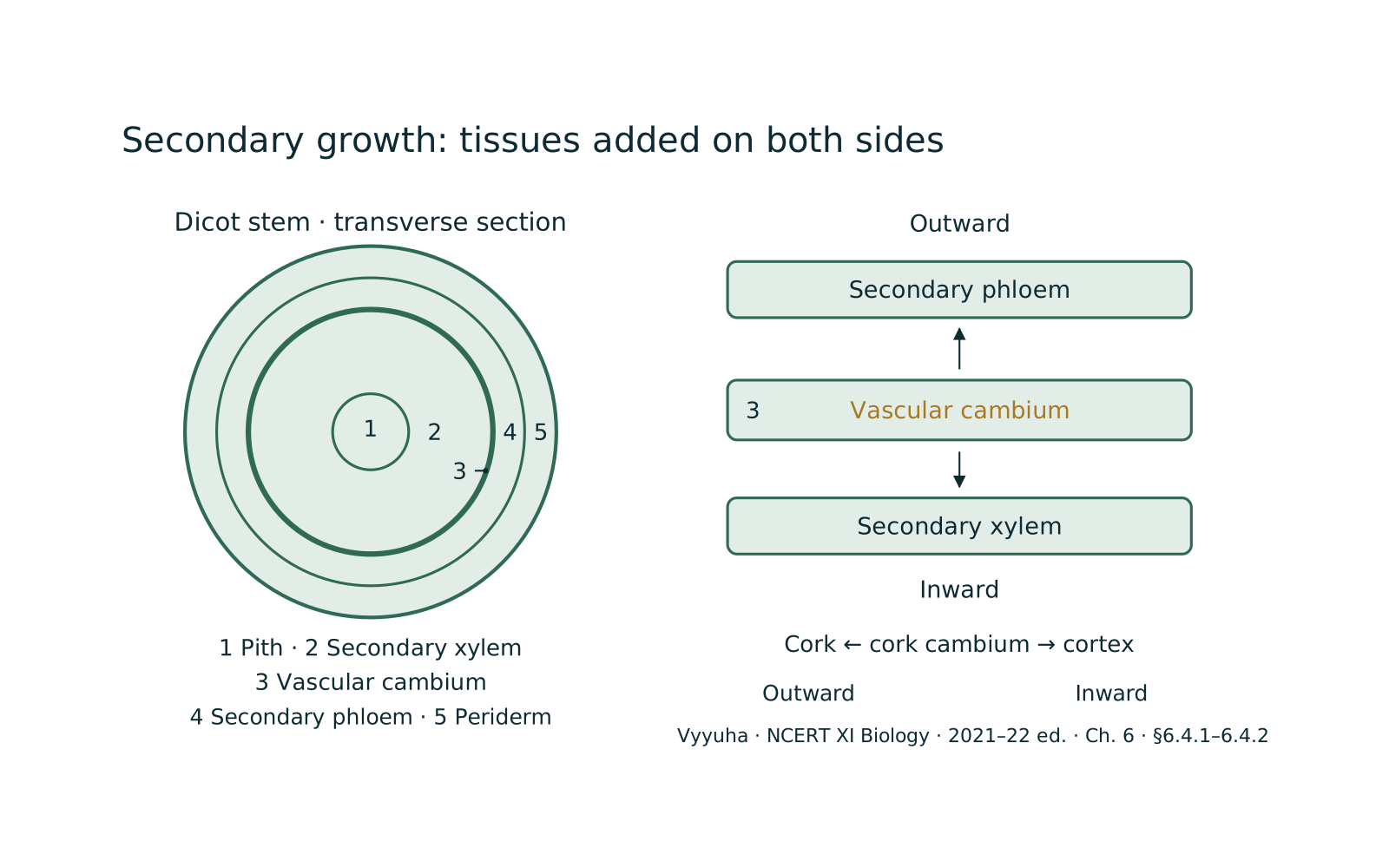
- Fusiform initials — Elongated cells that give rise to the axial system (secondary xylem and secondary phloem). They divide periclinally (parallel to the surface) to produce secondary xylem cells towards the inner side and secondary phloem cells towards the outer side. The cells produced towards the inside differentiate into tracheids, vessels, xylem fibres, and xylem parenchyma, forming the secondary xylem. The cells produced towards the outside differentiate into sieve tubes, companion cells, phloem parenchyma, and phloem fibres, forming the secondary phloem. The amount of secondary xylem produced is significantly greater than secondary phloem, leading to the characteristic woody stem.
- Ray initials — Isodiametric or slightly elongated cells that give rise to the radial system (vascular rays or medullary rays). These rays are composed of parenchyma cells that facilitate radial conduction of water and nutrients and storage.
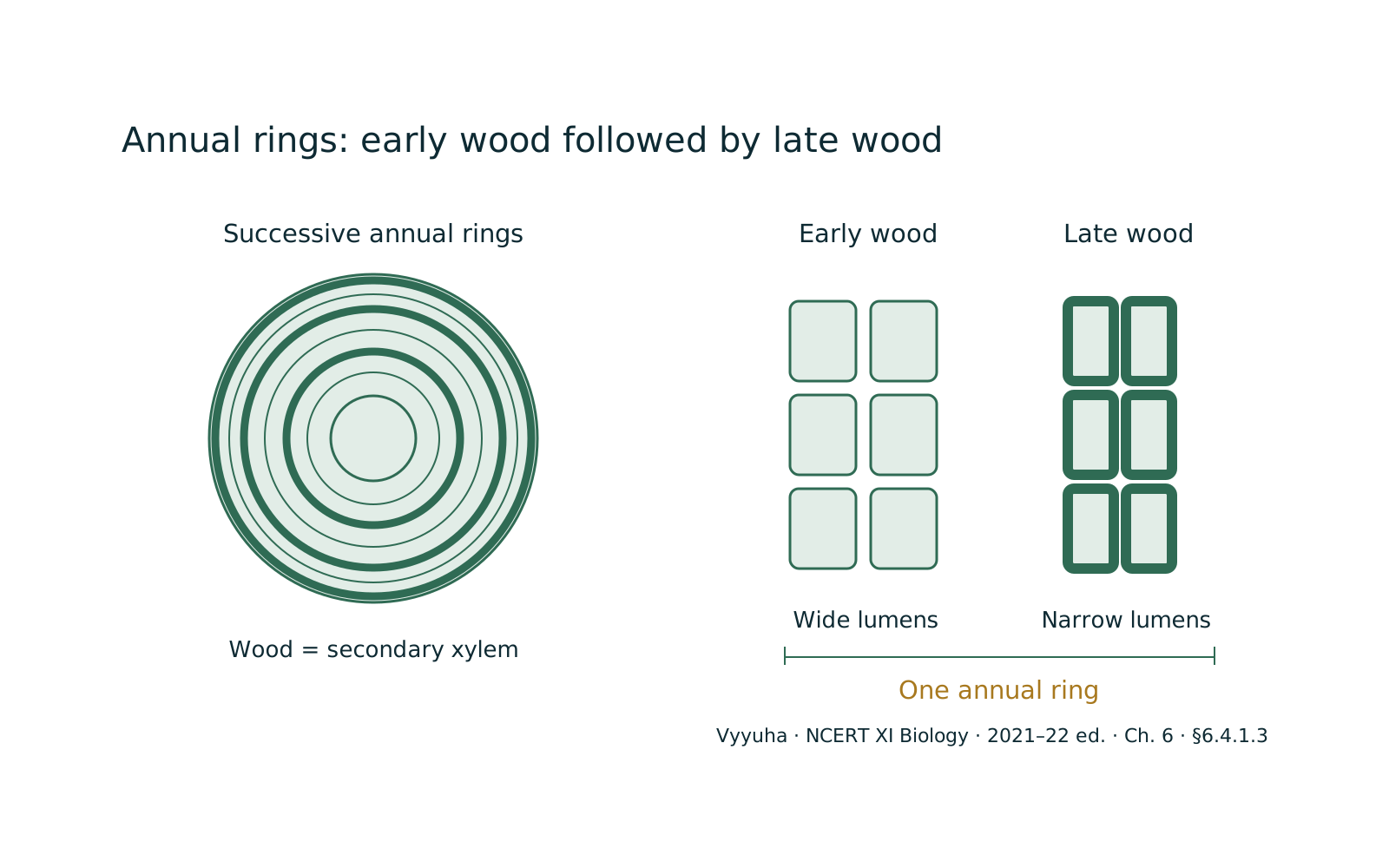
The activity of the vascular cambium is not uniform throughout the year in temperate regions, leading to the formation of annual rings. In spring, the cambium is more active, producing wider vessels and more parenchyma (spring wood or early wood). In winter, activity decreases, producing narrower vessels and more fibres (autumn wood or late wood). These distinct layers form visible annual rings, which can be used to determine the age of the tree.
Derivations where relevant: Formation and Activity of Cork Cambium (Phellogen)
As the secondary xylem and phloem accumulate, the stem's girth increases, putting pressure on the outer primary tissues (epidermis and cortex). The epidermis eventually ruptures. To provide a new protective layer, another lateral meristem, the cork cambium (phellogen), develops. Its origin varies; it can arise from the hypodermis, outer cortical cells, or even the pericycle in some roots.
The phellogen is a thin layer of meristematic cells that divides periclinally, similar to the vascular cambium:
- Towards the outside, it cuts off cells that differentiate into cork (phellum). These cells become dead, compactly arranged, and impregnated with suberin, making them impermeable to water and gases. Cork provides excellent protection against desiccation, mechanical injury, and pathogen invasion.
- Towards the inside, it cuts off cells that differentiate into secondary cortex (phelloderm). These are living parenchymatous cells, often containing chloroplasts, and function in storage.
The phellogen, phellum (cork), and phelloderm (secondary cortex) together constitute the periderm. This periderm replaces the epidermis as the protective outer covering of the stem or root. The accumulation of periderm layers, along with dead secondary phloem, forms the bark.
Lenticels
At certain regions, the phellogen cuts off parenchymatous cells instead of suberized cork cells towards the outside. These parenchymatous cells are loosely arranged and form a lens-shaped opening called a lenticel. Lenticels allow for gaseous exchange between the internal living tissues and the outer atmosphere, as the suberized cork is impermeable to gases. They appear as raised pores on the bark.
Real-World Applications
- Wood Production — Secondary xylem is the primary component of wood, a vital resource for construction, furniture, paper, and fuel.
- Bark — The outer protective layer, bark, is used for various purposes, including cork stoppers (from cork oak), tannins, and medicines.
- Dendrochronology — The study of annual rings (tree rings) to date events and study past climates. Each ring represents one year's growth.
- Tree Girth Measurement — The increase in girth due to secondary growth is a key indicator of tree health and growth rate.
Common Misconceptions
- Confusing Primary and Secondary Meristems — Students often confuse apical meristems (primary growth) with lateral meristems (secondary growth). It's crucial to understand that apical meristems increase length, while lateral meristems increase girth.
- Understanding Cambial Activity Direction — Remembering that vascular cambium produces secondary xylem inwards and secondary phloem outwards, and cork cambium produces cork outwards and phelloderm inwards, is key.
- Bark vs. Periderm — Bark is a broader term that includes all tissues outside the vascular cambium, which means it includes secondary phloem and all layers of the periderm. Periderm specifically refers to cork cambium, cork, and phelloderm.
- Annual Rings in Monocots — Monocots generally do not exhibit secondary growth and thus do not form annual rings, a common point of confusion.
NEET-specific Angle
For NEET, understanding the origin, location, and products of both vascular cambium and cork cambium is paramount. Questions often focus on:
- Identifying the tissues formed by each cambium.
- The relative amounts of secondary xylem and phloem.
- The components of the periderm and bark.
- The function of lenticels.
- The formation and significance of annual rings (early wood, late wood, heartwood, sapwood).
- Differences between primary and secondary growth, and between dicots/gymnosperms and monocots regarding secondary growth.
- The specific cells involved in forming the cambial rings (intrafascicular vs. interfascicular cambium).
Often confused with
Side-by-side differences the NEET paper likes to test.
| Aspect | Formation of Secondary Tissues | Primary Growth vs. Secondary Growth |
|---|---|---|
| Meristem Involved | Apical meristems (root apex, shoot apex) | Lateral meristems (vascular cambium, cork cambium) |
| Direction of Growth | Increases length of plant (vertical growth) | Increases girth/diameter of plant (horizontal growth) |
| Tissues Formed | Primary tissues (epidermis, primary cortex, primary xylem/phloem) | Secondary tissues (secondary xylem/phloem, periderm) |
| Occurrence | Occurs in all vascular plants (monocots, dicots, gymnosperms) | Mainly in dicots and gymnosperms; generally absent in monocots |
| Timing | Occurs throughout the plant's life at growing tips | Starts after primary growth is established, continues for many years in woody plants |
Primary growth is responsible for the elongation of the plant body, driven by apical meristems, and forms the initial set of tissues. In contrast, secondary growth, mediated by lateral meristems, leads to the thickening of stems and roots, producing specialized secondary tissues that provide structural support and enhanced transport capabilities, a characteristic feature of woody plants and gymnosperms. Understanding this distinction is fundamental to comprehending plant development.
Why it is tested: NEET relevance: This distinction is frequently tested in NEET, often through conceptual questions asking about the meristems involved, the tissues produced, or the overall effect on plant morphology. Students must clearly differentiate between the roles of apical and lateral meristems.
Questions students ask
5 answered on this topic.
What is the primary difference between primary and secondary growth in plants?
Primary growth refers to the increase in the length of a plant, occurring at the tips of roots and shoots due to the activity of apical meristems. It produces primary tissues like epidermis, primary cortex, and primary vascular bundles.
Secondary growth, on the other hand, is the increase in the girth or diameter of the plant, occurring in the lateral regions of stems and roots due to the activity of lateral meristems (vascular cambium and cork cambium).
It produces secondary tissues such as secondary xylem, secondary phloem, and periderm.
Where does the vascular cambium originate in a dicot stem, and what does it produce?
In a dicot stem, the vascular cambium originates from two sources: the intrafascicular cambium, which is already present within the vascular bundles between primary xylem and primary phloem, and the interfascicular cambium, which forms from the dedifferentiation of medullary ray cells located between the vascular bundles. These two merge to form a complete ring. The vascular cambium then produces secondary xylem towards the inner side of the stem and secondary phloem towards the outer side.
What is the periderm, and what are its components?
The periderm is the protective tissue that replaces the epidermis in plants undergoing secondary growth. It is formed by the activity of the cork cambium (phellogen). The periderm consists of three layers: the phellogen itself (cork cambium), the phellum (cork) which is produced towards the outside, and the phelloderm (secondary cortex) which is produced towards the inside. The phellum consists of dead, suberized cells providing protection, while the phelloderm is living parenchyma.
How are annual rings formed, and what is their significance?
Annual rings, also known as growth rings, are formed due to the differential activity of the vascular cambium throughout the year, especially in temperate regions. During spring, the cambium is more active, producing wider vessels and more parenchyma (early wood/spring wood).
In autumn/winter, its activity decreases, producing narrower vessels and more fibres (late wood/autumn wood). This creates distinct concentric rings. Each ring represents one year of growth, allowing for the determination of a tree's age (dendrochronology) and providing insights into past climatic conditions.
What are lenticels, and what is their function?
Lenticels are lens-shaped, raised openings on the surface of the bark, formed by the activity of the cork cambium. Instead of producing compact, suberized cork cells, the phellogen at these specific regions produces loosely arranged parenchymatous cells called complementary cells.
These cells create intercellular spaces, allowing for the exchange of gases (oxygen and carbon dioxide) between the internal living tissues of the stem and the external atmosphere, as the surrounding cork is impermeable to gases.
They are vital for respiration in woody stems.