Secondary Growth
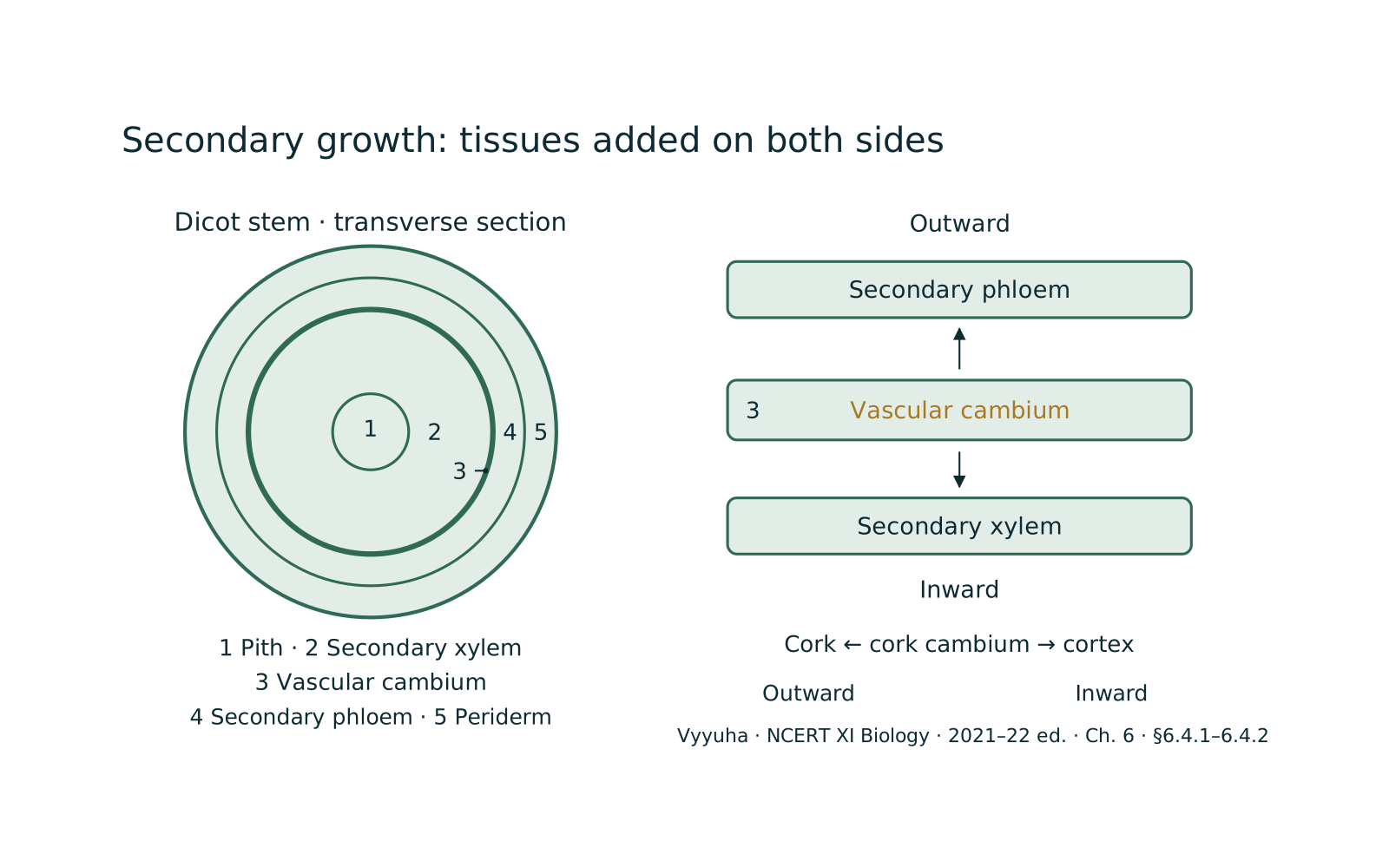
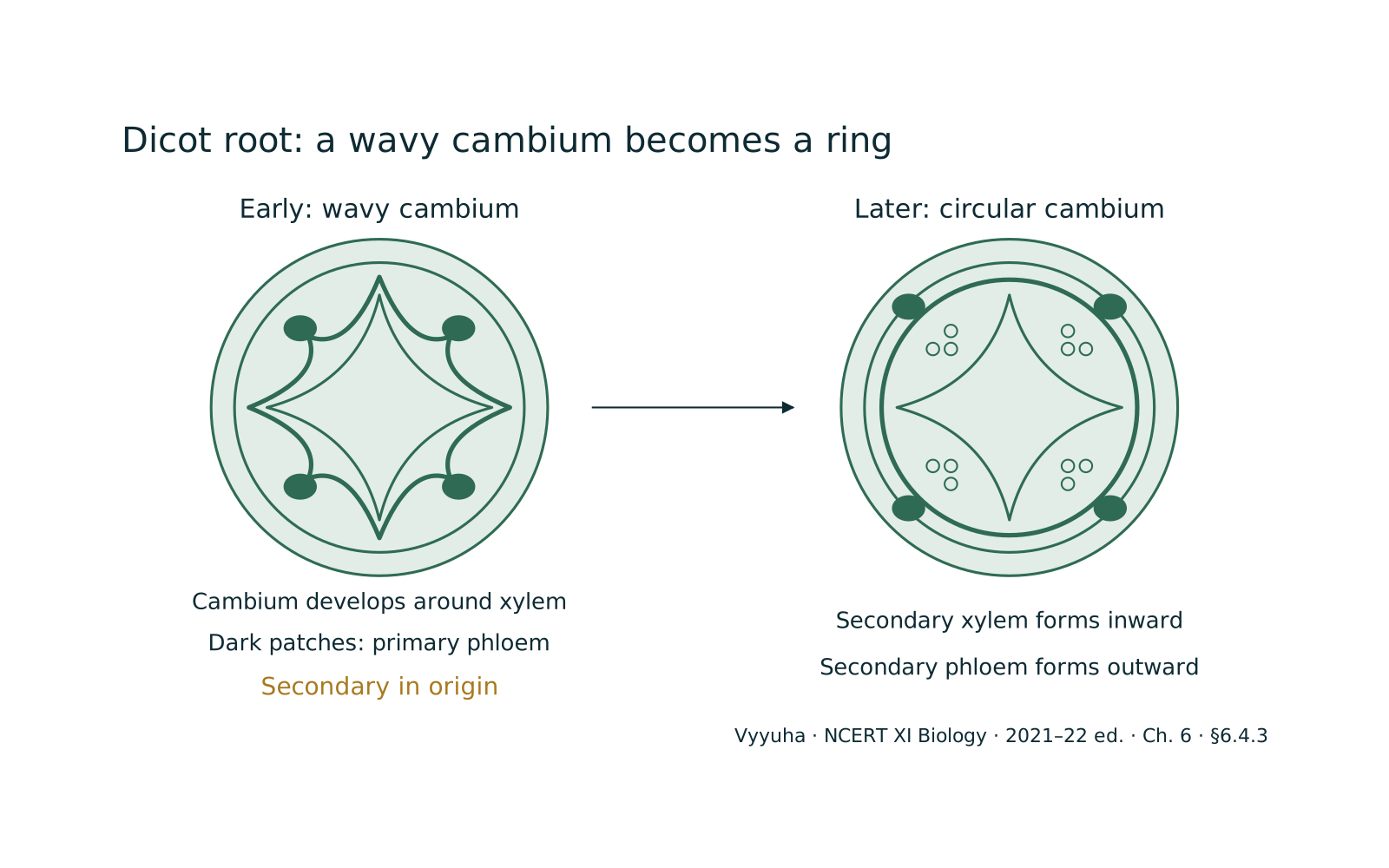
Secondary growth refers to the increase in girth or diameter of the plant body, primarily in dicotyledonous plants and gymnosperms. This growth is facilitated by the activity of two lateral meristems: the vascular cambium and the cork cambium. The vascular cambium produces secondary xylem towards the inner side and secondary phloem towards the outer side, leading to the formation of wood. The cork…
Quick Summary
Secondary growth is the increase in the girth of plant stems and roots, primarily in dicots and gymnosperms. It is driven by two lateral meristems: the vascular cambium and the cork cambium. The vascular cambium, forming a ring between primary xylem and phloem, produces secondary xylem (wood) inwards and secondary phloem outwards, significantly increasing the stem's diameter and transport capacity.
The cork cambium (phellogen) develops in the outer cortex, producing cork (phellem) towards the outside and secondary cortex (phelloderm) inwards. These three layers (phellogen, phellem, phelloderm) constitute the periderm, which replaces the epidermis as the protective outer layer.
All tissues outside the vascular cambium, including secondary phloem and periderm, are collectively called bark. Seasonal activity of the vascular cambium leads to annual rings, useful for age determination.
Heartwood (non-functional, central wood) provides support, while sapwood (functional, peripheral wood) conducts water. Lenticels are pores in the bark facilitating gas exchange.
Full explanation
Secondary growth is a fundamental developmental process in most dicotyledonous plants and all gymnosperms, leading to an increase in the girth or diameter of their stems and roots. This phenomenon is crucial for the long-term survival and structural integrity of perennial woody plants, enabling them to achieve significant size and longevity.
Unlike primary growth, which elongates the plant body through the activity of apical meristems, secondary growth involves lateral meristems that produce tissues in a radial direction.
Conceptual Foundation:
Plants, especially trees, need to grow not only taller but also wider to support the increasing biomass above ground, facilitate efficient long-distance transport of water and nutrients, and provide protection against environmental stresses and pathogens.
Primary vascular tissues (primary xylem and primary phloem) formed during initial growth are often insufficient for the demands of a large, mature plant. Secondary growth addresses these needs by continuously adding new vascular tissues and a robust protective outer layer.
Key Principles and Laws:
- Lateral Meristems: — The entire process is driven by the sustained activity of two types of lateral meristems: the vascular cambium and the cork cambium (phellogen).
- Unidirectional and Bidirectional Differentiation: — The vascular cambium exhibits bidirectional differentiation, producing secondary xylem inwards and secondary phloem outwards. The cork cambium, however, primarily produces phellem (cork) outwards and phelloderm (secondary cortex) inwards.
- Replacement of Epidermis: — As the stem or root expands, the primary protective tissue, the epidermis, is stretched and eventually sloughed off. The periderm, formed by the cork cambium, takes over the protective function.
- Environmental Influence: — The activity of the vascular cambium is often seasonal, leading to the formation of distinct growth rings (annual rings) that reflect environmental conditions.
Formation and Activity of Vascular Cambium:
In a young dicot stem, the vascular bundles are arranged in a ring. Each vascular bundle contains a strip of cambium called the fascicular cambium (or intrafascicular cambium), located between the primary xylem and primary phloem. To form a complete ring, cells of the medullary rays (parenchymatous cells between vascular bundles) become meristematic and form the interfascicular cambium. These two types of cambia join to form a continuous ring of vascular cambium.
Once formed, the vascular cambium ring becomes active. It is composed of two types of cells:
- Fusiform initials: — Elongated cells that give rise to the axial system (tracheary elements, sieve elements, fibers, axial parenchyma) of secondary xylem and phloem.
- Ray initials: — Isodiametric cells that produce the radial system (vascular rays) of secondary xylem and phloem, which are involved in radial transport and storage.
The vascular cambium divides periclinally (parallel to the surface) to produce new cells. Cells cut off towards the inner side differentiate into secondary xylem, while cells cut off towards the outer side differentiate into secondary phloem. The cambium itself remains meristematic. The amount of secondary xylem produced is significantly greater than secondary phloem, leading to the accumulation of wood.
Secondary Xylem (Wood):
Secondary xylem consists of tracheids, vessels, xylem fibres, and xylem parenchyma. It forms the bulk of the woody stem. The continuous addition of secondary xylem pushes the primary xylem towards the center (pith), where it eventually gets crushed or remains as a small, non-functional core. The secondary xylem is responsible for the efficient conduction of water and minerals and provides mechanical support.
Annual Rings (Growth Rings):
The activity of the vascular cambium is often influenced by seasonal climatic conditions, particularly in temperate regions. In spring, when conditions are favorable (ample water, warmth), the cambium is very active and produces a large number of wider vessels with thinner walls.
This wood is called spring wood or early wood, and it is lighter in color and less dense. In winter or late summer, when conditions are less favorable, the cambium is less active and produces narrower vessels with thicker walls, forming autumn wood or late wood.
This wood is darker and denser. The distinct boundary between spring wood and autumn wood of successive years forms an annual ring. Each annual ring represents one year's growth, allowing for the determination of a tree's age (dendrochronology).
Heartwood and Sapwood:
As a tree ages, the older, central part of the secondary xylem loses its water-conducting ability and becomes dark, hard, and durable due to the deposition of tannins, resins, gums, oils, and aromatic substances in the lumen of vessels and tracheids.
This non-functional, dark central region is called heartwood (duramen). It provides mechanical support but does not conduct water. The peripheral, lighter-colored part of the secondary xylem, which is still functional in water conduction, is called sapwood (alburnum).
Secondary Phloem:
Secondary phloem consists of sieve tubes, companion cells, phloem parenchyma, and phloem fibres. It is responsible for the translocation of organic nutrients (sugars) from leaves to other parts of the plant. Unlike secondary xylem, secondary phloem is produced in smaller quantities and is often crushed and sloughed off along with the outer bark layers as the stem expands.
Formation and Activity of Cork Cambium (Phellogen):
As the stem increases in girth, the epidermis and outer cortical layers are stretched and eventually break. To provide a new protective layer, a second lateral meristem, the cork cambium or phellogen, develops. It typically arises from the outer cortical cells, but can also originate from the hypodermis or even the pericycle in some plants. The phellogen is a few layers thick and divides periclinally.
Cells cut off towards the outside differentiate into cork or phellem. Phellem cells are dead, compactly arranged, and impregnated with suberin (a waxy substance) in their cell walls, making them impermeable to water and gases. This provides excellent protection against water loss, mechanical injury, and pathogen invasion. Cells cut off towards the inside differentiate into secondary cortex or phelloderm. Phelloderm cells are living, parenchymatous, and may contain chloroplasts.
The phellogen, phellem, and phelloderm collectively constitute the periderm, which replaces the epidermis as the protective tissue.
Bark:
All tissues exterior to the vascular cambium are collectively called bark. This includes secondary phloem and the periderm (phellogen, phellem, phelloderm). Bark can be of two types: early or soft bark (formed initially) and late or hard bark (formed later). Bark is a crucial protective layer.
Lenticels:
At certain regions, the phellogen cuts off parenchymatous cells instead of cork cells towards the outside. These parenchymatous cells rupture the epidermis, forming lens-shaped openings called lenticels. Lenticels facilitate gaseous exchange between the atmosphere and the internal tissues of the stem, as the suberized cork layer is impermeable to gases.
Secondary Growth in Dicot Roots:
Secondary growth in dicot roots is similar in principle but differs in the initial formation of the vascular cambium. In dicot roots, the vascular bundles are radial, with xylem and phloem separate. The vascular cambium originates from two sources:
- A portion of the pericycle, located just outside the protoxylem, becomes meristematic.
- Cells of the conjunctive parenchyma, located just below the phloem bundles, also become meristematic.
These meristematic strips join to form a wavy, complete ring of vascular cambium. This wavy ring soon becomes circular due to the greater activity of the cambium on the inner side of the phloem. The vascular cambium then produces secondary xylem towards the inside and secondary phloem towards the outside, similar to the stem. The cork cambium in roots typically originates from the pericycle, forming the periderm.
Real-World Applications:
- Dendrochronology: — The study of tree rings to date past events and understand climate history.
- Wood Industry: — Secondary xylem (wood) is a primary raw material for construction, furniture, paper, and fuel.
- Cork Production: — The phellem (cork) from certain trees (e.g., cork oak) is harvested for stoppers, insulation, and flooring.
Common Misconceptions:
- Monocots and Secondary Growth: — A common misconception is that all plants undergo secondary growth. Most monocots do not exhibit typical secondary growth, lacking a vascular cambium that forms a continuous ring. Some monocots, like palms and Dracaena, show anomalous secondary thickening, but it's not the same as the typical dicot/gymnosperm process.
- Primary vs. Secondary Tissues: — Students often confuse primary xylem/phloem with secondary xylem/phloem. Primary tissues are formed by apical meristems, while secondary tissues are formed by lateral meristems.
- Bark Composition: — Bark is not just cork. It includes all tissues outside the vascular cambium, encompassing secondary phloem and the entire periderm.
NEET-Specific Angle:
NEET questions frequently test the origin and activity of vascular and cork cambia, the composition of bark and periderm, the differences between heartwood and sapwood, and the formation of annual rings.
Understanding the sequence of events in secondary growth, especially the relative positions of primary and secondary tissues, is crucial. The distinction between secondary growth in dicot stems and roots, particularly the origin of the vascular cambium, is a common point of inquiry.
Anomalous secondary growth is usually not a primary focus but might appear as an option to distinguish from typical secondary growth.
Key Concepts
The vascular cambium is the primary engine of secondary growth. In a dicot stem, it doesn't just appear as a…
As the stem or root expands due to the vascular cambium's activity, the epidermis, which is the primary…
Annual rings are a fascinating outcome of secondary growth, particularly evident in trees from temperate…
Often confused with
Side-by-side differences the NEET paper likes to test.
| Aspect | Secondary Growth | Primary Growth |
|---|---|---|
| Meristem Involved | Apical meristems (shoot and root apices) | Lateral meristems (vascular cambium, cork cambium) |
| Direction of Growth | Increases length (elongation) | Increases girth/diameter (thickness) |
| Tissues Formed | Primary xylem, primary phloem, epidermis, cortex, pith | Secondary xylem, secondary phloem, periderm (cork, phelloderm) |
| Occurrence | Occurs in all vascular plants (monocots, dicots, gymnosperms) | Mainly in dicots and gymnosperms; generally absent in monocots |
| Timing | Occurs throughout the plant's life at growing tips | Begins after primary growth is established, continues throughout life in perennial woody plants |
| Protective Layer | Epidermis | Periderm (bark) |
Primary growth is responsible for the increase in length of a plant, driven by apical meristems at the tips of shoots and roots, forming primary tissues like epidermis, cortex, and primary vascular bundles.
In contrast, secondary growth increases the girth or thickness of the plant, primarily in dicots and gymnosperms, through the activity of lateral meristems – the vascular cambium and cork cambium. This process forms secondary vascular tissues (wood and secondary phloem) and a protective periderm (bark), providing structural support and enhanced transport capacity.
Why it is tested: For NEET, understanding the fundamental distinction between primary and secondary growth is crucial. Questions often test the meristems involved, the tissues produced, and the functional significance of each type of growth. Knowing which plant groups exhibit which type of growth is also a common test point.
| Aspect | Secondary Growth | Dicot Stem Secondary Growth |
|---|---|---|
| Origin of Vascular Cambium | Partially from fascicular cambium (intrafascicular) and partially from interfascicular cambium (medullary ray cells) | Partially from conjunctive parenchyma (below phloem) and partially from pericycle (outside protoxylem) |
| Shape of Cambial Ring (Initial) | Initially discontinuous, then forms a continuous ring by interfascicular cambium | Initially wavy, then becomes circular due to differential activity |
| Primary Xylem Position | Pushed towards the pith (center) | Remains in the center, often crushed or non-functional |
| Origin of Cork Cambium | Typically from outer cortical cells | Typically from the pericycle |
| Lenticels | Present on the stem surface | May be present on the root surface, but less prominent than in stems |
While both dicot stems and roots undergo secondary growth, the origin of their lateral meristems differs. In dicot stems, the vascular cambium forms from both fascicular and interfascicular cambium, creating a continuous ring.
The cork cambium typically arises from the cortex. In dicot roots, the vascular cambium originates from conjunctive parenchyma and the pericycle, initially forming a wavy ring that later becomes circular.
The cork cambium in roots usually originates from the pericycle. These differences reflect the distinct primary anatomical arrangements of stems and roots.
Why it is tested: NEET often includes questions that require distinguishing between secondary growth in dicot stems and roots, particularly concerning the specific tissues from which the vascular and cork cambia originate. Understanding these subtle differences is key to correctly answering such comparative questions.
Questions students ask
6 answered on this topic.
What is the primary function of secondary growth in plants?
The primary function of secondary growth is to increase the girth or diameter of the plant stem and root. This increase in thickness provides several critical advantages: enhanced mechanical support to bear the weight of a growing canopy, increased capacity for long-distance transport of water and nutrients through additional vascular tissues, and improved protection against physical damage, pathogens, and desiccation through the formation of a robust periderm (bark).
It allows perennial plants to achieve larger sizes and greater longevity.
How does the vascular cambium differ from the cork cambium?
The vascular cambium and cork cambium are both lateral meristems, but they differ in their location, origin, and the tissues they produce. The vascular cambium is located between the primary xylem and primary phloem, forming a continuous ring, and produces secondary xylem inwards and secondary phloem outwards, contributing to the plant's vascular system.
The cork cambium (phellogen) typically originates in the cortex or pericycle, is located more superficially, and produces cork (phellem) outwards and secondary cortex (phelloderm) inwards, forming the protective periderm.
What are annual rings and what is their significance?
Annual rings, also known as growth rings, are concentric circles visible in the cross-section of a woody stem. They are formed due to the seasonal activity of the vascular cambium. During favorable conditions (spring), the cambium is highly active, producing 'spring wood' with larger, thinner-walled cells.
During unfavorable conditions (autumn/winter), activity decreases, forming 'autumn wood' with smaller, thicker-walled cells. The distinct boundary between these two types of wood from successive years forms an annual ring.
Each ring represents one year's growth, allowing scientists to determine the age of a tree (dendrochronology) and infer past climatic conditions.
Explain the difference between heartwood and sapwood.
Heartwood (duramen) and sapwood (alburnum) are two distinct regions within the secondary xylem of a woody stem. Sapwood is the outer, lighter-colored, living, and physiologically active part of the secondary xylem that is responsible for water and mineral conduction.
Heartwood, on the other hand, is the older, central, darker-colored, and non-functional part of the secondary xylem. Its vessels become plugged with resins, gums, tannins, and other metabolic byproducts, making it more durable and resistant to decay, primarily serving a mechanical support function.
What is bark, and what are its components?
Bark is a general term referring to all tissues located exterior to the vascular cambium in a woody stem or root. It serves as the primary protective layer of the plant. Its components include the secondary phloem (which transports sugars) and the periderm.
The periderm itself is composed of three layers: the phellogen (cork cambium), which is the meristematic layer; the phellem (cork), which is the protective, suberized tissue produced outwards; and the phelloderm (secondary cortex), which is the living parenchymatous tissue produced inwards by the phellogen.
Bark protects against water loss, physical damage, and pathogen entry.
Do monocots exhibit secondary growth?
Generally, monocotyledonous plants do not exhibit typical secondary growth. This is because they lack a continuous ring of vascular cambium that can produce secondary xylem and phloem in a sustained manner.
Their vascular bundles are scattered and closed (lacking cambium). However, some monocots, such as palms (e.g., date palm) and species of Dracaena or Yucca, show a type of 'anomalous secondary thickening' where diffuse meristematic activity in the ground tissue or a specialized cambium produces additional vascular bundles and parenchyma, leading to an increase in girth, but this process differs significantly from the typical secondary growth seen in dicots and gymnosperms.
Revise in 30 seconds
- Secondary Growth: — Increase in girth/diameter.
- Lateral Meristems: — Vascular cambium, Cork cambium.
- Vascular Cambium: — Between primary xylem & phloem. Produces secondary xylem (inwards) & secondary phloem (outwards).
- Cork Cambium (Phellogen): — In cortex (stem) or pericycle (root). Produces phellem (cork, outwards) & phelloderm (secondary cortex, inwards).
- Periderm: — Phellem + Phellogen + Phelloderm. Replaces epidermis.
- Bark: — All tissues external to vascular cambium (secondary phloem + periderm).
- Annual Rings: — Spring wood + Autumn wood = 1 year's growth. Formed by seasonal vascular cambium activity.
- Heartwood (Duramen): — Central, dark, non-conducting, durable, supportive.
- Sapwood (Alburnum): — Peripheral, light, conducting, living.
- Lenticels: — Pores in bark for gas exchange.
Very Clever Cambium Produces Secondary Xylem Inside, Secondary Phloem Outside. Cork Cambium Protects Plants With Periderm.