Law of Definite Proportions
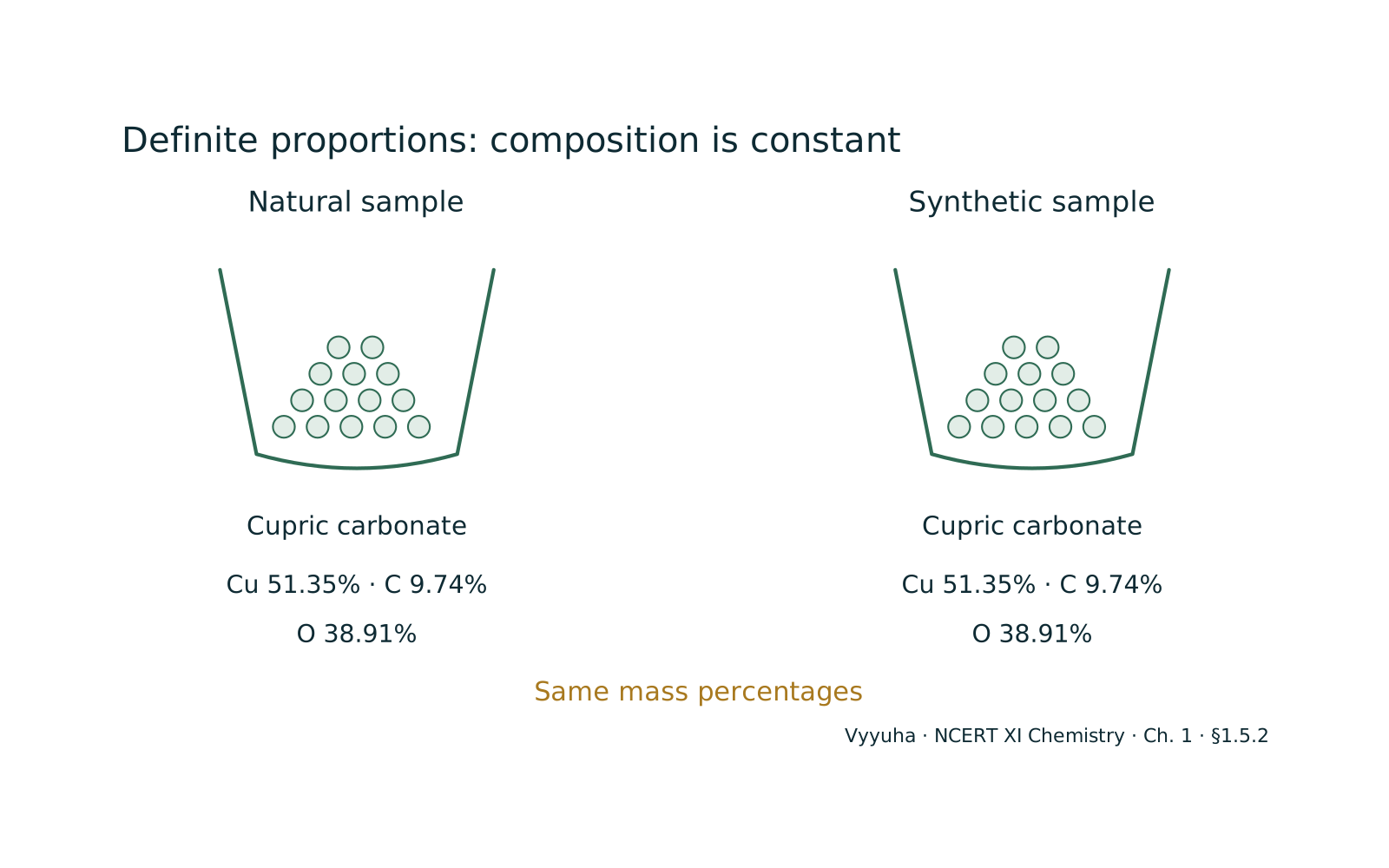
The Law of Definite Proportions, also known as Proust's Law or the Law of Constant Composition, states that a given chemical compound always contains its component elements in fixed ratio by mass, irrespective of the source or method of preparation. This fundamental principle implies that for any pure chemical compound, the proportion of each element by mass will remain constant. For instance, wat…
Quick Summary
The Law of Definite Proportions, also known as Proust's Law or the Law of Constant Composition, is a fundamental principle in chemistry. It states that any given pure chemical compound always contains its constituent elements combined in the same fixed ratio by mass, regardless of its source or method of preparation.
For example, water () always consists of hydrogen and oxygen in a mass ratio of 1:8. This law is a direct consequence of atoms combining in specific whole-number ratios to form molecules. It helps distinguish pure compounds from mixtures, as mixtures can have variable compositions.
This principle is essential for understanding stoichiometry, performing chemical analysis, and ensuring quality control in various industries. While minor exceptions exist for non-stoichiometric compounds, for most substances, this law is universally applicable and forms a cornerstone of quantitative chemistry.
Full explanation
The Law of Definite Proportions, a foundational principle in chemistry, asserts that a pure chemical compound, irrespective of its source or method of preparation, will always consist of the same elements combined in the same fixed ratio by mass.
This law, first formally articulated by the French chemist Joseph Proust in 1799, was a crucial step in moving chemistry from a qualitative art to a quantitative science. It provided a clear distinction between chemical compounds and mixtures, laying the groundwork for Dalton's atomic theory.
Conceptual Foundation
At its heart, the Law of Definite Proportions is a direct consequence of the atomic theory and the nature of chemical bonding. When atoms combine to form molecules or ionic lattices, they do so in specific, whole-number ratios to achieve stable electron configurations.
For instance, two hydrogen atoms will always combine with one oxygen atom to form a water molecule (). Each hydrogen atom has a specific atomic mass (approximately 1 amu), and each oxygen atom has a specific atomic mass (approximately 16 amu).
Therefore, in any water molecule, the mass contributed by hydrogen will be amu, and the mass contributed by oxygen will be amu. The mass ratio of hydrogen to oxygen is thus , which simplifies to .
This ratio is inherent to the structure of the water molecule itself. Since all pure water samples are composed of identical molecules, their overall elemental mass composition must also be constant.
This principle holds true for all pure compounds. For example, carbon dioxide () always contains carbon and oxygen in a mass ratio of (or ), because one carbon atom (12 amu) combines with two oxygen atoms ( amu). This fixed atomic ratio translates directly into a fixed mass ratio.
Key Principles and Implications
- Constant Composition — The most direct implication is that the elemental composition by mass of a pure compound is invariant. This means that if you analyze a sample of a specific compound, say sodium chloride (common salt), from different sources (e.g., evaporated seawater, mined rock salt, or laboratory synthesis), the percentage by mass of sodium and chlorine will always be the same.
- Distinction from Mixtures — This law provides a clear criterion to differentiate compounds from mixtures. In a mixture, the components can be present in variable proportions. For example, a sugar solution can be dilute or concentrated, meaning the ratio of sugar to water can vary. However, in a compound, the ratio is fixed.
- Basis for Stoichiometry — The law is fundamental to stoichiometry, the branch of chemistry dealing with the quantitative relationships between reactants and products in chemical reactions. Knowing the fixed mass ratios allows chemists to predict the amount of reactants needed or products formed in a reaction.
- Purity of Substances — The law implies that any deviation from the expected fixed mass ratio indicates either an impure sample or a different chemical compound altogether.
Illustrative Examples and Calculations
Let's consider a few examples to solidify understanding:
- Water ($H_2O$) — Atomic mass of H amu, O amu.
Mass of H in amu. Mass of O in amu. Mass ratio H:O = . Percentage of H by mass = . Percentage of O by mass = . These percentages are constant for all pure water samples.
- Ammonia ($NH_3$) — Atomic mass of N amu, H amu.
Mass of N in amu. Mass of H in amu. Mass ratio N:H = . Percentage of N by mass = . Percentage of H by mass = .
Real-World Applications
- Chemical Analysis — The law is crucial in analytical chemistry for determining the composition of unknown compounds and verifying the purity of known substances. If an experimental analysis yields a different mass ratio than expected for a known compound, it suggests impurities or an error in the analysis.
- Industrial Chemistry — In manufacturing processes, maintaining precise ratios of reactants is essential to produce the desired compound efficiently and with high purity. For example, in the Haber process for ammonia synthesis, the ratio of nitrogen to hydrogen is carefully controlled.
- Quality Control — Industries use this law for quality control. For instance, if a pharmaceutical company is producing a drug, they must ensure that each batch has the exact same chemical composition to guarantee efficacy and safety.
- Environmental Science — Analyzing pollutants often involves determining the composition of various compounds. The Law of Definite Proportions helps identify specific compounds present in environmental samples.
Common Misconceptions and Nuances
- Mixtures vs. Compounds — Students often confuse compounds with mixtures. The key differentiator is the fixed mass ratio for compounds versus variable ratios for mixtures. A solution of sugar in water is a mixture, but the sugar () itself is a compound with a definite composition.
- Isotopes — While the law states a fixed mass ratio, it's important to remember that atomic masses are average masses. The presence of different isotopes (atoms of the same element with different numbers of neutrons, hence different masses) can lead to slight variations in the exact mass of individual molecules. However, for macroscopic samples, the average atomic masses ensure that the overall mass ratio remains constant and definite. For example, water made with deuterium () will have a different mass ratio than water made with protium (), but itself will always have a definite composition, and will always have its own definite composition. The law applies to a specific compound.
- Non-Stoichiometric Compounds — A small class of compounds, primarily certain metal oxides and sulfides, are known as non-stoichiometric compounds (e.g., ). These compounds do not strictly adhere to the Law of Definite Proportions because their elemental composition can vary within a narrow range due to crystal lattice defects. However, these are exceptions and are typically discussed at more advanced levels. For the vast majority of inorganic and organic compounds relevant to NEET, the law holds true.
- Allotropes — Allotropes are different structural forms of the same element (e.g., diamond and graphite are allotropes of carbon). They are not compounds and thus the law does not apply to them in the same way. The law applies to substances formed by the chemical combination of two or more different elements.
NEET-Specific Angle
For NEET aspirants, understanding the Law of Definite Proportions is crucial for several reasons:
- Foundation for Stoichiometry — It's a prerequisite for solving problems involving mole concepts, empirical and molecular formulas, and reaction stoichiometry. Many numerical problems in NEET indirectly test this understanding.
- Conceptual Questions — Questions might involve identifying whether a given scenario violates or adheres to the law, or distinguishing between compounds and mixtures based on composition data.
- Calculations of Percentage Composition — Direct questions asking for the percentage by mass of an element in a compound are common.
- Relationship with Other Laws — It's often tested in conjunction with the Law of Conservation of Mass and the Law of Multiple Proportions, requiring students to differentiate between them and apply the correct law to a given problem. Mastering this law ensures a strong foundation for quantitative chemistry, which is a significant part of the NEET syllabus.
Key Concepts
This is the core idea of the Law of Definite Proportions. It means that for any specific chemical compound,…
The Law of Definite Proportions serves as a crucial criterion to distinguish between a pure compound and a…
Understanding the Law of Definite Proportions allows us to calculate the percentage by mass of each element…
Often confused with
Side-by-side differences the NEET paper likes to test.
| Aspect | Law of Definite Proportions | Law of Multiple Proportions |
|---|---|---|
| Focus | Composition of a single compound | Composition of two or more compounds formed from the same elements |
| Statement | Elements combine in fixed mass ratios in a given compound. | If two elements combine to form more than one compound, the masses of one element that combine with a fixed mass of the other are in simple whole-number ratios. |
| Example | Water ($H_2O$) always has H:O mass ratio of 1:8. | In $CO$ (C:O = 12:16) and $CO_2$ (C:O = 12:32), for a fixed mass of C (12g), oxygen masses (16g and 32g) are in ratio 1:2. |
| Purpose | Defines the constant nature of a specific compound's composition. | Explains the existence of multiple compounds between the same two elements. |
The Law of Definite Proportions establishes that a specific compound always has the same elemental mass ratio, defining its unique composition. In contrast, the Law of Multiple Proportions addresses situations where two elements form more than one compound.
It states that if one element's mass is fixed, the masses of the other element combining with it in different compounds will bear a simple whole-number ratio. Both laws are crucial for understanding chemical composition and were instrumental in the development of atomic theory, but they describe different aspects of how elements combine.
Why it is tested: NEET relevance: Both laws are fundamental to understanding the quantitative aspects of chemical reactions and the nature of compounds. Questions often require distinguishing between these laws or applying them to solve problems related to empirical formulas and stoichiometry. A clear understanding of both is essential for conceptual clarity and problem-solving in chemical combination laws.
Questions students ask
5 answered on this topic.
What is the main difference between the Law of Definite Proportions and the Law of Conservation of Mass?
The Law of Definite Proportions focuses on the composition of a pure chemical compound, stating that elements combine in fixed mass ratios. It describes the internal makeup of a compound. The Law of Conservation of Mass, on the other hand, deals with the total mass in a chemical reaction, stating that mass is neither created nor destroyed.
It describes what happens to mass during a transformation. While both are fundamental, the former describes the 'recipe' of a compound, and the latter describes the 'accounting' of mass in a reaction.
Does the Law of Definite Proportions apply to mixtures?
No, the Law of Definite Proportions does not apply to mixtures. This is a critical distinction. Mixtures, by definition, can have variable compositions. For example, you can mix different amounts of sugar and water to create various sugar solutions, each with a different ratio of sugar to water.
In contrast, a pure chemical compound, like water (), always has hydrogen and oxygen in a fixed 1:8 mass ratio, regardless of its source or how it was formed. This fixed ratio is what defines a compound.
Are there any exceptions to the Law of Definite Proportions?
While the Law of Definite Proportions holds true for the vast majority of chemical compounds, there are a few notable exceptions, primarily non-stoichiometric compounds. These are typically solid inorganic compounds, like certain metal oxides or sulfides (e.
g., ), where the ratio of elements can vary slightly due to crystal lattice defects. However, for the purpose of NEET and general chemistry, this law is considered universally applicable to pure, stoichiometric compounds.
Another nuance arises with isotopes, where the exact atomic mass can vary, but for macroscopic samples, average atomic masses ensure the law's validity.
How does this law help in identifying a pure compound?
The Law of Definite Proportions is a powerful tool for identifying and verifying the purity of a chemical compound. If you analyze a substance and find that its elemental composition by mass matches the known fixed ratio for a specific compound, it strongly suggests that you have a pure sample of that compound.
Conversely, if the mass ratios deviate from the expected values, it indicates that the substance is either impure (a mixture) or a different compound altogether. This principle is widely used in analytical chemistry and quality control.
What is the significance of Joseph Proust in relation to this law?
Joseph Proust was a French chemist who, through meticulous experiments conducted between 1797 and 1804, observed and formally stated the Law of Definite Proportions. He meticulously analyzed various compounds, such as copper carbonate, and consistently found that the elements within them were always present in the same proportions by mass.
His work was crucial in establishing a quantitative basis for chemistry and played a significant role in the development of John Dalton's atomic theory, which later provided a theoretical explanation for Proust's empirical observations.
Revise in 30 seconds
- Law of Definite Proportions (Proust's Law) — A pure chemical compound always contains its elements in a fixed ratio by mass, regardless of source or preparation.
- Key Idea — Constant composition for a specific compound.
- Formula for Percentage Composition —
- Distinction — Applies to one compound, unlike Law of Multiple Proportions (multiple compounds from same elements).
- Example — Water () always has H:O mass ratio of .
Pure Compounds Fix Mass Ratios: Proust's Law states that Compounds have Fixed Mass Ratios of their elements.