Molar Volume of Gases
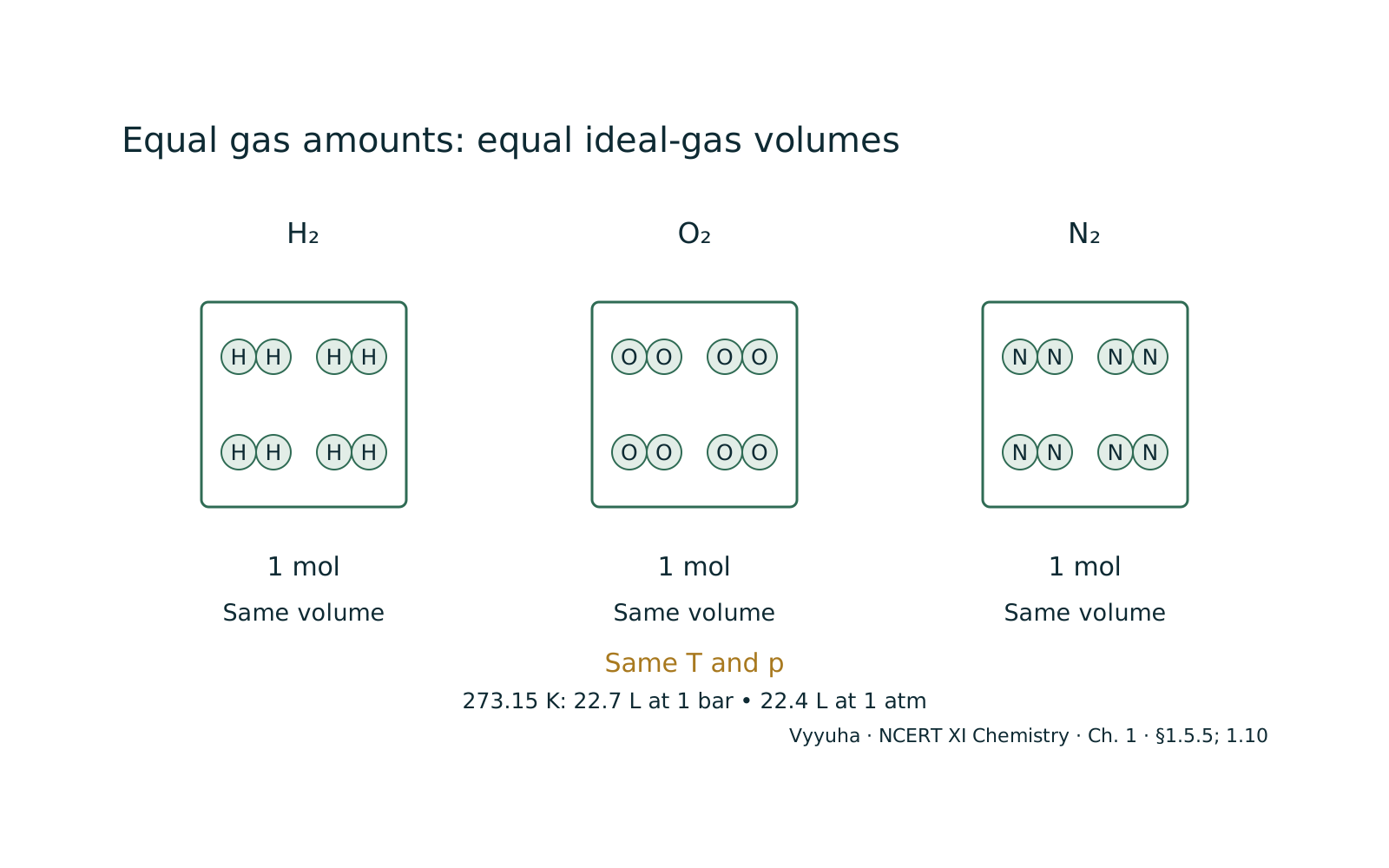
The molar volume of a gas is defined as the volume occupied by one mole of that gas under specific conditions of temperature and pressure. According to Avogadro's hypothesis, equal volumes of all gases, at the same temperature and pressure, contain an equal number of moles or molecules. This implies that one mole of any ideal gas will occupy the same volume under identical conditions. The most com…
Quick Summary
Molar volume of a gas is the volume occupied by one mole ( molecules) of that gas under specified conditions of temperature and pressure. This concept is derived from Avogadro's Law and the Ideal Gas Equation (), which states that for an ideal gas, .
Crucially, for ideal gases, the molar volume is independent of the gas's chemical identity. The most common standard conditions are STP (Standard Temperature and Pressure) and NTP (Normal Temperature and Pressure).
At old STP ( and ), the molar volume of an ideal gas is approximately . At IUPAC STP ( and ), it's .
At NTP ( and ), it's about . This concept is vital for stoichiometric calculations involving gases, allowing direct conversion between volume and moles under standard conditions.
However, it's important to remember that these values apply to ideal gases and change with varying temperature and pressure, and real gases deviate from ideal behavior.
Full explanation
The concept of molar volume of gases is a cornerstone of chemical stoichiometry, particularly when dealing with gaseous reactants and products. It provides a direct link between the macroscopic volume of a gas and the microscopic number of moles, simplifying calculations that would otherwise require the full ideal gas law. To truly grasp molar volume, we must first understand its conceptual underpinnings.
Conceptual Foundation: Avogadro's Law and the Ideal Gas Equation
The foundation of molar volume lies in Avogadro's Law, which states that equal volumes of all gases, at the same temperature and pressure, contain the same number of molecules (or moles).
- is the pressure of the gas
- is the volume of the gas
- is the number of moles of the gas
- is the ideal gas constant
- is the absolute temperature of the gas (in Kelvin)
The ideal gas equation describes the behavior of an 'ideal gas' – a theoretical gas composed of randomly moving point particles that do not interact with each other except through elastic collisions. While no real gas is perfectly ideal, many gases behave very close to ideal under conditions of high temperature and low pressure.
Key Principles and Derivations
To derive the molar volume (), we simply rearrange the ideal gas equation for one mole of gas ():
Let's calculate the molar volume under commonly used standard conditions:
- Old Standard Temperature and Pressure (STP)
* Temperature () = * Pressure () = * Ideal Gas Constant () = (or )
Using :
- IUPAC Standard Temperature and Pressure (STP)
* Temperature () = * Pressure () = * Ideal Gas Constant () = (or )
Using :
- Normal Temperature and Pressure (NTP) / Room Temperature and Pressure (RTP)
* Temperature () = (sometimes for RTP) * Pressure () =
Using and : $$V_m = \frac{(0.0821\,\text{L} \cdot \text{atm} \cdot \text{mol}^{-1} \cdot \text{K}^{-1}) \times (293.
15\,\text{K})}{1\,\text{atm}}
15\,\text{K})}{1\,\text{atm}}
Real-World Applications
The concept of molar volume is indispensable in various chemical and industrial contexts:
- Stoichiometry of Gaseous Reactions — It allows for direct conversion between the volume of a gas and the moles involved in a chemical reaction. For example, in the Haber process (), if we know the volume of nitrogen consumed at STP, we can directly calculate the volume of hydrogen required and ammonia produced without explicitly calculating moles using the ideal gas law for each component, assuming ideal behavior.
- Gas Density Calculations — Molar volume is inversely related to gas density. Density () = Molar Mass () / Molar Volume (). This is useful for determining the identity of an unknown gas or for calculating the mass of a certain volume of gas.
- Industrial Process Design — Engineers use molar volume to design reaction vessels, storage tanks, and pipelines for gases, ensuring appropriate sizing and safety measures based on the amount of gas to be handled.
- Environmental Monitoring — Calculating the volume of pollutant gases released from industrial stacks or vehicle exhausts often involves molar volume conversions to determine the total amount of substance.
Common Misconceptions
NEET aspirants often fall prey to several misconceptions regarding molar volume:
- Molar volume is always $22.4\,\text{L}$ — This is perhaps the most common mistake. is the molar volume for an ideal gas specifically at old STP ( and ). It changes with temperature and pressure. If the conditions are different, the molar volume will be different, and the ideal gas law () must be used.
- Molar volume applies to liquids and solids — Molar volume is primarily a concept for gases, where intermolecular forces are negligible and particles are far apart. For liquids and solids, intermolecular forces and particle size are significant, meaning one mole of different liquids or solids will occupy vastly different volumes. For example, one mole of water (18 g) is about , while one mole of lead (207 g) is about . The volumes are not universal.
- Real gases always behave ideally — Real gases deviate from ideal behavior, especially at high pressures and low temperatures. At these conditions, the volume occupied by the gas molecules themselves and the attractive forces between them become significant. Therefore, the actual molar volume of a real gas might be slightly different from the ideal molar volume calculated using .
- Confusing STP definitions — As discussed, there are two common STP definitions. Always clarify which one is being used in a problem. If not specified, the older and (yielding ) is often assumed in NEET, but it's best to be aware of the IUPAC standard ( and , yielding ).
NEET-Specific Angle
For NEET, understanding molar volume is critical for:
- Stoichiometric Calculations — Many problems involve reactions where gases are reactants or products. Being able to quickly convert between volume and moles at standard conditions is a time-saver. If conditions are non-standard, the ideal gas law must be applied first to find moles or volume.
- Gas Law Problems — Molar volume is a specific application of the ideal gas law. Questions might involve calculating the volume of a gas at non-STP/NTP conditions, requiring the use of or combined gas law principles.
- Density and Molar Mass — Problems might ask for the density of a gas at STP or to determine the molar mass of an unknown gas given its density at specific conditions. These often involve the molar volume concept.
- Conceptual Understanding — Questions testing the understanding of Avogadro's law, ideal vs. real gases, and the factors affecting molar volume are common. For instance, 'Which of the following gases will have the largest molar volume at STP?' (Answer: All ideal gases have the same molar volume at STP).
Mastering molar volume means not just memorizing but understanding its derivation, the conditions under which it applies, and its limitations for real gases. This deeper understanding will enable you to tackle a wider range of NEET problems effectively.
Key Concepts
While or are convenient for standard conditions, many problems will present…
The density () of a gas is defined as mass per unit volume. For one mole of gas, the mass is its molar…
Molar volume simplifies stoichiometric calculations involving gaseous reactants and products, especially at…
Often confused with
Side-by-side differences the NEET paper likes to test.
| Aspect | Molar Volume of Gases | Molar Volume of Ideal Gas vs. Real Gas |
|---|---|---|
| Definition Basis | Based on Ideal Gas Law ($PV=nRT$), assuming point particles with no intermolecular forces. | Based on actual experimental measurements, considering finite molecular volume and intermolecular forces (van der Waals equation). |
| Value at STP (old) | Constant for all ideal gases: $22.4\,\text{L/mol}$ ($0^\circ\text{C}$, $1\,\text{atm}$). | Varies slightly for different real gases; generally close to $22.4\,\text{L/mol}$ but not exactly. E.g., $\text{O}_2$ is $22.39\,\text{L/mol}$, $\text{CO}_2$ is $22.26\,\text{L/mol}$. |
| Deviation from Ideal | By definition, no deviation; it's a theoretical construct. | Deviates from ideal behavior, especially at high pressures and low temperatures, where intermolecular forces and molecular volume become significant. |
| Predictability | Highly predictable and constant for all ideal gases under identical conditions. | Less predictable; requires specific gas properties (van der Waals constants) for accurate calculation under non-ideal conditions. |
| Applicability in NEET | Often assumed for calculations unless explicitly stated otherwise or conditions are extreme. | Considered in advanced problems or conceptual questions about gas behavior and deviations from ideality. |
The molar volume of an ideal gas is a theoretical constant value (e.g., at old STP) derived from the ideal gas law, assuming no molecular volume and no intermolecular forces. In contrast, the molar volume of a real gas is its actual experimentally determined volume per mole, which deviates from the ideal value due to the finite size of its molecules and the attractive/repulsive forces between them.
This deviation is more pronounced at high pressures and low temperatures, making the ideal gas molar volume a useful approximation but not an exact representation for real gases under all conditions.
Why it is tested: NEET relevance: Understanding this difference is crucial for conceptual questions on gas behavior, ideal vs. real gases, and the conditions under which gases deviate from ideality. While most numerical problems assume ideal behavior, the conceptual understanding of real gas deviations is frequently tested.
Questions students ask
5 answered on this topic.
What is the primary difference between the molar volume of an ideal gas and a real gas?
For an ideal gas, the molar volume is calculated assuming negligible molecular volume and no intermolecular forces, leading to a constant value at specific temperature and pressure (e.g., at old STP).
Real gases, however, have finite molecular volumes and experience intermolecular forces. These factors cause real gases to deviate from ideal behavior, especially at high pressures and low temperatures.
Consequently, the actual molar volume of a real gas will differ from the ideal molar volume, often being slightly higher due to molecular volume or lower due to attractive forces, depending on the specific conditions.
Why is the molar volume of all ideal gases the same at STP?
The molar volume of all ideal gases is the same at STP (or any given temperature and pressure) due to Avogadro's Law and the Ideal Gas Equation (). Avogadro's Law states that equal moles of any gas occupy equal volumes under identical conditions.
Since the ideal gas equation doesn't include any term specific to the identity of the gas (like its molar mass or molecular size), for one mole (), the volume will be the same for all ideal gases at the same and .
The 'ideal' assumption simplifies gas behavior to be independent of molecular identity.
How does temperature affect the molar volume of a gas?
According to the ideal gas law, , molar volume is directly proportional to the absolute temperature (). This means that as the temperature of a gas increases (at constant pressure), its molar volume will also increase. The gas molecules gain kinetic energy, move faster, and exert more pressure, causing the gas to expand and occupy a larger volume per mole if the external pressure is kept constant. Conversely, decreasing temperature leads to a decrease in molar volume.
How does pressure affect the molar volume of a gas?
From the ideal gas law, , molar volume is inversely proportional to the pressure (). This implies that as the pressure exerted on a gas increases (at constant temperature), its molar volume will decrease. The increased external pressure forces the gas molecules closer together, reducing the volume occupied by each mole. Conversely, decreasing pressure allows the gas to expand, leading to an increase in molar volume.
Can molar volume be used for liquids and solids?
While the term 'molar volume' can technically be applied to liquids and solids (volume occupied by one mole of the substance), it does not hold the same universal significance as it does for ideal gases.
For liquids and solids, the molar volume is highly dependent on the specific substance's molecular size, packing efficiency, and intermolecular forces. One mole of water occupies about , while one mole of ethanol occupies about .
There is no single 'standard molar volume' for all liquids or solids, unlike the approximate for ideal gases at STP.
Revise in 30 seconds
- Molar Volume ($V_m$) — Volume of 1 mole of gas.
- Old STP — (), . .
- IUPAC STP — (), . .
- NTP — (), . .
- Ideal Gas Law — .
- Molar Volume from Ideal Gas Law — (for ).
- Gas Density — .
- Avogadro's Law — (at constant ). Volume ratios = mole ratios for gases in reactions.
To remember the molar volume at old STP: 'Twenty-Two Point Four' is the 'Volume' for 'One Mole' of 'Gas' at 'Standard' conditions. (22.4 L/mol at STP)