Electronic Configuration
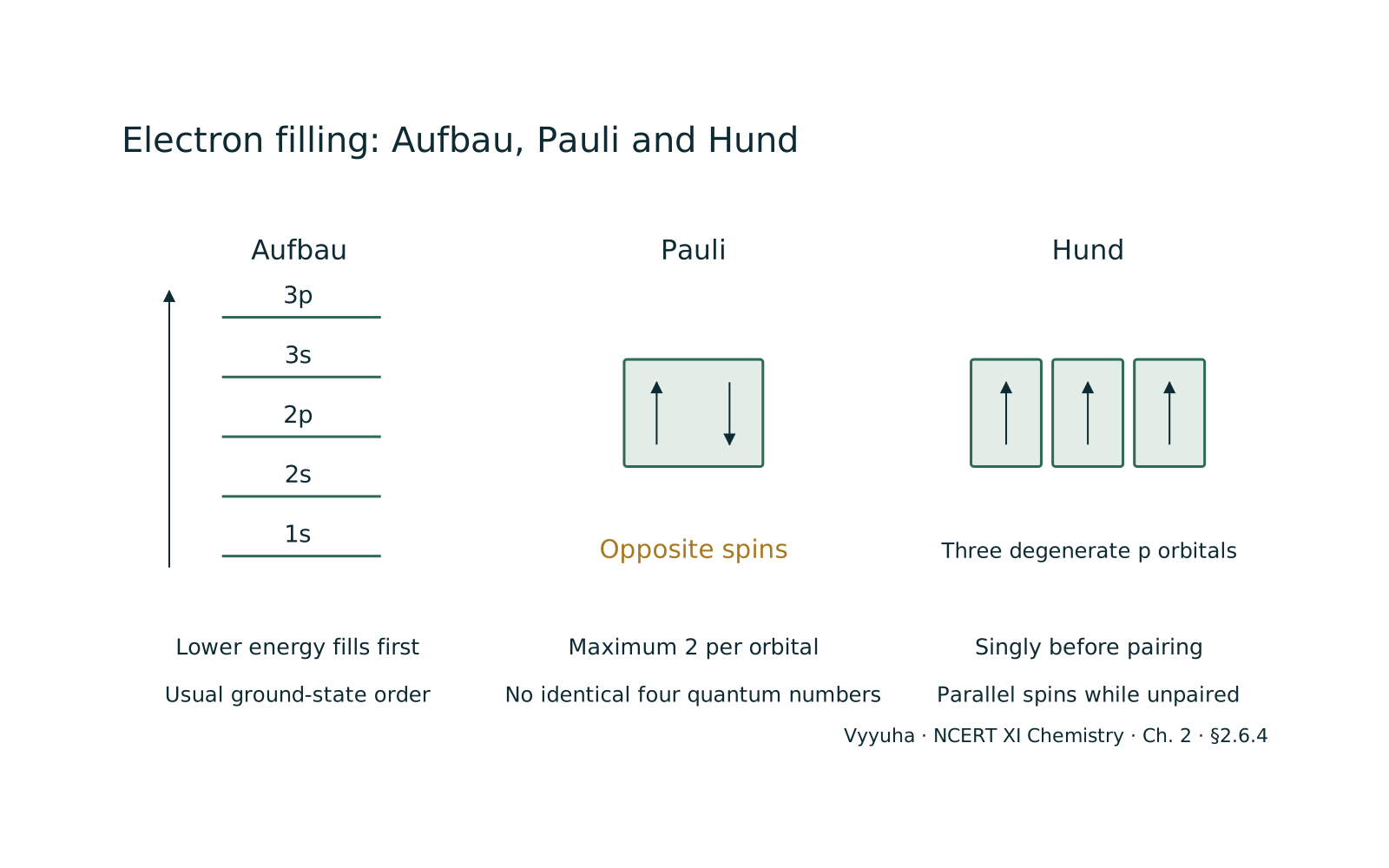
Electronic configuration refers to the distribution of electrons of an atom or molecule (or other physical structure) in atomic or molecular orbitals. It is governed by fundamental quantum mechanical principles, namely the Aufbau principle, Pauli's exclusion principle, and Hund's rule of maximum multiplicity. This arrangement dictates an atom's chemical properties, including its reactivity, valenc…
Quick Summary
Electronic configuration describes how electrons are arranged in an atom's orbitals. This arrangement is governed by three key principles: the Aufbau principle, which dictates filling orbitals from lowest to highest energy; Pauli's exclusion principle, stating that each orbital can hold a maximum of two electrons with opposite spins; and Hund's rule of maximum multiplicity, which requires electrons to singly occupy degenerate orbitals with parallel spins before pairing up.
Orbitals are regions of space defined by quantum numbers (n, l, m_l, m_s), representing shells, subshells (s, p, d, f), and their spatial orientations. The order of filling generally follows the rule.
Exceptions exist for elements like Chromium and Copper, where half-filled or fully-filled subshells provide extra stability. Understanding electronic configuration is crucial for predicting an element's chemical properties, its position in the periodic table, and its bonding behavior.
Full explanation
The electronic configuration of an atom is a fundamental concept in chemistry, providing a concise way to describe the distribution of electrons within its atomic orbitals. This distribution is not random but follows specific quantum mechanical principles that dictate the most stable, lowest energy arrangement for the electrons. Understanding these principles is paramount for predicting an element's chemical properties, its position in the periodic table, and its bonding behavior.
Conceptual Foundation: Quantum Numbers and Orbitals
Before delving into the rules, it's essential to grasp the concept of quantum numbers and atomic orbitals. Each electron in an atom is described by a unique set of four quantum numbers:
- Principal Quantum Number (n): — Denotes the main energy shell or level. It can be any positive integer (1, 2, 3, ...). Higher 'n' values indicate higher energy levels and larger average distance from the nucleus.
- Azimuthal or Angular Momentum Quantum Number (l): — Defines the shape of the orbital and the subshell within a given principal shell. Its values range from 0 to .
* corresponds to an 's' subshell (spherical shape). * corresponds to a 'p' subshell (dumbbell shape). * corresponds to a 'd' subshell (more complex shapes, often double dumbbell). * corresponds to an 'f' subshell (even more complex shapes).
- Magnetic Quantum Number (m_l): — Describes the orientation of the orbital in space. Its values range from to , including 0. For example, for (p subshell), can be -1, 0, +1, indicating three p-orbitals ().
- Spin Quantum Number (m_s): — Represents the intrinsic angular momentum of an electron, referred to as its 'spin'. It can only take two values: (spin up) or (spin down).
An atomic orbital is a region around the nucleus where the probability of finding an electron is maximum. Each orbital can accommodate a maximum of two electrons with opposite spins.
Key Principles Governing Electronic Configuration
- Aufbau Principle (German for 'building-up'):
This principle states that electrons occupy the lowest energy orbitals available first before occupying higher energy orbitals. The order of filling is generally determined by the rule: orbitals with lower values are filled first.
If two orbitals have the same value, the one with the lower 'n' value is filled first. The common order of filling is: .
Mini-Example: For Sodium (Na, Z=11): . The orbital is filled first, then , then , and finally the last electron goes into .
- Pauli's Exclusion Principle:
Formulated by Wolfgang Pauli, this principle states that no two electrons in an atom can have the same set of all four quantum numbers (). This implies that an atomic orbital can hold a maximum of two electrons, and these two electrons must have opposite spins.
If they had the same spin, they would have identical quantum numbers, which is forbidden. Mini-Example: For Helium (He, Z=2): The two electrons are in the orbital. Their quantum numbers would be: Electron 1: Electron 2: They differ only in their spin quantum number.
- Hund's Rule of Maximum Multiplicity:
This rule, proposed by Friedrich Hund, applies to degenerate orbitals (orbitals within the same subshell that have the same energy, e.g., ). It states that for degenerate orbitals, electrons will first occupy each orbital singly with parallel spins before any orbital is doubly occupied.
This maximizes the total spin multiplicity and leads to a more stable configuration due to reduced electron-electron repulsion. Mini-Example: For Nitrogen (N, Z=7): The electronic configuration is .
For the subshell, there are three degenerate orbitals (). According to Hund's rule, the three electrons will occupy each of these orbitals singly with parallel spins: (all spins up, for instance), rather than .
Writing Electronic Configurations
Electronic configurations are typically written in a shorthand notation, where the principal quantum number (n) is followed by the subshell letter (s, p, d, f), and a superscript indicating the number of electrons in that subshell. For example, .
Orbital Diagrams: Sometimes, a more visual representation called an orbital diagram is used, where each orbital is represented by a box or a line, and electrons are represented by arrows (up arrow for spin, down arrow for spin).
Exceptions to the Aufbau Principle
While the Aufbau principle provides a reliable general order, there are notable exceptions, particularly for transition metals and inner transition metals. These exceptions arise due to the subtle energy differences between closely spaced orbitals (like and ) and the enhanced stability associated with half-filled or completely filled subshells.
Common Exceptions:
- Chromium (Cr, Z=24): — Expected: . Actual: . A half-filled subshell () and a half-filled subshell () provide extra stability.
- Copper (Cu, Z=29): — Expected: . Actual: . A completely filled subshell () and a half-filled subshell () provide extra stability.
- Similar exceptions occur for elements like Molybdenum (Mo), Silver (Ag), Gold (Au), etc.
Real-World Applications and Significance
Electronic configuration is not just an academic exercise; it has profound implications for understanding and predicting chemical phenomena:
- Periodic Table Trends: — The electronic configuration directly explains the organization of the periodic table into blocks (s, p, d, f) and the periodicity of chemical properties. Elements in the same group have similar outermost electronic configurations (valence electrons), leading to similar chemical behavior.
- Chemical Bonding: — The number of valence electrons (electrons in the outermost shell) determines an atom's tendency to gain, lose, or share electrons, thus dictating the type of chemical bonds (ionic, covalent) it will form and its valency.
- Spectroscopy: — The electronic transitions between different energy levels are responsible for the absorption and emission of light by atoms, forming the basis of various spectroscopic techniques (e.g., atomic absorption spectroscopy, UV-Vis spectroscopy) used for elemental analysis.
- Magnetic Properties: — The presence of unpaired electrons (as predicted by Hund's rule) gives rise to paramagnetism, while atoms with all paired electrons are diamagnetic. This is crucial in material science and medical imaging (MRI).
- Reactivity and Stability: — Atoms tend to achieve a stable noble gas configuration (completely filled outermost shell). This drive explains why certain elements are highly reactive (e.g., alkali metals, halogens) and others are inert (noble gases).
Common Misconceptions
- Energy Order vs. Shell Number: — Students often confuse the order of filling with the principal quantum number. For instance, orbitals are higher in energy than orbitals and are filled after , even though is less than . However, when electrons are removed to form ions, they are removed from the outermost shell first (highest 'n' value), so electrons are removed before electrons.
- Hund's Rule for all orbitals: — Hund's rule only applies to degenerate orbitals within the same subshell. It doesn't apply when filling different subshells (e.g., and ).
- Pauli's Principle and Spin: — Pauli's principle doesn't mean electrons must have opposite spins in any two orbitals; it means they must have opposite spins if they are in the same orbital.
NEET-Specific Angle
For NEET, a strong grasp of electronic configuration is non-negotiable. Questions frequently test:
- Direct application of rules: — Writing configurations for elements up to Z=30-36, and sometimes beyond.
- Exceptions: — Identifying and explaining exceptions like Cr and Cu.
- Ions: — Writing electronic configurations for cations and anions (remember to remove/add electrons from/to the outermost shell first).
- Periodic Trends: — Relating electronic configuration to atomic size, ionization enthalpy, electron gain enthalpy, electronegativity, and metallic character.
- Magnetic Properties: — Determining if an atom or ion is paramagnetic (unpaired electrons) or diamagnetic (all paired electrons).
- Quantum Numbers: — Assigning quantum numbers to specific electrons or identifying valid/invalid sets of quantum numbers.
- Orbital Diagrams: — Correctly drawing orbital diagrams following Hund's rule and Pauli's principle.
Mastering electronic configuration is a gateway to understanding a vast array of chemical principles and is a high-yield topic for NEET.
Key Concepts
The Aufbau principle guides the filling of electrons into orbitals from lowest to highest energy. The …
This principle is fundamental to understanding electron distribution within orbitals. It states that no two…
Hund's rule specifies how electrons are distributed among degenerate orbitals (orbitals of the same energy,…
Often confused with
Side-by-side differences the NEET paper likes to test.
| Aspect | Electronic Configuration | Orbital Diagram |
|---|---|---|
| Representation | Uses alphanumeric notation (e.g., $1s^2 2s^2 2p^6$). | Uses boxes/lines for orbitals and arrows for electrons. |
| Detail Level | Shows the number of electrons in each subshell. | Shows the number of electrons in each specific orbital and their spin orientations. |
| Information Conveyed | Primarily indicates electron distribution across energy levels and subshells. | Visually depicts adherence to Hund's rule and Pauli's principle, showing paired/unpaired electrons. |
| Application | Useful for quick notation and understanding general electron distribution. | Essential for determining magnetic properties (paramagnetic/diamagnetic) and understanding bonding geometry. |
| Example (Carbon, Z=6) | $1s^2 2s^2 2p^2$ | $1s: \uparrow\downarrow \quad 2s: \uparrow\downarrow \quad 2p: \uparrow \quad \uparrow \quad \_$ |
While electronic configuration provides a concise alphanumeric summary of electron distribution, an orbital diagram offers a more detailed visual representation. The configuration tells us how many electrons are in each subshell (e.
g., ), but the orbital diagram explicitly shows how those electrons are distributed among the individual orbitals within that subshell, including their spin orientations. This visual detail is crucial for applying Hund's rule and Pauli's principle, and for determining properties like paramagnetism, which depends on the presence of unpaired electrons.
Why it is tested: NEET relevance: Both electronic configuration and orbital diagrams are fundamental. Questions often require writing both, or using orbital diagrams to deduce magnetic properties or explain Hund's rule. Understanding their differences helps in choosing the appropriate representation for a given problem.
Questions students ask
6 answered on this topic.
What is the significance of the 'n+l' rule in determining the order of filling orbitals?
The rule, also known as the Madelung rule or Klechkowski rule, is a guideline used to predict the order in which atomic orbitals are filled with electrons according to the Aufbau principle. It states that orbitals with a lower value of are filled first.
If two orbitals have the same value, the orbital with the lower principal quantum number (n) is filled first. This rule helps explain why, for instance, the orbital (n=4, l=0; ) is filled before the orbital (n=3, l=2; ), even though belongs to a lower principal shell.
Why do Chromium and Copper show exceptions to the Aufbau principle?
Chromium (Cr) and Copper (Cu) exhibit exceptions to the Aufbau principle due to the enhanced stability associated with half-filled and completely filled subshells, respectively. For Cr (Z=24), the expected configuration is .
However, it adopts . A half-filled subshell () and a half-filled subshell () are more stable than the expected configuration. Similarly, for Cu (Z=29), the expected configuration is .
It prefers , where a completely filled subshell () and a half-filled subshell () provide greater stability. This stability arises from symmetry and exchange energy.
How does electronic configuration relate to an element's position in the periodic table?
Electronic configuration is the direct basis for the organization of the periodic table. Elements are arranged in periods (rows) based on the principal quantum number (n) of their outermost electron shell, and in groups (columns) based on the number of valence electrons and the type of subshell being filled.
The s-block elements have their last electron in an s-orbital, p-block in a p-orbital, d-block in a d-orbital, and f-block in an f-orbital. Elements within the same group share similar valence electron configurations, leading to similar chemical properties.
What is the difference between an orbital and a subshell?
A subshell is a collection of orbitals that have the same principal quantum number (n) and azimuthal quantum number (l). For example, the subshell consists of three orbitals ().
An orbital, on the other hand, is a specific region of space around the nucleus where there is a high probability of finding an electron. Each orbital can hold a maximum of two electrons with opposite spins, as per Pauli's exclusion principle.
So, a subshell is a grouping of one or more orbitals of the same type and energy level.
How do you write the electronic configuration for an ion?
To write the electronic configuration for a cation (positive ion), you first write the configuration for the neutral atom, then remove electrons from the outermost shell (the one with the highest principal quantum number 'n').
For example, for (Z=26), neutral Fe is . The outermost shell is , so two electrons are removed from , resulting in : . For an anion (negative ion), you add electrons to the lowest available energy orbital, following the Aufbau principle.
For example, for (Z=8), neutral O is . Two electrons are added to the subshell, resulting in : .
Why is Hund's rule important for stability?
Hund's rule of maximum multiplicity states that electrons will occupy degenerate orbitals singly with parallel spins before pairing up. This arrangement is more stable for two main reasons: firstly, it minimizes electron-electron repulsion.
When electrons occupy separate orbitals, they are further apart, reducing their electrostatic repulsion. Secondly, it maximizes exchange energy. Electrons with parallel spins can 'exchange' their positions without violating Pauli's principle, and this exchange leads to a stabilization energy.
The more possible exchanges, the greater the stability. Thus, half-filled and fully-filled subshells, which have maximum multiplicity, exhibit extra stability.
Revise in 30 seconds
- Aufbau Principle: — Fill lowest energy orbitals first. Order:
- Pauli's Exclusion Principle: — Max 2 electrons per orbital, with opposite spins ().
- Hund's Rule: — For degenerate orbitals, fill singly with parallel spins before pairing.
- Quantum Numbers: — (shell), (subshell, ), (orbital orientation, ), (spin, ).
- Exceptions: — Cr (), Cu ().
- Ions: — Remove/add electrons from/to outermost shell (highest 'n') first for cations, lowest available for anions.
To remember the three rules of electronic configuration: All People Have Spin.
- Aufbau: Fill from lowest energy.
- Pauli: Max 2 electrons per orbital, opposite spins.
- Hund's: Single occupancy in degenerate orbitals first, then pair up.
- Spin: Refers to the spin quantum number and the opposite spins in an orbital.