Units and Measurements
Units and Measurements form the bedrock of experimental physics, providing a standardized framework for quantifying physical phenomena. A 'unit' is a universally accepted reference standard used for measuring a physical quantity, while 'measurement' is the process of comparing an unknown quantity with a known standard unit. Without precise and consistent units, scientific communication would be im…
Quick Summary
Units and Measurements are fundamental to physics, providing a standardized way to quantify physical quantities. A unit is a reference standard, and measurement is the comparison of an unknown quantity with this standard.
Physical quantities are either fundamental (like length, mass, time) or derived (like speed, force). The International System of Units (SI) is the globally accepted system, based on seven fundamental units.
All measurements inherently contain errors, categorized as systematic (consistent bias, correctable) or random (unpredictable, minimized by averaging). Accuracy refers to how close a measurement is to the true value, while precision refers to the reproducibility of measurements.
Significant figures indicate the reliability of digits in a measurement, with specific rules for arithmetic operations. Dimensional analysis is a technique to check the consistency of equations and derive relationships between quantities by comparing their fundamental dimensions (M, L, T).
It's a powerful tool but has limitations, such as not being able to determine dimensionless constants.
Full explanation
The study of Units and Measurements is not merely about memorizing definitions; it's about grasping the fundamental language of physics. Every physical phenomenon, from the motion of planets to the behavior of subatomic particles, is described quantitatively using measurements. This section delves into the conceptual underpinnings, key principles, and practical aspects crucial for a NEET aspirant.
1. Conceptual Foundation: The Essence of Measurement
Physics is an experimental science. To understand the physical world, we must observe, quantify, and analyze. This quantification is achieved through measurement. A 'physical quantity' is any property of a material or system that can be measured. For a quantity to be physical, it must be quantifiable and measurable. For example, 'length' is a physical quantity, but 'happiness' is not, as it cannot be objectively measured with a standard unit.
Every measurement involves two essential components: a numerical value and a unit. The numerical value tells us 'how much,' and the unit tells us 'what.' For instance, '10 meters' means a length that is 10 times the standard unit of length, the meter.
2. Key Principles and Laws: Fundamental vs. Derived Quantities and Systems of Units
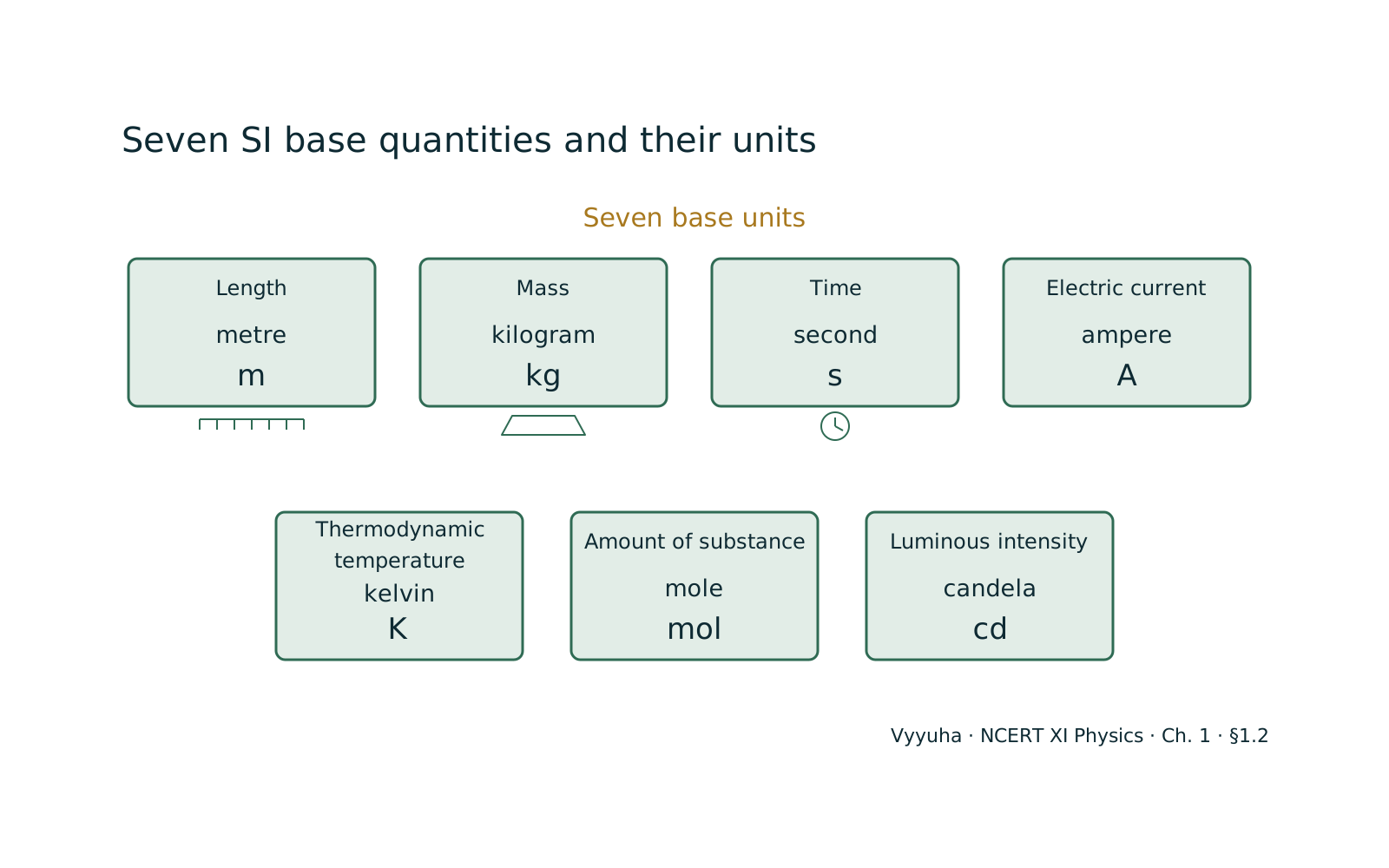
- Fundamental (Base) Quantities and Units: — These are the foundational quantities that are independent of each other. They cannot be expressed in terms of other physical quantities. The International System of Units (SI) recognizes seven base quantities:
1. Length (meter, m): The distance light travels in vacuum in of a second. 2. Mass (kilogram, kg): Defined by taking the fixed numerical value of the Planck constant to be $6.
62607015 imes 10^{-34}, ext{J}cdot ext{s} ext{kg}cdot ext{m}^2/ ext{s} ext{J}cdot ext{s}9,192,631,770$ periods of the radiation corresponding to the transition between the two hyperfine levels of the ground state of the cesium-133 atom.
4. Electric Current (ampere, A): Defined by taking the fixed numerical value of the elementary charge to be (or ), when expressed in units of .
5. Thermodynamic Temperature (kelvin, K): Defined by taking the fixed numerical value of the Boltzmann constant to be , when expressed in units of .
6. Amount of Substance (mole, mol): Contains exactly elementary entities. This number is the fixed numerical value of the Avogadro constant . 7. Luminous Intensity (candela, cd): The luminous intensity, in a given direction, of a source that emits monochromatic radiation of frequency and that has a radiant intensity in that direction of .
- Derived Quantities and Units: — These quantities are expressed in terms of one or more fundamental quantities. Their units are derived from the fundamental units. Examples include:
* Area: length length * Volume: length length length * Speed: length / time * Force: mass acceleration (Newton, N) * Energy: force distance (Joule, J)
- Systems of Units: — Historically, several systems existed:
* CGS System: Centimeter, Gram, Second (for length, mass, time). * MKS System: Meter, Kilogram, Second (for length, mass, time). * FPS System: Foot, Pound, Second (primarily used in some engineering contexts). * SI System (International System of Units): The modern form of the MKS system, expanded to include all seven base units. It is a coherent system, meaning derived units are formed by simple multiplication or division of base units without numerical factors.
3. Measurement of Length, Mass, and Time
- Length: — Direct methods (ruler, measuring tape) for short distances. For very small lengths (e.g., diameter of a wire), instruments like Vernier Calipers (least count typically or ) and Screw Gauge (least count typically or ) are used. For large distances (e.g., distance to a star), indirect methods like the Parallax Method are employed. In this method, the position of an object is observed from two different points (e.g., two diametrically opposite points on Earth's orbit), and the angle (parallax angle) subtended by the baseline at the object is measured. Using trigonometry, the distance can be calculated.
- Mass: — Measured using a common balance for everyday objects. For atomic and subatomic particles, the Atomic Mass Unit (amu or u) is used, where . Mass can be inertial (resistance to change in motion) or gravitational (measure of gravitational force). Einstein's mass-energy equivalence highlights the fundamental nature of mass.
- Time: — Measured using clocks. The most accurate timekeeping devices are Atomic Clocks, which utilize the precise oscillations of atoms (like Cesium-133) to define the second with extreme accuracy. Time intervals can range from femtoseconds () in nuclear physics to billions of years in cosmology.
4. Accuracy, Precision, and Errors in Measurement
No measurement is perfect; there's always some uncertainty. Understanding this is crucial.
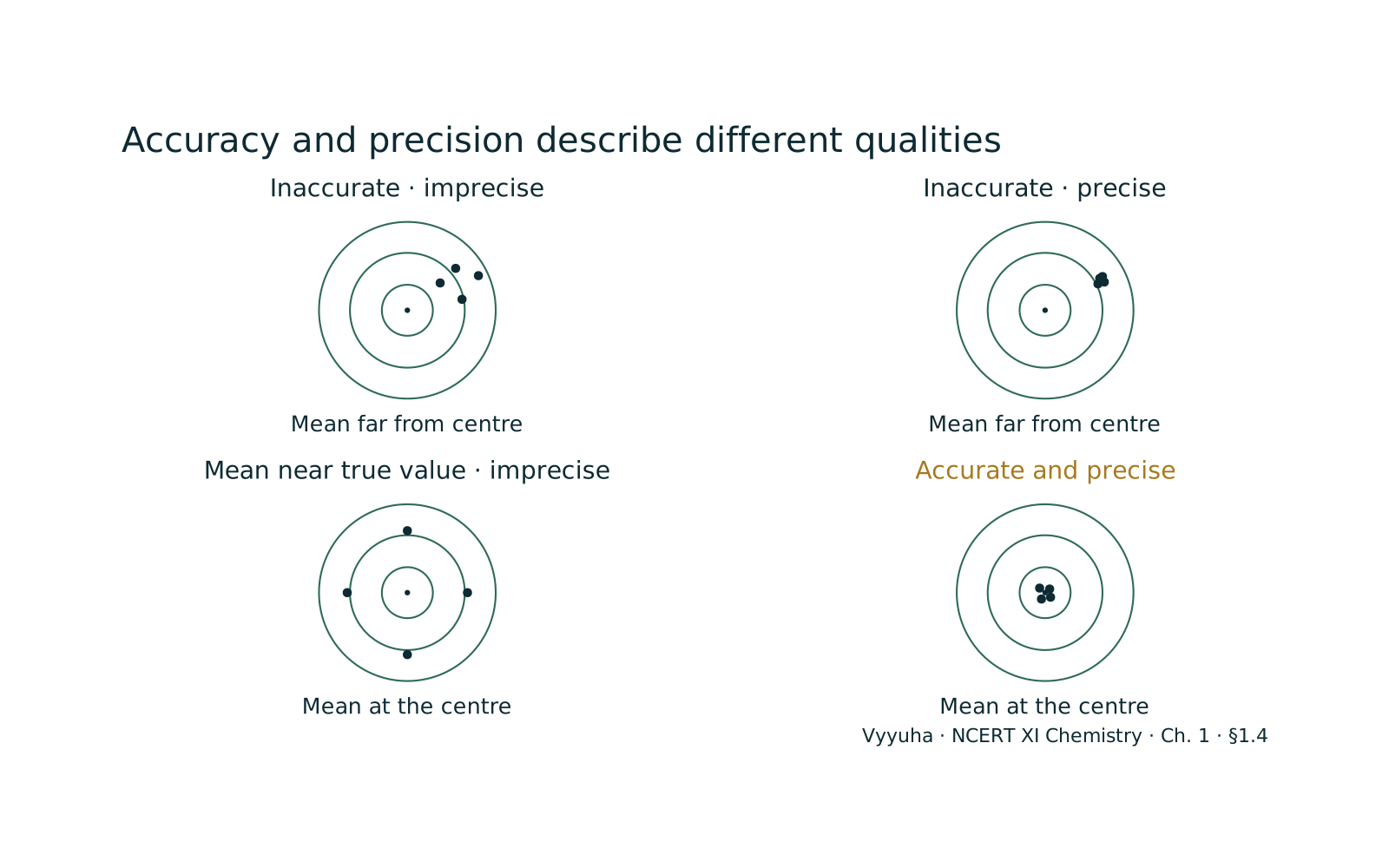
- Accuracy: — How close a measured value is to the true value of the quantity.
- Precision: — How close multiple measurements of the same quantity are to each other (reproducibility), regardless of their closeness to the true value.
- Errors: — The difference between the measured value and the true value.
* Systematic Errors: Errors that consistently affect measurements in one direction (either always too high or always too low). Causes include instrumental errors (faulty calibration), imperfect experimental technique, or personal errors (e.
g., parallax error). These can often be identified and minimized. * Random Errors: Errors that occur irregularly and are unpredictable. They arise from unpredictable fluctuations in experimental conditions (e.
g., temperature, voltage supply) or personal judgment (e.g., estimating readings). These errors can be minimized by taking many readings and calculating the mean. * Least Count Error: The error associated with the resolution of the measuring instrument.
The smallest division on a scale is its least count, and the uncertainty in a reading is typically half of the least count or the least count itself.
- Error Analysis:
* **Absolute Error ():** The magnitude of the difference between the individual measurement and the true value (or mean value). . * **Mean Absolute Error ():** The arithmetic mean of all absolute errors.
. * Relative Error: The ratio of the mean absolute error to the mean value. . * Percentage Error: Relative error expressed as a percentage.
.
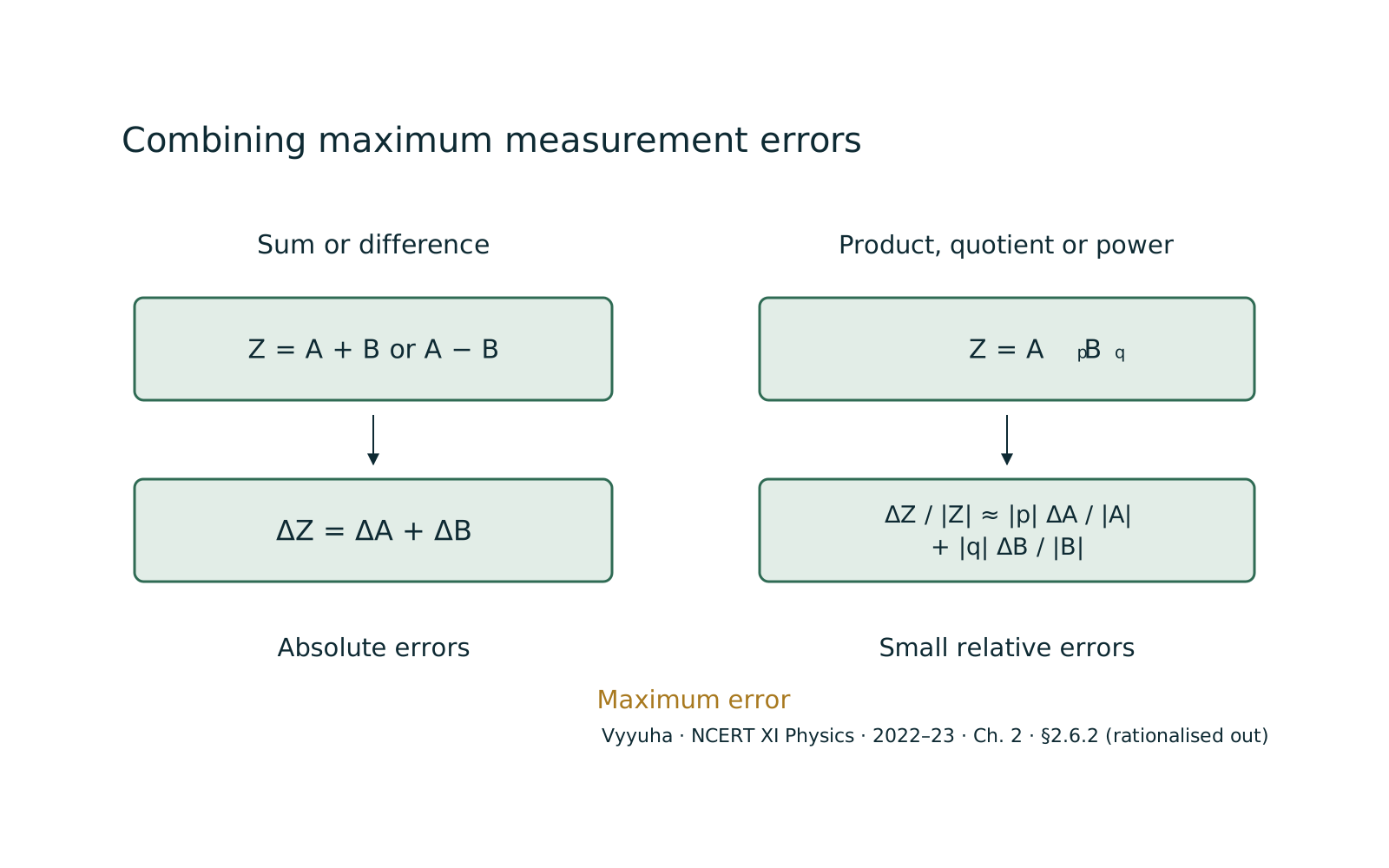
- Combination of Errors (Propagation of Errors):
* Addition/Subtraction: If , then . * Multiplication/Division: If or , then . * Powers: If , then . If , then . (Note: Errors always add up in magnitude).
5. Significant Figures
Significant figures (or significant digits) represent the number of reliable digits in a measurement, including the last digit that is uncertain. They convey the precision of a measurement.
- Rules for Counting Significant Figures:
1. All non-zero digits are significant (e.g., 123 has 3 s.f.). 2. Zeros between two non-zero digits are significant (e.g., 102 has 3 s.f.). 3. Leading zeros (zeros before non-zero digits) are not significant (e.
g., 0.0012 has 2 s.f.). 4. Trailing zeros (zeros at the end of a number) are significant if the number contains a decimal point (e.g., 1.200 has 4 s.f., 1200. has 4 s.f.). If no decimal point, they may or may not be significant (e.
g., 1200 could have 2, 3, or 4 s.f.; use scientific notation to clarify: has 2 s.f., has 3 s.f.).
- Rules for Arithmetic Operations:
* Addition/Subtraction: The result should be rounded to the same number of decimal places as the number with the fewest decimal places (e.g., ). * Multiplication/Division: The result should be rounded to the same number of significant figures as the number with the fewest significant figures (e.g., ).
6. Dimensional Analysis
Dimensions are the fundamental physical quantities (like M for mass, L for length, T for time) that make up a physical quantity. Dimensional analysis is a powerful tool based on the principle of homogeneity, which states that an equation is dimensionally correct if the dimensions of the terms on both sides of the equation are the same.
- Uses of Dimensional Analysis:
1. Checking the dimensional consistency (homogeneity) of equations: If an equation is dimensionally incorrect, it is definitely wrong. If it is dimensionally correct, it might be correct (but not necessarily, as dimensionless constants are not accounted for).
2. Deriving relations between physical quantities: If we know the factors on which a physical quantity depends, we can use dimensional analysis to find the relationship between them (up to a dimensionless constant).
3. Converting units from one system to another: By equating the dimensions in two different systems, we can find the conversion factor.
- Limitations of Dimensional Analysis:
1. Cannot determine dimensionless constants (e.g., in ). 2. Cannot be used for equations involving trigonometric, exponential, or logarithmic functions (as these are dimensionless). 3. Cannot be used if a physical quantity depends on more than three fundamental quantities (for systems based on M, L, T). 4. Cannot distinguish between physical quantities having the same dimensions (e.g., work and torque both have ).
7. Real-World Applications
Units and measurements are indispensable across all scientific and engineering fields. From designing spacecraft that require extreme precision in navigation and fuel consumption to developing new medicines where dosages must be exact, the principles of measurement are constantly applied.
In daily life, we use them for cooking (recipes), driving (speed, distance), and even telling time. The global standardization provided by the SI system facilitates international trade, scientific collaboration, and technological advancement.
8. Common Misconceptions
- Accuracy vs. Precision: — Often confused. Accuracy is about hitting the target; precision is about hitting the same spot repeatedly, even if it's not the target.
- Significant Figures: — Students often struggle with trailing zeros without a decimal point or applying rules incorrectly in mixed operations.
- Dimensional Analysis: — Believing that a dimensionally correct equation is always physically correct. It's a necessary but not sufficient condition. Also, forgetting its limitations, especially with dimensionless constants or complex functions.
- Error Propagation: — Incorrectly subtracting errors or assuming errors cancel out. Errors always add up in magnitude when combining quantities.
9. NEET-Specific Angle
For NEET, the focus on Units and Measurements primarily revolves around:
- Dimensional Analysis: — Frequently tested for checking equation consistency, deriving formulas, and unit conversion. Questions often involve finding the dimensions of a new constant or a combination of known quantities.
- Error Analysis: — Calculating absolute, relative, and percentage errors, and especially the propagation of errors in various mathematical operations (addition, subtraction, multiplication, division, powers). This is a high-yield area.
- Significant Figures: — Applying rules for counting significant figures and rounding results of arithmetic operations. This often appears as part of a larger numerical problem where the final answer needs to be reported with correct significant figures.
- Least Count: — Understanding the least count of Vernier calipers and screw gauges and its role in measurement uncertainty. While direct questions on using these instruments might be less frequent, the concept of least count error is important.
- Fundamental vs. Derived Units: — Identifying base units, derived units, and understanding the SI system. Questions might ask to find the unit of a specific physical quantity or identify which of the given quantities is fundamental.
Mastering these aspects ensures a strong foundation for all subsequent physics topics and helps secure marks in this foundational chapter.
Key Concepts
Dimensional analysis is a powerful tool to verify if a physical equation is dimensionally consistent. The…
When physical quantities are multiplied or divided, their relative errors add up to give the relative error…
Significant figures indicate the precision of a measurement. When performing calculations, the result must be…
Often confused with
Side-by-side differences the NEET paper likes to test.
| Aspect | Units and Measurements | Precision |
|---|---|---|
| Definition | Accuracy refers to how close a measured value is to the true or accepted value of the quantity being measured. | Precision refers to how close multiple measurements of the same quantity are to each other, indicating reproducibility. |
| Target Analogy | Hitting the bullseye (true value). | Hitting the same spot repeatedly, even if it's not the bullseye. |
| Relation to Errors | High accuracy implies small systematic errors. | High precision implies small random errors. |
| Improvement Method | Improved by calibrating instruments, correcting systematic errors, and using better techniques. | Improved by using instruments with higher resolution (smaller least count) and careful, consistent technique. |
| Example | A weighing scale that consistently reads your weight as 60 kg when your true weight is 60.1 kg is accurate. | A weighing scale that consistently reads your weight as 65 kg (even if your true weight is 60 kg) but gives readings like 65.0, 65.1, 64.9 kg is precise but not accurate. |
Accuracy and precision are distinct but often confused concepts in measurement. Accuracy gauges how close a measurement is to the actual, true value, essentially reflecting the correctness of the measurement.
Precision, on the other hand, describes the consistency and reproducibility of a series of measurements, indicating how close repeated measurements are to each other. A measurement can be precise without being accurate, and vice-versa, though the ideal scientific measurement is both accurate and precise.
Understanding this distinction is crucial for evaluating the quality and reliability of experimental data and identifying the types of errors present.
Why it is tested: For NEET, understanding the difference between accuracy and precision is vital for interpreting experimental results and error analysis. Questions often test this conceptual clarity, especially in scenarios involving instrument calibration or experimental design. It helps students identify the nature of errors (systematic vs. random) and how to mitigate them, which is a core skill for practical physics.
Questions students ask
5 answered on this topic.
What is the difference between fundamental and derived units?
Fundamental units are the basic, independent units that cannot be expressed in terms of any other units. The SI system has seven such units: meter (length), kilogram (mass), second (time), ampere (electric current), kelvin (temperature), mole (amount of substance), and candela (luminous intensity).
Derived units, on the other hand, are combinations of fundamental units. They are used to measure derived quantities, which themselves are combinations of fundamental quantities. For example, the unit of speed, meter per second (m/s), is derived from the fundamental units of length (meter) and time (second).
Why is the SI system of units preferred globally?
The SI system is preferred globally due to its coherence, rationality, and universality. It is a coherent system because all derived units are formed by simple multiplication or division of base units without any numerical factors.
It is rational because it assigns only one unit to a particular physical quantity (e.g., Joule for all forms of energy). Its decimal nature makes calculations straightforward. Most importantly, its global adoption facilitates international trade, scientific research, and technological development by ensuring a common language for measurements, reducing confusion and errors.
How do accuracy and precision differ in measurements?
Accuracy refers to how close a measured value is to the true or accepted value of the quantity being measured. A highly accurate measurement is very close to the actual value. Precision, however, refers to the consistency or reproducibility of a set of measurements.
If you take multiple measurements, and they are all very close to each other, then your measurements are precise, even if they are far from the true value. Ideally, scientific measurements strive for both high accuracy and high precision.
What are the main types of errors in measurement, and how can they be minimized?
The main types of errors are systematic errors and random errors. Systematic errors consistently push measurements in one direction (always too high or too low) and arise from faulty instruments, imperfect experimental techniques, or personal biases.
They can be minimized by calibrating instruments, refining experimental procedures, and using different methods. Random errors are unpredictable fluctuations that cause measurements to vary randomly around the true value.
They arise from uncontrolled variables or human judgment. These can be minimized by taking a large number of readings and calculating their arithmetic mean, as random errors tend to cancel each other out over many trials.
What is dimensional analysis, and what are its limitations?
Dimensional analysis is a powerful tool used to check the consistency of physical equations, derive relationships between physical quantities, and convert units. It is based on the principle of homogeneity, which states that the dimensions of all terms on both sides of a physically correct equation must be identical.
However, dimensional analysis has limitations: it cannot determine dimensionless constants (like 1/2 in kinetic energy), it cannot be used for equations involving trigonometric, exponential, or logarithmic functions, and it cannot distinguish between physical quantities that share the same dimensions (e.
g., work and torque).
Revise in 30 seconds
- Fundamental Quantities (7 SI): — Length (m), Mass (kg), Time (s), Electric Current (A), Temperature (K), Amount of Substance (mol), Luminous Intensity (cd).
- Derived Quantities: — Combinations of fundamental quantities (e.g., Speed = L/T, Force = ML/T).
- Dimensional Homogeneity: — Dimensions of all terms in an equation must be same.
- Error Propagation:
- **Addition/Subtraction ():** - **Multiplication/Division ( or ):** - **Powers ():**
- Significant Figures Rules:
- Non-zero digits: Always significant. - Zeros between non-zeros: Significant. - Leading zeros: Not significant (e.g., has 1 s.f.). - Trailing zeros (with decimal): Significant (e.g., has 3 s.f.).
- Rounding (Add/Sub): — Round to least decimal places.
- Rounding (Mult/Div): — Round to least significant figures.
SI Base Units: M K S A K M C
M - Meter (Length) K - Kilogram (Mass) S - Second (Time) A - Ampere (Electric Current) K - Kelvin (Temperature) M - Mole (Amount of Substance) C - Candela (Luminous Intensity)
Think of it as 'My King's Sister Always Keeps My Crown' - a simple way to remember the initial letters of the units.