Inertia
Inertia is the fundamental property of any physical body to resist changes in its state of motion. This inherent resistance means an object at rest tends to stay at rest, and an object in motion tends to continue moving with the same velocity (same speed and direction) unless acted upon by an external, unbalanced force. It is a scalar quantity, directly proportional to the mass of the object. The …
Quick Summary
Inertia is the fundamental property of matter that describes its resistance to any change in its state of motion. This means an object at rest tends to stay at rest, and an object in motion tends to continue moving at a constant velocity (constant speed and direction) unless an external, unbalanced force acts upon it.
It is not a force, but rather a measure of an object's 'laziness' or reluctance to alter its current motion. The quantitative measure of inertia is mass; the greater an object's mass, the greater its inertia.
This implies that more force is required to accelerate a more massive object. Inertia manifests in three forms: inertia of rest (resistance to starting motion), inertia of motion (resistance to stopping or changing speed), and inertia of direction (resistance to changing direction).
Newton's First Law of Motion, often called the Law of Inertia, formally articulates this principle, stating that objects maintain their state of motion unless acted upon by a net external force. Understanding inertia is crucial for comprehending all aspects of classical mechanics.
Full explanation
Inertia, a concept first articulated by Galileo Galilei and later formalized by Isaac Newton, is arguably the most fundamental property of matter in the realm of classical mechanics. It describes the inherent resistance of any physical object to a change in its state of motion. This 'state of motion' encompasses both its velocity (speed and direction) and its state of rest (which is simply a special case of motion with zero velocity).
Conceptual Foundation:
At its core, inertia is about persistence. Objects 'prefer' to maintain their current state. If an object is stationary, it will remain stationary unless an external, unbalanced force acts upon it. If an object is moving at a constant velocity (constant speed in a straight line), it will continue to move at that constant velocity unless an external, unbalanced force acts upon it.
This resistance to change is what we call inertia. It's not a force that causes motion or resists it actively; rather, it's a measure of how much force is required to induce a given acceleration. The more massive an object, the greater its inertia, and thus, the greater the force required to change its velocity by a certain amount in a given time.
Consider the microscopic view: matter is composed of particles. These particles, due to their very nature, possess mass. Mass is the quantitative measure of inertia. When we try to accelerate an object, we are essentially trying to accelerate all the constituent particles within it.
The more particles, or the 'heavier' these particles are (in terms of their contribution to the object's overall mass), the more difficult it becomes to get them all moving or to stop them once they are in motion.
This intrinsic property is universal; it applies to everything from subatomic particles to galaxies.
Key Principles and Laws (Newton's First Law of Motion):
Newton's First Law of Motion, often referred to as the Law of Inertia, states: 'An object at rest stays at rest and an object in motion stays in motion with the same speed and in the same direction unless acted upon by an unbalanced force.
' This law is a direct consequence and formal statement of the concept of inertia. It establishes a crucial link between force and the change in an object's state of motion. Without an unbalanced force, the state of motion (including rest) remains unchanged due to inertia.
This law also implicitly defines what a 'force' is in the Newtonian sense: a force is that which causes a change in the state of motion (i.e., causes acceleration). If there's no change in motion, either there's no force acting, or the forces acting are balanced, resulting in a net force of zero. In both scenarios, inertia dictates that the object's velocity remains constant.
Types of Inertia:
While inertia is a singular property, it's often helpful to categorize its manifestations based on the state of motion being resisted:
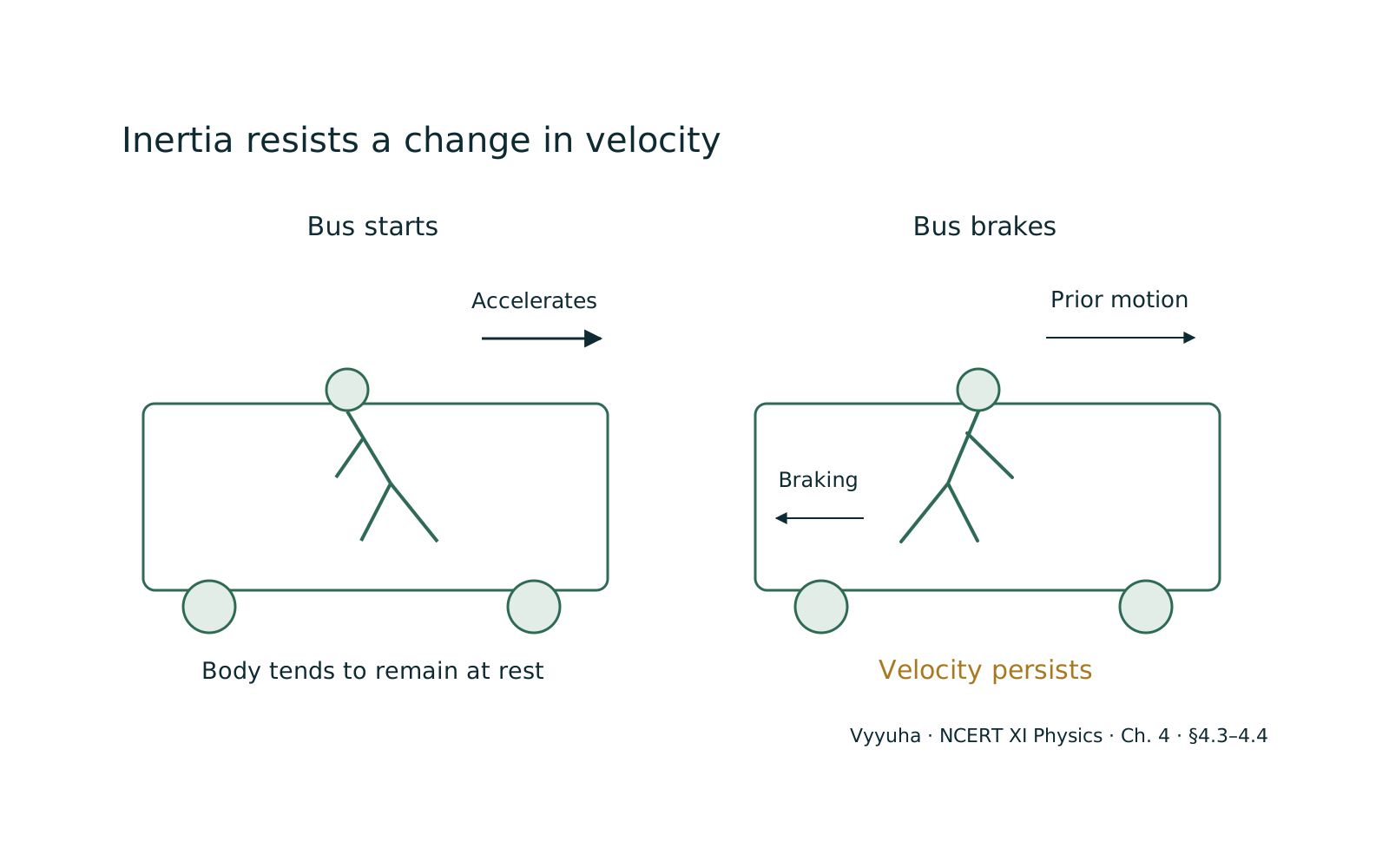
- Inertia of Rest: — This is the tendency of an object to remain in its state of rest. For example, when a bus suddenly starts moving forward, passengers tend to fall backward. Their bodies, due to inertia of rest, try to maintain their original state of rest, while the bus moves forward beneath them. Another classic example is shaking a carpet to remove dust; the carpet moves, but the dust particles, due to their inertia of rest, tend to remain in place and fall off.
- Inertia of Motion: — This is the tendency of an object to continue moving with uniform velocity (constant speed in a straight line). When a moving bus suddenly applies brakes, passengers tend to fall forward. Their bodies, due to inertia of motion, try to continue moving forward with the velocity they had before the brakes were applied. A long jumper runs a distance before jumping to gain momentum, but also to utilize inertia of motion to carry them further through the air.
- Inertia of Direction: — This is the tendency of an object to resist any change in its direction of motion. When a car takes a sharp turn, passengers are thrown outwards. This is because their bodies, due to inertia of direction, try to continue moving in the original straight-line path, even as the car changes direction. Similarly, sparks flying tangentially from a grinding wheel demonstrate inertia of direction; the sparks, once detached, continue in a straight line tangent to the wheel's path at the point of detachment.
Mass as a Measure of Inertia:
The quantitative measure of inertia is mass (). The more massive an object, the greater its inertia. This means a larger force is required to produce a given acceleration for a more massive object.
Conversely, for a given force, a more massive object will experience a smaller acceleration. This relationship is precisely quantified by Newton's Second Law, , where . Here, in the denominator clearly shows that acceleration is inversely proportional to mass, highlighting mass as the resistance to acceleration, i.
e., inertia.
Real-World Applications and Examples:
- Seatbelts in Cars: — Seatbelts are designed to counteract inertia of motion. In a sudden stop or collision, your body's inertia would propel you forward. The seatbelt applies a force to bring you to rest along with the car, preventing injury.
- Shaking a Tree Branch: — When you shake a tree branch, the branch moves, but the fruits or leaves, due to their inertia of rest, tend to stay in their original position and eventually detach.
- Athletics: — A shot-putter or discus thrower spins around multiple times before releasing the object. This builds up the object's velocity, and due to its inertia of motion, it continues along its trajectory after release.
- Hammering a Nail: — When you strike a nail with a hammer, the hammer's large mass and high velocity give it significant inertia of motion, allowing it to exert a large impulsive force on the nail, driving it into the wood.
- Centrifuges: — These devices use inertia of direction to separate substances of different densities. Denser particles, having greater inertia, resist the change in direction more strongly and move further away from the center.
Common Misconceptions:
- Inertia is a Force: — This is a very common mistake. Inertia is not a force. It is a property of matter, a resistance to change. Forces cause changes in motion; inertia resists those changes.
- Inertia and Momentum are the Same: — While related, they are distinct. Inertia is the resistance to change in motion (quantified by mass). Momentum () is a measure of the 'quantity of motion' an object possesses, depending on both its mass and velocity. An object can have high inertia (large mass) but zero momentum (if at rest). An object can have low inertia (small mass) but high momentum (if moving very fast).
- Inertia Only Applies to Objects at Rest: — As discussed, inertia applies equally to objects in motion, resisting changes in their speed or direction.
- Inertia Requires Air Resistance/Friction: — Inertia is an intrinsic property of mass and would exist even in a perfect vacuum with no external forces. Air resistance and friction are external forces that act against inertia of motion, eventually bringing objects to rest, but they don't cause inertia.
NEET-specific Angle:
For NEET aspirants, a deep understanding of inertia is paramount because it forms the conceptual bedrock for almost all topics in mechanics. Questions often test the application of inertia in various scenarios, requiring students to identify the type of inertia at play (rest, motion, or direction) and relate it to the object's mass.
Numerical problems might involve calculating forces required to overcome inertia (i.e., cause acceleration) using Newton's Second Law, where mass is the direct measure of inertia. Conceptual questions frequently involve scenarios like passengers in vehicles, objects on moving platforms, or the behavior of fluids in accelerating containers.
Distinguishing inertia from momentum, force, and energy is a common trap. A strong grasp of inertia ensures a solid foundation for understanding subsequent topics like friction, work, energy, power, rotational motion, and gravitation, where the resistance to change in motion or rotation is a recurring theme.
Key Concepts
Inertia of rest is the property of an object to resist any change from its state of being stationary. If an…
Inertia of motion is the property of an object to resist any change from its state of uniform motion. If an…
Inertia of direction is the property of an object to resist any change in the direction of its motion. An…
Often confused with
Side-by-side differences the NEET paper likes to test.
| Aspect | Inertia | Momentum |
|---|---|---|
| Definition | Inertia is the inherent property of an object to resist changes in its state of motion (rest or uniform velocity). | Momentum is the 'quantity of motion' an object possesses, defined as the product of its mass and velocity. |
| Nature | It is a scalar property of matter. | It is a vector quantity, having both magnitude and direction. |
| Dependence | Depends only on the mass of the object. | Depends on both the mass and velocity of the object ($p = mv$). If velocity is zero, momentum is zero. |
| Units | No specific unit, often quantified by mass (kilograms, kg). | Kilogram-meter per second (kg·m/s). |
| Presence at Rest | Present even when the object is at rest (due to its mass). | Zero when the object is at rest (since velocity is zero). |
While both inertia and momentum are fundamental concepts in mechanics and are related to an object's mass, they describe different aspects of its physical state. Inertia is the intrinsic resistance to change in motion, quantified by mass, and is always present if mass exists.
Momentum, on the other hand, is a measure of the 'oomph' an object has due to its motion, depending on both its mass and its velocity. An object at rest has inertia but no momentum, whereas a moving object possesses both.
Understanding this distinction is crucial for solving problems involving collisions, impulses, and conservation laws in NEET.
Why it is tested: For NEET, distinguishing between inertia and momentum is critical. Questions often test conceptual clarity, asking about scenarios where one is present and the other is not, or how they change under different conditions. For instance, a common trap involves confusing the 'resistance to change' (inertia) with the 'quantity of motion' (momentum). A clear understanding helps in applying Newton's laws and conservation principles correctly, which are frequently tested.
Questions students ask
5 answered on this topic.
What is the primary difference between inertia and mass?
Mass is the quantitative measure of inertia. While inertia is the property of an object to resist changes in its state of motion, mass is the numerical value that quantifies this property. A more massive object possesses greater inertia, meaning it requires a larger force to accelerate it or to bring it to rest. So, you can think of mass as 'how much' inertia an object has, making them intrinsically linked but conceptually distinct. Inertia is the effect, mass is its measure.
Can an object have inertia but no momentum?
Absolutely. Inertia is an intrinsic property of any object that possesses mass. Therefore, any object with mass has inertia, regardless of its state of motion. Momentum, however, is defined as the product of mass and velocity (). If an object is at rest, its velocity () is zero, and consequently, its momentum () is also zero. So, a stationary object (like a book on a table) has inertia (due to its mass) but zero momentum.
Does inertia apply to objects in space where there is no gravity or air resistance?
Yes, inertia applies universally to all objects with mass, regardless of their environment. In fact, the effects of inertia are even more pronounced and observable in space because the absence of significant gravitational forces and air resistance means that once an object is set in motion, it will continue to move at a constant velocity indefinitely, as dictated by Newton's First Law of Motion, which is the law of inertia.
This is why satellites continue to orbit and spacecraft travel vast distances without continuous propulsion.
How does inertia relate to Newton's First Law of Motion?
Newton's First Law of Motion is often called the 'Law of Inertia' because it directly describes the consequences of inertia. The law states that an object at rest stays at rest, and an object in motion stays in motion with the same speed and in the same direction unless acted upon by an unbalanced force. This tendency to maintain its current state of motion is precisely what inertia is. The law essentially formalizes the concept of inertia, making it a cornerstone of classical mechanics.
Is it possible to completely overcome inertia?
No, inertia cannot be 'overcome' in the sense of eliminating it, because it is an inherent property of mass. However, its effects can be counteracted or changed by applying an external, unbalanced force.
When you push a stationary box, you are applying a force to change its state of rest, thereby overcoming its resistance (inertia of rest). When you brake a moving car, you apply a force to change its state of motion, overcoming its inertia of motion.
The inertia itself remains, but its manifestation (resistance to change) is addressed by the applied force.
Revise in 30 seconds
- Inertia: — Property of matter to resist changes in its state of motion.
- Newton's First Law: — Law of Inertia (object at rest stays at rest, object in motion stays in motion unless acted upon by unbalanced force).
- Mass ($m$): — Quantitative measure of inertia. Higher mass = higher inertia.
- Inertia of Rest: — Tendency to remain at rest (e.g., passenger falling backward when bus starts).
- Inertia of Motion: — Tendency to continue moving (e.g., passenger falling forward when bus brakes).
- Inertia of Direction: — Tendency to maintain straight-line path (e.g., passenger thrown outwards on a turn).
- Not a force: — Inertia is a property, not a force.
Inertia Makes Matter Resist Change: Inertia is Measured by Mass, Resists Change in state of motion.