Kinetic Friction
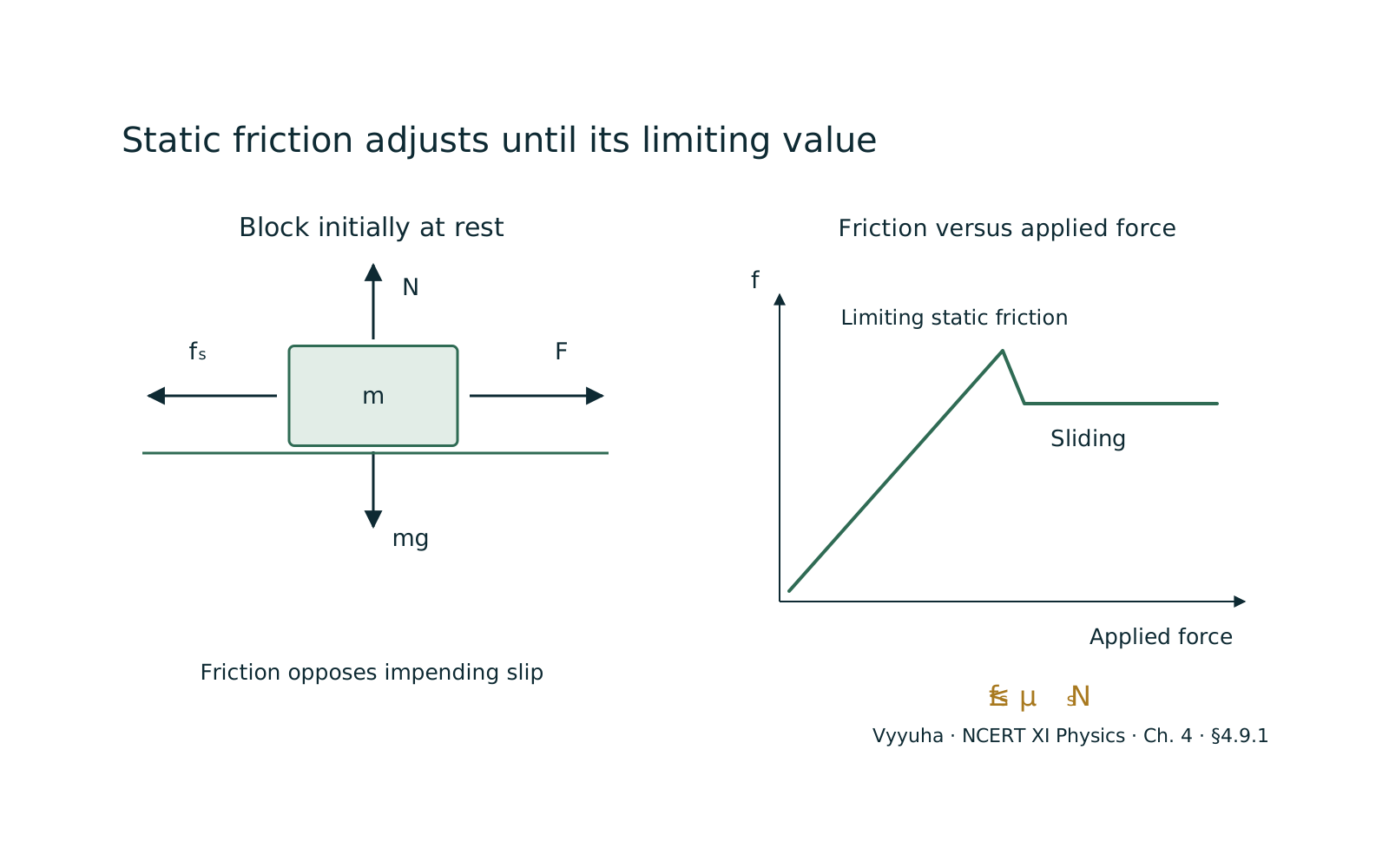
Kinetic friction is a resistive force that opposes the relative motion between two surfaces in contact when they are already sliding or rolling past each other. Unlike static friction, which acts to prevent the initiation of motion, kinetic friction acts when motion is already occurring. Its magnitude is generally considered to be constant for a given pair of surfaces and a given normal force, and…
Quick Summary
Kinetic friction is a resistive force that opposes the relative motion between two surfaces when they are already sliding past each other. It is distinct from static friction, which prevents the initiation of motion.
The magnitude of kinetic friction, denoted as , is directly proportional to the normal force () pressing the surfaces together, given by the formula , where is the dimensionless coefficient of kinetic friction.
This coefficient depends solely on the nature of the two contacting surfaces and is generally less than the coefficient of static friction (). Kinetic friction acts in the direction opposite to the relative motion.
Crucially, for typical scenarios, is largely independent of the relative speed between the surfaces and the apparent area of contact. This force arises from microscopic irregularities (asperities) interlocking and adhesive forces between the surfaces, leading to energy dissipation, primarily as heat.
Understanding kinetic friction is vital for analyzing dynamics problems involving moving objects, especially in scenarios like braking, sliding on inclined planes, or systems of blocks.
Full explanation
Kinetic friction, often denoted as , is a fundamental resistive force encountered whenever two surfaces are in relative motion, specifically sliding or rolling, against each other. It stands in contrast to static friction, which acts to prevent the initiation of motion. Once an object begins to slide, the static friction limit is overcome, and kinetic friction takes over, typically with a magnitude less than the maximum static friction.
1. Origin and Microscopic Nature:
At a macroscopic level, surfaces might appear smooth, but under magnification, they reveal a landscape of peaks (asperities) and valleys. When two surfaces are in contact, only the tips of these asperities actually touch, leading to a much smaller 'true' or 'actual' contact area compared to the 'apparent' contact area. As one surface slides over another, several phenomena contribute to kinetic friction:
- Interlocking of Asperities: — The microscopic bumps and grooves on the surfaces can interlock, requiring a force to shear or deform them as the surfaces slide past each other. This 'plowing' effect contributes to resistance.
- Adhesion and Cold Welding: — At the points of actual contact, the atoms of the two surfaces come so close that strong intermolecular forces (van der Waals forces, and sometimes even metallic bonds for very clean metal surfaces) can form. These 'cold welds' must be continuously broken and reformed as the surfaces slide, dissipating energy and contributing to the resistive force.
- Deformation and Hysteresis: — The asperities can deform elastically and plastically as they interact. The energy stored during deformation is not entirely recovered upon release, leading to energy dissipation, often as heat.
2. Laws of Kinetic Friction (Amontons' and Coulomb's Laws):
The behavior of kinetic friction is described by empirical laws, often attributed to Amontons and Coulomb:
- First Law: — The force of kinetic friction is directly proportional to the normal force () pressing the two surfaces together. Mathematically, .
- Second Law: — The force of kinetic friction is independent of the apparent area of contact between the surfaces, provided the normal force remains constant. This is because the actual contact area, where adhesion and interlocking occur, is primarily determined by the normal force and the material properties, not the macroscopic geometry.
- Third Law: — The force of kinetic friction is largely independent of the relative speed of sliding, within a wide range of speeds. At very high speeds, or extremely low speeds, this independence may break down, but for typical NEET problems, it's a valid assumption.
- Fourth Law: — The force of kinetic friction depends on the nature of the two surfaces in contact (their material composition, roughness, and cleanliness).
3. Coefficient of Kinetic Friction ($\mu_k$):
Combining the first and fourth laws, we can express the magnitude of kinetic friction as:
- is the force of kinetic friction.
- (mu-k) is the coefficient of kinetic friction, a dimensionless constant specific to the pair of surfaces in contact. It's a measure of the 'slipperiness' or 'roughness' between them. A higher means greater friction.
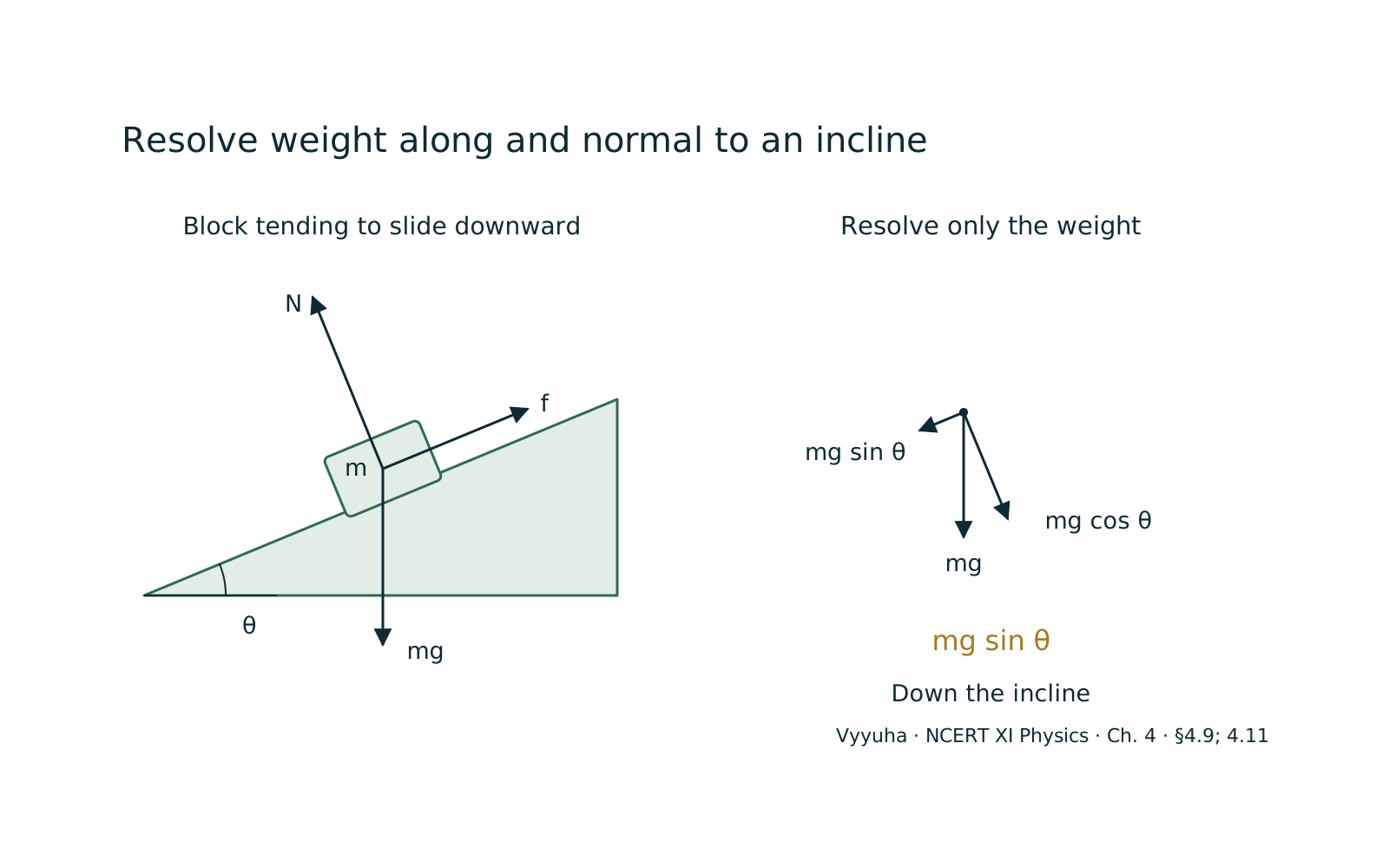
- is the normal force, the force perpendicular to the surfaces in contact. For an object on a horizontal surface, is typically equal to the object's weight (), assuming no other vertical forces. On an inclined plane, .
It's important to note that is generally less than the coefficient of static friction, (i.e., ). This explains why it takes more force to get an object moving than to keep it moving.
4. Direction of Kinetic Friction:
Kinetic friction always acts in a direction opposite to the relative motion between the surfaces. If block A slides to the right over block B, then block A experiences kinetic friction to the left from block B, and block B experiences kinetic friction to the right from block A (Newton's third law).
5. Factors Affecting Kinetic Friction:
- Normal Force: — As established, . This is the most significant factor.
- Nature of Surfaces: — The materials, their surface finish (roughness), and the presence of lubricants significantly alter .
- Temperature: — Extreme temperatures can affect material properties and thus , but this is generally not considered in basic NEET problems.
- Presence of Lubricants: — Lubricants reduce friction by introducing a layer between the surfaces, reducing direct contact and replacing solid-solid friction with fluid friction, which is typically much lower.
6. Real-World Applications and Implications:
- Braking Systems: — Kinetic friction between brake pads and rotors/drums is essential for slowing down and stopping vehicles. A higher is desirable here.
- Walking and Running: — While static friction is crucial for pushing off the ground, kinetic friction plays a role in situations like skidding or slipping.
- Machinery: — In engines, gears, and bearings, kinetic friction is often undesirable as it leads to energy loss (as heat), wear and tear, and reduced efficiency. Lubricants are extensively used to minimize it.
- Sports: — The design of sports equipment, like skis on snow, tires on tracks, or shoes on various surfaces, heavily relies on optimizing kinetic friction for performance.
- Material Handling: — Conveyor belts, chutes, and slides utilize kinetic friction principles.
7. Common Misconceptions and NEET-Specific Angles:
- Friction always opposes motion: — This is true for the relative motion between surfaces. However, friction can sometimes cause or assist the motion of an object relative to an external observer. For example, when a car accelerates, the static friction from the road on the tires pushes the car forward. If the tires slip, kinetic friction acts, but it's still opposing the relative motion of the tire surface against the road.
- Kinetic friction depends on speed: — As discussed, it's largely independent within typical ranges. NEET questions often test this understanding.
- Kinetic friction depends on contact area: — Again, largely independent of apparent contact area. This is a common trap.
- Confusion between static and kinetic friction: — Students often mix up and . Remember, . The maximum static friction is the threshold to overcome, after which kinetic friction acts.
- Calculating Normal Force: — The normal force is not always equal to . On an inclined plane, it's . If there are additional vertical forces (e.g., pushing down, lifting up), the normal force must be calculated by summing vertical forces and setting the net vertical force to zero (if there's no vertical acceleration).
- Systems of Blocks: — When dealing with multiple blocks, correctly identifying the relative motion between each pair of surfaces and applying Newton's third law for friction forces is critical. For instance, if block A is on block B, and B is on the ground, there can be friction between A and B, and between B and the ground. Each friction force must be considered based on the relative motion at that interface.
- Energy Dissipation: — Kinetic friction is a non-conservative force. The work done by kinetic friction is always negative, leading to a loss of mechanical energy, which is typically converted into heat. This concept is often linked with work-energy theorem problems.
Understanding kinetic friction requires a clear grasp of Newton's laws, free-body diagrams, and careful identification of forces and their directions. For NEET, expect problems involving inclined planes, blocks on blocks, and scenarios where kinetic friction is the primary resistive force, often combined with concepts of dynamics, work, and energy.
Key Concepts
The normal force is the perpendicular force exerted by a surface on an object in contact with it. It's…
It's vital to use the correct coefficient. (coefficient of static friction) is used when an object is…
Kinetic friction is a non-conservative force, and the work it does is always negative, as it opposes…
Often confused with
Side-by-side differences the NEET paper likes to test.
| Aspect | Kinetic Friction | Static Friction |
|---|---|---|
| State of Motion | Acts when surfaces are at rest relative to each other (no relative motion). | Acts when surfaces are in relative motion (sliding or rolling). |
| Magnitude | Variable, from zero up to a maximum value ($f_{s,max} = \mu_s N$). It adjusts to oppose the applied force until the maximum is reached. | Generally constant for a given normal force ($f_k = \mu_k N$), once motion has started. |
| Coefficient | Coefficient of static friction ($\mu_s$). | Coefficient of kinetic friction ($\mu_k$). |
| Relationship between Coefficients | $\mu_s \ge \mu_k$ | $\mu_k \le \mu_s$ |
| Energy Conversion | Does no work if there is no displacement. If it prevents motion, no energy is dissipated. | Always does negative work, converting mechanical energy into heat (non-conservative force). |
| Role in Motion | Prevents motion or causes motion (e.g., car accelerating, walking). | Always opposes relative motion, slowing down objects. |
Static friction is the resistive force that prevents an object from starting to move, adjusting its magnitude up to a maximum value. Kinetic friction, conversely, is the resistive force that acts on an object once it is already in motion, typically having a constant magnitude.
The coefficient of static friction () is generally greater than or equal to the coefficient of kinetic friction (), which explains why more force is often needed to initiate motion than to sustain it.
Static friction can do no work if no displacement occurs, while kinetic friction always does negative work, dissipating mechanical energy as heat.
Why it is tested: NEET relevance: Distinguishing between static and kinetic friction is fundamental for solving a wide range of dynamics problems. Incorrectly applying the coefficients or understanding their roles is a common source of error in NEET questions. Problems often involve scenarios where an object transitions from static to kinetic friction, requiring careful analysis of both.
Questions students ask
5 answered on this topic.
What is the primary difference between static and kinetic friction?
The fundamental difference lies in the state of motion. Static friction acts when surfaces are at rest relative to each other, preventing the initiation of motion. Its magnitude can vary from zero up to a maximum value ().
Kinetic friction, on the other hand, acts when surfaces are already in relative motion (sliding or rolling). Its magnitude is generally constant for a given pair of surfaces and normal force (), and importantly, is typically less than .
This means it takes more force to start an object moving than to keep it moving.
Does kinetic friction depend on the speed of the object?
For most practical purposes and within the typical range of speeds encountered in NEET problems, the magnitude of kinetic friction is considered to be independent of the relative speed between the surfaces. This is an empirical observation. While at extremely high speeds (like re-entry of spacecraft) or very low, molecular-level speeds, this independence might break down, for general physics problems, you can assume is constant regardless of how fast the object is sliding.
Why is the coefficient of kinetic friction ($\mu_k$) usually less than the coefficient of static friction ($\mu_s$)?
When surfaces are at rest relative to each other (static friction), the microscopic asperities have more time to settle into each other and form stronger adhesive bonds. To initiate motion, these stronger interlocks and bonds must be broken.
Once motion begins (kinetic friction), the asperities are constantly 'jumping' over each other, and the adhesive bonds have less time to form strongly and are continuously broken, resulting in a lower average resistance.
Hence, less force is required to maintain motion than to start it.
How does the normal force affect kinetic friction?
The normal force () is directly proportional to the kinetic friction force (). This relationship is expressed by the formula . The normal force represents how hard the two surfaces are pressed together. A greater normal force means more microscopic contact points are engaged, leading to stronger interlocking of asperities and increased adhesive forces, thus resulting in a larger kinetic friction force. This is why it's harder to slide a heavy object than a light one.
Does the area of contact influence kinetic friction?
No, the magnitude of kinetic friction is largely independent of the apparent (macroscopic) area of contact between the surfaces, provided the normal force remains constant. This is a common misconception.
The reason is that the actual microscopic contact area, where the friction-generating interactions occur, is primarily determined by the normal force and the material properties, not by how much of the surface appears to be touching.
If you spread the same weight over a larger area, the pressure at each microscopic contact point decreases, but the total number of such points increases, balancing out the effect.
Revise in 30 seconds
- Definition: — Resistive force opposing relative motion between sliding surfaces.
- Formula: —
- $\mu_k$: — Coefficient of kinetic friction, depends on surface nature, dimensionless.
- Direction: — Always opposite to relative motion.
- Independence: — Largely independent of speed and apparent contact area.
- Relationship: — (coefficient of static friction).
- Normal Force (N): — Perpendicular force from surface. Not always .
- Work Done: — (negative, non-conservative, dissipates energy as heat).
Keeping Friction Needs Motion: Kinetic Friction () is proportional to Normal force () and acts when there's Motion. Remember Kinetic is Less than Static (). Area and Speed don't matter (for typical cases).