Binomial Nomenclature — Explained
Detailed Explanation
Binomial nomenclature, a cornerstone of modern biological classification, is the universally accepted system for naming species. Its primary objective is to provide a unique, unambiguous, and stable name for every known organism, thereby facilitating global scientific communication and preventing confusion arising from regional common names.
This system was formally established and popularized by the Swedish botanist Carl Linnaeus in his seminal work, 'Species Plantarum' (1753) for plants and 'Systema Naturae' (10th edition, 1758) for animals.
Conceptual Foundation: The Need for a Universal System
Before binomial nomenclature, organisms were often described using long, descriptive polynomial names, which were cumbersome, varied, and did not provide a stable identifier. Common names, while easy for local communication, suffer from several drawbacks:
- Variability: — A single organism can have multiple common names in different regions or languages (e.g., 'sparrow' vs. 'gorrión').
- Ambiguity: — One common name might refer to different organisms (e.g., 'starfish' is not a fish, 'jellyfish' is not a fish).
- Lack of Scientific Basis: — Common names do not reflect evolutionary relationships or hierarchical classification.
Binomial nomenclature addresses these issues by providing a standardized, Latinized name that is universally recognized, reflects taxonomic relationships (at the genus level), and remains stable over time.
Key Principles and Rules of Binomial Nomenclature
The rules governing binomial nomenclature are codified and maintained by international bodies:
- International Code of Botanical Nomenclature (ICBN), now known as International Code of Nomenclature for algae, fungi, and plants (ICN).
- International Code of Zoological Nomenclature (ICZN).
- International Code of Nomenclature of Bacteria (ICNB).
- International Committee on Taxonomy of Viruses (ICTV).
Despite specific differences between these codes, several fundamental rules are common:
- Two-Part Name: — Each scientific name consists of two parts: the generic name (genus) and the specific epithet (species).
* Example: \textit{Homo sapiens} (human).
- Latin Origin: — Scientific names are typically derived from Latin or Greek, or are Latinized, regardless of their original language. This ensures universality and avoids linguistic bias.
- Formatting:
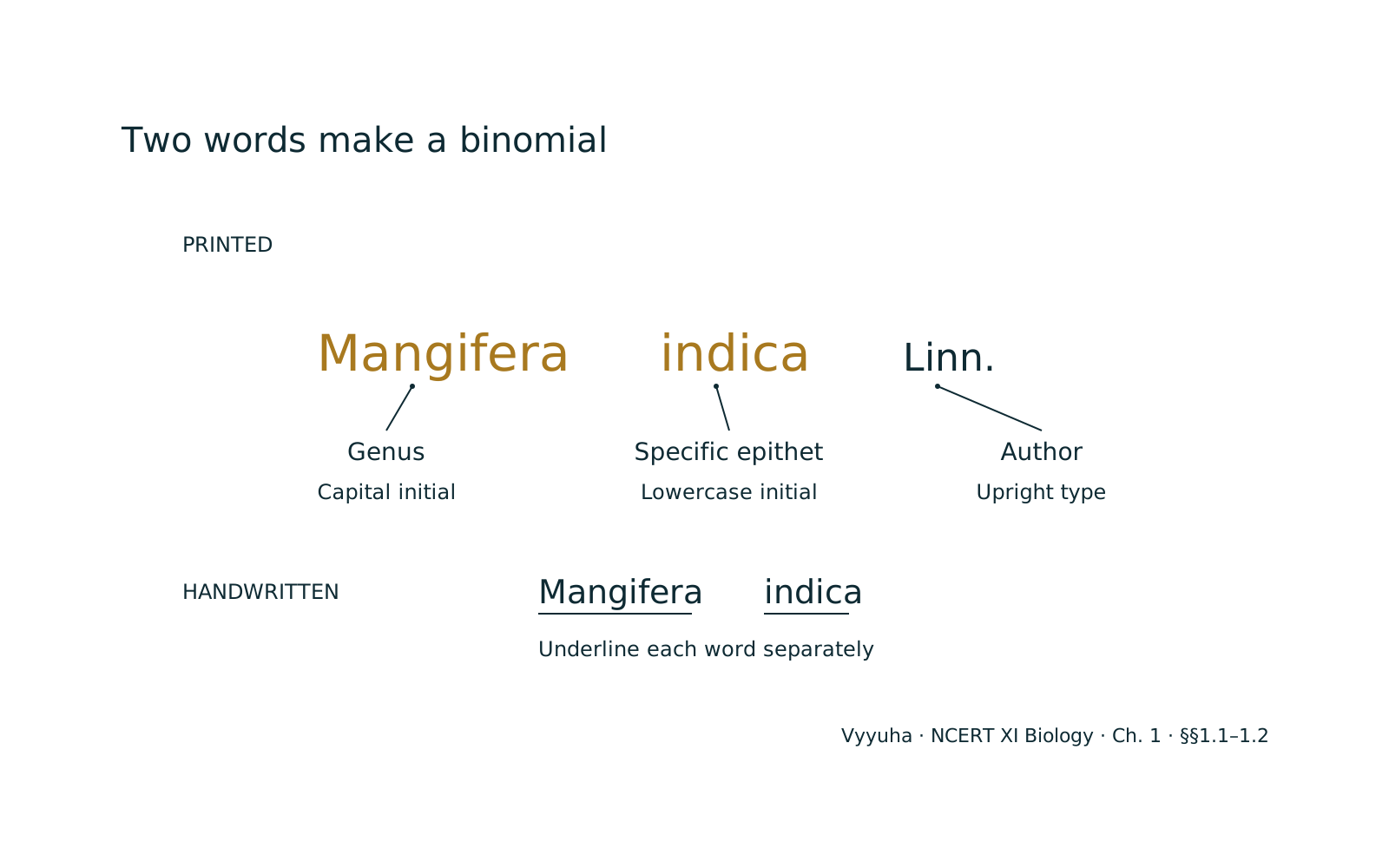
* Italics/Underlining: When typed, the scientific name must be italicized (e.g., \textit{Mangifera indica}). When handwritten, both parts must be separately underlined (e.g., \underline{Mangifera} \underline{indica}). * Capitalization: The generic name always begins with a capital letter (e.g., \textit{Mangifera}), while the specific epithet always begins with a small letter (e.g., \textit{indica}).
- Author Citation (Optional but Common): — The name of the author who first described the species can be written in an abbreviated form after the scientific name, without italics. This provides credit and historical context.
* Example: \textit{Mangifera indica} L. (where 'L.' stands for Linnaeus).
- Priority: — The first validly published name for a species, according to the rules of the respective code, is the correct name. This 'principle of priority' ensures stability and avoids multiple names for the same organism. If a species is renamed or reclassified, its original specific epithet is often retained if possible.
- Type Specimen: — For each species, a 'type specimen' (a preserved physical example) is designated. This specimen serves as the definitive reference for the species, ensuring that the name is permanently associated with a particular biological entity.
- Uniqueness: — No two species within the same kingdom can have the exact same scientific name. While the same specific epithet can be used in different genera (e.g., \textit{Solanum nigrum} and \textit{Brassica nigra}), the combination of genus and specific epithet must be unique.
Components of a Scientific Name
Let's break down \textit{Mangifera indica} L.:
- \textit{Mangifera} — This is the generic name. It indicates the genus to which the mango tree belongs. All species within the genus \textit{Mangifera} share certain fundamental characteristics, reflecting a common evolutionary lineage.
- \textit{indica} — This is the specific epithet. It distinguishes the common mango from other species within the genus \textit{Mangifera} (e.g., \textit{Mangifera zeylanica}). The specific epithet often describes a characteristic (like \textit{indica} meaning 'from India'), habitat, or honors a person.
- L. — This is the author citation, indicating that Linnaeus first described and named this species.
Real-World Applications and Significance
- Global Communication: — Scientists worldwide can communicate precisely about specific organisms, regardless of their native language.
- Stability: — The rules of priority and type specimens ensure that names are stable and do not change frequently.
- Clarity: — Eliminates ambiguity and confusion caused by common names.
- Taxonomic Organization: — Binomial names are integral to hierarchical classification, allowing organisms to be grouped into genera, families, orders, classes, phyla, and kingdoms based on shared characteristics and evolutionary relationships.
- Conservation: — Accurate naming is crucial for conservation efforts, allowing specific endangered species to be identified and protected.
- Research and Development: — In fields like medicine, agriculture, and biotechnology, precise identification of organisms (e.g., pathogens, crop varieties) is paramount.
Common Misconceptions for NEET Aspirants
- Confusing Genus and Species: — Students sometimes mistakenly capitalize the specific epithet or fail to italicize/underline both parts. Remember, genus is capitalized, specific epithet is lowercase, both italicized/underlined.
- Incorrect Formatting: — Forgetting to italicize or underline, or underlining the entire name as one unit instead of two separate parts, are common errors.
- Misunderstanding 'Species Name': — The 'species name' technically refers to the binomial (genus + specific epithet) as a whole, not just the specific epithet. The specific epithet alone is not a species name.
- Rigidity vs. Evolution: — While names are stable, taxonomy is dynamic. Organisms can be reclassified based on new genetic or morphological evidence, leading to changes in their scientific names (e.g., a species moving to a different genus).
NEET-Specific Angle
For NEET, questions on binomial nomenclature typically focus on:
- The rules of writing scientific names: — Correct capitalization, italicization/underlining, and the two-part structure.
- Examples of scientific names: — Identifying the correct scientific name for common organisms (e.g., mango, human, housefly, wheat).
- The contributions of Linnaeus: — Recognizing him as the 'Father of Taxonomy' and the popularizer of binomial nomenclature.
- The purpose and advantages of binomial nomenclature: — Why it's used over common names.
- Understanding the components: — Distinguishing between generic name and specific epithet.
- Principle of priority: — Though less frequent, understanding its role in name stability.
Mastering these rules and understanding the underlying principles is essential for scoring well in taxonomy-related questions in NEET.
Often confused with
Side-by-side differences the NEET paper likes to test.
| Aspect | Binomial Nomenclature | Common Names |
|---|---|---|
| Universality | Globally recognized and understood by scientists. | Vary by region, language, and culture; often local. |
| Ambiguity | Unique for each species, preventing confusion. | One name can refer to multiple species, or one species can have many names. |
| Scientific Basis | Reflects taxonomic relationships (genus level) and evolutionary history. | Often based on superficial characteristics, folklore, or local perception; no scientific basis. |
| Stability | Governed by international codes, ensuring stability and priority. | Can change frequently or spontaneously without formal rules. |
| Format | Strict rules for capitalization, italicization/underlining, and two-part structure. | No formal rules for writing or usage. |
Binomial nomenclature provides a stable, unambiguous, and universally understood scientific name for every species, crucial for global scientific communication and classification. In stark contrast, common names are highly variable, often ambiguous, lack a scientific basis, and are subject to regional and linguistic differences.
While common names serve everyday communication, they are entirely unsuitable for precise scientific discourse due to their inherent inconsistencies and lack of standardization, which binomial nomenclature effectively resolves through its rigorous international codes and formatting rules.
Why it is tested: NEET relevance: Understanding the fundamental differences between scientific and common names is crucial for appreciating the significance and necessity of binomial nomenclature. Questions often test the advantages of scientific names over common names, or the reasons for adopting a universal naming system.
Questions students ask
5 answered on this topic.
Why is binomial nomenclature preferred over common names?
Binomial nomenclature is universally preferred because common names are highly variable and ambiguous. A single organism can have multiple common names across different regions or languages, leading to confusion.
Conversely, one common name might refer to several different organisms. Scientific names, being standardized, Latinized, and unique for each species, eliminate this ambiguity. They facilitate precise communication among scientists globally, ensuring everyone refers to the exact same organism, which is crucial for research, conservation, and education.
Who is credited with popularizing binomial nomenclature?
The Swedish naturalist Carl Linnaeus is widely credited with popularizing and systematically applying binomial nomenclature. He published his comprehensive works, 'Species Plantarum' in 1753 for plants and the 10th edition of 'Systema Naturae' in 1758 for animals, where he consistently used the two-part naming system. His efforts laid the foundation for modern taxonomy and earned him the title 'Father of Taxonomy' due to his profound impact on biological classification and nomenclature.
What are the key rules for writing a scientific name?
The key rules for writing a scientific name are: 1. It consists of two parts: the generic name (genus) and the specific epithet (species). 2. Both parts are typically derived from Latin or are Latinized.
3. When typed, both parts are italicized; when handwritten, they are separately underlined. 4. The generic name always starts with a capital letter, while the specific epithet starts with a small letter.
5. The author's name (who first described the species) can be written in an abbreviated form after the scientific name, without italics, but this is optional.
Can the same specific epithet be used for different genera?
Yes, the same specific epithet can indeed be used for species belonging to different genera, as long as the complete binomial name (genus + specific epithet) remains unique. For example, \textit{Solanum nigrum} (black nightshade) and \textit{Brassica nigra} (black mustard) both use 'nigra' as their specific epithet, meaning 'black'.
This is permissible because the generic names (\textit{Solanum} and \textit{Brassica}) are different, ensuring that the full scientific names are distinct and refer to different organisms.
What is the principle of priority in nomenclature?
The principle of priority is a fundamental rule in biological nomenclature stating that the first validly published name for a taxon (e.g., a species or genus) is the correct and legitimate name. If an organism is described multiple times under different names, or if its classification changes, the earliest published name that conforms to the rules of the respective nomenclature code (ICN, ICZN, etc.
) takes precedence. This principle ensures stability and avoids the proliferation of multiple scientific names for the same organism, promoting consistency in biological literature.