General Characteristics — Explained
Detailed Explanation
Gymnosperms represent a pivotal evolutionary group in the plant kingdom, bridging the gap between spore-reproducing plants (like pteridophytes) and fruit-bearing plants (angiosperms). Their defining characteristic, the 'naked seed,' signifies a major adaptation for terrestrial life, offering enhanced protection and dispersal capabilities for the embryo.
1. Habitat and Distribution:
Gymnosperms are primarily found in temperate and cold regions, often forming vast forests, especially conifers. They are well-adapted to withstand extreme temperatures, drought, and strong winds. Many species are evergreen, retaining their leaves throughout the year, which is an adaptation to conserve water and photosynthesize whenever conditions permit. Examples include pine, spruce, fir, cedar, and redwood. Cycads, on the other hand, are more prevalent in tropical and subtropical regions.
2. Plant Body:
- Sporophyte Dominance: — The main plant body of a gymnosperm is the sporophyte, which is diploid () and differentiated into true roots, stems, and leaves.
- Roots: — They typically possess a well-developed tap root system. In some cases, specialized roots like coralloid roots are found in Cycas, which are associated with nitrogen-fixing cyanobacteria (e.g., Nostoc, Anabaena). Mycorrhizal associations (symbiotic relationship with fungi) are also common, particularly in Pinus roots, aiding in nutrient absorption.
- Stem: — Stems are usually erect, woody, and perennial. They can be unbranched, as seen in Cycas (palm-like appearance), or branched, as in Pinus and Cedrus. The wood is typically pycnoxylic (compact, with narrow medullary rays, e.g., Pinus) or manoxylic (loose, with large pith and broad medullary rays, e.g., Cycas). Secondary growth, leading to an increase in girth, is prominent due to the activity of a vascular cambium.
- Leaves: — Leaves are generally dimorphic (two types) or monomorphic. They are well-adapted to extreme environmental conditions. In conifers, leaves are needle-like (e.g., Pinus) or scale-like (e.g., Thuja), reducing surface area to minimize water loss through transpiration. They often have a thick cuticle, sunken stomata, and transfusion tissue, all xerophytic adaptations. In Cycas, leaves are pinnately compound, large, and persist for a few years.
3. Reproductive Structures and Reproduction:
Gymnosperms are heterosporous, meaning they produce two different types of spores: microspores and megaspores. These spores are produced within sporangia, which are borne on specialized leaves called sporophylls. The sporophylls are typically aggregated to form compact, cone-like structures called strobili or cones.
- Male Cones (Microsporangiate Strobili): — These are generally smaller and more numerous. Each male cone consists of numerous microsporophylls arranged spirally around a central axis. Each microsporophyll bears two or more microsporangia (pollen sacs) on its lower (abaxial) surface. Inside the microsporangia, microspore mother cells undergo meiosis to produce haploid microspores. These microspores develop into pollen grains (male gametophytes).
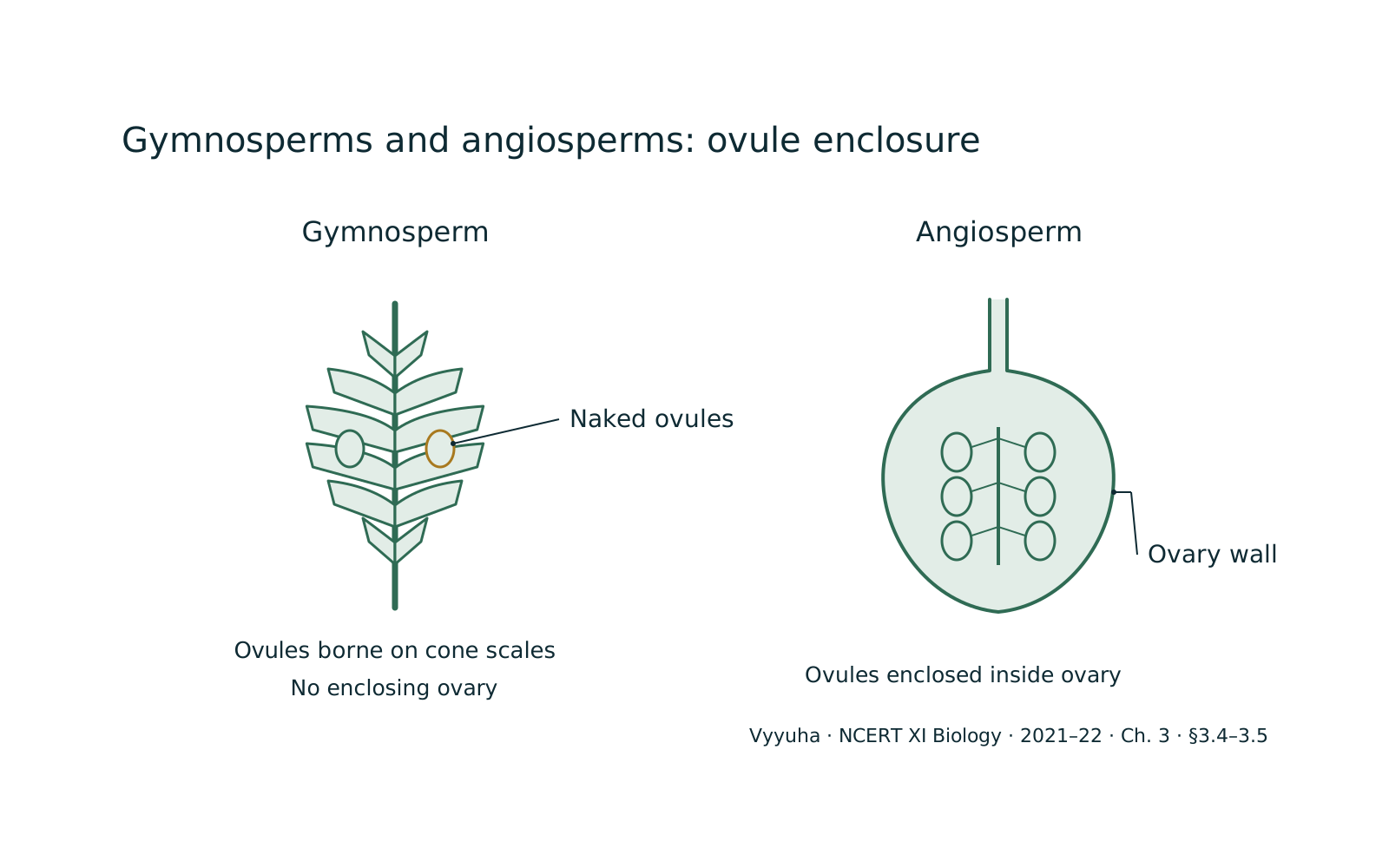
- Female Cones (Megasporangiate Strobili): — These are typically larger and fewer, sometimes solitary (e.g., Cycas). Each female cone consists of numerous megasporophylls arranged spirally. Unlike angiosperms, the ovules are not enclosed within an ovary. Each megasporophyll bears one or more ovules (megasporangia) directly on its surface. The ovule consists of a nucellus (megasporangium proper) protected by one or two integuments, which leaves a small opening called the micropyle. Inside the nucellus, a single megaspore mother cell undergoes meiosis to form four haploid megaspores, usually only one of which is functional.
- Gametophyte Development: — The functional megaspore develops into the female gametophyte (embryo sac or endosperm) within the ovule. This female gametophyte is multicellular and bears two or more archegonia, which are the female sex organs, each containing an egg cell. The male gametophyte (pollen grain) is highly reduced and consists of only a few cells (prothallial cells, generative cell, tube cell).
- Pollination: — Pollination is predominantly anemophilous (wind-pollinated). Pollen grains are released from the male cones and carried by wind currents to the micropyle of the ovule in the female cone. A 'pollination droplet' secreted by the ovule helps to capture the pollen grains.
- Fertilization: — Once a pollen grain lands on the micropyle, it germinates to form a pollen tube. The pollen tube grows towards the archegonia, carrying the male gametes (sperms). In Cycas, sperms are large and flagellated (motile), representing a primitive trait shared with pteridophytes. In Pinus and other conifers, sperms are non-flagellated (non-motile). Fertilization occurs when a male gamete fuses with the egg cell, forming a diploid zygote.
- Seed Development: — The zygote develops into an embryo. The ovule, after fertilization, matures into a seed. The integuments of the ovule form the seed coat. The female gametophyte tissue, which is haploid (), develops into the nutritive tissue (endosperm) for the developing embryo. This is a key distinction from angiosperms, where the endosperm is triploid () and formed by double fertilization.
4. Life Cycle:
Gymnosperms exhibit a diplontic life cycle, with the sporophyte () being the dominant and independent phase. The gametophyte () is highly reduced, dependent on the sporophyte, and short-lived. Alternation of generations is present, but the sporophyte is clearly the more prominent generation.
5. Economic Importance:
- Timber: — Many conifers (e.g., Pinus, Cedrus, Abies, Picea) are major sources of softwood timber, used extensively in construction, furniture, and paper industries.
- Resins and Turpentine: — Pine trees yield resin, which is used to produce turpentine (a solvent) and rosin (used in varnishes, sealing wax, and sizing paper).
- Food: — Seeds of Pinus gerardiana (chilgoza) are edible. Sago is obtained from the stem pith of Cycas.
- Medicinal: — Ephedrine, an alkaloid used to treat asthma and bronchitis, is obtained from Ephedra.
- Ornamental: — Many gymnosperms like Cycas, Thuja, Araucaria, and Ginkgo are cultivated as ornamental plants in gardens and parks due to their aesthetic appeal.
6. Evolutionary Significance:
Gymnosperms represent the first group of plants to develop seeds, marking a significant evolutionary leap. The seed habit offered several advantages: protection of the embryo, provision of nourishment, and dispersal over greater distances without the need for water for fertilization.
Their adaptation to drier terrestrial environments paved the way for the diversification of seed plants. While they lack true flowers and fruits, their reproductive strategies, particularly wind pollination and the development of a robust seed, were crucial steps towards the dominance of angiosperms in later geological periods.
Common Misconceptions & NEET-Specific Angles:
- Endosperm Ploidy: — Remember, gymnosperm endosperm is haploid () and forms before fertilization, representing the female gametophyte. Angiosperm endosperm is triploid () and forms after double fertilization.
- Vessels: — Most gymnosperms lack true vessels in their xylem, possessing tracheids as the primary water-conducting elements. However, Gnetophytes (e.g., Gnetum, Ephedra, Welwitschia) are an exception, possessing vessels, which is considered an advanced feature.
- Motile Sperms: — While most gymnosperms have non-motile sperms, Cycas and Ginkgo are notable exceptions, possessing large, multiflagellated, motile sperms, a relict feature from their pteridophyte ancestors.
- Absence of Fruit: — The defining characteristic – naked seeds – means no fruit formation. This is a crucial differentiator from angiosperms.
- Double Fertilization: — Double fertilization is characteristic of angiosperms, not gymnosperms. Gymnosperms undergo single fertilization.
Often confused with
Side-by-side differences the NEET paper likes to test.
| Aspect | General Characteristics | Angiosperms |
|---|---|---|
| Seed Enclosure | Naked seeds (ovules exposed) | Enclosed seeds (ovules within ovary, developing into fruit) |
| Reproductive Structures | Cones/Strobili | Flowers |
| Fruit Formation | Absent | Present (ovary develops into fruit) |
| Endosperm Ploidy | Haploid ($n$), formed before fertilization | Triploid ($3n$), formed after double fertilization |
| Vessels in Xylem | Mostly absent (except Gnetophytes), primarily tracheids | Present (along with tracheids) |
| Pollination | Predominantly wind (anemophily) | Diverse (wind, insects, water, animals) |
| Double Fertilization | Absent (single fertilization) | Present |
| Life Cycle Dominance | Sporophyte dominant, gametophyte highly reduced and dependent | Sporophyte dominant, gametophyte highly reduced and dependent |
Gymnosperms and angiosperms both produce seeds, but their fundamental difference lies in the enclosure of the ovules. Gymnosperms have 'naked seeds' exposed on sporophylls, while angiosperms enclose their ovules within an ovary that matures into a fruit.
This leads to further distinctions in reproductive structures (cones vs. flowers), endosperm ploidy (haploid vs. triploid), presence of vessels in xylem, and the occurrence of double fertilization. These differences highlight the evolutionary advancements that led to the widespread success and diversity of angiosperms.
Why it is tested: For NEET, understanding these differences is critical for classification, identifying evolutionary trends, and answering comparative questions. Questions frequently test the ploidy of endosperm, presence/absence of fruits/flowers, and the type of vascular tissue. Knowing these distinctions helps in accurately categorizing plant examples and understanding their unique biological features.
Questions students ask
6 answered on this topic.
What does 'naked seed' mean in the context of gymnosperms?
The term 'naked seed' is the defining characteristic of gymnosperms. It means that the ovules, which develop into seeds after fertilization, are not enclosed within an ovary wall. Instead, they are openly exposed on the surface of specialized leaves called sporophylls, which are often aggregated into cones.
This contrasts sharply with angiosperms (flowering plants), where the ovules are always protected inside an ovary, which then develops into a fruit after fertilization. The exposed nature of gymnosperm ovules and seeds is a key evolutionary distinction.
Do gymnosperms produce flowers and fruits?
No, gymnosperms do not produce true flowers or fruits. True flowers, with their distinct sepals, petals, stamens, and pistils, are characteristic features of angiosperms. Similarly, fruits are developed from the ovary wall after fertilization in angiosperms to enclose and protect the seeds. In gymnosperms, the reproductive structures are typically cones or strobili, and their seeds are 'naked,' meaning they are not enclosed within any fruit structure.
What is the ploidy of the endosperm in gymnosperms, and how does it differ from angiosperms?
In gymnosperms, the endosperm is haploid () and develops from the female gametophyte before fertilization. It serves as the primary nutritive tissue for the developing embryo. This is a significant difference from angiosperms, where the endosperm is triploid () and forms after fertilization through a process called double fertilization, involving the fusion of one male gamete with the central cell's diploid secondary nucleus.
How do gymnosperms typically get pollinated?
Gymnosperms are predominantly wind-pollinated, a process known as anemophily. Their pollen grains are often lightweight and sometimes winged (e.g., Pinus) to facilitate dispersal by air currents. The pollen is carried from the male cones to the exposed ovules of the female cones. Many gymnosperms also secrete a 'pollination droplet' at the micropylar end of the ovule, which helps to capture airborne pollen grains and draw them into the ovule for fertilization.
Are all gymnosperms evergreen?
While many familiar gymnosperms, especially conifers like pines, spruces, and firs, are evergreen (meaning they retain their leaves throughout the year), not all gymnosperms are. A notable exception is Ginkgo biloba, the maidenhair tree, which is deciduous and sheds its leaves in autumn. Similarly, some species of Larix (larches) are also deciduous conifers. So, while evergreen habit is common and an adaptation to harsh environments, it's not a universal characteristic for all gymnosperms.
What are coralloid roots, and which gymnosperm possesses them?
Coralloid roots are specialized roots found in Cycas, a genus of gymnosperms. These roots grow negatively geotropically (upwards) and branch dichotomously, resembling corals. They contain symbiotic nitrogen-fixing cyanobacteria (blue-green algae) like Nostoc and Anabaena in their cortical region. These cyanobacteria fix atmospheric nitrogen, providing essential nutrients to the Cycas plant, making it an important ecological adaptation for nutrient acquisition in poor soils.