Classification into Families
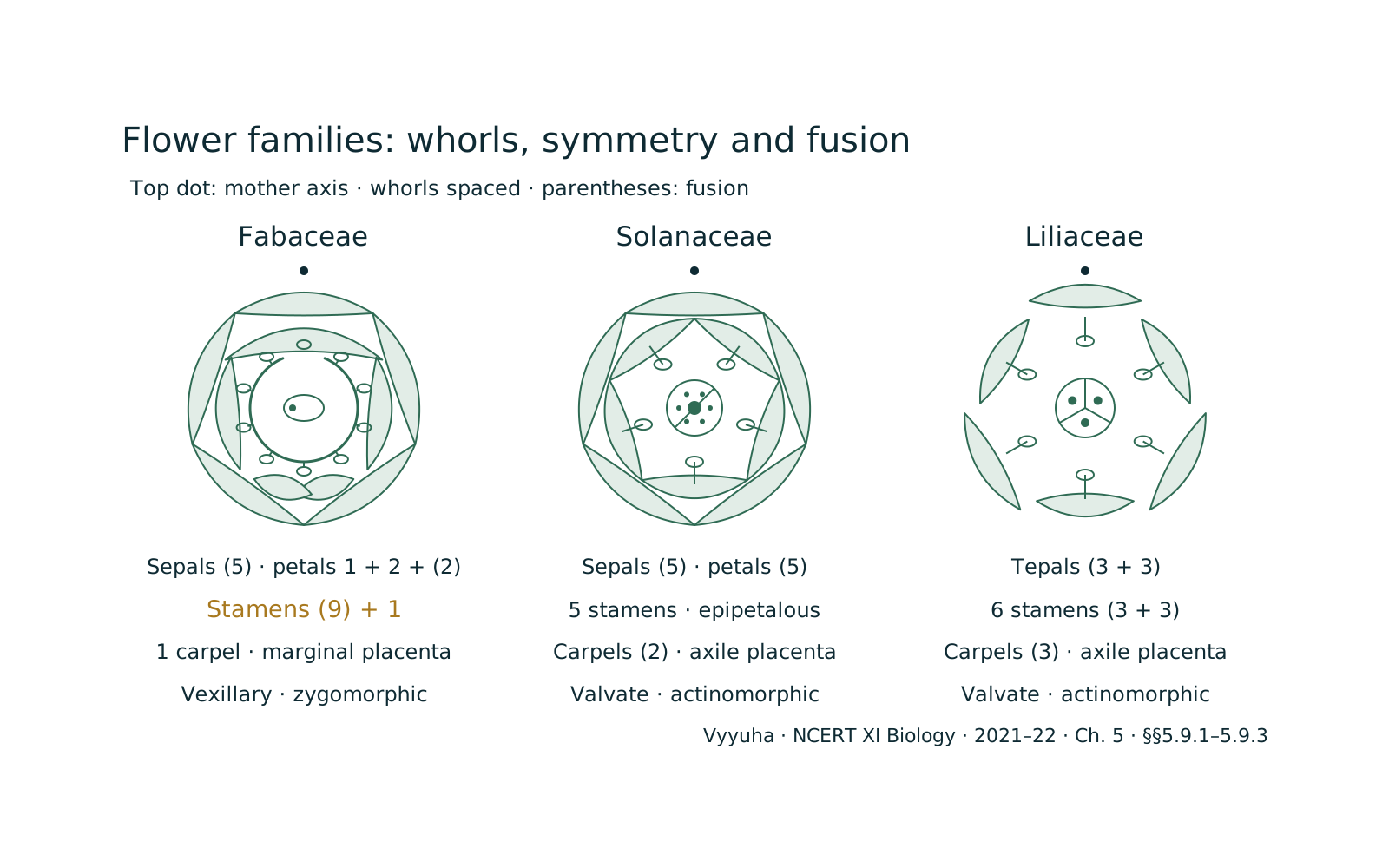
The classification of angiosperms into families is a fundamental aspect of plant taxonomy, aiming to group plants that share a significant number of common morphological, anatomical, and genetic characteristics, reflecting their evolutionary relatedness. A plant family represents a taxonomic rank above genus and below order, serving as a cohesive unit for studying the diversity and relationships w…
Quick Summary
Classifying angiosperms into families involves grouping flowering plants based on shared morphological and anatomical characteristics, particularly floral features, to reflect their evolutionary relationships.
This hierarchical system helps in organizing the vast diversity of plants. Key characters used include vegetative traits like habit, root, stem, and leaf structure, but floral characters are paramount due to their stability.
These include inflorescence type, flower symmetry (actinomorphic or zygomorphic), the number and arrangement of sepals (calyx), petals (corolla), stamens (androecium), and carpels (gynoecium). Important features like aestivation (arrangement of sepals/petals in bud), placentation (arrangement of ovules in ovary), and ovary position (superior/inferior) are critical.
Floral formulae and diagrams are symbolic representations that concisely summarize these features. For NEET, understanding the distinguishing characteristics and economic importance of key families like Fabaceae (pea family), Solanaceae (potato family), and Liliaceae (lily family) is essential, as questions often involve identifying families based on these specific traits.
Full explanation
The classification of angiosperms into families is a cornerstone of plant systematics, providing a structured framework to organize the immense diversity of flowering plants. This hierarchical arrangement reflects evolutionary relationships, grouping genera that share a common ancestry and a suite of distinguishing characteristics. The primary aim is to create monophyletic groups, meaning each family should ideally include all descendants of a common ancestor.
Conceptual Foundation:
Plant classification systems have evolved over centuries, from artificial systems based on one or a few characters (e.g., Linnaeus's sexual system) to natural systems considering overall similarities (e.g., Bentham and Hooker's system), and finally to phylogenetic systems that reflect evolutionary history (e.g., APG system). For NEET, understanding the morphological basis of classification, particularly floral characters, is crucial.
Key Principles and Characters Used for Classification:
Classification into families primarily relies on a combination of vegetative and, more importantly, floral characters. Floral characters are considered more stable and less prone to environmental variation, making them reliable indicators of evolutionary relationships.
- Vegetative Characters:
* Habit: Herb, shrub, tree, climber. * Root: Taproot or fibrous root system. * Stem: Erect, prostrate, climbing, underground modifications (rhizome, corm, tuber, bulb). * Leaf: Type (simple, compound), venation (reticulate, parallel), phyllotaxy (alternate, opposite, whorled), stipules (present/absent, type), leaf modifications (tendrils, spines).
- Floral Characters (Most Important):
* Inflorescence: The arrangement of flowers on the floral axis. Examples include racemose (raceme, spike, catkin, spadix, corymb, umbel, capitulum) and cymose (monochasial, dichasial, polychasial).
* Flower: Complete/incomplete, bisexual/unisexual, actinomorphic (radial symmetry) / zygomorphic (bilateral symmetry). * Perianth: Sepals (calyx) and petals (corolla). * Calyx: Number of sepals, aestivation (valvate, twisted, imbricate, vexillary), fusion (polysepalous/gamosepalous).
* Corolla: Number of petals, aestivation, fusion (polypetalous/gamopetalous), shape (tubular, bell-shaped, funnel-shaped, wheel-shaped). * Androecium: Stamens (male reproductive parts). * Number of stamens, arrangement (epipetalous, epiphyllous), fusion (monadelphous, diadelphous, polyadelphous, syngenesious, synandrous), length (didynamous, tetradynamous).
Anther attachment (basifixed, dorsifixed, versatile, adnate), dehiscence (longitudinal, transverse, porous). Gynoecium: Carpels (female reproductive parts). * Number of carpels (monocarpellary, bicarpellary, multicarpellary).
Fusion (apocarpous - free carpels / syncarpous - fused carpels). Ovary position (superior, inferior, half-inferior). * Placentation: Arrangement of ovules within the ovary (marginal, axile, parietal, free central, basal).
Style and stigma characteristics. Fruit: Type (simple, aggregate, multiple), dehiscence (dehiscent/indehiscent). * Seed: Endospermic/non-endospermic.
Floral Formula and Floral Diagram:
These are symbolic representations that concisely summarize the key floral characteristics of a plant family or species.
- Floral Formula: — Uses symbols to denote various floral parts:
Br: Bracteate, Ebr: Ebracteate BrL: Bracteolate, EbrL: Ebracteolate * : Actinomorphic, : Zygomorphic * : Male, : Female, : Bisexual K: Calyx (sepals), C: Corolla (petals), P: Perianth (when sepals and petals are indistinguishable) A: Androecium (stamens), G: Gynoecium (carpels) * Numbers indicate the count of parts.
Parentheses () indicate fusion. A line above G indicates inferior ovary, below G indicates superior ovary.
- Floral Diagram: — A graphical representation of the cross-section of a flower, showing the relative position and arrangement of floral parts, their number, and their fusion. It helps visualize aestivation, placentation, and symmetry.
Important Angiosperm Families (NEET Perspective):
- Fabaceae (Leguminosae):
* Habit: Herbs, shrubs, trees, climbers. * Root: Taproot with root nodules (nitrogen fixation). * Stem: Erect or climber. * Leaves: Alternate, pinnately compound or simple, stipulate, pulvinus at leaf base.
* Inflorescence: Racemose. * Flower: Bisexual, zygomorphic. * Calyx: 5 sepals, gamosepalous, valvate/imbricate aestivation. * Corolla: 5 petals, polypetalous, papilionaceous (one standard, two wings, two keel fused), vexillary aestivation.
* Androecium: 10 stamens, diadelphous (9 fused, 1 free) or monadelphous, anther dithecous. * Gynoecium: Monocarpellary, unilocular, superior ovary, marginal placentation, short style. * Fruit: Legume (pod).
* Seed: Non-endospermic. * Floral Formula: ext{Br, %, ⚥, K}_{(5)}, \text{C}_{1+2+(2)}, \text{A}_{(9)+1}, \text{G}_1 * Economic Importance: Pulses (gram, arhar, moong, soyabean), edible oil (soyabean, groundnut), dye (indigofera), fibres (sunhemp), fodder (sesbania, trifolium), ornamentals (lupin, sweet pea), medicine (muliathi).
- Solanaceae (Potato Family):
* Habit: Herbs, shrubs, small trees. * Stem: Erect, herbaceous/woody, often hollow, hairy, underground stem in potato. * Leaves: Alternate, simple, rarely pinnately compound, exstipulate, reticulate venation.
* Inflorescence: Solitary, axillary, or cymose. * Flower: Bisexual, actinomorphic. * Calyx: 5 sepals, gamosepalous, persistent, valvate aestivation. * Corolla: 5 petals, gamopetalous, valvate aestivation.
* Androecium: 5 stamens, epipetalous. * Gynoecium: Bicarpellary, syncarpous, superior ovary, bilocular (often multilocular due to false septa), axile placentation, swollen placenta, many ovules.
* Fruit: Berry or capsule. * Seed: Many, endospermic. * Floral Formula: (superior ovary) * Economic Importance: Food (tomato, potato, brinjal, chilli), spice (chilli), medicine (belladonna, ashwagandha), fumigatory (tobacco), ornamentals (petunia).
- Liliaceae (Lily Family):
* Habit: Monocots, mostly perennial herbs with underground bulbs, corms, or rhizomes. * Leaves: Mostly basal, alternate, linear, parallel venation, exstipulate. * Inflorescence: Solitary, cymose, or racemose.
* Flower: Bisexual, actinomorphic. * Perianth: 6 tepals (petaloid), in two whorls of 3 each, often fused (gamophyllous), valvate aestivation. * Androecium: 6 stamens, in two whorls of 3 each, epitepalous.
* Gynoecium: Tricarpellary, syncarpous, superior ovary, trilocular, axile placentation, many ovules. * Fruit: Capsule, rarely berry. * Seed: Endospermic. * Floral Formula: (superior ovary) * Economic Importance: Ornamentals (tulip, gloriosa, lily), medicine (aloe), vegetables (asparagus), colchicine (colchicum autumnale).
Evolutionary Significance:
Family classification helps trace evolutionary pathways. For instance, the presence of a superior ovary is generally considered more primitive than an inferior ovary. Similarly, free petals (polypetalous) are often considered ancestral to fused petals (gamopetalous). Understanding these trends provides insights into the diversification of angiosperms.
Common Misconceptions:
- Vegetative vs. Floral Characters: — Students often overemphasize vegetative characters. While useful for initial identification, floral characters are taxonomically more significant due to their stability.
- Memorization vs. Understanding: — Simply memorizing floral formulae without understanding the underlying morphology leads to errors. It's crucial to visualize the flower structure.
- Monocot vs. Dicot: — While general differences exist, specific family characteristics are key. Not all monocots are Liliaceae, and not all dicots are Fabaceae or Solanaceae.
- Economic Importance: — Often overlooked, but frequently asked in NEET. Relate the family features to their economic products.
NEET-Specific Angle:
NEET questions on plant families typically involve:
- Identifying a family based on a given set of floral or vegetative characters.
- Interpreting or constructing floral formulae/diagrams.
- Matching families with their characteristic features or economic importance.
- Comparing features across different families (e.g., placentation types, aestivation).
- Identifying specific plants belonging to a particular family.
Mastering the distinguishing features of the prescribed families (Fabaceae, Solanaceae, Liliaceae are most common) is essential.
Key Concepts
A floral formula is a shorthand notation for describing a flower's structure. Each symbol represents a…
Placentation describes how ovules are attached inside the ovary. This is a crucial diagnostic feature for…
Aestivation refers to the arrangement of sepals or petals in the floral bud. It's a key character for…
Often confused with
Side-by-side differences the NEET paper likes to test.
| Aspect | Classification into Families | Monocotyledonous vs. Dicotyledonous Families |
|---|---|---|
| Embryo | Single cotyledon | Two cotyledons |
| Root System | Fibrous root system | Tap root system |
| Venation | Parallel venation | Reticulate venation |
| Flower Parts (typically) | Trimerous (multiples of 3) | Tetramerous or pentamerous (multiples of 4 or 5) |
| Vascular Bundles in Stem | Scattered, closed | Arranged in a ring, open |
| Secondary Growth | Absent (usually) | Present (usually) |
| Example Family | Liliaceae (Lily family) | Fabaceae (Pea family), Solanaceae (Potato family) |
The fundamental distinction between monocotyledonous and dicotyledonous families lies in several key morphological and anatomical features. Monocots are characterized by a single cotyledon in the embryo, fibrous root systems, parallel venation in leaves, and trimerous flowers (parts in multiples of three).
Dicot families, conversely, possess two cotyledons, taproot systems, reticulate venation, and tetramerous or pentamerous flowers. These differences extend to stem vascular bundle arrangement and the presence or absence of secondary growth, providing a broad framework for initial family classification before delving into specific floral details.
Why it is tested: For NEET, understanding the broad distinctions between monocot and dicot families is foundational. This knowledge helps in quickly categorizing a given plant and narrowing down potential families. Questions often test these fundamental differences, either directly or by presenting characteristics of a plant and asking to identify if it's a monocot or dicot family. Specific examples like Liliaceae for monocots and Fabaceae/Solanaceae for dicots are frequently tested.
Questions students ask
5 answered on this topic.
Why are floral characters considered more important than vegetative characters for classifying angiosperms into families?
Floral characters, such as the number and arrangement of sepals, petals, stamens, and carpels, as well as the type of inflorescence, are generally more stable and less influenced by environmental factors compared to vegetative characters like leaf shape, stem type, or habit.
This stability makes them more reliable indicators of evolutionary relationships and genetic similarities among plants, providing a consistent basis for grouping them into families. Vegetative parts can show significant plasticity depending on growing conditions, making them less dependable for precise taxonomic distinctions.
What is the significance of a floral formula and a floral diagram?
A floral formula is a concise symbolic representation summarizing the key structural features of a flower, including its symmetry, sexuality, and the number and arrangement of its whorls (calyx, corolla, androecium, gynoecium), along with fusion and ovary position.
A floral diagram is a graphical cross-sectional representation that visually depicts the arrangement of floral parts, their aestivation, placentation, and relative positions. Both tools provide a quick and standardized way to describe and compare flowers, aiding in the identification and classification of plant families by highlighting their unique morphological signatures.
What is placentation, and why is it an important character in family classification?
Placentation refers to the arrangement of ovules within the ovary. It describes how the ovules are attached to the placenta, which is the tissue inside the ovary that bears the ovules. Common types include marginal (e.
g., Fabaceae), axile (e.g., Solanaceae, Liliaceae), parietal (e.g., Brassicaceae), free central, and basal. Placentation is a crucial character for family classification because it is a relatively stable and genetically determined feature, often consistent within a particular family, providing a strong diagnostic trait for distinguishing between different plant groups.
Can you explain the difference between actinomorphic and zygomorphic flowers?
Actinomorphic flowers exhibit radial symmetry, meaning they can be divided into two equal halves by any vertical plane passing through the center (like a star or a circle). Examples include flowers of Solanaceae and Liliaceae.
Zygomorphic flowers, on the other hand, show bilateral symmetry, meaning they can be divided into two equal halves by only one specific vertical plane (like a human face or a pea flower). This type of symmetry is characteristic of families like Fabaceae and Orchidaceae.
This distinction is a key feature used in floral formulae and family identification.
What are epipetalous stamens, and in which important NEET family are they found?
Epipetalous stamens are those that are attached to the petals, rather than directly to the thalamus. This fusion or attachment can be partial or complete. This characteristic is significant because it is a consistent feature in certain plant families and helps in their identification.
A prominent example of a family exhibiting epipetalous stamens, which is highly relevant for NEET, is Solanaceae (the potato family). In Solanaceae, the five stamens are typically attached to the gamopetalous corolla.
Revise in 30 seconds
- Fabaceae: — ext{Br, %, ⚥, K}_{(5)}, \text{C}_{1+2+(2)}, \text{A}_{(9)+1}, \text{G}_1 (superior). Zygomorphic, vexillary aestivation, diadelphous stamens, marginal placentation, legume fruit, root nodules. Ex: Pea, Gram, Groundnut.
- Solanaceae: — (superior). Actinomorphic, epipetalous stamens, axile placentation, berry/capsule fruit. Ex: Potato, Tomato, Brinjal, Chilli.
- Liliaceae: — (superior). Actinomorphic, trimerous, epitepalous stamens, axile placentation, capsule/berry fruit, underground storage organs. Ex: Onion, Garlic, Lily, Aloe.
For the three main families (Fabaceae, Solanaceae, Liliaceae), remember their key floral formulae and a 'signature' feature:
Fabaceae: Five fused calyx, Five petals (1+2+2), Fused 9+1 stamens, Fruit is a legume. For vexillary aestivation and For zygomorphic symmetry.
Solanaceae: Superior ovary, Sticky stamens (epipetalous), Symmetry is actinomorphic. Six (false) locules sometimes, Seeds are many.
Liliaceae: Large perianth (P3+3), Lots of stamens (A3+3), Locules three (G3), Like monocots (parallel venation, fibrous roots). Lily-like flowers.