Leaf Modifications — Explained
Detailed Explanation
The leaf, a typically flattened, green appendage of the stem, is primarily responsible for photosynthesis and transpiration. However, the plant kingdom exhibits an astounding array of structural and functional deviations from this archetypal form, collectively known as leaf modifications.
These adaptations are pivotal for a plant's survival in diverse and often challenging environments, allowing them to perform specialized roles such as protection, support, storage, reproduction, and even predation.
Conceptual Foundation:
Leaf modifications are evolutionary responses to environmental pressures. The basic leaf structure—comprising the lamina, petiole, and stipules—can be profoundly altered. The driving force behind these changes is natural selection, favoring individuals whose modified leaves confer a survival or reproductive advantage.
For instance, in arid environments, modifications that reduce water loss are selected for, while in nutrient-deficient soils, structures that facilitate nutrient acquisition become advantageous. Understanding these modifications requires a grasp of the basic leaf anatomy and the ecological context in which the plant thrives.
Key Principles of Adaptation:
- Resource Optimization: — Modifications often aim to optimize the acquisition or conservation of vital resources like water, light, and nutrients.
- Defense Mechanisms: — Protection against herbivores or harsh physical conditions is a common driver.
- Structural Support: — Enhancing the plant's ability to grow upright or climb to access light.
- Reproductive Advantage: — Though less common, some modifications aid in reproduction.
Types of Leaf Modifications:
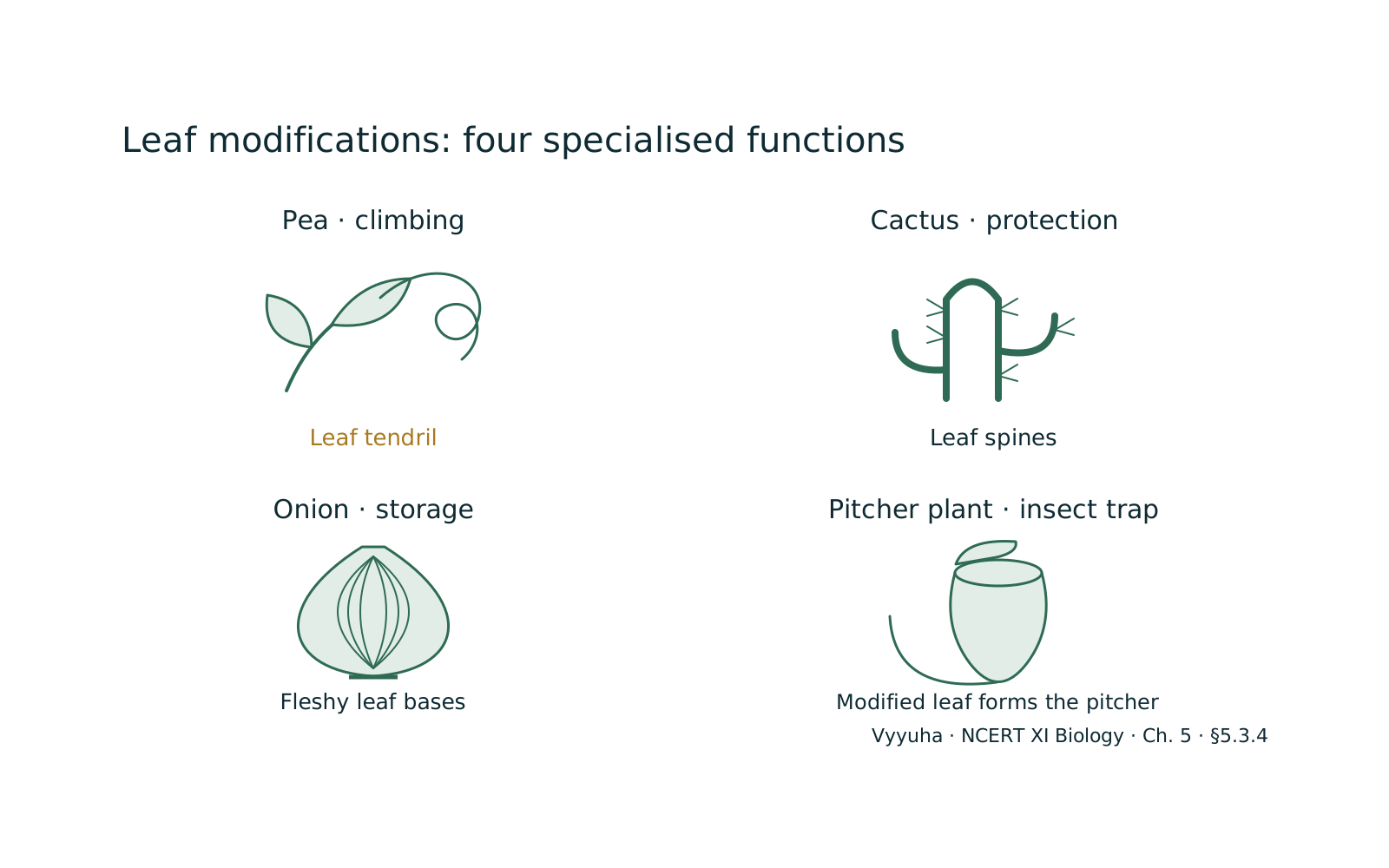
1. Leaf Tendrils:
- Description: — These are slender, wiry, spirally coiled structures that are highly sensitive to touch. They can be modifications of the entire leaf, leaflets, petiole, or stipules.
- Function: — Provide support to weak-stemmed plants by coiling around nearby objects, allowing the plant to climb and access better light conditions.
- Examples:
* Whole leaf tendril: Lathyrus aphaca (Wild Pea) - the entire leaf is modified into a tendril. * Leaflet tendril: Pisum sativum (Garden Pea) - the terminal leaflets are modified into tendrils. * Petiole tendril: Clematis, Smilax - the petiole becomes tendril-like. * Stipular tendril: Smilax (though often debated, some consider stipules to form tendrils).
2. Leaf Spines:
- Description: — Sharp, pointed, rigid structures, typically derived from the leaf lamina, apex, or margins. They are often lignified and lack chlorophyll.
- Function: — Primarily serve as a defense mechanism against herbivores, deterring grazing animals. They also help in reducing water loss by decreasing the surface area for transpiration, especially in xerophytic plants.
- Examples:
* Leaf apex spine: Agave, Yucca. * Leaf margin spine: Opuntia (prickly pear cactus) - the leaves are reduced to spines, and the stem becomes flattened and photosynthetic (phylloclade). * Whole leaf spine: Berberis (Barberry) - entire leaves are modified into spines.
3. Storage Leaves (Fleshy Leaves):
- Description: — Thick, succulent leaves, often with a reduced surface area, specialized for storing water and/or food (starch, mucilage).
- Function: — Enable plants to survive in arid or semi-arid conditions by providing a reservoir of water. They can also store nutrients.
- Examples:
* Water storage: Aloe, Agave, Bryophyllum. * Food storage: Allium cepa (Onion) - the fleshy scales of the onion bulb are modified leaves that store food.
4. Phyllodes:
- Description: — In some plants, the petiole (leaf stalk) or rachis (main axis of a compound leaf) becomes flattened, green, and leaf-like, performing photosynthesis, while the true leaf blade is either reduced or absent, especially in juvenile stages.
- Function: — To take over the photosynthetic function of the true leaves, which are often reduced to minimize water loss, particularly in xerophytic conditions.
- Examples: — Acacia auriculiformis, Acacia longifolia (Australian Acacia species).
5. Insectivorous (Carnivorous) Leaves:
- Description: — Highly specialized leaves adapted to trap and digest insects and other small arthropods. These plants typically grow in nitrogen-deficient soils (e.g., bogs, swamps) and obtain nitrogen and other nutrients from their prey.
- Function: — Supplement nutrient intake, especially nitrogen, which is scarce in their habitat.
- Examples:
* **Pitcher Plant (Nepenthes, Sarracenia):** The leaf forms a pitcher-like structure containing digestive fluids. The rim is often slippery, and the inner surface has downward-pointing hairs to prevent escape.
In Nepenthes, the pitcher is a modification of the leaf lamina, and the tendril connects it to the stem. * **Bladderwort (Utricularia):** Submerged leaves are modified into small bladders with a trap door.
When aquatic insects or larvae touch trigger hairs, the door opens, and the prey is sucked in by negative pressure. * **Venus Flytrap (Dionaea muscipula):** The leaf blade is modified into two hinged lobes with stiff marginal bristles and sensitive trigger hairs.
When an insect touches these hairs, the lobes snap shut, trapping the prey. * **Sundew (Drosera):** Leaves bear numerous glandular tentacles that secrete a sticky, glistening mucilage to trap insects.
The tentacles then bend inwards to digest the prey.
6. Scale Leaves:
- Description: — Thin, dry, membranous, or sometimes fleshy, sessile, and often colorless structures. They are typically found at the nodes of underground stems (rhizomes, bulbs, corms) or as protective coverings for buds.
- Function: — Primarily protective, shielding axillary buds or young shoots. In some cases (e.g., onion), they can store food.
- Examples: — Asparagus (reduced scale leaves on cladodes), ginger (on rhizome), onion (fleshy scales of the bulb), buds of trees.
7. Leaf Hooks:
- Description: — The leaf apex or leaflets are modified into stiff, sharp, hook-like structures.
- Function: — Provide support for climbing, similar to tendrils but with a different morphology.
- Examples: — Bignonia unguis-cati (Cat's Claw Creeper) - the terminal leaflets are modified into three stiff, claw-like hooks.
Common Misconceptions:
- Leaf vs. Stem Modifications: — Students often confuse leaf spines (e.g., Opuntia, Berberis) with stem thorns (e.g., Bougainvillea, Citrus) or stem tendrils (e.g., Cucurbita, grapes). Spines are modified leaves, thorns are modified stems, and stem tendrils are modified axillary buds. Careful observation of their position and developmental origin is key.
- Phyllode vs. Cladode/Phylloclade: — Phyllodes are modified petioles/rachis, while cladodes/phylloclades are modified stems that become flattened and green, performing photosynthesis (e.g., Opuntia, Ruscus, Asparagus). The presence of true leaves (even if reduced to scales or spines) in the axil of a phylloclade helps distinguish it from a phyllode.
NEET-Specific Angle:
NEET questions frequently test the identification of specific leaf modifications with their corresponding plant examples and adaptive functions. Emphasis is often placed on:
- Matching: — Matching a plant name with its leaf modification type.
- Functional Significance: — Understanding why a particular modification occurs (e.g., water conservation, defense, nutrient acquisition).
- Distinguishing Features: — Differentiating between similar-looking structures (e.g., leaf tendril vs. stem tendril, spine vs. thorn).
- Insectivorous Plants: — These are a favorite topic, requiring knowledge of the specific trapping mechanisms and the nutrient deficiency they address.
Mastering the examples and their adaptive roles is crucial for scoring well on this topic.
Often confused with
Side-by-side differences the NEET paper likes to test.
| Aspect | Leaf Modifications | Stem Tendrils |
|---|---|---|
| Origin | Modified leaf or part of a leaf (leaflet, petiole, stipule). | Modified stem (axillary bud or terminal bud). |
| Position | Arises from the leaf axil or as a part of the leaf structure itself. | Arises from the axil of a leaf, often replacing an axillary branch. |
| Examples | *Pisum sativum* (garden pea - terminal leaflets), *Lathyrus aphaca* (wild pea - whole leaf), *Smilax* (stipules/petiole). | *Vitis vinifera* (grape), *Cucurbita* (gourds), *Passiflora* (passion flower). |
| Associated Structures | Often found with a normal leaf or leaf base. | A leaf is typically present in its axil, or it replaces a branch. |
Leaf tendrils and stem tendrils both serve the function of providing support for climbing, but their developmental origins are fundamentally different. Leaf tendrils are transformations of leaf components, while stem tendrils are modified stem structures, specifically axillary buds. This distinction is crucial for accurate botanical identification and understanding plant morphology. Observing the position and what structure it replaces or is associated with helps in differentiation.
Why it is tested: NEET relevance: High. Differentiating between leaf and stem modifications is a frequently tested concept, often appearing in identification-based or matching questions. Understanding the origin helps avoid common misconceptions.
Questions students ask
6 answered on this topic.
What is the primary reason for leaf modifications in plants?
The primary reason for leaf modifications is adaptation to specific environmental conditions or to perform specialized functions beyond their typical roles of photosynthesis and transpiration. These adaptations are crucial for a plant's survival and reproductive success.
For instance, in arid environments, leaves modify to reduce water loss, while in nutrient-poor soils, they might adapt to capture insects for nitrogen. Essentially, modifications help plants thrive in challenging niches by optimizing resource acquisition, defense, or support.
How can I differentiate between a leaf tendril and a stem tendril?
Differentiating between leaf and stem tendrils requires observing their origin. A leaf tendril originates from a leaf (either the whole leaf, leaflets, petiole, or stipules), as seen in peas (Pisum sativum) where terminal leaflets become tendrils. A stem tendril, on the other hand, develops from an axillary bud, which is a modified stem structure. Examples include grapes (Vitis) and gourds (Cucurbita). The position and developmental origin are the key distinguishing features.
Why do insectivorous plants have modified leaves to trap insects?
Insectivorous plants typically grow in soils that are deficient in essential nutrients, particularly nitrogen. While they can photosynthesize, they cannot obtain sufficient nitrogen from the soil for protein synthesis and growth.
Therefore, their leaves have evolved into specialized traps to capture and digest insects. The digested insect bodies provide the necessary nitrogen and other minerals, supplementing the plant's nutritional requirements and allowing it to thrive in otherwise inhospitable environments.
What is a phyllode, and how does it differ from a normal leaf?
A phyllode is a modified petiole (leaf stalk) or rachis (main axis of a compound leaf) that becomes flattened, green, and leaf-like, taking over the photosynthetic function. In plants with phyllodes, the true leaf blade is often reduced, rudimentary, or falls off early.
A normal leaf, in contrast, has a distinct, broad lamina (leaf blade) as its primary photosynthetic organ. Phyllodes are an adaptation, particularly in some Australian Acacia species, to reduce water loss by minimizing the surface area of the true leaf blade while maintaining photosynthetic capacity.
Are spines always modified leaves? What about thorns and prickles?
No, not all sharp, pointed structures on plants are modified leaves. Spines are indeed modified leaves (e.g., Opuntia, Berberis). Thorns, however, are modified stems, originating from axillary buds (e.g., Bougainvillea, Citrus). Prickles are epidermal outgrowths, meaning they arise from the outer layer of the stem or leaf and are not modified organs (e.g., roses). Understanding their developmental origin is crucial for correct identification in botany.
Can a single plant exhibit multiple types of leaf modifications?
Yes, it is possible for a single plant species to exhibit multiple types of leaf modifications, or even for different parts of the same plant to show distinct modifications. For example, some plants might have both scale leaves (for protection) and tendrils (for support).
While less common to have drastically different modifications on the same mature leaf, the overall plant body can certainly display a range of adaptations across its various leaf structures, reflecting complex evolutionary strategies for survival.