Aestivation and Placentation — Explained
Detailed Explanation
The intricate world of flowering plants reveals a fascinating array of structural adaptations, two of the most significant being aestivation and placentation. These features are not merely aesthetic but represent crucial evolutionary strategies for protection, reproduction, and species survival. Understanding them is fundamental to plant morphology and taxonomy.
Conceptual Foundation:
Both aestivation and placentation are aspects of floral morphology that are genetically determined and highly conserved within species, making them valuable taxonomic markers. Aestivation, the arrangement of perianth members (sepals and petals) in a floral bud, primarily serves a protective function, shielding the delicate reproductive organs within before anthesis (flowering).
Placentation, the arrangement of ovules on the placenta within the ovary, is directly linked to successful fertilization, seed development, and ultimately, fruit formation and seed dispersal. The specific patterns observed in different plant families reflect adaptations to various environmental pressures and pollination strategies.
Aestivation: The Bud's Blueprint
Aestivation refers to the specific manner in which the sepals or petals are arranged in a floral bud relative to one another. It's a snapshot of the perianth's organization before the flower opens.
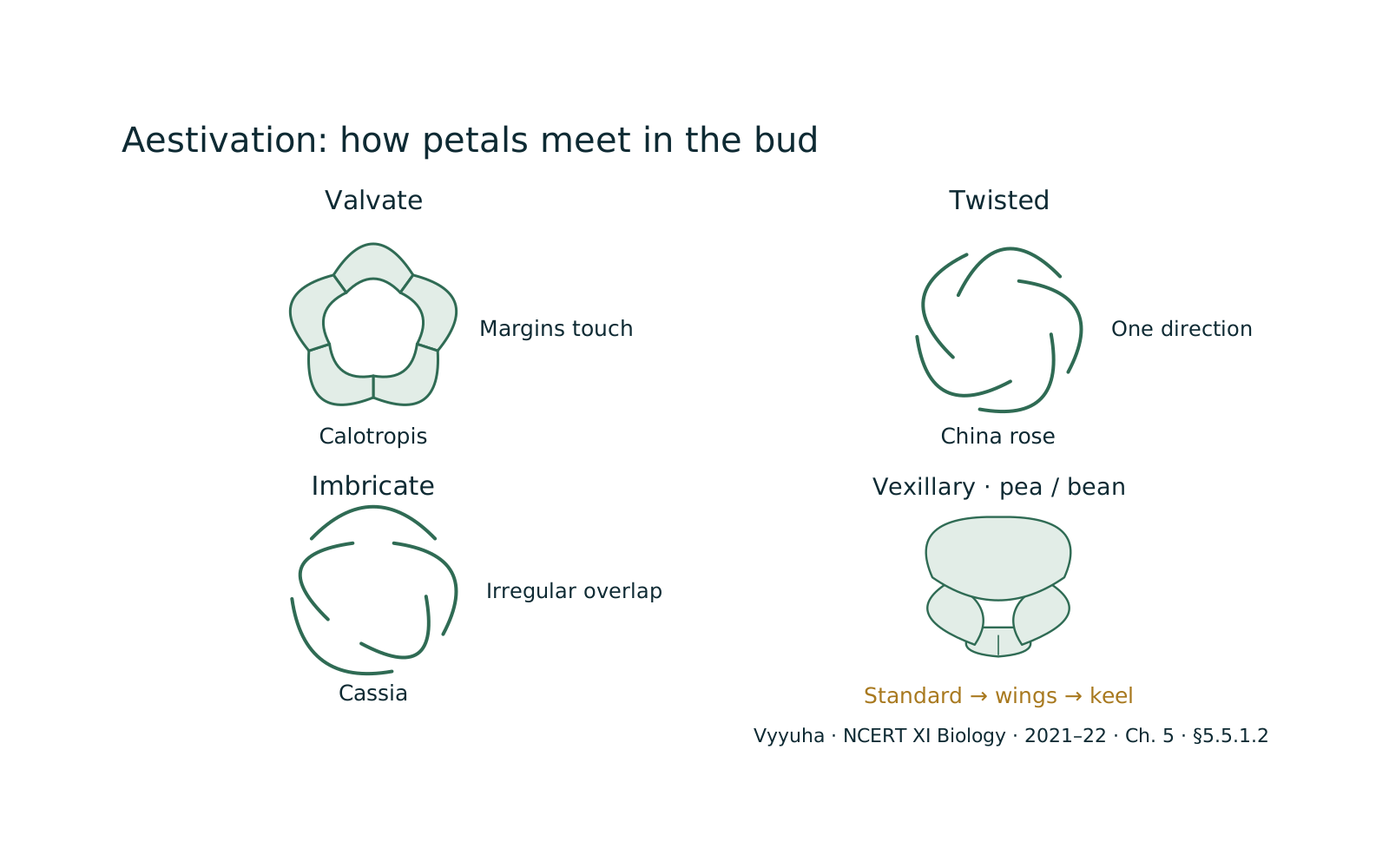
- Valvate Aestivation: — In this type, the margins of the sepals or petals just touch each other without overlapping. Imagine the edges of five petals meeting perfectly at a central point, like the segments of an orange peel. There's no overlapping, just a precise meeting. This arrangement allows for easy and rapid opening of the flower.
* Examples: Calotropis (Madar), Mustard.
- Twisted Aestivation: — Here, one margin of each sepal or petal overlaps the margin of the adjacent sepal or petal in a regular, consistent direction (either clockwise or anti-clockwise). This creates a spiral or twisted appearance. It's like a series of dominoes, where each one pushes the next in a specific sequence. This overlapping provides enhanced protection to the inner floral parts.
* Examples: China rose (Hibiscus rosa-sinensis), Cotton (Gossypium), Lady's finger (Abelmoschus esculentus).
- Imbricate Aestivation: — This is a more complex type where the margins of sepals or petals overlap, but not in a regular, consistent direction as seen in twisted aestivation. There's no fixed pattern of one margin consistently overlapping the next. Instead, some petals might overlap others, while some might be overlapped, and one or two might be entirely internal or external.
* Sub-types of Imbricate: * Ascending Imbricate: In this specific imbricate type, the posterior (uppermost) petal is overlapped by the lateral petals, and these, in turn, overlap the anterior (lowermost) petals.
It's a specific sequence of overlapping from back to front. * Examples: Cassia, Gulmohar (Delonix regia). * Descending Imbricate (Vexillary Aestivation): This is a highly specialized form characteristic of the Papilionaceae (pea family).
The largest, posterior petal (called the standard or vexillum) overlaps the two lateral petals (wings), which in turn overlap the two smallest anterior petals (keel). The keel petals are often fused. This arrangement is highly adapted for specific insect pollination, providing a landing platform and protecting the reproductive organs.
* Examples: Pea (Pisum sativum), Bean (Phaseolus vulgaris).
Placentation: The Ovule's Home
Placentation refers to the manner in which ovules are arranged on the placenta within the ovary. The placenta is the nutritive tissue to which the ovules are attached. The type of placentation is determined by the number of carpels (individual units of the pistil) and how they are fused.
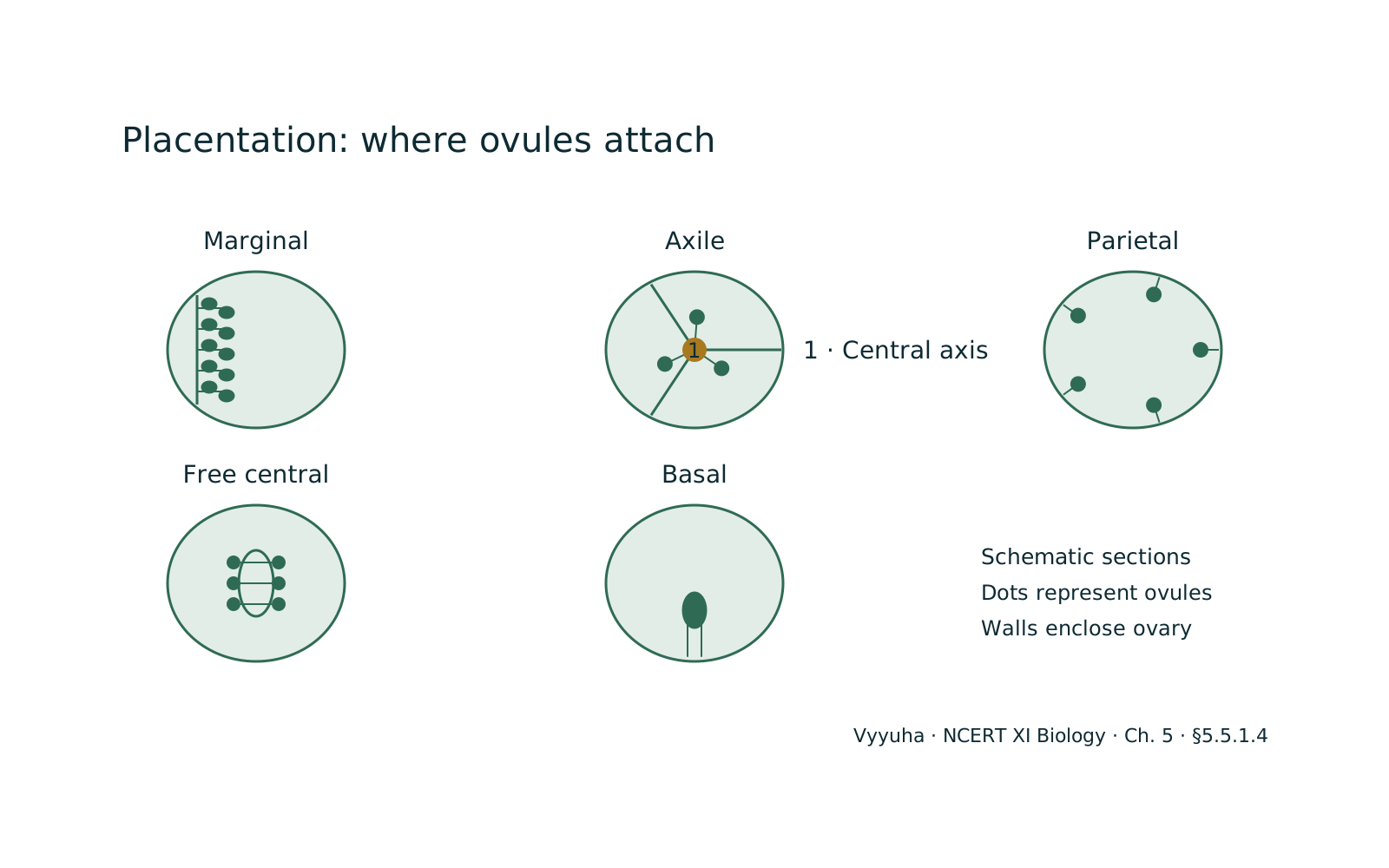
- Marginal Placentation: — This is characteristic of monocarpellary (single carpel) or multicarpellary, apocarpous (free carpels) ovaries. The placenta forms a ridge along the ventral suture (the fused margin) of the ovary, and the ovules are arranged in two rows on this ridge. Imagine a pea pod, where the peas (ovules) are attached along a single seam inside the pod (carpel).
* Examples: Pea (Pisum sativum), other legumes.
- Axile Placentation: — This occurs in multicarpellary, syncarpous (fused carpels) ovaries. The carpels fuse to form a central axis, and the placenta develops from the septa (partitions) where the carpels meet in the center. The ovary is typically multilocular (divided into chambers). The ovules are borne on the central axis within each locule. Think of a cross-section of an orange or tomato, where seeds are arranged around a central column in distinct compartments.
* Examples: China rose (Hibiscus rosa-sinensis), Tomato (Solanum lycopersicum), Lemon (Citrus limon).
- Parietal Placentation: — Found in multicarpellary, syncarpous ovaries that are typically unilocular (single-chambered) or become so due to the breakdown of septa. The placentas develop on the inner wall of the ovary, often at the points where the margins of the carpels fuse. Sometimes, a false septum (replum) may develop, making the ovary appear bilocular. Imagine the seeds of a cucumber or pumpkin attached to the outer walls of the fruit.
* Examples: Mustard (Brassica campestris), Argemone (Prickly Poppy), Cucumber (Cucumis sativus).
- Free Central Placentation: — This occurs in multicarpellary, syncarpous ovaries that are unilocular. The ovules are borne on a central column that arises from the base of the ovary, but this column is not connected to the ovary wall by any septa. It's essentially an axile placentation where the septa have disappeared, leaving a free central column.
* Examples: Dianthus (Carnation), Primrose (Primula).
- Basal Placentation: — In this type, the ovary is unilocular, and a single ovule is present, attached directly to the base of the ovary. This is the simplest form of placentation, often found in flowers with a single seed per fruit.
* Examples: Sunflower (Helianthus annuus), Marigold (Tagetes).
- Superficial Placentation: — A less common type, found in multicarpellary, syncarpous, multilocular ovaries. The placentas develop over the entire inner surface of the septa (partitions) within the ovary, not just at the central axis. This leads to ovules being scattered across the septal surfaces.
* Examples: Water lily (Nymphaea).
Real-World Applications & NEET-Specific Angle:
These morphological features are critical for plant identification and classification. Botanists use aestivation and placentation patterns, along with other floral characteristics, to place plants into their respective families and genera. For NEET aspirants, the focus is primarily on:
- Identification of types: — Being able to recognize and differentiate between the various types of aestivation and placentation based on diagrams or descriptions.
- Examples: — Memorizing the classic plant examples associated with each type is crucial, as questions often test this direct recall.
- Functional significance: — Understanding why these arrangements exist (e.g., protection in aestivation, efficient seed development in placentation).
- Distinguishing similar types: — For instance, the difference between axile and free central placentation, or ascending vs. descending imbricate aestivation.
Common Misconceptions:
- Aestivation vs. Vernation: — A common error is confusing aestivation with vernation. Aestivation refers to the arrangement of sepals/petals in a flower bud. Vernation, on the other hand, describes the arrangement of young leaves within a leaf bud. While both describe bud arrangements, they apply to different plant parts.
- Axile vs. Free Central Placentation: — Students often confuse these. The key difference is the presence or absence of septa connecting the central column to the ovary wall. Axile has septa, making it multilocular; free central lacks septa, making it unilocular.
- Imbricate vs. Twisted: — Imbricate lacks the regular, consistent overlap direction of twisted aestivation. One petal is not consistently overlapping the next in a fixed sequence.
By mastering these concepts and their associated examples, NEET aspirants can confidently tackle questions related to floral morphology.
Often confused with
Side-by-side differences the NEET paper likes to test.
| Aspect | Aestivation and Placentation | Vernation |
|---|---|---|
| Definition | Aestivation: Arrangement of sepals or petals in a floral bud. | Vernation: Arrangement of young leaves within a leaf bud. |
| Plant Part Involved | Aestivation: Floral parts (sepals and petals). | Vernation: Vegetative parts (leaves). |
| Functional Role | Aestivation: Protection of reproductive organs, taxonomic marker. | Vernation: Protection of developing leaves, taxonomic marker. |
| Examples of Types | Aestivation: Valvate, Twisted, Imbricate (Ascending, Descending/Vexillary). | Vernation: Circinate, Convolute, Involute, Revolute, Plicate. |
While both aestivation and vernation describe the arrangement of developing structures within a bud, they apply to distinct plant organs. Aestivation specifically refers to the protective folding and overlapping patterns of sepals and petals in a flower bud, crucial for floral development and classification.
Vernation, on the other hand, details the coiling, folding, or rolling patterns of young leaves within a leaf bud, serving to protect the delicate leaf primordia. Understanding this distinction is vital for accurate botanical terminology and identification.
Why it is tested: For NEET, understanding the precise definitions and the specific plant parts involved for both aestivation and vernation is important. Questions often test the ability to differentiate between these terms and recall examples associated with each, especially in the context of plant morphology and taxonomy. Misinterpreting these terms can lead to errors in identifying plant families or characteristics.
| Aspect | Aestivation and Placentation | Axile Placentation |
|---|---|---|
| Ovary Structure | Axile Placentation: Multilocular (divided into chambers) due to septa. | Free Central Placentation: Unilocular (single chambered) as septa are absent. |
| Placenta Connection | Axile Placentation: Central column connected to ovary wall by septa. | Free Central Placentation: Central column free, not connected to ovary wall by septa. |
| Origin | Axile Placentation: Placentas develop from fused margins of carpels forming a central axis. | Free Central Placentation: Believed to evolve from axile placentation by breakdown of septa. |
| Examples | Axile Placentation: China rose, Tomato, Lemon. | Free Central Placentation: *Dianthus*, Primrose. |
Axile and free central placentation both involve ovules attached to a central column, but their key difference lies in the ovary's internal structure. Axile placentation features a multilocular ovary with septa connecting the central placenta to the ovary wall, creating distinct chambers.
In contrast, free central placentation occurs in a unilocular ovary where the central ovule-bearing column stands freely, without any septa connecting it to the ovary wall. This distinction is critical for accurate botanical identification.
Why it is tested: NEET questions frequently test the ability to differentiate between similar-looking placentation types. The distinction between axile and free central, particularly regarding the presence or absence of septa and the resulting locularity of the ovary, is a common point of confusion. Knowing the defining structural characteristics and associated examples is essential for scoring well on such conceptual questions.
Questions students ask
5 answered on this topic.
What is the primary difference between aestivation and vernation?
Aestivation specifically refers to the arrangement of sepals or petals within a floral bud before the flower opens. It's about how the perianth parts are folded or overlapped. Vernation, in contrast, describes the arrangement of young leaves within a leaf bud.
While both terms deal with the arrangement of developing structures within a bud, they apply to different organs: aestivation to floral parts, and vernation to vegetative leaves. This distinction is important for precise botanical terminology.
Why is vexillary aestivation considered a specialized type?
Vexillary aestivation, characteristic of the pea family (Papilionaceae), is specialized because of its unique and highly evolved overlapping pattern. The largest posterior petal (standard) overlaps the two lateral petals (wings), which in turn overlap the two smallest anterior petals (keel).
This arrangement creates a landing platform for pollinators and effectively encloses and protects the stamens and pistil, facilitating a specific type of insect pollination mechanism. Its complexity and functional adaptation make it highly specialized.
How can I easily distinguish between axile and free central placentation?
The easiest way to distinguish between axile and free central placentation is by examining the presence or absence of septa (partitions) within the ovary. In axile placentation, the ovary is multilocular (divided into chambers) due to the presence of septa that extend from the central axis to the ovary wall, with ovules attached to this central axis within each locule.
In free central placentation, the ovary is unilocular (single-chambered) because the septa are absent, leaving a central column bearing ovules that is not connected to the ovary wall.
Are there any plants that exhibit more than one type of aestivation or placentation?
Generally, a single plant species exhibits a consistent type of aestivation and placentation, as these are genetically determined and stable taxonomic characters. However, within a larger plant family, different genera or species might display variations.
For instance, while most legumes show marginal placentation, some might have slight variations. Similarly, while a family might predominantly show imbricate aestivation, specific genera might lean towards ascending or descending forms.
The key is that for a given species, these features are typically fixed.
What is the functional significance of different placentation types?
Different placentation types are functionally significant primarily for efficient nourishment, protection, and dispersal of developing seeds. For example, axile placentation in multilocular ovaries offers robust protection to ovules in separate chambers.
Marginal placentation allows for easy dehiscence along a single suture for seed release. Basal placentation, with a single ovule, is efficient for plants producing one-seeded fruits. These arrangements optimize resource allocation to ovules and facilitate successful reproduction and propagation.