Cell Theory
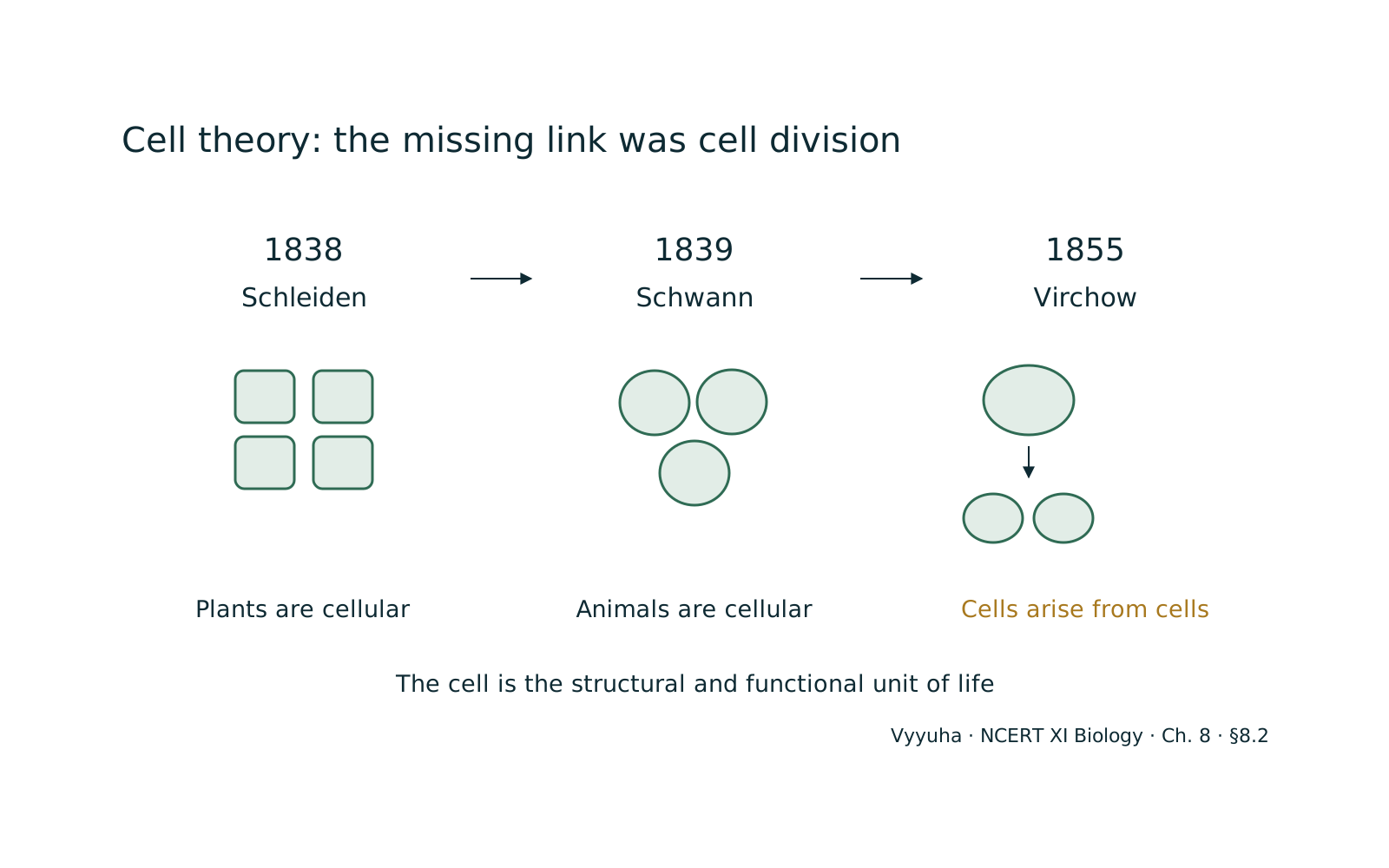
The Cell Theory is a fundamental unifying principle in biology, asserting that all known living organisms are composed of one or more cells, that the cell is the basic structural and functional unit of all living organisms, and that all cells arise from pre-existing cells through division. This theory underpins our understanding of life's continuity, growth, and development, providing a framework …
Quick Summary
The Cell Theory is a cornerstone of biology, asserting three fundamental principles about life. Firstly, all living organisms, from the simplest bacteria to complex humans, are composed of one or more cells.
This establishes the cell as the universal building block of life. Secondly, the cell is the basic structural and functional unit of all living organisms. This means it's the smallest entity capable of performing all life processes independently, like metabolism, growth, and reproduction.
Thirdly, all cells arise from pre-existing cells through division, a concept famously stated as 'Omnis cellula e cellula' by Rudolf Virchow. This principle refutes spontaneous generation and explains the continuity of life, growth, and repair.
Key historical figures include Robert Hooke (coined 'cell'), Antonie van Leeuwenhoek (observed living cells), Matthias Schleiden (plants are cellular), Theodor Schwann (animals are cellular), and Rudolf Virchow (cells from pre-existing cells).
Modern Cell Theory also acknowledges that cells contain hereditary information, share similar chemical compositions, and that all life functions occur within them. Viruses are often considered exceptions due to their acellular nature and obligate parasitic lifestyle.
Full explanation
The Cell Theory stands as one of the most fundamental and unifying principles in modern biology, providing a conceptual framework for understanding the organization, function, and continuity of life. Its development was a gradual process, built upon centuries of observation and experimentation, ultimately transforming our understanding of living organisms.
Conceptual Foundation: What is a Cell?
Before delving into the theory, it's crucial to understand what a 'cell' truly represents. A cell is the smallest structural and functional unit of an organism, typically microscopic, consisting of cytoplasm and a nucleus enclosed in a membrane. It is the basic unit of life, capable of independent existence and performing all essential life functions. The discovery of the cell itself predates the formal Cell Theory.
Historical Development and Key Contributors:
- Robert Hooke (1665): — Often credited with coining the term 'cell'. Using a crude compound microscope, Hooke observed thin slices of cork. He saw tiny, box-like compartments that reminded him of the small rooms (cells) in a monastery. What he actually observed were the dead cell walls of plant cells, but his observations marked the first recorded description of cellular structures. He published his findings in 'Micrographia'.
- Antonie van Leeuwenhoek (1674): — A Dutch draper and amateur scientist, Leeuwenhoek developed much more powerful single-lens microscopes than Hooke's. He was the first to observe and describe living cells, including bacteria (which he called 'animalcules'), protozoa, sperm cells, and red blood cells. His meticulous observations provided the first glimpse into the microscopic world of living, moving organisms, laying the groundwork for understanding that cells were not just empty boxes but contained living matter.
- Jean-Baptiste Lamarck (1809): — Although known for his theory of evolution, Lamarck was one of the first to state that 'no body can have life if its constituent parts are not cellular tissue or are not formed by cells.' This was an early, albeit general, recognition of the cellular basis of life.
- Robert Brown (1831): — A Scottish botanist, Brown observed a prominent, spherical structure within plant cells, which he named the 'nucleus'. This discovery was significant as it identified a key organelle within the cell, suggesting internal organization.
- Matthias Schleiden (1838): — A German botanist, Schleiden concluded that all plants are composed of cells and that cells are the basic building blocks of plant life. He published his observations, emphasizing the cellular nature of plant tissues.
- Theodor Schwann (1839): — A German zoologist and physiologist, Schwann extended Schleiden's observations to the animal kingdom. He concluded that all animals are also composed of cells. More importantly, he proposed that cells are the fundamental units of both plant and animal life, thus unifying the observations across kingdoms. Schwann also recognized the importance of the cell membrane.
* The Original Cell Theory (Schleiden and Schwann): Based on their independent observations and discussions, Schleiden and Schwann jointly formulated the initial tenets of the Cell Theory, which essentially stated: 1. All living organisms are composed of cells. 2. The cell is the basic unit of structure and organization in living organisms.
- Rudolf Virchow (1855): — A German physician and pathologist, Virchow made a crucial addition to the Cell Theory. He famously stated 'Omnis cellula e cellula,' meaning 'all cells arise from pre-existing cells.' This principle directly challenged the prevailing theory of spontaneous generation and provided a mechanism for the continuity of life, explaining how organisms grow, repair, and reproduce at the cellular level. Virchow's contribution completed the classical Cell Theory.
The Postulates of Modern Cell Theory:
The classical Cell Theory, as refined by Virchow, comprises three main postulates:
- All known living organisms are composed of one or more cells. — This postulate emphasizes the universality of cellular organization across all forms of life, from the simplest bacteria to the most complex multicellular organisms. It means that the cell is the fundamental unit of biological construction.
- The cell is the basic structural and functional unit of all living organisms. — This means that the cell is the smallest entity that can perform all the processes necessary for life (e.g., metabolism, reproduction, response to stimuli). Sub-cellular components like organelles cannot survive independently, but a whole cell can.
- All cells arise from pre-existing cells through cell division. — This postulate, Virchow's crucial addition, explains the origin of new cells. It refutes spontaneous generation and establishes the principle of cellular continuity, meaning life begets life at the cellular level.
Modern Additions and Refinements to Cell Theory:
While the three classical postulates remain central, modern biological understanding has led to several important additions and refinements:
- Cells contain hereditary information (DNA) which is passed from cell to cell during cell division. — This highlights the genetic continuity and the role of DNA in directing cellular activities and inheritance.
- All cells are fundamentally similar in chemical composition and metabolic activities. — Despite vast diversity in form and function, cells share common biochemical pathways (e.g., glycolysis, Krebs cycle) and molecular components (e.g., proteins, nucleic acids, lipids, carbohydrates).
- All basic chemical and physiological functions (e.g., energy flow, metabolism) are carried out inside cells. — This reinforces the cell as the site of all life processes.
- Cell activity depends on the activities of sub-cellular structures within the cell (organelles). — This acknowledges the specialized roles of organelles in maintaining cellular function.
Exceptions and Limitations:
While the Cell Theory is widely accepted, certain biological entities present interesting challenges or 'exceptions' that are often debated:
- Viruses: — Viruses are acellular (lack cellular structure) and cannot carry out metabolic functions or reproduce independently. They are obligate intracellular parasites, meaning they can only replicate by hijacking the machinery of a host cell. Whether viruses are 'living' is a long-standing debate, but they clearly do not fit the definition of a cell and thus challenge the 'all living organisms are composed of cells' postulate.
- Coenocytic Organisms (e.g., some fungi, algae): — These organisms have multinucleated cytoplasm that is not divided into distinct cells by cell walls or membranes. Examples include Rhizopus (a fungus) and Vaucheria (an alga). While they contain nuclei and cytoplasm, the lack of clear cellular compartmentalization makes them an interesting case, though their nuclei still arise from pre-existing nuclei.
- Prokaryotes vs. Eukaryotes: — While both are cellular, their structural complexity differs greatly. Prokaryotes lack membrane-bound organelles and a true nucleus, but they still adhere to the fundamental postulates of being a cell, being the basic unit of life, and arising from pre-existing cells.
Significance of Cell Theory:
- Unifying Principle: — It provides a universal framework for understanding all life forms, linking diverse organisms through a common cellular basis.
- Foundation for Modern Biology: — It is the bedrock for fields like genetics, molecular biology, developmental biology, pathology, and evolutionary biology.
- Understanding Disease: — Many diseases, including cancer, are fundamentally cellular disorders, involving uncontrolled cell division or cellular dysfunction. Understanding cell theory is crucial for medical research.
- Explaining Growth and Reproduction: — It explains how organisms grow (by increasing cell number) and how life perpetuates through cell division.
- Refutation of Spontaneous Generation: — Virchow's contribution definitively ended the belief that life could spontaneously arise from non-living matter, paving the way for modern scientific inquiry into the origins of life.
NEET-Specific Angle:
For NEET aspirants, understanding Cell Theory is not just about memorizing postulates but grasping its historical context, the contributions of key scientists, and its implications. Questions often test:
- Identification of scientists and their contributions: — Matching Hooke, Leeuwenhoek, Schleiden, Schwann, and Virchow with their discoveries or statements.
- The three main postulates: — Direct recall or application of these principles.
- Exceptions to Cell Theory: — Particularly viruses and coenocytic organisms, as these are common conceptual traps.
- The 'Omnis cellula e cellula' concept: — Its meaning and significance.
- The timeline of discoveries: — Understanding the chronological order of events.
- Distinction between early and modern cell theory.
Mastering Cell Theory provides a strong foundation for subsequent topics in 'Cell: The Unit of Life' such as prokaryotic and eukaryotic cells, cell organelles, and cell division, as it establishes the fundamental unit upon which all these more complex structures and processes are built.
Key Concepts
This concept is central to Cell Theory. It means that the cell is the smallest level of organization that can…
This postulate, 'Omnis cellula e cellula,' is crucial for understanding the continuity of life. It implies…
Modern Cell Theory emphasizes that despite the vast diversity in form and function, all cells share…
Often confused with
Side-by-side differences the NEET paper likes to test.
| Aspect | Cell Theory | Early Cell Theory vs. Modern Cell Theory |
|---|---|---|
| Formulators | Matthias Schleiden & Theodor Schwann | Schleiden, Schwann, and Rudolf Virchow, with subsequent scientific consensus |
| Key Postulates | 1. All organisms are made of cells. 2. Cell is the basic unit of structure and organization. | 1. All organisms are made of cells. 2. Cell is the basic unit of structure and function. 3. All cells arise from pre-existing cells. (Additionally: Cells contain hereditary info, similar chemical composition, energy flow occurs within cells, cell activity depends on organelles.) |
| Origin of New Cells | Unaddressed or vaguely implied spontaneous generation for some cells. | Explicitly stated: 'Omnis cellula e cellula' (all cells from pre-existing cells). |
| Scope of Understanding | Primarily focused on structural composition. | Encompasses structural, functional, genetic, and evolutionary aspects of cells. |
| Refutation of Spontaneous Generation | Did not directly refute it. | Directly refuted spontaneous generation through Virchow's postulate. |
The early Cell Theory, proposed by Schleiden and Schwann, established that all living organisms are composed of cells and that the cell is the fundamental unit of structure. However, it lacked a clear explanation for the origin of new cells.
Modern Cell Theory incorporates Rudolf Virchow's crucial addition, 'Omnis cellula e cellula,' stating that all cells arise from pre-existing cells, thereby refuting spontaneous generation. Furthermore, modern understanding expands upon the original postulates to include aspects like the genetic continuity of cells, their fundamental biochemical similarities, and the role of organelles in cellular function, providing a more comprehensive view of life at the cellular level.
Why it is tested: NEET relevance: Understanding the evolution of scientific theories is crucial. Questions often differentiate between the contributions of Schleiden/Schwann and Virchow, and the additional points of modern cell theory. This comparison helps clarify the historical progression and the completeness of the current understanding, which is frequently tested.
Questions students ask
6 answered on this topic.
What is the primary difference between Schleiden and Schwann's original Cell Theory and Virchow's contribution?
Schleiden and Schwann's original Cell Theory, formulated in 1838-1839, established two main postulates: that all living organisms are composed of cells, and that the cell is the basic unit of structure and organization.
Their work unified the understanding of plant and animal life under a common cellular basis. Virchow's crucial contribution in 1855 was the third postulate, 'Omnis cellula e cellula' (all cells arise from pre-existing cells).
This explained the origin of new cells, a mechanism missing from Schleiden and Schwann's initial theory, and fundamentally refuted the concept of spontaneous generation.
Why are viruses often considered an exception to the Cell Theory?
Viruses are considered an exception because they are acellular, meaning they lack the cellular structure (cytoplasm, organelles, cell membrane) characteristic of living cells. They cannot carry out metabolic processes or reproduce independently.
Instead, they are obligate intracellular parasites, relying entirely on the host cell's machinery for replication and survival. This directly contradicts the first two postulates of Cell Theory, which state that all living organisms are composed of cells and that the cell is the basic unit of life.
What is the significance of Robert Hooke's contribution to the Cell Theory?
Robert Hooke, in 1665, was the first to observe and coin the term 'cell' while examining thin slices of cork under his self-designed compound microscope. Although he was observing dead plant cell walls and not living protoplasm, his detailed drawings and descriptions in 'Micrographia' provided the initial visual evidence of discrete structural units within organisms.
His work opened the door to the microscopic world and inspired further investigations into the fundamental building blocks of life, even if the full implications of 'cell' weren't immediately apparent.
How did the Cell Theory refute the concept of spontaneous generation?
The Cell Theory, particularly Rudolf Virchow's postulate 'Omnis cellula e cellula' (all cells arise from pre-existing cells), directly refuted the long-held belief in spontaneous generation. Spontaneous generation proposed that living organisms could arise from non-living matter (e.
g., maggots from rotting meat). Virchow's work demonstrated that new cells are always formed through the division of existing cells, establishing a principle of biological continuity and showing that life does not spontaneously appear from inert substances.
Are coenocytic organisms true exceptions to the Cell Theory?
Coenocytic organisms, such as some fungi (e.g., Rhizopus) and algae (e.g., Vaucheria), are often cited as 'exceptions' because their cytoplasm contains multiple nuclei without being divided into distinct, individual cells by septa or cell walls.
While they challenge the idea of discrete cellular units, they still contain nuclei and cytoplasm, and their nuclei arise from pre-existing nuclei. So, they are more of a structural variation or a partial exception to the strict definition of a 'cell' as a single, compartmentalized unit, rather than a complete refutation of the theory's core principles.
What does it mean for a cell to be the 'basic functional unit'?
For a cell to be the 'basic functional unit' means that it is the smallest entity capable of performing all the essential life processes independently. These functions include metabolism (converting nutrients into energy, building and breaking down molecules), growth, reproduction (through cell division), and responding to stimuli.
While organelles within a cell perform specific tasks, they cannot sustain life on their own. Only when organized within the complete cellular structure do these components collectively exhibit the properties of life, making the cell the fundamental unit of biological activity.
Revise in 30 seconds
- Robert Hooke (1665): — Coined 'cell' from dead cork observations.
- Antonie van Leeuwenhoek (1674): — First observed living cells ('animalcules').
- Schleiden (1838): — All plants are composed of cells.
- Schwann (1839): — All animals are composed of cells; cell is basic unit.
- Virchow (1855): — 'Omnis cellula e cellula' (all cells from pre-existing cells).
- Classical Cell Theory Postulates:
1. All living organisms are composed of cells. 2. Cell is the basic structural and functional unit of life. 3. All cells arise from pre-existing cells.
- Modern Cell Theory Additions: — Cells contain hereditary info (DNA), similar chemical composition, energy flow within cells.
- Exceptions: — Viruses (acellular), Coenocytic organisms (multinucleated without septa).
Hooke Looked Slowly, Saw Viruses.
- Hooke: Coined 'cell'
- Leeuwenhoek: Looked at 'living' cells
- Schleiden: Saw 'plants' are cells
- Schwann: Saw 'animals' are cells
- Virchow: Saw 'cells' come from pre-existing cells
- (The 'Viruses' part is a reminder of the main exception to the theory.)