Monosaccharides and Disaccharides
Monosaccharides, often referred to as simple sugars, represent the fundamental building blocks of all carbohydrates. They are polyhydroxy aldehydes or polyhydroxy ketones that cannot be hydrolyzed into simpler carbohydrate units. Disaccharides, on the other hand, are carbohydrates formed by the condensation of two monosaccharide units, linked together by a glycosidic bond, with the elimination of …
Quick Summary
Monosaccharides are the simplest carbohydrates, single sugar units like glucose, fructose, and galactose. They are polyhydroxy aldehydes (aldoses) or polyhydroxy ketones (ketoses) and cannot be hydrolyzed further.
They serve as primary energy sources and building blocks. Glucose is an aldohexose, fructose a ketohexose. Many monosaccharides exist in cyclic forms (pyranose or furanose) and exhibit isomerism, including D/L forms, anomers (), and epimers.
Most monosaccharides are reducing sugars due to a free anomeric carbon. Disaccharides are formed by joining two monosaccharide units via a glycosidic bond, a covalent linkage formed by dehydration. Key examples include sucrose (glucose + fructose, non-reducing), lactose (galactose + glucose, reducing), and maltose (glucose + glucose, reducing).
These disaccharides are hydrolyzed into their constituent monosaccharides by specific enzymes, playing vital roles in diet and energy metabolism.
Full explanation
Carbohydrates are one of the four major classes of biomolecules, playing indispensable roles in energy storage, structural support, and cell-cell recognition. They are polyhydroxy aldehydes or ketones, or substances that yield these compounds upon hydrolysis. The fundamental classification of carbohydrates is based on the number of sugar units they contain: monosaccharides (single units), disaccharides (two units), oligosaccharides (3-10 units), and polysaccharides (many units).
Conceptual Foundation
Carbohydrates are organic compounds composed of carbon, hydrogen, and oxygen, typically with a hydrogen-to-oxygen atom ratio of 2:1, similar to water, hence the name 'carbo-hydrate'. Their general empirical formula is . They are synthesized by plants through photosynthesis and serve as the primary source of energy for most living organisms. The presence of multiple hydroxyl groups makes them highly soluble in water.
Monosaccharides: The Simple Sugars
Monosaccharides are the simplest carbohydrates and serve as the monomeric units for disaccharides, oligosaccharides, and polysaccharides. They cannot be hydrolyzed into simpler forms. They are classified based on two main criteria:
- Number of carbon atoms:
Trioses (3 carbons): e.g., Glyceraldehyde, Dihydroxyacetone Tetroses (4 carbons): e.g., Erythrose Pentoses (5 carbons): e.g., Ribose, Deoxyribose, Xylose Hexoses (6 carbons): e.g., Glucose, Fructose, Galactose, Mannose * Heptoses (7 carbons): e.g., Sedoheptulose
- Nature of the carbonyl group:
* Aldoses: Contain an aldehyde group () at one end. E.g., Glucose, Galactose, Ribose. * Ketoses: Contain a ketone group () typically at the second carbon atom. E.g., Fructose, Dihydroxyacetone.
Key Monosaccharides and their Structures:
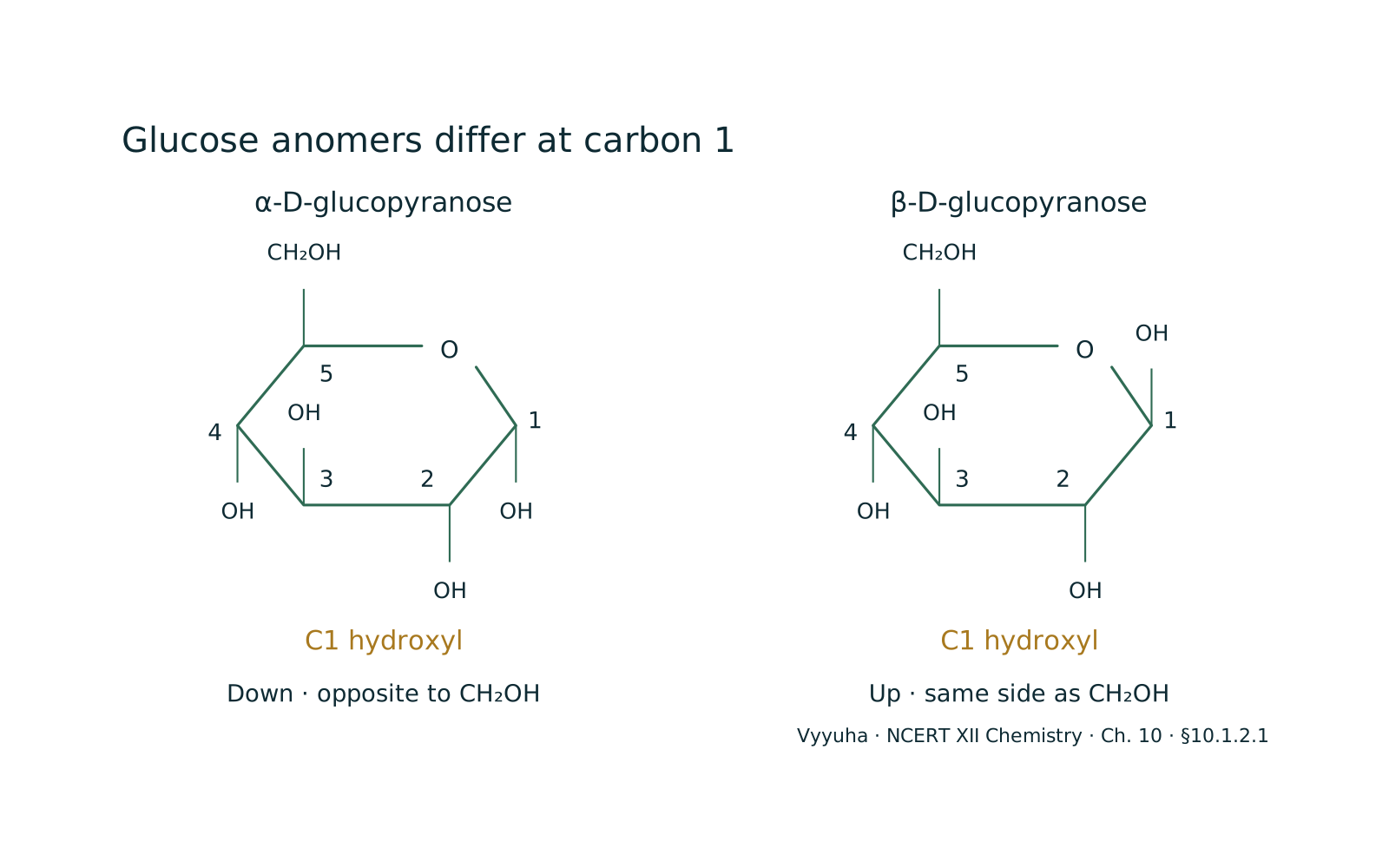
- Glucose (D-Glucose): — An aldohexose, meaning it's an aldehyde with six carbons. It is the most abundant monosaccharide and the primary energy source for cells. Its open-chain form is a straight chain of six carbons. In aqueous solutions, glucose predominantly exists in cyclic forms, specifically as a six-membered ring called a pyranose (glucopyranose). This cyclization occurs through a reaction between the aldehyde group (C1) and the hydroxyl group on C5. This creates a new chiral center at C1, leading to two anomeric forms: -D-glucopyranose and -D-glucopyranose. These anomers differ in the orientation of the hydroxyl group at C1 (anomeric carbon) relative to the group at C6. If the -OH at C1 is on the opposite side of the ring from the at C6, it's ; if it's on the same side, it's . The interconversion between these and forms via the open-chain intermediate is called mutarotation.
- Fructose (D-Fructose): — A ketohexose, meaning it's a ketone with six carbons. It is the sweetest natural sugar. Fructose also exists in cyclic forms, predominantly as a five-membered ring called a furanose (fructofuranose) in disaccharides like sucrose, and as a six-membered pyranose in its free state. Cyclization occurs between the ketone group (C2) and the hydroxyl group on C5 (for furanose) or C6 (for pyranose), creating and anomers at C2.
- Galactose (D-Galactose): — An aldohexose, an epimer of glucose. It differs from glucose only in the configuration of the hydroxyl group at C4. Like glucose, it forms pyranose rings and exhibits mutarotation. Galactose is a crucial component of lactose.
- Ribose (D-Ribose): — An aldopentose, a five-carbon sugar. It is a key component of RNA, ATP, and various coenzymes (e.g., NAD, FAD). Deoxyribose, a derivative of ribose lacking an oxygen atom at C2, is a component of DNA.
Isomerism in Monosaccharides:
- D/L Isomerism: — Based on the configuration of the chiral carbon furthest from the carbonyl group. If the -OH group on this carbon is on the right in a Fischer projection, it's a D-sugar; if on the left, it's an L-sugar. Most naturally occurring sugars are D-isomers.
- Enantiomers: — Stereoisomers that are non-superimposable mirror images of each other (e.g., D-glucose and L-glucose).
- Diastereomers: — Stereoisomers that are not mirror images of each other.
- Epimers: — Diastereomers that differ in configuration at only one chiral carbon atom (e.g., D-glucose and D-galactose differ at C4; D-glucose and D-mannose differ at C2).
- Anomers: — Cyclic monosaccharides that differ in configuration only at the anomeric carbon (the carbon derived from the carbonyl carbon of the open-chain form). E.g., -D-glucose and -D-glucose.
Reducing Sugars:
Monosaccharides are generally reducing sugars. This property arises from the presence of a free aldehyde group (in aldoses) or a ketone group that can isomerize to an aldehyde group (in ketoses) in their open-chain form. These groups can reduce mild oxidizing agents like Benedict's reagent (containing ions) or Tollens' reagent ( ions). The anomeric carbon, when free to open, is responsible for this reducing capability.
Disaccharides: Two Sugars Joined
Disaccharides are formed when two monosaccharide units are linked together by a glycosidic bond, a covalent bond formed between the anomeric carbon of one monosaccharide and a hydroxyl group of another monosaccharide, with the elimination of a water molecule (a condensation reaction). This bond can be or depending on the orientation of the anomeric carbon involved.
Key Disaccharides:
- Sucrose (Table Sugar):
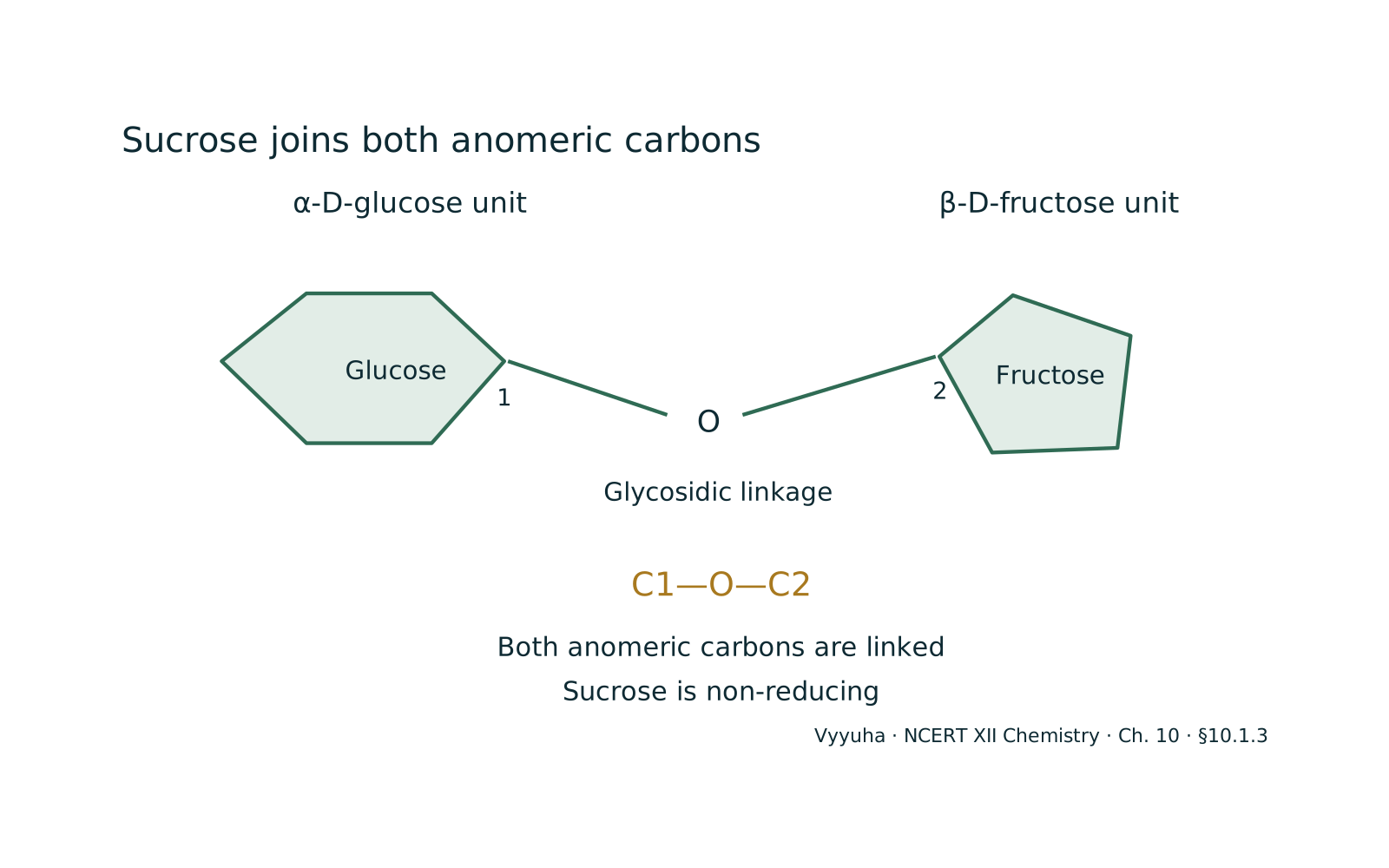
Composition: D-Glucose + D-Fructose. Glycosidic bond: glycosidic bond. The anomeric carbon of glucose (C1, -configuration) is linked to the anomeric carbon of fructose (C2, -configuration).
Both anomeric carbons are involved in the bond. * Nature: Non-reducing sugar. Since both anomeric carbons are involved in the glycosidic bond, neither can open to form a free aldehyde or ketone group.
Therefore, sucrose does not exhibit reducing properties. * Biological role: Major transport sugar in plants, common dietary sugar.
- Lactose (Milk Sugar):
Composition: D-Galactose + D-Glucose. Glycosidic bond: glycosidic bond. The anomeric carbon of galactose (C1, -configuration) is linked to the C4 hydroxyl group of glucose. The anomeric carbon of glucose is free.
* Nature: Reducing sugar. The free anomeric carbon of the glucose unit allows lactose to act as a reducing sugar. * Biological role: Found in milk, provides energy for mammalian infants. Lactose intolerance results from a deficiency of the enzyme lactase, which hydrolyzes lactose.
- Maltose (Malt Sugar):
Composition: D-Glucose + D-Glucose. Glycosidic bond: glycosidic bond. The anomeric carbon of one glucose unit (C1, -configuration) is linked to the C4 hydroxyl group of the other glucose unit. The anomeric carbon of the second glucose unit is free. * Nature: Reducing sugar. The free anomeric carbon of the second glucose unit allows maltose to act as a reducing sugar. * Biological role: Intermediate product in starch digestion, found in germinating seeds.
Hydrolysis of Disaccharides:
Disaccharides can be broken down into their constituent monosaccharides by hydrolysis, a reaction that involves the addition of a water molecule across the glycosidic bond. This process is catalyzed by specific enzymes (e.g., sucrase for sucrose, lactase for lactose, maltase for maltose) or by strong acids.
Real-World Applications & Biological Significance
- Energy Source: — Glucose, derived from the digestion of disaccharides and polysaccharides, is the primary fuel for cellular respiration, generating ATP.
- Dietary Importance: — Sucrose, lactose, and maltose are common dietary sugars. Their digestion is crucial for nutrient absorption.
- Structural Components: — While monosaccharides and disaccharides are primarily energy sources, their derivatives can be structural. For example, ribose and deoxyribose are integral to nucleic acids (RNA and DNA).
- Medical Relevance: — Understanding sugar metabolism is vital for conditions like diabetes (glucose regulation) and lactose intolerance (lactose digestion).
Common Misconceptions
- All sugars are sweet: — While many monosaccharides and disaccharides are sweet, sweetness is a sensory property and not a defining chemical characteristic of all carbohydrates. Some complex carbohydrates are tasteless.
- All sugars are reducing sugars: — This is incorrect. While most monosaccharides are reducing, and some disaccharides (like maltose and lactose) are, sucrose is a notable exception as a non-reducing disaccharide.
- Confusing D/L isomers with optical rotation (+/-): — D/L configuration refers to the absolute configuration at the chiral carbon furthest from the carbonyl group, while (+) or (-) refers to the direction of rotation of plane-polarized light, which is an experimentally determined property and not directly correlated with D or L.
- Anomers vs. Epimers: — Anomers are diastereomers that differ only at the anomeric carbon (C1 for aldoses, C2 for ketoses) in cyclic forms. Epimers are diastereomers that differ at only one chiral carbon other than the anomeric carbon.
NEET-Specific Angle
For NEET, a deep understanding of the structures (both open-chain and cyclic, especially Haworth projections for common hexoses), the types of glycosidic bonds (, , ), and the reducing/non-reducing nature of specific monosaccharides and disaccharides is paramount.
Questions frequently test the identification of constituent monosaccharides of disaccharides, the type of linkage, and their biological roles. Knowledge of isomerism (epimers, anomers, D/L forms) is also crucial.
Pay close attention to the enzymes involved in their hydrolysis.
Key Concepts
A glycosidic bond is the fundamental linkage in complex carbohydrates. It's formed when the hydroxyl group of…
This property is crucial for biochemical tests and understanding sugar reactivity. A sugar is 'reducing' if…
Isomerism is vital for the diversity and specificity of carbohydrate functions. Epimers are stereoisomers…
Often confused with
Side-by-side differences the NEET paper likes to test.
| Aspect | Monosaccharides and Disaccharides | Monosaccharides vs. Disaccharides |
|---|---|---|
| Definition | Simplest carbohydrate units; cannot be hydrolyzed into smaller sugars. | Carbohydrates formed by the condensation of two monosaccharide units. |
| Structure | Single polyhydroxy aldehyde or ketone unit. | Two monosaccharide units linked by a glycosidic bond. |
| General Formula | $(CH_2O)_n$, where n=3-7. | $C_{12}H_{22}O_{11}$ (for common hexose-derived disaccharides). |
| Hydrolysis | Cannot be hydrolyzed. | Can be hydrolyzed into two monosaccharide units by enzymes or acid. |
| Examples | Glucose, Fructose, Galactose, Ribose. | Sucrose, Lactose, Maltose. |
| Reducing Property | Mostly reducing (due to free anomeric carbon). | Can be reducing (lactose, maltose) or non-reducing (sucrose), depending on glycosidic bond. |
| Biological Role | Immediate energy source, building blocks for larger carbohydrates, components of nucleic acids. | Energy storage and transport, dietary sugars, broken down for energy. |
Monosaccharides are the fundamental, unhydrolyzable sugar units, serving as direct energy sources and the building blocks for all other carbohydrates. They possess a single polyhydroxy aldehyde or ketone structure.
Disaccharides, conversely, are composed of two monosaccharide units joined by a glycosidic bond, formed through dehydration. They require hydrolysis to release their constituent monosaccharides for metabolism.
While most monosaccharides are reducing, disaccharides can be either reducing or non-reducing depending on whether their anomeric carbons are free or involved in the glycosidic linkage, a critical distinction in their chemical and biological properties.
Why it is tested: For NEET, understanding the structural and functional differences between monosaccharides and disaccharides is fundamental. Questions frequently test their definitions, examples, reducing/non-reducing nature, and the specific types of glycosidic bonds that link disaccharides. This comparison helps clarify their roles in metabolism and digestion, which are high-yield areas for the exam.
Questions students ask
5 answered on this topic.
What is the primary difference between an aldose and a ketose?
The primary difference lies in the type of carbonyl functional group present. An aldose is a monosaccharide that contains an aldehyde group () at one end of its carbon chain, typically at carbon-1. Examples include glucose and galactose. A ketose, on the other hand, contains a ketone group (), usually at carbon-2, within its carbon chain. Fructose is a classic example of a ketose. This structural difference impacts their chemical reactivity and metabolic pathways.
Why is sucrose considered a non-reducing sugar, while maltose and lactose are reducing sugars?
The reducing property of a sugar depends on the presence of a free anomeric carbon that can open to form an aldehyde or ketone group. In sucrose, the anomeric carbon of glucose (C1) and the anomeric carbon of fructose (C2) are both involved in forming the glycosidic bond.
This means neither anomeric carbon is free to open, hence sucrose is non-reducing. In contrast, maltose (glucose-glucose) has an bond, and lactose (galactose-glucose) has a bond.
In both cases, the anomeric carbon of one of the glucose units remains free, allowing these disaccharides to exhibit reducing properties.
What is a glycosidic bond and how is it formed?
A glycosidic bond is a type of covalent bond that links a carbohydrate molecule to another group, which may or may not be another carbohydrate. In the context of disaccharides, it specifically links two monosaccharide units.
It is formed through a condensation reaction (also known as dehydration synthesis) between the anomeric carbon of one monosaccharide and a hydroxyl group of another monosaccharide, with the elimination of a water molecule.
The specific carbons involved and the or orientation of the bond are critical for defining the disaccharide's structure and properties.
Explain the concept of mutarotation in monosaccharides.
Mutarotation is the change in the optical rotation of a solution of a sugar due to the interconversion of its and anomeric forms. When a cyclic monosaccharide, like glucose, is dissolved in water, it exists in equilibrium between its -anomer, -anomer, and a small amount of the open-chain aldehyde form.
The open-chain form acts as an intermediate, allowing the and forms to interconvert until an equilibrium mixture is reached. This equilibrium mixture has a specific optical rotation, different from the pure or forms.
What are epimers? Give an example.
Epimers are a specific type of diastereomer that differ in configuration at only one chiral carbon atom, excluding the anomeric carbon. They are not mirror images of each other. A classic example is D-glucose and D-galactose.
These two monosaccharides are epimers because they differ in the configuration of the hydroxyl group only at carbon-4. Another example is D-glucose and D-mannose, which differ at carbon-2. Understanding epimers is important for recognizing subtle structural variations among sugars.
Revise in 30 seconds
- Monosaccharides: — Single sugar units. General formula . E.g., Glucose (aldohexose), Fructose (ketohexose), Galactose (aldohexose).
- Isomerism: — D/L forms, Epimers (differ at one chiral C, e.g., Glucose & Galactose at C4), Anomers ( forms, differ at anomeric C1/C2).
- Reducing Sugars: — Possess a free anomeric carbon capable of opening to an aldehyde/ketone. All monosaccharides are reducing.
- Disaccharides: — Two monosaccharides linked by a glycosidic bond (condensation reaction).
- Sucrose: Glucose + Fructose, glycosidic bond. Non-reducing sugar. - Lactose: Galactose + Glucose, glycosidic bond. Reducing sugar. - Maltose: Glucose + Glucose, glycosidic bond. Reducing sugar.
- Glycosidic Bond: — Covalent bond formed by dehydration between anomeric C of one sugar and -OH of another.
To remember the reducing/non-reducing nature of common disaccharides:
Sucrose is Special, it's Stuck (both anomeric carbons involved), so it's Simply Non-reducing.
Lactose and Maltose Reduce (Lactose and Maltose Are Reducing).