Amino Acids and Peptide Bonds — Explained
Detailed Explanation
Proteins are arguably the most versatile macromolecules in living systems, performing a vast array of functions from catalysis (enzymes) and transport to structural support and immune defense. Their remarkable diversity in function stems directly from the intricate and varied structures they adopt, which in turn are dictated by their fundamental building blocks: amino acids, and the way these amino acids are linked together by peptide bonds.
Conceptual Foundation: The Monomer-Polymer Relationship
At the most basic level, proteins are polymers, and amino acids are their monomers. Just as a string of pearls is formed by linking individual pearls, a protein (polypeptide) chain is formed by linking individual amino acids. The specific sequence of these amino acids is genetically encoded and is the primary determinant of a protein's ultimate three-dimensional structure and function.
Amino Acids: The Building Blocks
There are 20 common amino acids found in proteins, each sharing a common fundamental structure but differing in their unique side chain, or R-group.
1. General Structure:
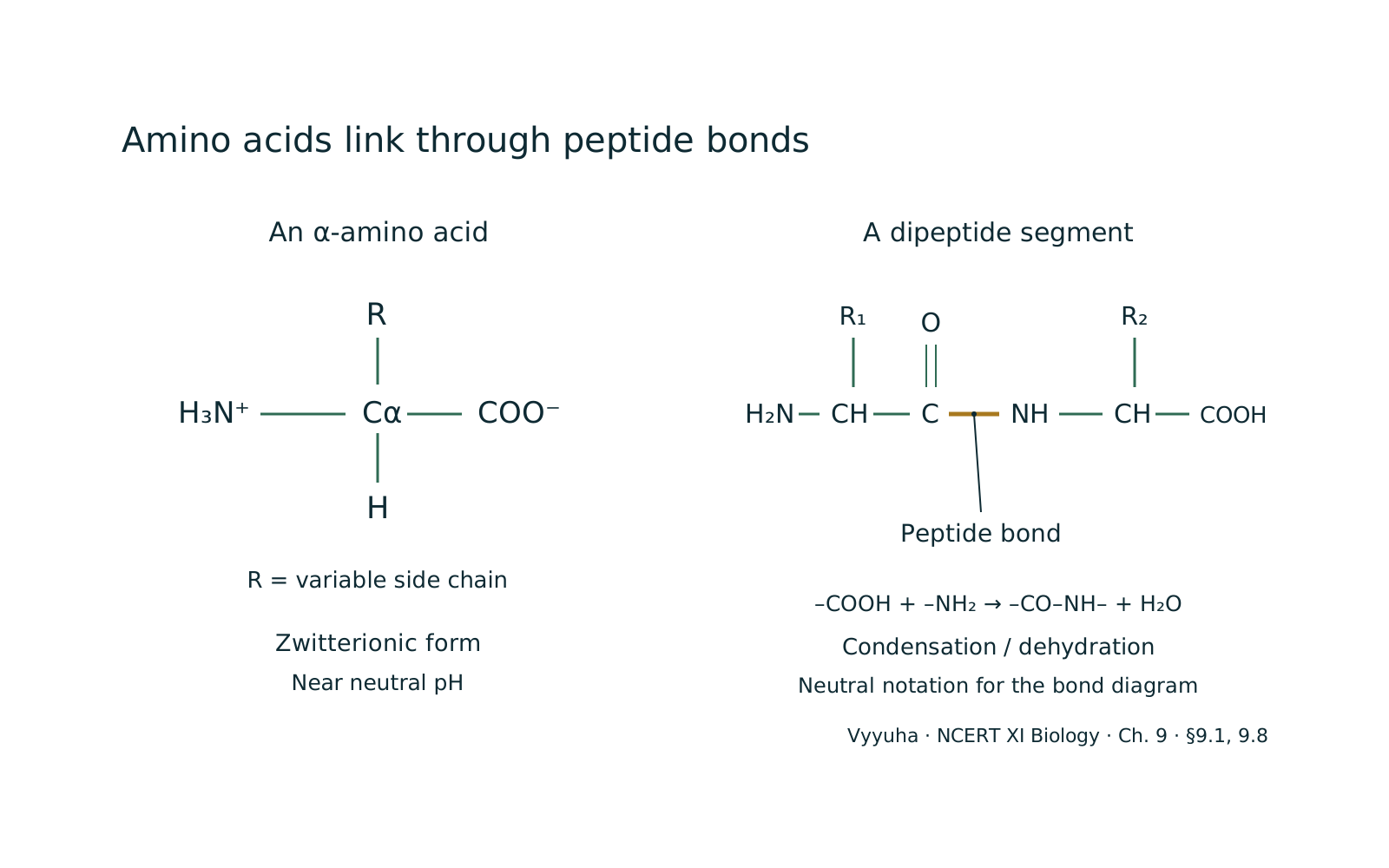
Every amino acid (except proline, which has a cyclic structure involving its amino group) possesses a central carbon atom, known as the -carbon. To this -carbon are attached four distinct groups:
- An amino group (): Typically protonated to at physiological pH.
- A carboxyl group (): Typically deprotonated to at physiological pH.
- A hydrogen atom ().
- A side chain (R-group): This variable group confers the unique chemical properties to each amino acid.
2. Chirality:
With the exception of glycine (where the R-group is simply a hydrogen atom, making the -carbon bonded to two identical hydrogen atoms), all -carbons in the other 19 amino acids are chiral centers. This means they are bonded to four different groups, leading to two possible stereoisomeric forms: L- and D-isomers. In biological systems, almost exclusively L-amino acids are found in proteins. This stereospecificity is critical for the precise folding and function of proteins.
3. Classification of Amino Acids (Based on R-group properties):
The R-group's chemical nature dictates an amino acid's behavior and its role in protein structure. Amino acids are broadly classified into several categories:
- Nonpolar, Aliphatic R-groups: — Glycine (Gly, G), Alanine (Ala, A), Valine (Val, V), Leucine (Leu, L), Isoleucine (Ile, I), Methionine (Met, M), Proline (Pro, P). These tend to be hydrophobic and are often found buried within the interior of globular proteins.
- Aromatic R-groups: — Phenylalanine (Phe, F), Tyrosine (Tyr, Y), Tryptophan (Trp, W). These are relatively nonpolar and can absorb UV light. Tyrosine and Tryptophan have polar hydroxyl and indole groups, respectively, allowing them to participate in hydrogen bonding.
- Polar, Uncharged R-groups: — Serine (Ser, S), Threonine (Thr, T), Cysteine (Cys, C), Asparagine (Asn, N), Glutamine (Gln, Q). These groups can form hydrogen bonds with water and other polar molecules. Cysteine is unique due to its sulfhydryl group (), which can form disulfide bonds () with another cysteine, crucial for stabilizing protein tertiary and quaternary structures.
- Acidic R-groups: — Aspartate (Asp, D), Glutamate (Glu, E). These possess an extra carboxyl group in their side chain, which is deprotonated (negatively charged) at physiological pH.
- Basic R-groups: — Lysine (Lys, K), Arginine (Arg, R), Histidine (His, H). These possess an extra amino group or guanidinium group in their side chain, which is protonated (positively charged) at physiological pH. Histidine is particularly important as its imidazole ring has a pKa near physiological pH, allowing it to act as both a proton donor and acceptor in enzyme active sites.
4. Essential vs. Non-essential Amino Acids:
- Essential Amino Acids: — These cannot be synthesized by the human body and must be obtained through diet. Examples include Valine, Leucine, Isoleucine, Methionine, Phenylalanine, Tryptophan, Threonine, Lysine, and Histidine (for infants).
- Non-essential Amino Acids: — These can be synthesized by the body from other precursors.
5. Zwitterionic Nature and Isoelectric Point (pI):
Amino acids are amphoteric, meaning they can act as both acids and bases. At physiological pH (around 7.4), the amino group is protonated () and the carboxyl group is deprotonated ().
The molecule thus carries both a positive and a negative charge, but the net charge is zero. This dipolar ion form is called a zwitterion. The isoelectric point (pI) is the specific pH at which an amino acid (or protein) has a net electrical charge of zero.
At pH values below the pI, the amino acid will be positively charged; above the pI, it will be negatively charged.
Peptide Bonds: The Linkage
Amino acids are joined together in a specific sequence to form polypeptide chains through the formation of peptide bonds.
1. Formation (Condensation Reaction):
A peptide bond is an amide linkage formed between the -carboxyl group of one amino acid and the -amino group of another amino acid. This is a dehydration synthesis reaction, meaning a molecule of water is eliminated during the bond formation.
For example, if amino acid 1 (AA1) has a carboxyl group and amino acid 2 (AA2) has an amino group, the reaction is:
2. Characteristics of the Peptide Bond:
- Planar and Rigid: — The peptide bond has significant partial double-bond character due to resonance between the carbonyl oxygen and the amide nitrogen. This means the C-N bond is shorter than a typical single bond and longer than a typical double bond. This partial double-bond character restricts rotation around the C-N bond, making the peptide bond rigid and planar. The six atoms involved in the peptide bond (the -carbon of the first amino acid, its carbonyl carbon, carbonyl oxygen, amide nitrogen, amide hydrogen, and the -carbon of the second amino acid) all lie in the same plane.
- Trans Configuration: — Due to steric hindrance between the R-groups, the trans configuration (where the -carbons are on opposite sides of the peptide bond) is strongly favored over the cis configuration, especially for all amino acids except proline.
- Polarity: — The carbonyl oxygen and amide nitrogen atoms of the peptide bond are polar, allowing them to participate in hydrogen bonding, which is crucial for stabilizing secondary structures like -helices and -sheets.
- Stability: — Peptide bonds are very stable and have a long half-life under physiological conditions, requiring enzymatic catalysis (proteases) or strong acid/base treatment for hydrolysis.
3. Polypeptide Chain Directionality:
A polypeptide chain has a distinct directionality. One end has a free amino group (the N-terminus or amino-terminus), and the other end has a free carboxyl group (the C-terminus or carboxyl-terminus). By convention, amino acid sequences are written from the N-terminus to the C-terminus.
4. Oligopeptides, Polypeptides, and Proteins:
- Oligopeptides: — Short chains of a few amino acids (typically 2-20).
- Polypeptides: — Longer chains of many amino acids (typically 20-50 or more).
- Proteins: — Functional biological molecules that can consist of one or more polypeptide chains, often folded into specific three-dimensional structures and sometimes associated with non-amino acid components.
Real-World Applications and NEET-Specific Angle
Understanding amino acids and peptide bonds is foundational to biochemistry and molecular biology. In medicine, knowledge of essential amino acids is critical for nutrition. The specificity of proteases (enzymes that cleave peptide bonds) is exploited in drug development (e.g., HIV protease inhibitors). The unique properties of amino acids, such as their pKa values and isoelectric points, are used in protein purification techniques like electrophoresis and ion-exchange chromatography.
For NEET, focus on:
- Amino acid classification: — Be able to identify amino acids based on their R-groups and categorize them (polar, nonpolar, acidic, basic, essential, non-essential).
- Structure of a generic amino acid: — Identify the -carbon, amino group, carboxyl group, and R-group.
- Peptide bond formation: — Understand it as a dehydration reaction between the carboxyl and amino groups.
- Characteristics of the peptide bond: — Its planar, rigid nature due to partial double-bond character, and its role in restricting protein conformation.
- N-terminus and C-terminus: — Directionality of polypeptide chains.
- Zwitterionic nature and pI: — How amino acids behave at different pH values.
Common Misconceptions
- Peptide bond rotation: — A common mistake is assuming free rotation around the C-N bond of the peptide linkage. Due to its partial double-bond character, this rotation is severely restricted, leading to the planar nature of the peptide bond. Rotation is primarily allowed around the -carbon to carbonyl carbon () and -carbon to amino nitrogen () bonds.
- Peptide bond vs. Ester bond: — While both involve condensation, a peptide bond is an amide linkage (), whereas an ester bond is formed between a carboxyl group and a hydroxyl group (). They have different chemical properties and stability.
- All amino acids are chiral: — Glycine is an exception as its R-group is a hydrogen atom, making its -carbon achiral.
Often confused with
Side-by-side differences the NEET paper likes to test.
| Aspect | Amino Acids and Peptide Bonds | Glycosidic Bond |
|---|---|---|
| Definition | A covalent amide linkage formed between the carboxyl group of one amino acid and the amino group of another, releasing water. | A covalent bond formed between a carbohydrate (sugar) molecule and another molecule (often another sugar or a non-carbohydrate), releasing water. |
| Monomers Joined | Amino acids | Monosaccharides (simple sugars) |
| Macromolecule Formed | Proteins (polypeptides) | Polysaccharides (e.g., starch, cellulose, glycogen) |
| Chemical Linkage | $-\text{CO-NH}-$ (Amide bond) | $-\text{C-O-C}-$ (Ether bond) |
| Rigidity/Planarity | Exhibits partial double-bond character, making it rigid and planar, restricting rotation. | Generally allows free rotation around the C-O-C linkage, providing flexibility to carbohydrate chains. |
| Biological Role | Forms the primary structure of proteins, crucial for their diverse functions. | Forms complex carbohydrates for energy storage, structural support, and cell recognition. |
While both peptide bonds and glycosidic bonds are crucial covalent linkages in biological macromolecules formed via dehydration synthesis, they differ fundamentally in the monomers they join and their chemical nature.
Peptide bonds link amino acids to form proteins, characterized by an amide linkage () with partial double-bond character, imparting rigidity. Glycosidic bonds, on the other hand, link monosaccharides to form carbohydrates, characterized by an ether linkage () that typically allows for more rotational freedom.
These distinct properties are fundamental to the unique structures and functions of proteins and carbohydrates, respectively.
Why it is tested: NEET relevance: Understanding the differences between these fundamental bonds is critical for distinguishing between the major classes of biomolecules (proteins vs. carbohydrates) and appreciating how their unique linkages contribute to their distinct structural and functional roles in living systems. Questions often test the chemical nature of these bonds and the monomers they connect.
Questions students ask
6 answered on this topic.
What makes each of the 20 amino acids unique, given they share a common backbone structure?
The uniqueness of each of the 20 standard amino acids lies entirely in its 'R-group' or side chain. While all amino acids share a common backbone consisting of an alpha-carbon, an amino group, a carboxyl group, and a hydrogen atom, the R-group varies significantly from one amino acid to another.
This R-group can be as simple as a hydrogen atom (in glycine) or a complex ring structure (in tryptophan). The chemical properties of this R-group – whether it's hydrophobic, hydrophilic, acidic, basic, or contains sulfur – dictate the overall chemical characteristics of the amino acid and, consequently, its specific role in protein structure, folding, and function.
Why are L-amino acids predominantly found in proteins, and what is the significance of this stereospecificity?
In biological systems, proteins are almost exclusively composed of L-amino acids, rather than their D-counterparts. This stereospecificity is a fundamental characteristic of life and is believed to have arisen early in evolution.
The significance lies in the precise three-dimensional structures that proteins must adopt to function correctly. Using only one enantiomeric form (L-amino acids) ensures that proteins can fold into highly specific and reproducible structures, allowing for specific interactions with other molecules (like substrates for enzymes or receptors).
If both L- and D-amino acids were incorporated randomly, proteins would likely form a chaotic mixture of structures, losing their functional specificity.
Explain the zwitterionic nature of amino acids and its importance.
Amino acids are amphoteric molecules, meaning they can act as both acids and bases. At physiological pH (around 7.4), the amino group () is protonated to a positively charged ammonium group (), and the carboxyl group () is deprotonated to a negatively charged carboxylate group ().
This results in a molecule that carries both a positive and a negative charge simultaneously, yet has a net charge of zero. This dipolar ion is called a zwitterion. The zwitterionic nature is crucial for amino acid solubility in water, their buffering capacity, and their behavior in electric fields, which is exploited in techniques like electrophoresis for protein separation.
What is the 'partial double-bond character' of a peptide bond, and why is it significant for protein structure?
The peptide bond, an amide linkage between the carboxyl carbon and amino nitrogen, exhibits partial double-bond character due to resonance. This means the electrons are delocalized across the C-O and C-N bonds, giving the C-N bond some characteristics of a double bond.
This partial double-bond character has two major implications: firstly, it makes the peptide bond rigid and planar, restricting rotation around the C-N axis. Secondly, it makes the six atoms involved in the peptide bond (C, C, O, N, H, C) lie in a single plane.
This rigidity and planarity are fundamental constraints on the possible conformations a polypeptide chain can adopt, directly influencing the formation of secondary structures like alpha-helices and beta-sheets, which are crucial for a protein's overall 3D structure and function.
How do essential and non-essential amino acids differ, and why is this distinction important for human health?
Essential amino acids are those that the human body cannot synthesize on its own or cannot synthesize in sufficient quantities to meet its metabolic needs. Therefore, they must be obtained through the diet.
Examples include leucine, lysine, and tryptophan. Non-essential amino acids, on the other hand, can be synthesized by the body from other precursors. This distinction is vital for human health because a diet lacking in one or more essential amino acids can lead to protein deficiency, impaired growth, and various health problems, as the body cannot produce the necessary proteins for its functions.
This is particularly relevant in understanding balanced diets and malnutrition.
Can peptide bonds be broken? If so, how?
Yes, peptide bonds can be broken, a process known as hydrolysis. This is essentially the reverse of their formation, requiring the addition of a water molecule. In living organisms, this hydrolysis is typically catalyzed by specific enzymes called proteases (or peptidases).
Proteases are crucial for protein digestion, protein turnover (breaking down old or damaged proteins), and regulating protein activity. Outside of biological systems, peptide bonds can also be hydrolyzed under harsh laboratory conditions, such as prolonged heating in strong acids or bases, though this method is less specific and can damage the amino acids themselves.