Molecular Mass and Formula Mass
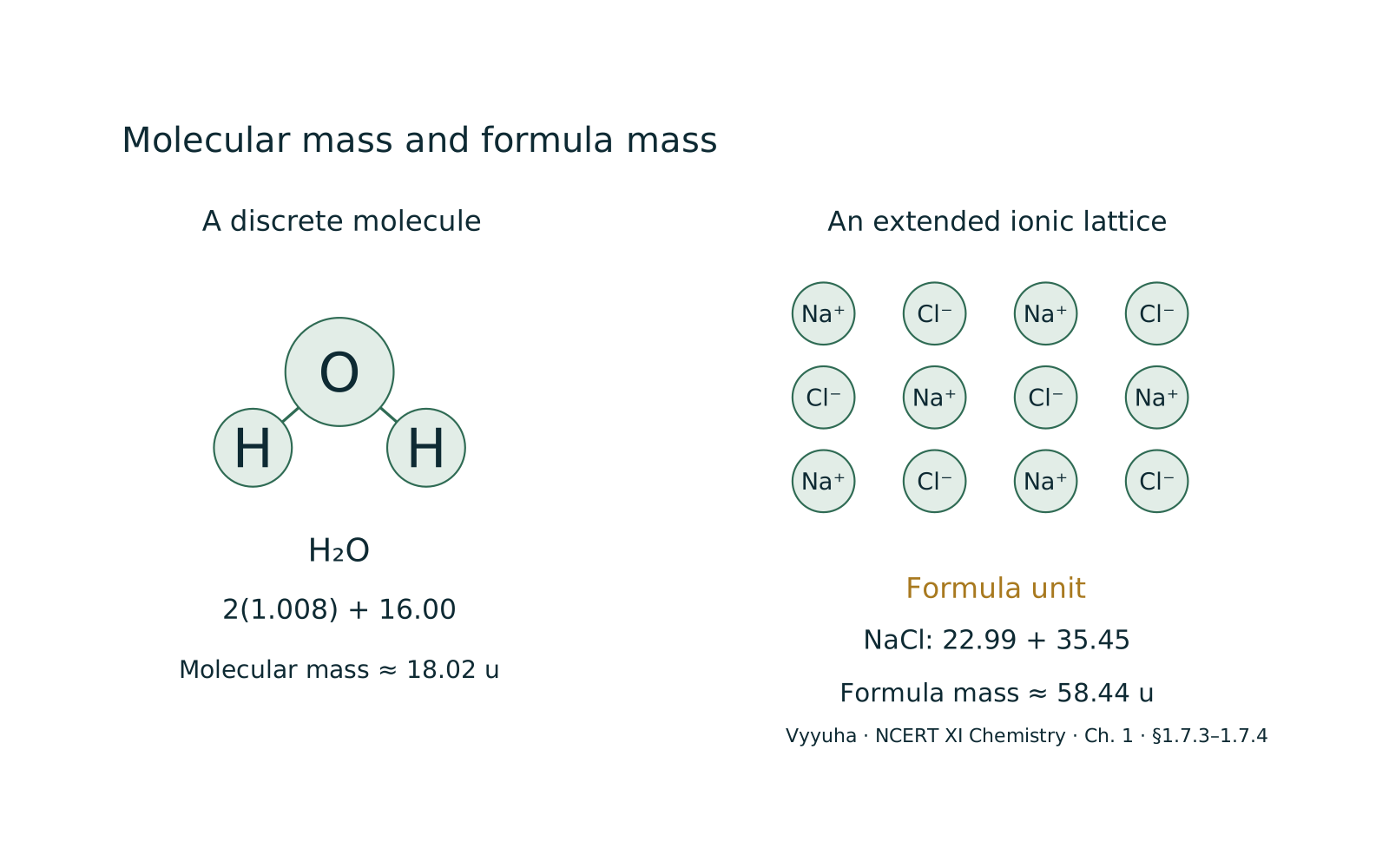
Molecular mass is the sum of the atomic masses of all atoms present in a molecule of a covalent compound, expressed in atomic mass units (amu). It represents the average mass of a single molecule relative to 1/12th the mass of a carbon-12 atom. Formula mass, on the other hand, is the sum of the atomic masses of all atoms present in a formula unit of an ionic compound, also expressed in amu. This d…
Quick Summary
Molecular mass and formula mass are fundamental concepts in chemistry that quantify the mass of chemical entities. Molecular mass refers to the sum of the atomic masses of all atoms in a single molecule of a covalent compound, expressed in atomic mass units (amu).
It applies to substances that exist as discrete, independent molecules, like water () or carbon dioxide (). Formula mass, conversely, is used for ionic compounds, which do not form discrete molecules but rather extended crystal lattices.
It represents the sum of the atomic masses of all atoms in the empirical formula (formula unit) of the ionic compound, also expressed in amu. Examples include sodium chloride () or calcium carbonate ().
Both are calculated by adding the atomic masses of constituent atoms, multiplied by their respective counts in the chemical formula. These masses are crucial for understanding the mole concept, stoichiometry, and various quantitative chemical calculations, forming the basis for converting between mass and moles in chemical reactions.
Full explanation
The concepts of molecular mass and formula mass are foundational to quantitative chemistry, providing the bridge between the microscopic world of atoms and molecules and the macroscopic world of measurable quantities. To truly grasp these concepts, we must first revisit the idea of atomic mass and the atomic mass unit (amu).
Conceptual Foundation: Atomic Mass and AMU
Every atom of an element has a characteristic mass. However, these masses are incredibly small, making direct measurement and expression in grams cumbersome. To address this, scientists established a relative scale.
The atomic mass unit (amu), also known as the unified atomic mass unit (u) or Dalton (Da), is defined as exactly one-twelfth (1/12) the mass of a single carbon-12 atom. This carbon-12 isotope was chosen as the reference standard.
Thus, one carbon-12 atom has a mass of exactly 12 amu. The atomic mass of any other element is then expressed relative to this standard. For instance, a hydrogen atom has an atomic mass of approximately $1.
008\,\text{amu}$, meaning it is about 1/12th the mass of a carbon-12 atom. The atomic masses listed in the periodic table are typically average atomic masses, which account for the natural abundance of different isotopes of an element.
Molecular Mass: For Covalent Compounds
When two or more atoms combine through covalent bonds, they form a discrete, independent unit called a molecule. Examples include water (), carbon dioxide (), glucose (), and oxygen gas (). The molecular mass of such a compound is simply the sum of the atomic masses of all the atoms present in one molecule of that compound. It is expressed in atomic mass units (amu).
Calculation Method: To calculate the molecular mass, you need the chemical formula of the compound and the average atomic masses of each element involved. The steps are:
- Identify all elements present in the molecule.
- Note the number of atoms of each element from the chemical formula.
- Look up the average atomic mass of each element from the periodic table.
- Multiply the atomic mass of each element by the number of its atoms in the molecule.
- Sum up these products.
*Example: Calculation of Molecular Mass of Water ()*
- Atomic mass of Hydrogen (H)
- Atomic mass of Oxygen (O)
- In , there are 2 H atoms and 1 O atom.
- Mass from H atoms =
- Mass from O atoms =
- Molecular mass of
Formula Mass: For Ionic Compounds
Ionic compounds are formed by the electrostatic attraction between positively charged ions (cations) and negatively charged ions (anions). Unlike covalent compounds, ionic compounds do not exist as discrete molecules.
Instead, they form an extended, repeating three-dimensional crystal lattice where each ion is surrounded by ions of opposite charge. For example, in sodium chloride (), each ion is surrounded by six ions, and each ion is surrounded by six ions.
The chemical formula for an ionic compound, such as or , represents the simplest whole-number ratio of the ions in the crystal lattice, known as the empirical formula or formula unit.
Since there are no individual molecules, the term 'molecular mass' is inappropriate. Instead, we use 'formula mass'. The formula mass is the sum of the atomic masses of all the atoms present in one formula unit of the ionic compound. It is also expressed in atomic mass units (amu).
Calculation Method: The calculation method for formula mass is identical to that for molecular mass, but it applies to the empirical formula of the ionic compound.
- Identify all elements present in the formula unit.
- Note the number of atoms of each element from the empirical formula.
- Look up the average atomic mass of each element.
- Multiply the atomic mass of each element by the number of its atoms in the formula unit.
- Sum up these products.
*Example: Calculation of Formula Mass of Sodium Chloride ()*
- Atomic mass of Sodium (Na)
- Atomic mass of Chlorine (Cl)
- In , there is 1 Na atom and 1 Cl atom.
- Mass from Na atoms =
- Mass from Cl atoms =
- Formula mass of
Real-World Applications and Significance
Molecular and formula masses are not just theoretical constructs; they are indispensable in various chemical calculations and applications:
- Stoichiometry — They are crucial for converting between mass and moles, determining limiting reagents, and calculating theoretical yields in chemical reactions. For example, knowing the molecular mass of reactants and products allows us to predict how much product will form from a given amount of reactants.
- Mole Concept — One mole of any substance contains Avogadro's number () of particles (atoms, molecules, or formula units). The molar mass (mass of one mole) in grams per mole () is numerically equal to the molecular or formula mass in amu. This equivalence is a cornerstone of quantitative chemistry.
- Solution Chemistry — Calculating concentrations (e.g., molarity, molality, mass percentage) requires knowledge of the molecular or formula mass of the solute.
- Gas Laws — For ideal gases, the molecular mass is used in conjunction with the ideal gas law () to determine the density or molar mass of an unknown gas.
- Percentage Composition — These masses are used to calculate the percentage by mass of each element in a compound, which is vital for empirical and molecular formula determination.
Common Misconceptions
- Molecular Mass vs. Molar Mass — Students often confuse these. Molecular mass is the mass of one molecule in amu. Molar mass is the mass of one mole of molecules (or formula units) in grams. Numerically, they are the same (e.g., has a molecular mass of and a molar mass of ), but their units and the entities they refer to are different.
- Formula Mass is Only for Ionic Compounds — While primarily used for ionic compounds due to their lattice structure, the term 'formula mass' can technically be applied to any substance where the empirical formula is used, even if it's a covalent network solid (like ) or a macromolecule where a repeating unit is considered.
- Ignoring Subscripts — A common error is failing to multiply the atomic mass by the correct subscript in the chemical formula (e.g., forgetting to multiply hydrogen's atomic mass by 2 in ).
- Incorrect Atomic Masses — Using rounded atomic masses without sufficient precision can lead to slight inaccuracies, though for NEET, standard rounded values are often acceptable unless specified.
NEET-Specific Angle
For NEET aspirants, a solid understanding of molecular and formula mass is non-negotiable. This topic forms the bedrock for numerous other chapters in Physical Chemistry. Questions frequently appear in the following contexts:
- Direct Calculation — Simple questions asking to calculate the molecular or formula mass of a given compound.
- Mole Concept Problems — These masses are essential for converting between mass, moles, and number of particles. For example, 'How many molecules are present in grams of ?' or 'What is the mass of moles of ?'
- Stoichiometry — Calculating reactant or product masses in chemical reactions.
- Empirical and Molecular Formula Determination — Using percentage composition and molecular mass to find the actual molecular formula.
- Solution Concentration — Calculating molarity, molality, or normality where the mass of solute is involved.
- Gas Laws — Determining molar mass from gas density or vice versa.
Mastering the calculation and conceptual distinction between molecular and formula mass is a fundamental step towards excelling in the quantitative aspects of NEET Chemistry.
Key Concepts
Molecular mass is determined by summing the atomic masses of all atoms present in a given molecule. This…
Formula mass is calculated identically to molecular mass, but it is applied to ionic compounds, which exist…
The choice between 'molecular mass' and 'formula mass' is dictated by the nature of chemical bonding and the…
Often confused with
Side-by-side differences the NEET paper likes to test.
| Aspect | Molecular Mass and Formula Mass | Formula Mass |
|---|---|---|
| Type of Compound | Covalent compounds | Ionic compounds |
| Nature of Entity | Refers to a discrete, independent molecule | Refers to a formula unit (simplest ratio of ions) in a crystal lattice |
| Bonding Type | Covalent bonds (sharing of electrons) | Ionic bonds (electrostatic attraction between ions) |
| Existence of Discrete Units | Yes, molecules exist as individual units | No, forms an extended 3D lattice, no discrete molecules |
| Examples | $H_2O$, $CO_2$, $C_6H_{12}O_6$, $NH_3$ | $NaCl$, $CaCO_3$, $K_2SO_4$, $MgO$ |
| Calculation Method | Sum of atomic masses of all atoms in the molecular formula | Sum of atomic masses of all atoms in the empirical formula |
| Unit | Atomic mass units (amu) | Atomic mass units (amu) |
Molecular mass and formula mass both quantify the mass of a chemical entity in atomic mass units (amu) by summing the atomic masses of its constituent atoms. However, molecular mass is specifically used for covalent compounds that form discrete molecules, like water or carbon dioxide.
Formula mass, on the other hand, is applied to ionic compounds, which exist as extended crystal lattices rather than individual molecules, and thus refers to the mass of one formula unit (the simplest ratio of ions) within that lattice.
The distinction is crucial for accurately describing the nature of these different types of chemical substances.
Why it is tested: For NEET, understanding this distinction is critical for correctly applying the mole concept and stoichiometry to different types of compounds. Misidentifying a compound as molecular when it's ionic, or vice-versa, can lead to conceptual errors in problem-solving, especially when dealing with the number of 'molecules' versus 'formula units' or ions.
Questions students ask
5 answered on this topic.
What is the primary difference between molecular mass and formula mass?
The primary difference lies in the type of compound they describe and the nature of their bonding. Molecular mass is used for covalent compounds, which exist as discrete, independent molecules (e.g., , ).
Formula mass is used for ionic compounds, which form extended crystal lattices rather than discrete molecules (e.g., , ). Both are calculated by summing atomic masses, but the term 'molecular' implies a distinct molecule, while 'formula' refers to the simplest ratio of ions in a lattice.
Why is the atomic mass unit (amu) used instead of grams for molecular and formula mass?
Atoms and molecules are incredibly small, and their individual masses in grams would be extremely tiny numbers, making calculations cumbersome. The atomic mass unit (amu) provides a convenient, relative scale for these microscopic entities. It's defined as 1/12th the mass of a carbon-12 atom, allowing us to express atomic and molecular masses as manageable numbers (e.g., for water) rather than .
Is molar mass the same as molecular mass or formula mass?
No, they are not the same, though they are numerically equivalent. Molecular mass (or formula mass) is the mass of one molecule (or formula unit) expressed in atomic mass units (amu). Molar mass is the mass of one mole of that substance (which contains Avogadro's number of particles) expressed in grams per mole ().
For example, water has a molecular mass of and a molar mass of . The numerical value is the same, but the units and the quantity they represent are different.
How do I calculate the molecular mass of a compound like glucose ($C_6H_{12}O_6$)?
To calculate the molecular mass of glucose, you sum the atomic masses of all atoms in its formula. Using approximate atomic masses: Carbon (C) , Hydrogen (H) , Oxygen (O) . So, for : . This is the molecular mass of one glucose molecule.
Can formula mass be used for covalent compounds?
While the term 'molecular mass' is specifically preferred for discrete covalent molecules, 'formula mass' can technically be applied to any compound where the empirical formula is used to represent the simplest ratio of atoms. For instance, for a covalent network solid like silicon dioxide (), which doesn't form discrete molecules, 'formula mass' is more appropriate than 'molecular mass' because represents the empirical formula of a repeating unit in a larger structure.
Revise in 30 seconds
- Atomic Mass Unit (amu) — th mass of atom.
- Molecular Mass — Sum of atomic masses of atoms in a covalent molecule (e.g., ). Unit: amu.
- Formula Mass — Sum of atomic masses of atoms in a formula unit of an ionic compound (e.g., ). Unit: amu.
- Molar Mass — Numerically equal to molecular/formula mass, but unit is (mass of 1 mole).
- Calculation — For : .
Molecules are Covalent, Formulas are Ionic. (M-C, F-I) - Molecular mass for Covalent, Formula mass for Ionic.