Limiting Reagent — Explained
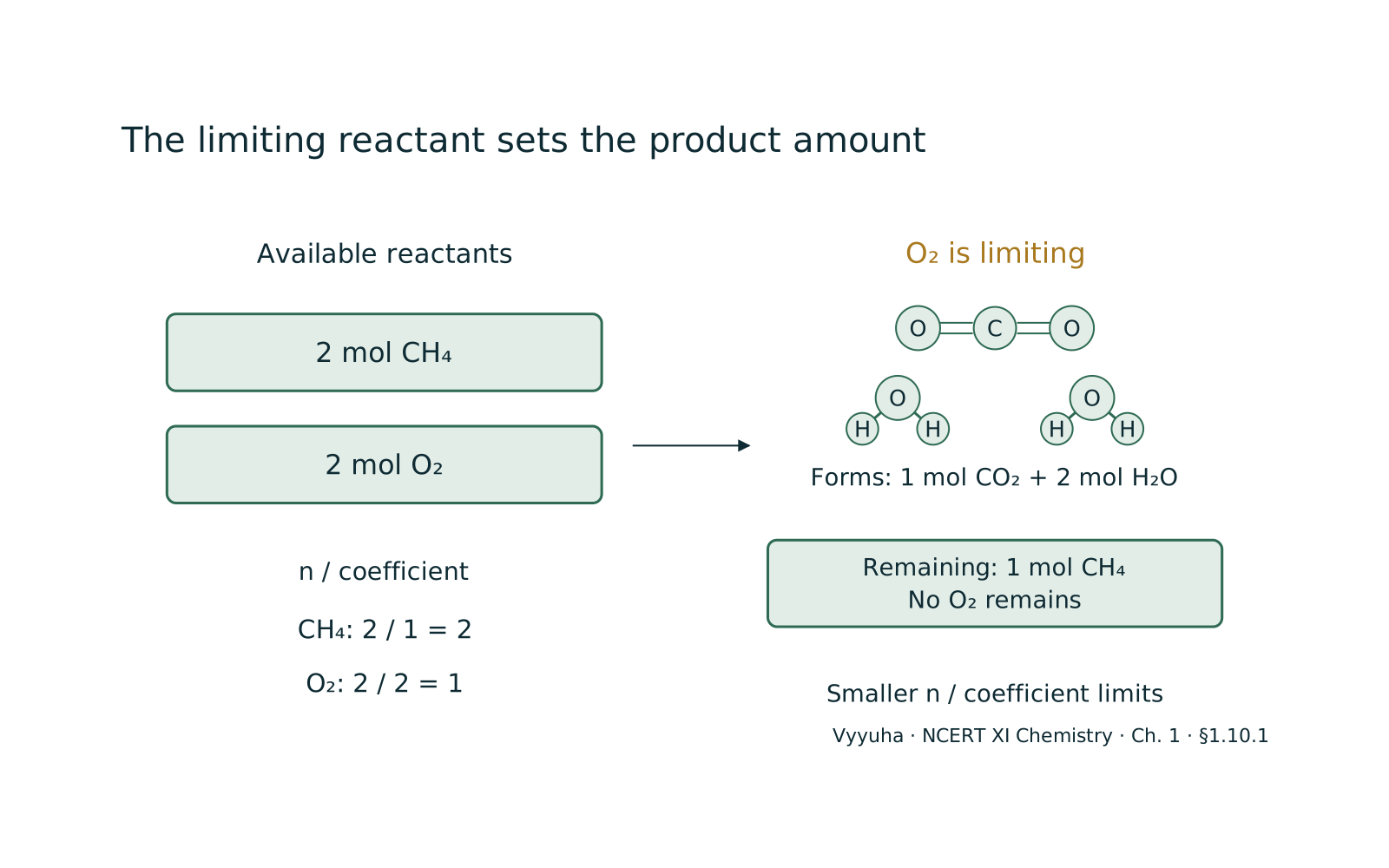
Detailed Explanation
The concept of a limiting reagent is a cornerstone of quantitative chemistry, particularly within the realm of stoichiometry. Stoichiometry is the branch of chemistry that deals with the quantitative relationships between reactants and products in chemical reactions. These relationships are governed by the law of conservation of mass and are expressed through balanced chemical equations.
Conceptual Foundation: Why Limiting Reagent Matters
A balanced chemical equation provides the molar ratios in which reactants combine and products are formed. For example, consider the reaction for the formation of water:
If we start with exactly 2 moles of and 1 mole of , both reactants will be completely consumed, and 2 moles of will be formed. This is an ideal stoichiometric ratio.
However, in most real-world scenarios, reactants are not supplied in perfect stoichiometric ratios. Often, one reactant is deliberately added in excess to ensure that the more expensive or critical reactant is fully consumed, or to drive the reaction to completion.
When reactants are not in their ideal stoichiometric proportions, one reactant will inevitably run out before the others. This reactant, which is completely consumed, is termed the limiting reagent.
Once the limiting reagent is used up, the reaction ceases, regardless of the availability of other reactants. The maximum amount of product that can be formed is therefore dictated by the initial quantity of the limiting reagent.
The reactants that are not fully consumed and are left over at the end of the reaction are called excess reagents. Identifying the limiting reagent is paramount because it directly determines the theoretical yield of the reaction – the maximum possible amount of product that can be formed under ideal conditions.
Key Principles and Steps to Identify the Limiting Reagent
To identify the limiting reagent and calculate the theoretical yield, follow these systematic steps:
- Write and Balance the Chemical Equation: — This is the absolute first step. A balanced equation provides the correct stoichiometric ratios (mole ratios) between all reactants and products. Without a balanced equation, any subsequent calculations will be incorrect.
Example: For the reaction of nitrogen and hydrogen to form ammonia:
- Convert Given Quantities of Reactants to Moles: — Chemical reactions occur at the molecular level, and stoichiometric coefficients in balanced equations represent mole ratios. Therefore, any given masses (in grams), volumes (for gases at STP), or concentrations (for solutions) of reactants must be converted into moles.
Formulae: * Moles () = Mass () / Molar Mass () * Moles () = Volume () / Molar Volume (22.4 L at STP for gases) * Moles () = Molarity () Volume ()
- Determine the Limiting Reagent: — There are several methods to do this, but a robust approach involves calculating the 'moles of product' that could be formed from each reactant, assuming it were the limiting reagent.
* Method A: Mole Ratio Comparison (Reactant-to-Reactant): * Pick one reactant (e.g., Reactant A) and calculate how many moles of the other reactant (Reactant B) would be required to react completely with it, based on the stoichiometric ratio from the balanced equation.
Compare the calculated required moles of Reactant B with the actual moles of Reactant B available. If (Actual moles of B) < (Required moles of B), then Reactant B is the limiting reagent. * If (Actual moles of B) > (Required moles of B), then Reactant A is the limiting reagent.
* Method B: Product Formation (Reactant-to-Product): This is often the most straightforward and least prone to error. * For each reactant, calculate the number of moles of a specific product that would be formed if that reactant were completely consumed.
* The reactant that produces the least amount of product is the limiting reagent. * The amount of product calculated from the limiting reagent is the theoretical yield.
*Example using Method B for : Suppose we start with 10 moles of and 24 moles of . * From : * From : Since produces less (16 moles vs 20 moles), is the limiting reagent.
- Calculate the Theoretical Yield: — Once the limiting reagent is identified, use its initial quantity (in moles) and the stoichiometric ratio from the balanced equation to calculate the moles of the desired product. Then, convert these moles into the required units (grams, liters, etc.). This value is the theoretical yield.
Continuing the example: The theoretical yield of is 16 moles. If asked for mass, convert: .
- Calculate the Amount of Excess Reagent Remaining (Optional but often asked): — Subtract the amount of the excess reagent that reacted from its initial amount. The amount that reacted is determined by the limiting reagent and the stoichiometric ratio.
Continuing the example: is the excess reagent. Moles of reacted: Initial moles of . Moles of remaining = .
Real-World Applications
The concept of limiting reagents is not just an academic exercise; it has profound implications in various real-world applications:
- Industrial Chemistry: — Chemical engineers meticulously calculate limiting reagents to optimize production processes. By identifying the limiting reagent, they can ensure that the most expensive or difficult-to-obtain reactant is fully utilized, minimizing waste and maximizing the yield of the desired product. For instance, in the Haber-Bosch process for ammonia synthesis, hydrogen is often used in excess to drive the reaction to completion and maximize ammonia production from nitrogen.
- Pharmaceutical Industry: — In drug synthesis, where raw materials can be very costly and purity is critical, precise control over reactant ratios and identification of limiting reagents are essential to maximize the yield of the active pharmaceutical ingredient (API) and reduce production costs.
- Environmental Chemistry: — Understanding limiting nutrients (like phosphates or nitrates) in ecosystems helps explain phenomena like algal blooms. The nutrient present in the lowest concentration relative to biological demand acts as the limiting reagent, controlling the growth of organisms.
- Everyday Cooking: — Even in cooking, the concept applies. If a recipe calls for 2 eggs and 1 cup of flour, and you have 6 eggs but only 1 cup of flour, the flour is your limiting ingredient for that recipe.
Common Misconceptions
Students often fall into common traps when dealing with limiting reagents:
- Smallest Mass/Moles is Limiting: — A common mistake is assuming that the reactant with the smallest initial mass or smallest number of moles is automatically the limiting reagent. This is incorrect because the stoichiometric coefficients in the balanced equation must be considered. For example, in , if you have 1 mole of and 1 mole of , is limiting even though it has more moles than the stoichiometric requirement for (2:1 ratio). You need 2 moles of for every 1 mole of . Since you only have 1 mole of , it will run out first.
- Ignoring Balanced Equation: — Failing to balance the chemical equation before performing calculations is a critical error that will lead to incorrect mole ratios and, consequently, an incorrect limiting reagent determination.
- Using Excess Reagent for Product Calculation: — Once the limiting reagent is identified, all subsequent calculations for product yield must be based on the amount of the limiting reagent. Using the excess reagent will result in an overestimation of the product.
NEET-Specific Angle
For NEET aspirants, mastering limiting reagent calculations is vital for several reasons:
- Foundation for Yield Calculations: — Limiting reagent problems are often combined with theoretical yield and percentage yield calculations. A strong grasp of limiting reagents is a prerequisite for these more complex problems.
- Direct Questioning: — NEET frequently features direct questions asking to identify the limiting reagent or to calculate the mass/volume of product formed when given initial amounts of multiple reactants.
- Conceptual Understanding: — Beyond calculations, conceptual questions might test the understanding of why a particular reactant is limiting or the implications of adding an excess of one reactant.
- Time Management: — These problems can be multi-step, involving conversions, ratio comparisons, and final calculations. Practicing efficient problem-solving strategies is key to saving time in the exam.
- Integration with Other Chapters: — Limiting reagent concepts can be integrated with gas laws (for gaseous reactants/products), solution stoichiometry (for reactions in solution), and even redox reactions, making it a versatile and frequently tested topic.
Often confused with
Side-by-side differences the NEET paper likes to test.
| Aspect | Limiting Reagent | Excess Reagent |
|---|---|---|
| Definition | The reactant that is completely consumed first in a chemical reaction, thereby stopping the reaction. | Any reactant present in a chemical reaction in an amount greater than what is required to react completely with the limiting reagent. |
| Role in Reaction | Determines the maximum amount of product (theoretical yield) that can be formed. | Does not determine the amount of product; some quantity will be left over unreacted. |
| Consumption | Fully consumed during the reaction. | Only partially consumed; a portion remains after the reaction ceases. |
| Calculation Basis | All product yield calculations are based on the initial amount of the limiting reagent. | Cannot be used to calculate the theoretical yield of the product. |
| Impact on Efficiency | Its availability directly impacts the efficiency and completeness of the reaction for product formation. | Often added in excess to ensure the complete consumption of the limiting reagent, especially if the limiting reagent is expensive or critical. |
The fundamental distinction between a limiting reagent and an excess reagent lies in their fate during a chemical reaction and their role in determining the reaction's outcome. The limiting reagent is the reactant that gets entirely used up, acting as the bottleneck for product formation and thus dictating the theoretical yield.
Conversely, the excess reagent is present in abundance, meaning some of it will be left unreacted once the limiting reagent is depleted. Understanding this difference is critical for stoichiometric calculations, as all product yields must be calculated based on the limiting reagent, not the excess one.
Why it is tested: For NEET, understanding the difference is crucial for solving problems involving theoretical yield, percentage yield, and calculating the amount of unreacted substances. Misidentifying these can lead to incorrect answers in multi-step stoichiometric problems.
Questions students ask
5 answered on this topic.
What is the primary purpose of identifying a limiting reagent?
The primary purpose of identifying a limiting reagent is to determine the maximum amount of product that can be formed in a chemical reaction, which is known as the theoretical yield. Since the reaction stops once the limiting reagent is completely consumed, its initial quantity dictates the extent of the reaction and, consequently, the quantity of product generated.
This is crucial for optimizing chemical processes, minimizing waste, and accurately predicting reaction outcomes in both laboratory and industrial settings.
Can a reaction have more than one limiting reagent?
No, a chemical reaction can only have one limiting reagent at a time. The limiting reagent is defined as the reactant that is completely consumed first. If two or more reactants were to be completely consumed simultaneously, it would imply that they were present in perfect stoichiometric ratios, in which case there would be no 'limiting' reactant in the traditional sense, as none would run out before the others.
However, in practical terms, even a slight deviation from perfect stoichiometry will make one reactant limiting.
How does temperature or pressure affect the limiting reagent?
Temperature and pressure do not directly affect which reactant is the limiting reagent. The identity of the limiting reagent is determined solely by the initial amounts (moles) of reactants and their stoichiometric ratios as dictated by the balanced chemical equation. Temperature and pressure can, however, affect the rate of the reaction and, for gaseous reactants, their volume, but they do not change the fundamental mole-to-mole relationships that define the limiting reagent.
Is the reactant with the smallest initial mass always the limiting reagent?
No, this is a common misconception. The reactant with the smallest initial mass is not necessarily the limiting reagent. The limiting reagent is determined by the number of moles of each reactant relative to its stoichiometric coefficient in the balanced chemical equation.
A reactant with a small molar mass might have a large number of moles even if its mass is small, or it might have a large stoichiometric coefficient, requiring more of it to react. Always convert to moles and compare based on mole ratios.
What is the relationship between limiting reagent and percentage yield?
The limiting reagent is directly linked to the theoretical yield, which is a component of percentage yield. Percentage yield is calculated as .
The theoretical yield is the maximum amount of product that could be formed, and this value is always calculated based on the complete consumption of the limiting reagent. Therefore, accurately identifying the limiting reagent is the first critical step in correctly determining the theoretical yield, which then allows for the calculation of the percentage yield.