Some Basic Concepts of Chemistry — Explained
Detailed Explanation
Chemistry is often called the central science because it connects physics, biology, geology, and environmental science. To truly appreciate its depth, one must first grasp its fundamental language and principles, which are precisely what 'Some Basic Concepts of Chemistry' aims to provide. This chapter is not just a collection of definitions; it's a toolkit for quantitative reasoning in chemistry.
Conceptual Foundation: The Nature of Matter
Our journey begins with matter, defined as anything that has mass and occupies space. Understanding matter requires classifying it systematically:
- Physical Classification — Based on physical state, matter exists primarily as solids, liquids, and gases. These states are interconvertible by changing temperature and pressure.
* Solids: Have definite shape and volume, particles are closely packed and vibrate about fixed positions. * Liquids: Have definite volume but no definite shape, take the shape of the container, particles are close but can move past each other. * Gases: Have neither definite shape nor volume, fill the entire container, particles are far apart and move randomly.
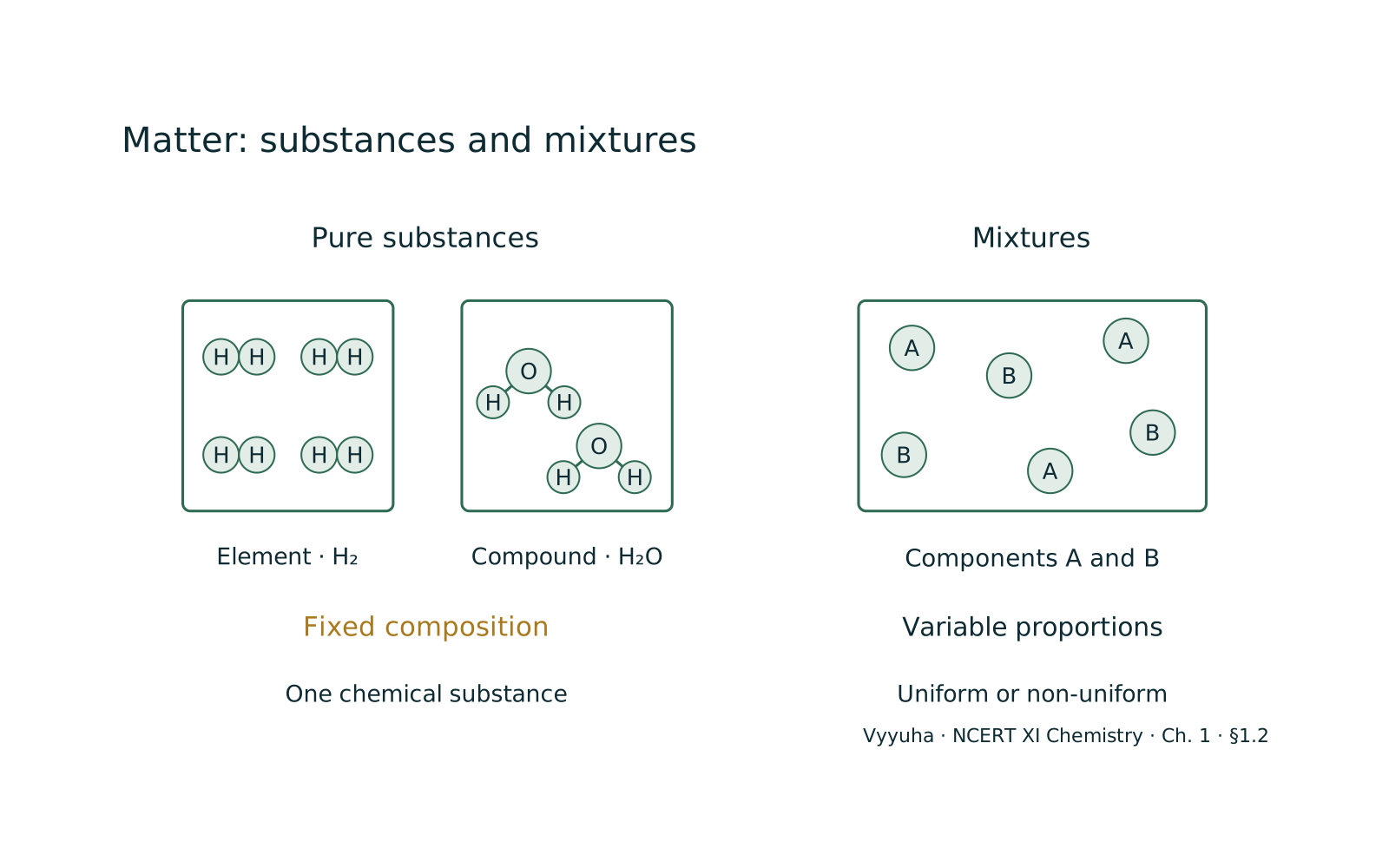
- Chemical Classification — Based on chemical composition, matter is divided into pure substances and mixtures.
* Pure Substances: Have a definite and constant composition. * Elements: Cannot be broken down into simpler substances by ordinary chemical means (e.g., O, N, Fe, Au). They consist of only one type of atom.
* Compounds: Formed when two or more elements combine chemically in a fixed ratio by mass. Their properties are distinct from their constituent elements (e.g., HO, CO, NaCl). * Mixtures: Contain two or more pure substances physically mixed together in any proportion.
Their components retain their individual properties and can be separated by physical methods. * Homogeneous Mixtures: Have a uniform composition throughout (e.g., salt solution, air, alloys). Components are indistinguishable.
* Heterogeneous Mixtures: Have a non-uniform composition, and components are visibly distinct (e.g., sand and water, oil and water).
Key Principles and Laws of Chemical Combination
These laws were instrumental in the development of atomic theory:
- Law of Conservation of Mass (Antoine Lavoisier, 1789) — In any physical or chemical change, the total mass of the reactants is equal to the total mass of the products. Mass is neither created nor destroyed. For example, if of A reacts with of B, of product C will be formed (assuming complete reaction and no side products).
- Law of Definite Proportions (Joseph Proust, 1799) — A given chemical compound always contains the same elements combined in the same fixed ratio by mass, irrespective of its source or method of preparation. For instance, water (HO) always contains hydrogen and oxygen in a mass ratio.
- Law of Multiple Proportions (John Dalton, 1803) — When two elements combine to form more than one compound, the masses of one element that combine with a fixed mass of the other element are in simple whole-number ratios. Consider carbon and oxygen forming CO and CO. In CO, C combines with O. In CO, C combines with O. The ratio of oxygen masses () is , a simple whole-number ratio.
- Gay-Lussac's Law of Gaseous Volumes (Joseph Louis Gay-Lussac, 1808) — When gases react, they do so in volumes that bear a simple whole-number ratio to one another and to the volumes of the gaseous products, provided all volumes are measured at the same temperature and pressure. For example, of H reacts with of Cl to form of HCl gas ( ratio).
- Avogadro's Law (Amedeo Avogadro, 1811) — Equal volumes of all gases, at the same temperature and pressure, contain an equal number of molecules. This law directly led to the understanding that elements like hydrogen and oxygen exist as diatomic molecules (H, O) rather than single atoms in their gaseous state.
Dalton's Atomic Theory
Based on the laws of chemical combination, John Dalton proposed his atomic theory in 1808. Its main postulates were:
- Matter consists of indivisible atoms.
- All atoms of a given element have identical properties, including identical mass. Atoms of different elements differ in mass and properties.
- Compounds are formed when atoms of different elements combine in a fixed simple whole-number ratio.
- Chemical reactions involve the rearrangement of atoms. Atoms are neither created nor destroyed in a chemical reaction.
Limitations: Dalton's theory couldn't explain subatomic particles, isotopes, isobars, or why atoms combine. However, it provided a robust framework for understanding chemical reactions.
Atomic and Molecular Masses
- Atomic Mass Unit (amu) — Defined as exactly one-twelfth the mass of one atom of carbon-12. .
- Relative Atomic Mass — The average mass of an atom of an element compared to th the mass of a carbon-12 atom. Since most elements exist as isotopes, we use average atomic mass, calculated by taking the weighted average of the atomic masses of its naturally occurring isotopes.
- Molecular Mass — The sum of the atomic masses of all the atoms in a molecule. For example, molecular mass of HO = .
- Formula Mass — Used for ionic compounds where discrete molecules don't exist. It's the sum of atomic masses of ions in the empirical formula (e.g., NaCl).
The Mole Concept and Molar Mass
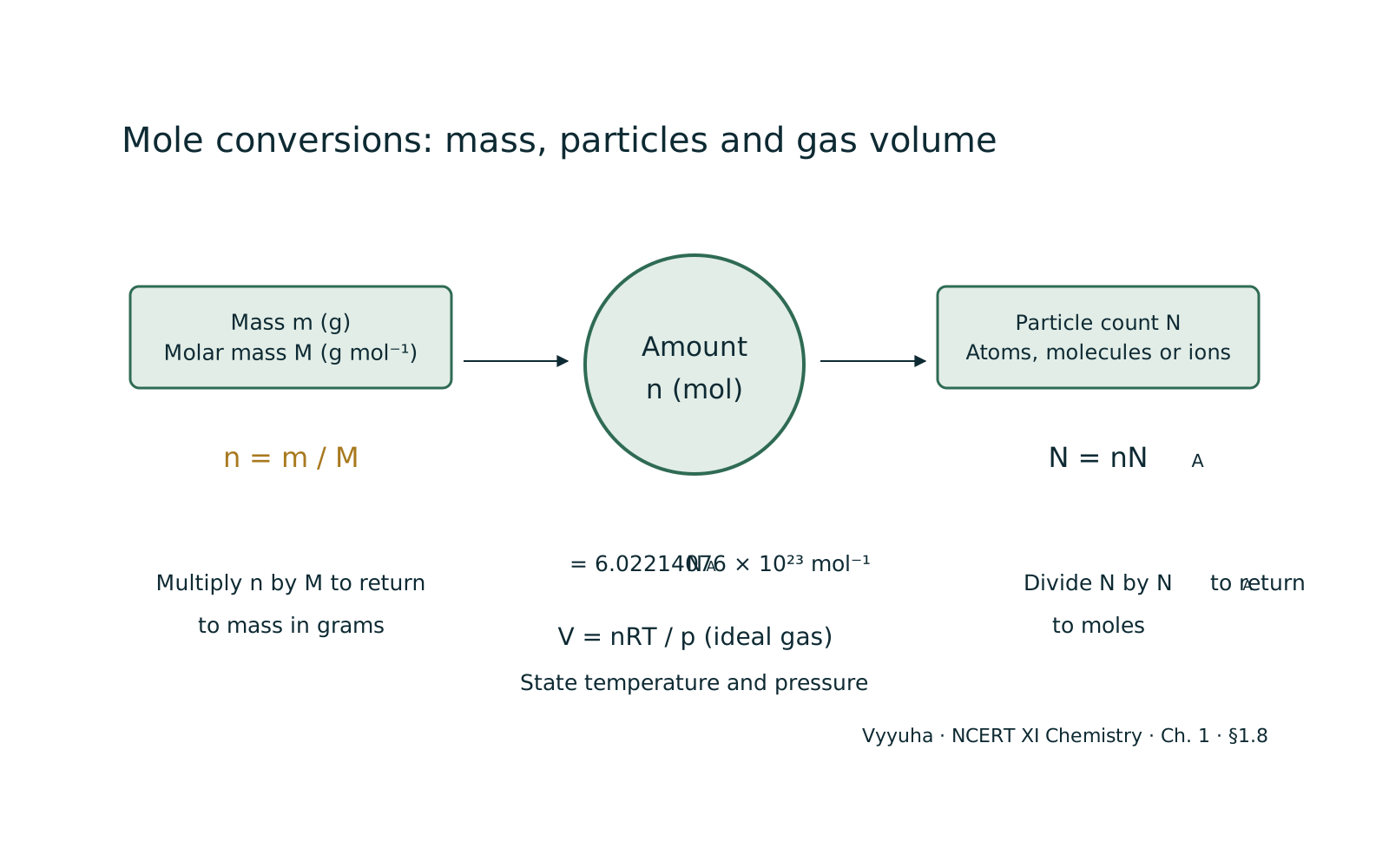
The mole is the central concept linking the microscopic world of atoms/molecules to the macroscopic world of measurable quantities. It's the SI unit for the amount of substance.
- Definition — One mole is the amount of substance that contains as many elementary entities (atoms, molecules, ions, electrons, etc.) as there are atoms in exactly of carbon-12 isotope.
- Avogadro's Number ($N_A$) — The number of entities in one mole, experimentally determined to be .
- Molar Mass — The mass of one mole of a substance in grams. Numerically, it's equal to the atomic/molecular/formula mass in amu, but with units of g/mol. For example, molar mass of HO = .
- Molar Volume — For any ideal gas at Standard Temperature and Pressure (STP: or and pressure), one mole occupies . At Standard Ambient Temperature and Pressure (SATP: or and pressure), one mole occupies .
Calculations involving moles:
- Number of moles () =
- Number of moles () =
- Number of moles () =
Stoichiometry: Quantitative Relationships in Reactions
Stoichiometry is the study of the quantitative relationships between reactants and products in a balanced chemical equation. A balanced equation provides the mole ratios of substances involved.
Steps for Stoichiometric Calculations:
- Write a balanced chemical equation.
- Convert given quantities (mass, volume, number of particles) to moles.
- Use mole ratios from the balanced equation to find moles of the desired substance.
- Convert moles of the desired substance back to the required units.
Limiting Reagent: In a chemical reaction, the reactant that is completely consumed first is called the limiting reagent. It determines the maximum amount of product that can be formed. The other reactant(s) are in excess.
Percentage Yield: The actual amount of product obtained in a reaction is often less than the theoretically calculated amount. Percentage yield quantifies this efficiency:
Empirical and Molecular Formulae
- Empirical Formula — Represents the simplest whole-number ratio of atoms of different elements present in a compound.
- Molecular Formula — Represents the actual number of atoms of each element present in a molecule of the compound.
Relationship: Molecular Formula = (Empirical Formula), where .
Steps to determine Empirical and Molecular Formula:
- Convert percentage composition to grams (assuming sample).
- Convert grams to moles for each element.
- Divide each mole value by the smallest mole value to get the simplest mole ratio.
- If not whole numbers, multiply by a suitable integer to get whole-number ratios (empirical formula).
- Calculate empirical formula mass.
- Determine using molecular mass (given or found from vapor density).
- Calculate molecular formula.
Concentration Terms for Solutions
Solutions are homogeneous mixtures. Their composition can be expressed quantitatively:
- Mass Percentage ($\% \text{w/w}$) —
- Volume Percentage ($\% \text{v/v}$) —
- Mass by Volume Percentage ($\% \text{w/v}$) —
- Parts per Million (ppm) — (used for very dilute solutions)
- Mole Fraction ($\chi$) — . Sum of mole fractions in a solution is always 1.
- Molarity (M) — . Molarity changes with temperature because volume changes.
- Molality (m) — . Molality is independent of temperature as mass does not change with temperature.
Significant Figures and Dimensional Analysis
- Significant Figures — The meaningful digits in a measured or calculated quantity. They indicate the precision of a measurement. Rules for counting and performing arithmetic operations with significant figures are crucial for reporting results accurately.
Non-zero digits are always significant. Zeros between non-zero digits are significant. Leading zeros (before non-zero digits) are not significant. Trailing zeros (at the end of a number) are significant if the number contains a decimal point. * Exact numbers (e.g., 1 dozen = 12) have infinite significant figures.
- Dimensional Analysis (Factor-Label Method) — A powerful technique for solving numerical problems by ensuring that units cancel out correctly, leading to the desired units for the answer. It involves using conversion factors (ratios of equivalent quantities with different units).
NEET-Specific Angle
For NEET, this chapter is foundational. Questions often test your ability to:
- Quickly apply the mole concept in various scenarios (mass-mole, particle-mole, volume-mole conversions).
- Identify limiting reagents and calculate product yields.
- Determine empirical and molecular formulae from percentage composition.
- Calculate and interconvert different concentration terms (Molarity, Molality, Mole Fraction).
- Apply significant figure rules in calculations, especially in multi-step problems.
- Understand the basic definitions and laws of chemical combination.
Mastering these basic concepts not only ensures marks in this chapter but also builds the necessary quantitative skills for physical chemistry topics like solutions, electrochemistry, chemical kinetics, and thermodynamics. Practice with a variety of numerical problems is key to developing speed and accuracy.
Often confused with
Side-by-side differences the NEET paper likes to test.
| Aspect | Some Basic Concepts of Chemistry | Accuracy vs. Precision |
|---|---|---|
| Definition | Accuracy refers to how close a measured value is to the true or accepted value. | Precision refers to how close multiple measurements of the same quantity are to one another (reproducibility). |
| Example | If the true mass is $10.00\,\text{g}$, and a measurement is $9.98\,\text{g}$, it is accurate. | If multiple measurements are $9.98\,\text{g}$, $9.97\,\text{g}$, $9.99\,\text{g}$, they are precise, regardless of accuracy. |
| Ideal Scenario | High accuracy means the measurement is close to the target. | High precision means repeated measurements are close to each other. |
| Error Type | Related to systematic errors (e.g., faulty calibration). | Related to random errors (e.g., reading variability). |
Accuracy and precision are distinct but equally important aspects of measurement. Accuracy tells us how 'correct' our measurement is by comparing it to the true value, often affected by systematic errors.
Precision, on the other hand, indicates the 'reproducibility' or consistency of our measurements, reflecting the random errors. A good measurement is both accurate and precise, meaning it is close to the true value and repeatable.
However, it's possible to have precise but inaccurate measurements (all values close to each other but far from the true value) or accurate but imprecise measurements (values scattered around the true value).
Why it is tested: For NEET, understanding accuracy and precision is vital for interpreting experimental data, evaluating the reliability of measurements, and performing calculations with appropriate significant figures. Questions might involve identifying scenarios of high/low accuracy and precision or applying these concepts to experimental results.
| Aspect | Some Basic Concepts of Chemistry | Homogeneous vs. Heterogeneous Mixtures |
|---|---|---|
| Uniformity | Uniform composition throughout. | Non-uniform composition; components are visibly distinct. |
| Phases | Consists of a single phase. | Consists of two or more distinct phases. |
| Visibility of Components | Components are indistinguishable. | Components are distinguishable, often visible to the naked eye. |
| Examples | Salt solution, air, alloys (e.g., brass). | Sand and water, oil and water, muddy water. |
The fundamental difference between homogeneous and heterogeneous mixtures lies in the uniformity of their composition. Homogeneous mixtures, like sugar dissolved in water, have a uniform composition and properties throughout, appearing as a single phase.
Their components are indistinguishable. Heterogeneous mixtures, such as sand mixed with water, have a non-uniform composition, and their components remain distinct and often visible, existing in two or more separate phases.
This distinction is crucial for understanding separation techniques and the properties of different types of matter.
Why it is tested: NEET questions often test basic classification of matter. Understanding this difference helps in identifying types of solutions, suspensions, and colloids, which are covered in later chapters. It also forms the basis for understanding separation techniques in practical chemistry.
Questions students ask
5 answered on this topic.
What is the primary difference between an atom and a molecule?
An atom is the smallest indivisible particle of an element that retains the chemical identity of that element. For example, a single oxygen atom (O). A molecule, on the other hand, is formed when two or more atoms chemically combine.
These atoms can be of the same element (like an oxygen molecule, O) or different elements (like a water molecule, HO). Molecules are the smallest unit of a compound that retains the chemical properties of that compound, or the smallest unit of an element that can exist independently.
How do I distinguish between empirical and molecular formulas?
The empirical formula represents the simplest whole-number ratio of atoms of different elements present in a compound. For instance, the empirical formula for glucose (CHO) is CHO. The molecular formula, however, shows the actual number of atoms of each element in a molecule.
So, for glucose, CHO is its molecular formula. The molecular formula is always an integer multiple of the empirical formula. You need the molecular mass to determine the molecular formula from the empirical formula.
What is a limiting reagent, and why is it important in chemical reactions?
A limiting reagent (or limiting reactant) is the reactant in a chemical reaction that is completely consumed first, thereby stopping the reaction and limiting the amount of product that can be formed. The other reactants are said to be in excess. It's crucial because it dictates the theoretical yield of a reaction. In practical chemistry, identifying the limiting reagent helps optimize reactions, ensuring efficient use of expensive reactants and predicting the maximum possible product.
Why are significant figures important in chemical calculations?
Significant figures are important because they convey the precision of a measurement or a calculated value. When we perform calculations with measured quantities, the result cannot be more precise than the least precise measurement used. Following significant figure rules ensures that our final answer accurately reflects the uncertainty inherent in the experimental data, preventing us from reporting results with unjustified precision. It's a way to communicate the reliability of our numbers.
What is the difference between molarity and molality, and when would I use one over the other?
Molarity (M) is defined as moles of solute per liter of solution, while molality (m) is moles of solute per kilogram of solvent. The key difference lies in the denominator: molarity uses the volume of the solution, which can change with temperature, making molarity temperature-dependent.
Molality uses the mass of the solvent, which is temperature-independent. Therefore, molality is preferred for experiments where temperature variations are significant, or when precise concentration is needed across different temperatures, such as in colligative properties studies.
Molarity is more common for general laboratory work due to ease of volume measurement.