Bohr's Model — Explained
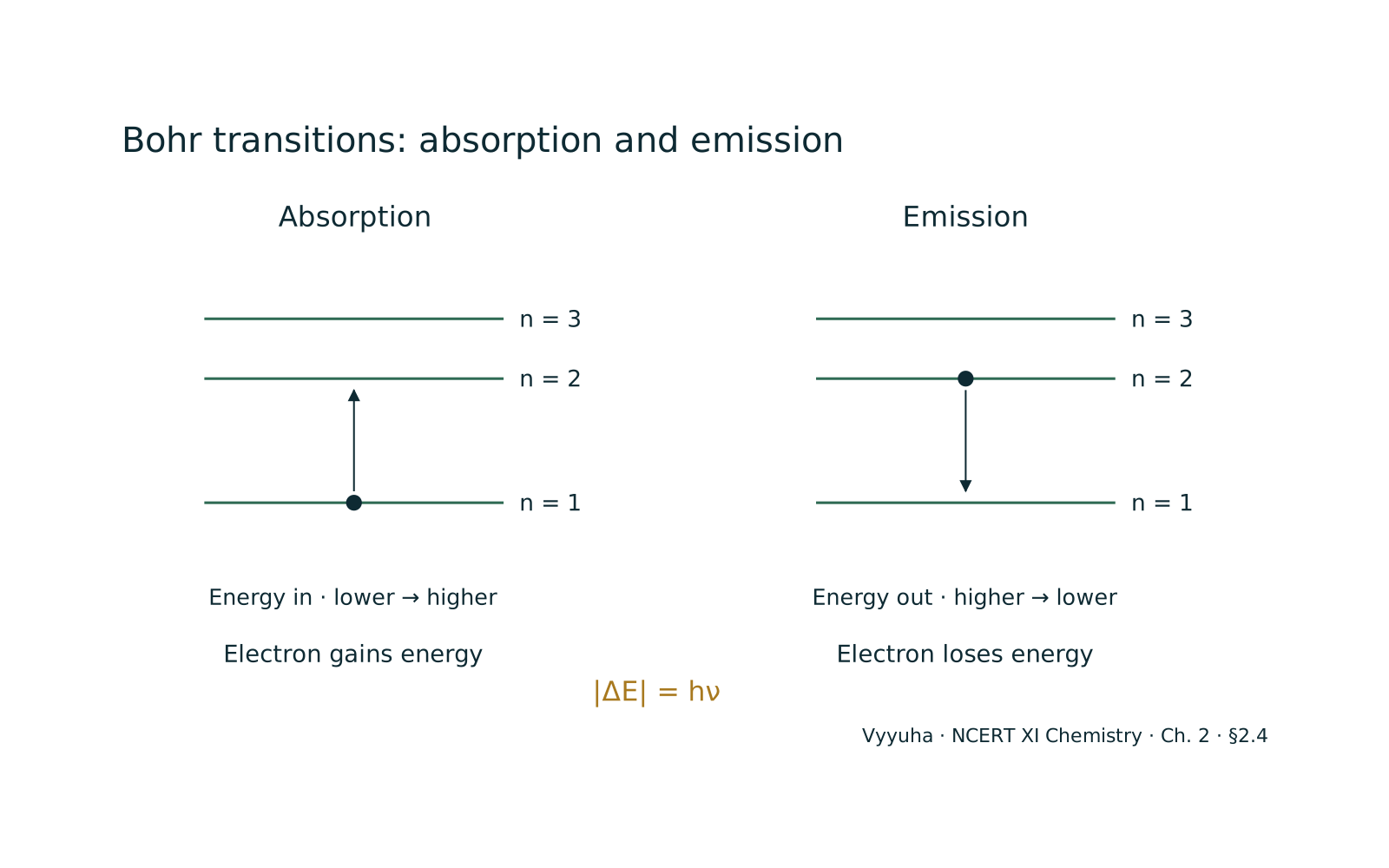
Detailed Explanation
The journey to understanding atomic structure has been a fascinating one, marked by successive models refining our comprehension. Ernest Rutherford's nuclear model, while revolutionary for establishing the existence of a dense, positively charged nucleus, faced two critical challenges that classical physics could not resolve: atomic stability and the nature of atomic spectra.
1. The Problem of Atomic Stability: According to classical electromagnetic theory (Maxwell's equations), an electron, being a charged particle accelerating in a circular orbit around the nucleus, should continuously radiate energy. As it loses energy, its orbit would shrink, and it would spiral into the nucleus in a fraction of a second ( seconds). This would imply that atoms are inherently unstable, which contradicts the observed stability of matter.
2. The Problem of Atomic Spectra: When atoms are excited (e.g., by heating or electric discharge), they emit light. However, this emitted light is not a continuous spectrum (like a rainbow from white light) but rather consists of discrete lines, each corresponding to a specific wavelength. This 'line spectrum' is unique for each element and was inexplicable by classical physics, which would predict a continuous range of frequencies from a spiraling electron.
Niels Bohr, a student of Rutherford, addressed these issues in 1913 by proposing a new model for the hydrogen atom, incorporating Planck's quantum theory. His model was based on three fundamental postulates:
Bohr's Postulates:
- Postulate 1: Stationary Orbits (Non-radiating Orbits): — Electrons revolve around the nucleus in certain definite circular paths called 'stationary orbits' or 'stationary states.' While in these orbits, electrons do not radiate energy, defying classical electromagnetism. Each stationary orbit is associated with a definite amount of energy, meaning the energy of the electron in an atom is quantized.
- Postulate 2: Quantization of Angular Momentum: — An electron can revolve only in those orbits for which its angular momentum is an integral multiple of , where is Planck's constant (). Mathematically, this is expressed as:
- Postulate 3: Energy Transitions (Frequency Condition): — An electron can jump from one stationary orbit to another only by absorbing or emitting a photon of energy. When an electron jumps from a lower energy orbit () to a higher energy orbit (), it absorbs a photon of energy . Conversely, when it jumps from a higher energy orbit () to a lower energy orbit (), it emits a photon of energy . This relationship is known as Bohr's frequency condition.
Derivations from Bohr's Model:
For a hydrogen-like species (one electron, Z protons in the nucleus), the electrostatic force of attraction between the nucleus (charge ) and the electron (charge ) provides the necessary centripetal force for the electron to orbit.
- Force Balance:
- Quantization of Angular Momentum:
Substitute (2) into (1) and solve for :
- Velocity of Electron: — Substitute the expression for back into equation (2):
- Energy of Electron: — The total energy () of an electron in an orbit is the sum of its kinetic energy (KE) and potential energy (PE).
6 \frac{Z^2}{n^2} \text{ eV}$nE_nn \to \infty$ (ionization).
Atomic Spectra and Rydberg Formula:
When an electron transitions from a higher energy level () to a lower energy level (), it emits a photon. The energy of this photon is:
6 Z^2}{hc} \left( \frac{1}{n_1^2} - \frac{1}{n_2^2} \right)$\frac{13.6}{hc}R_HR_H = 1.
09677 \times 10^7 \text{ m}^{-1}$.
Spectral Series of Hydrogen:
Different series are observed depending on the final energy level () to which the electron transitions:
- Lyman Series: — , (Ultraviolet region)
- Balmer Series: — , (Visible region)
- Paschen Series: — , (Infrared region)
- Brackett Series: — , (Infrared region)
- Pfund Series: — , (Infrared region)
Real-World Applications & NEET Relevance:
Bohr's model successfully explained:
- The stability of the hydrogen atom.
- The line spectrum of hydrogen and hydrogen-like ions ().
- The calculation of ionization energy for hydrogen and hydrogen-like species (energy required to remove an electron from to ).
- The concept of quantized energy levels, which is fundamental to all of quantum chemistry.
For NEET, understanding the derivations is less critical than knowing the final formulas and their dependencies on and . Questions frequently involve calculating radii, energies, velocities, or wavelengths of spectral lines for hydrogen and hydrogen-like species. Ratios of these quantities for different or values are also common.
Common Misconceptions:
- Electrons orbit like planets: — While a useful analogy, it's misleading. Electrons in Bohr's model are in 'stationary states' with quantized energy, not continuously orbiting like planets. They don't 'travel' between orbits; they 'jump' instantaneously.
- Bohr's model applies to all atoms: — It only works perfectly for single-electron systems (hydrogen and hydrogen-like ions). It fails for multi-electron atoms due to electron-electron repulsion and screening effects, which it doesn't account for.
- Bohr's model is completely wrong: — It was a crucial stepping stone. While superseded by more advanced quantum mechanics, its fundamental concepts of quantized energy and angular momentum remain valid and are integral to modern atomic theory.
- Energy levels are equally spaced: — The energy levels become closer together as increases (). This is a common trap in conceptual questions.
Despite its limitations, Bohr's model was a monumental achievement, bridging classical physics with the nascent quantum theory and providing the first successful explanation of atomic structure and spectra.
Often confused with
Side-by-side differences the NEET paper likes to test.
| Aspect | Bohr's Model | Rutherford's Model |
|---|---|---|
| Electron Orbits | Electrons orbit the nucleus like planets around the sun, with no restriction on orbit radius or energy. | Electrons orbit only in specific, discrete 'stationary orbits' with quantized radii and energy levels. |
| Atomic Stability | Predicts that electrons should continuously radiate energy and spiral into the nucleus, making atoms unstable (classical physics failure). | Postulates that electrons do not radiate energy in stationary orbits, thus explaining atomic stability (quantum postulate). |
| Atomic Spectra | Predicts a continuous spectrum of light if electrons were to spiral inwards. | Successfully explains the discrete line spectrum of hydrogen by postulating energy transitions between quantized levels. |
| Angular Momentum | No quantization of angular momentum; any value is possible. | Angular momentum is quantized, $mvr = n\frac{h}{2pi}$. |
| Applicability | Could not explain atomic stability or line spectra for any atom. | Successfully explained hydrogen and hydrogen-like ions, but failed for multi-electron atoms. |
Rutherford's model, while correctly identifying the nuclear structure, failed to explain atomic stability and the observed line spectra based on classical physics. Bohr's model, by introducing quantum postulates like stationary orbits and quantized angular momentum, successfully resolved these issues for hydrogen-like atoms.
It moved atomic theory from a purely classical framework to one incorporating quantum principles, marking a significant conceptual leap. The key difference lies in the quantization of energy and angular momentum, which was absent in Rutherford's purely classical approach.
Why it is tested: NEET relevance: Understanding the limitations of Rutherford's model and how Bohr's model addressed them is crucial. Questions often compare the two models or ask about the specific postulates Bohr introduced to overcome Rutherford's shortcomings. Knowing the historical progression helps in grasping the fundamental concepts of atomic structure and the evolution of quantum theory.
Questions students ask
5 answered on this topic.
Why did Bohr's model only work for hydrogen and hydrogen-like species?
Bohr's model was developed for a single-electron system, where the electron interacts only with the nucleus. In multi-electron atoms, the model fails because it does not account for the complex electron-electron repulsions and screening effects.
Each electron experiences a different effective nuclear charge due to the presence of other electrons, which significantly alters the energy levels and orbital characteristics. The simple force balance and angular momentum quantization used by Bohr become insufficient to describe these intricate interactions.
What is the significance of the negative sign in the energy formula $E_n = -13.6 \frac{Z^2}{n^2} \text{ eV}$?
The negative sign indicates that the electron is bound to the nucleus. It signifies that energy must be supplied to remove the electron from the atom (i.e., to ionize it). An electron with zero energy () is considered to be free from the influence of the nucleus (at ). Therefore, any negative energy value means the electron is in a bound state, and the more negative the energy, the more tightly bound the electron is to the nucleus.
What is the principal quantum number ($n$) in Bohr's model?
The principal quantum number () is a positive integer (1, 2, 3, ...) that defines the main energy level or shell in which an electron resides. In Bohr's model, it directly determines the radius of the orbit, the velocity of the electron, and its total energy. Higher values of correspond to larger orbits, higher energy levels (less negative), and lower electron velocities. It essentially quantizes the energy and size of the electron's orbit.
How does Bohr's model explain the discrete line spectrum of hydrogen?
Bohr's model explains the discrete line spectrum by postulating that electrons can only exist in specific, quantized energy levels. When an electron absorbs energy, it jumps to a higher energy level (excited state).
When it returns to a lower energy level, it emits the excess energy as a photon of light. Since the energy levels are discrete, the energy difference between any two levels is also discrete. This means only photons of specific, discrete energies (and thus specific wavelengths/frequencies) can be emitted, resulting in a line spectrum rather than a continuous one.
What are the main limitations of Bohr's model?
Bohr's model, despite its successes, had several limitations. It could not explain the spectra of multi-electron atoms, the splitting of spectral lines in a magnetic field (Zeeman effect) or an electric field (Stark effect), and the fine structure of spectral lines (i.
e., that some lines are actually composed of several closely spaced lines). It also failed to explain the chemical bonding ability of atoms and did not incorporate the wave nature of electrons (de Broglie hypothesis) or Heisenberg's Uncertainty Principle, which were later developments in quantum mechanics.