de Broglie's Relation — Explained
Detailed Explanation
The journey to understanding de Broglie's relation begins with a historical appreciation of light's dual nature. For centuries, light was debated as either a wave (Huygens) or a particle (Newton). By the early 20th century, experimental evidence had solidified both views.
Phenomena like interference and diffraction unequivocally demonstrated light's wave nature. However, phenomena like blackbody radiation (explained by Planck's quantization of energy, ) and the photoelectric effect (explained by Einstein's photon concept, ) clearly showed light behaving as discrete packets of energy, or particles, called photons.
This led to the acceptance of wave-particle duality for light.
Conceptual Foundation: Extending Duality to Matter
Louis de Broglie, inspired by this duality of light, proposed a bold hypothesis in 1924: if light, which is traditionally considered a wave, can exhibit particle-like properties, then perhaps particles of matter, like electrons, could also exhibit wave-like properties.
This was a radical departure from classical physics, which treated matter as purely particulate. De Broglie's genius lay in his symmetry argument – if nature exhibits duality for energy (light), it should also exhibit it for matter.
Key Principles and Derivation of de Broglie's Relation
De Broglie sought a mathematical relationship that would connect the wave properties (wavelength, ) with the particle properties (momentum, ) for matter. He started with Einstein's famous mass-energy equivalence relation for a particle:
For a photon, which has wave-like properties, its energy is given by Planck's relation:
We also know that the speed of light (), frequency (), and wavelength () are related by:
Substituting Equation 3 into Equation 2, we get the energy of a photon in terms of its wavelength:
Now, de Broglie made the crucial step: he equated the energy expressions from particle theory (Einstein's) and wave theory (Planck's) for a photon, assuming this duality could be extended to matter. Equating Equation 1 and Equation 4:
We can cancel one from both sides:
Rearranging for :
For a photon, represents its momentum (). So, for a photon, . Therefore, the relation becomes:
De Broglie then boldly proposed that this same relationship, , should apply to any moving particle, not just photons. For a material particle moving with velocity and having mass , its momentum is given by:
Substituting this into Equation 5, we get the de Broglie wavelength for a material particle:
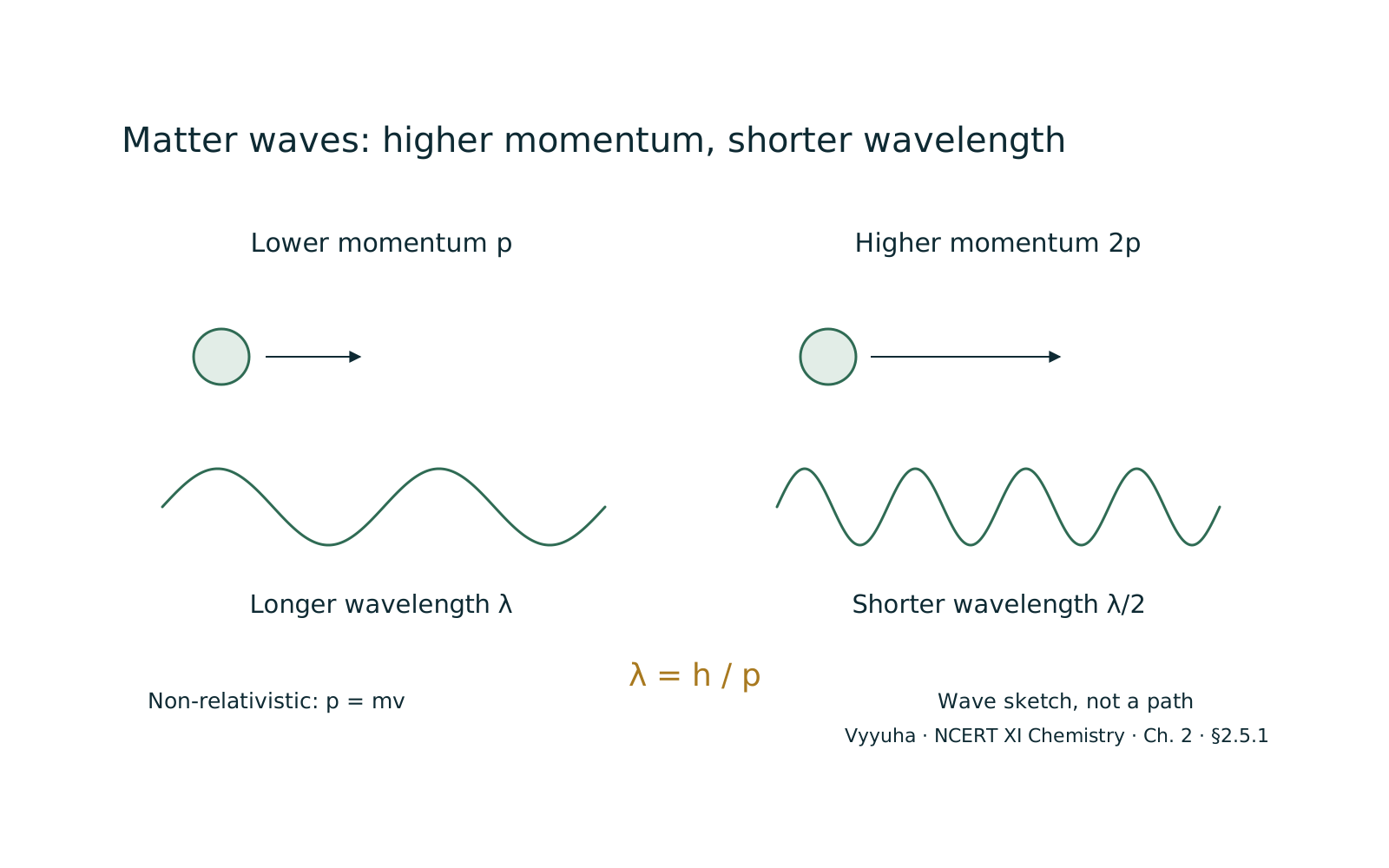
This is the famous de Broglie relation. It connects the wave property () with the particle properties ( and ) of matter.
Experimental Confirmation: Davisson and Germer Experiment
De Broglie's hypothesis was purely theoretical initially. Its experimental confirmation came in 1927 from the experiments of Clinton Davisson and Lester Germer, who observed the diffraction of electrons by a nickel crystal. Just as X-rays (a form of electromagnetic wave) are diffracted by crystal lattices, electrons were found to exhibit similar diffraction patterns. This provided compelling evidence for the wave nature of electrons, validating de Broglie's revolutionary idea.
Relation to Kinetic Energy and Accelerating Voltage
For a particle, especially an electron, its kinetic energy () is often given. We can express momentum in terms of kinetic energy:
This form is particularly useful when the kinetic energy of the particle is known.
For a charged particle (like an electron) accelerated through a potential difference , the work done on the particle () is converted into its kinetic energy (). So, , where is the charge of the particle.
Substituting this into the kinetic energy form of the de Broglie relation:
Real-World Applications: Electron Microscopy
One of the most significant practical applications of de Broglie's hypothesis is the electron microscope. Optical microscopes are limited by the wavelength of visible light (around 400-700 nm). To resolve finer details, a shorter wavelength is required.
Electrons, when accelerated through a high voltage, can have de Broglie wavelengths much shorter than visible light (e.g., an electron accelerated through 100 kV has a wavelength of about 0.0037 nm). This extremely short wavelength allows electron microscopes to achieve much higher resolution, enabling us to visualize structures at the atomic and molecular level, which is impossible with light microscopes.
Common Misconceptions
- Macroscopic objects and wave nature: — Students often wonder why we don't observe wave-like behavior for everyday objects. The key lies in the magnitude of Planck's constant () and the momentum (). For a macroscopic object (e.g., a 1 kg ball moving at 1 m/s), its momentum is . The de Broglie wavelength would be . This wavelength is astronomically small, far beyond any measurable scale, making its wave nature undetectable. Only for particles with extremely small masses (like electrons, protons, neutrons) and sufficiently low velocities does the de Broglie wavelength become comparable to atomic dimensions or interatomic distances in crystals, allowing their wave nature to be observed.
- De Broglie's relation vs. Heisenberg Uncertainty Principle: — While both are fundamental to quantum mechanics and deal with the wave-particle duality, they are distinct. De Broglie's relation quantifies the wavelength associated with a particle's momentum. Heisenberg's Uncertainty Principle states that it's impossible to simultaneously know with perfect precision both the position and momentum (or energy and time) of a particle. De Broglie gives us the 'what' (matter has waves), Heisenberg gives us the 'limitation' on measuring these wave-particle properties.
- **Wave-particle duality means a particle is both a wave and a particle simultaneously:** It's more accurate to say that a quantum entity exhibits either wave-like or particle-like properties depending on how it's observed or interacted with. It's not a simultaneous manifestation of both in the same measurement.
NEET-Specific Angle
De Broglie's relation is a cornerstone of the Quantum Mechanical Model of the Atom. It provides the theoretical basis for Bohr's postulate that electrons can only exist in specific, stable orbits (quantized energy levels).
If an electron in an orbit behaves as a wave, then for the orbit to be stable, the electron wave must form a standing wave, meaning the circumference of the orbit must be an integral multiple of the electron's de Broglie wavelength (, where $n = 1, 2, 3, ...
$). This condition naturally leads to the quantization of angular momentum and energy levels, which was a key aspect of Bohr's model, but de Broglie provided a more fundamental wave-mechanical justification.
NEET questions often test the direct application of the de Broglie formula, its variations involving kinetic energy or accelerating voltage, and conceptual understanding of wave-particle duality, especially for electrons, protons, and alpha particles.
Comparative questions, asking for the ratio of wavelengths for different particles under similar conditions (e.g., same kinetic energy or same accelerating voltage), are also common. Understanding the inverse relationship between wavelength and momentum is crucial.
Often confused with
Side-by-side differences the NEET paper likes to test.
| Aspect | de Broglie's Relation | Heisenberg Uncertainty Principle |
|---|---|---|
| Core Concept | De Broglie's Relation: All matter exhibits wave-like properties, with a wavelength inversely proportional to its momentum. | Heisenberg Uncertainty Principle: It is impossible to simultaneously know with perfect precision both the position and momentum (or energy and time) of a quantum particle. |
| Mathematical Expression | $\lambda = h/p$ (where $\lambda$ is wavelength, $h$ is Planck's constant, $p$ is momentum) | $\Delta x \cdot \Delta p \ge h/(4\pi)$ or $\Delta E \cdot \Delta t \ge h/(4\pi)$ (where $\Delta x$ is uncertainty in position, $\Delta p$ is uncertainty in momentum, etc.) |
| What it describes | Quantifies the wave nature of matter, linking particle properties (mass, velocity) to wave properties (wavelength). | Describes a fundamental limitation on the precision with which certain pairs of physical properties of a particle can be known simultaneously. |
| Implication for Quantum Mechanics | Provides the basis for the wave-mechanical model of the atom, explaining quantized energy levels as standing waves. | Highlights the probabilistic nature of quantum mechanics and the inherent fuzziness of quantum reality, challenging classical determinism. |
| Relationship to Duality | A direct consequence and quantification of wave-particle duality. | A consequence of wave-particle duality; if particles are waves, their position is spread out, leading to uncertainty in simultaneous measurement of position and momentum. |
While both de Broglie's relation and Heisenberg's Uncertainty Principle are foundational to quantum mechanics and arise from the wave-particle duality, they address different aspects. De Broglie's relation quantifies the wave nature of matter by providing a formula for the wavelength associated with any moving particle.
It tells us that matter has wave properties and how to calculate them. In contrast, Heisenberg's Uncertainty Principle describes a fundamental limitation on our ability to precisely measure certain pairs of complementary properties (like position and momentum) of a quantum particle simultaneously.
It tells us about the inherent fuzziness and probabilistic nature of quantum measurements, which is a consequence of the particle's wave-like spread.
Why it is tested: NEET relevance: Both concepts are crucial for understanding the quantum mechanical model of the atom. De Broglie's relation explains the stability of electron orbits and quantized energy, while Heisenberg's principle explains why we cannot precisely pinpoint an electron's exact position and momentum simultaneously, leading to the concept of orbitals (probability distributions) rather than fixed orbits. Questions often test the distinction and interrelation of these two principles.
Questions students ask
5 answered on this topic.
Why is de Broglie's relation significant in the context of atomic structure?
De Broglie's relation provides a fundamental justification for the quantization of energy levels and orbits in atoms, a concept first introduced by Bohr. If electrons behave as waves, then for an electron to exist in a stable orbit around the nucleus, its wave must form a standing wave.
This means the circumference of the orbit must be an integral multiple of the electron's de Broglie wavelength (). This condition directly leads to the quantization of angular momentum and energy, explaining why electrons occupy discrete energy states rather than spiraling into the nucleus, thus forming the basis of the quantum mechanical model.
Does de Broglie's relation apply to photons? If so, how?
Yes, de Broglie's relation, , applies to photons as well. In fact, de Broglie derived his relation by extending the wave-particle duality observed in light to matter. For a photon, its momentum () is given by , where is its energy and is the speed of light.
Since for a photon, its momentum is . Rearranging this gives , which is consistent with de Broglie's general relation. So, photons, despite being massless particles, possess momentum and an associated wavelength.
Why don't we observe the wave nature of macroscopic objects like a cricket ball?
The wave nature of macroscopic objects is not observable due to their large mass and, consequently, large momentum. De Broglie's wavelength is inversely proportional to momentum (). Planck's constant () is extremely small ($6.
626 \times 10^{-34}\ \text{J s}mmvhmv10^{-34}$ meters or less), which is far too small to be detected by any current experimental means.
Thus, their wave properties are negligible in everyday experience.
How is de Broglie's relation connected to the kinetic energy of a particle?
De Broglie's relation can be expressed in terms of kinetic energy. The momentum () of a particle is related to its kinetic energy () by the formula , where is the mass of the particle.
Substituting this into de Broglie's original equation, , we get . This form is particularly useful when the kinetic energy of the particle is known, allowing for direct calculation of its associated wavelength without needing to first calculate its velocity.
What is the role of accelerating voltage in determining the de Broglie wavelength of an electron?
For a charged particle like an electron, when it is accelerated through a potential difference (), the work done on it (, where is the charge of the electron) is converted into its kinetic energy.
So, . Substituting this into the de Broglie wavelength formula involving kinetic energy, we get . This equation shows that a higher accelerating voltage leads to a higher kinetic energy, greater momentum, and consequently, a shorter de Broglie wavelength for the electron.
This principle is fundamental to the operation of electron microscopes, where high voltages are used to achieve very short electron wavelengths for high resolution imaging.