Electronic Configuration — Explained
Detailed Explanation
Electronic configuration is a fundamental concept in chemistry that describes the arrangement of electrons within the atomic orbitals of an atom. This arrangement dictates an atom's chemical behavior, its position in the periodic table, and its physical properties like magnetism and spectral characteristics.
To understand electronic configuration fully, we must first grasp the underlying principles derived from quantum mechanics.\n\n1. Conceptual Foundation: Quantum Numbers and Atomic Orbitals\nElectrons within an atom are not randomly distributed but occupy specific energy states and regions of space defined by quantum numbers.
There are four main quantum numbers:\n* Principal Quantum Number (n): Defines the main energy shell and the size of the orbital. . Higher 'n' means higher energy and larger orbital size.
\n* Azimuthal (Angular Momentum) Quantum Number (l): Defines the shape of the orbital and the subshell. .\n * corresponds to an s-subshell (spherical shape).\n * corresponds to a p-subshell (dumbbell shape).
\n * corresponds to a d-subshell (more complex shapes).\n * corresponds to an f-subshell (even more complex shapes).\n* **Magnetic Quantum Number ():** Defines the orientation of the orbital in space.
. For a given 'l', there are possible values, which correspond to the number of orbitals within that subshell (e.g., for (p-subshell), , meaning three p-orbitals: ).
\n* **Spin Quantum Number ():** Describes the intrinsic angular momentum (spin) of an electron. (spin up) or (spin down). Each orbital can hold a maximum of two electrons, and they must have opposite spins.
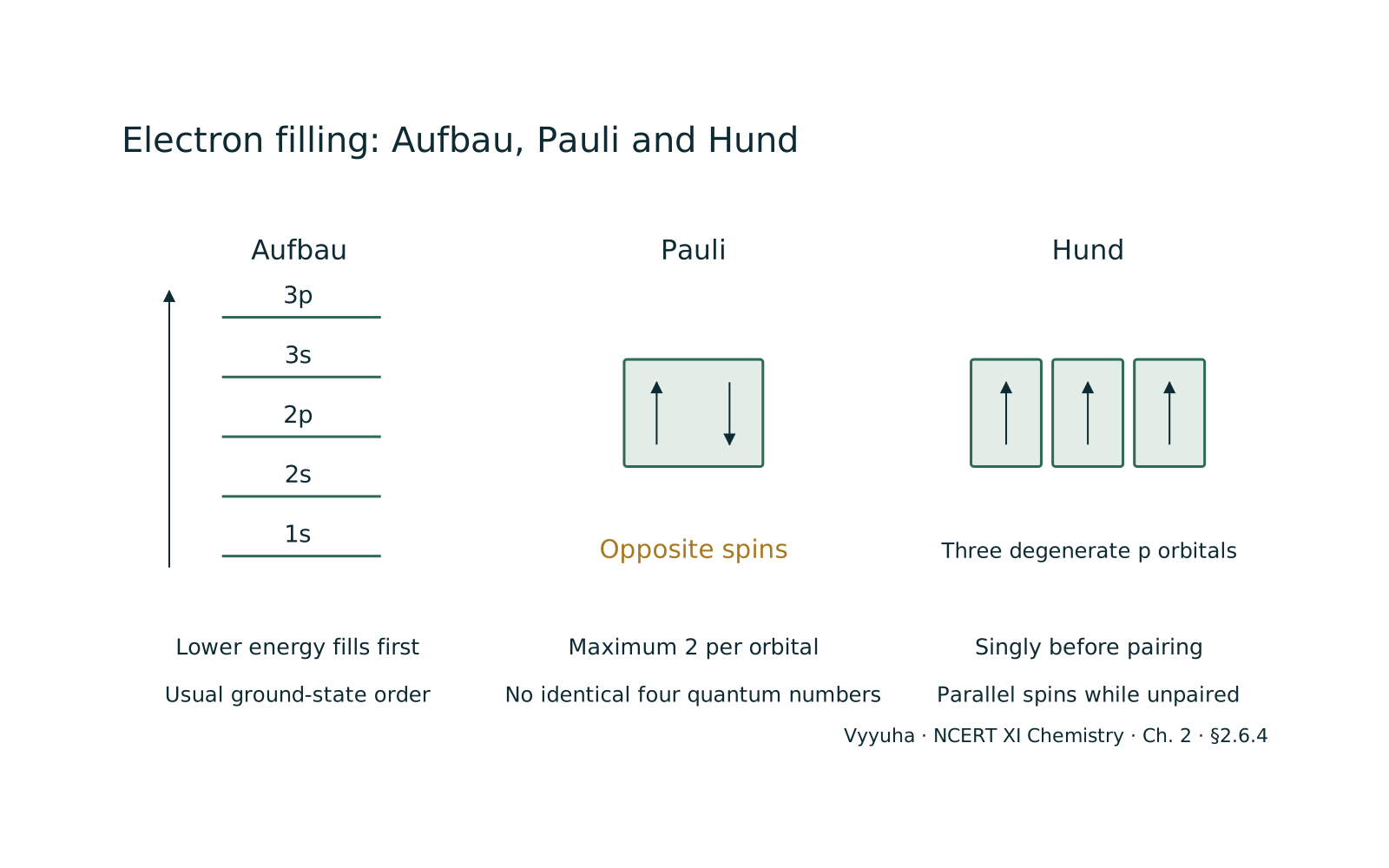
\n\n2. Key Principles Governing Electronic Configuration\nThree fundamental rules dictate how electrons fill atomic orbitals:\n\na) Aufbau Principle (Building-Up Principle):\nThis principle states that electrons first occupy the lowest energy orbitals available before filling higher energy orbitals.
The word 'Aufbau' is German for 'building up'. The energy of an orbital is primarily determined by the sum of the principal quantum number (n) and the azimuthal quantum number (l), i.e., the rule.
Orbitals with a lower value are filled first. If two orbitals have the same value, the one with the lower 'n' value is filled first.\n* Example: For 3d, . For 4s, .
Since 4s has a lower value, it is filled before 3d. This explains the common filling order: . This order can be easily remembered using the diagonal rule or Moeller diagram.
\n\nb) Pauli's Exclusion Principle:\nThis principle states that no two electrons in the same atom can have identical values for all four quantum numbers (). This implies that an atomic orbital can hold a maximum of two electrons, and these two electrons must have opposite spins.
If one electron has , the other must have . This ensures that each electron in an atom has a unique quantum 'identity'.\n* Example: In a orbital, the first electron has .
The second electron in the same orbital must have . A third electron cannot enter this orbital because it would have to duplicate one of the existing sets of quantum numbers.
\n\nc) Hund's Rule of Maximum Multiplicity:\nThis rule applies to degenerate orbitals (orbitals within the same subshell that have the same energy, e.g., ). It states that for a given subshell, electrons will first occupy each orbital singly with parallel spins before any orbital is doubly occupied.
This maximizes the total spin multiplicity and leads to a more stable configuration. Electrons repel each other, and by occupying separate orbitals, they minimize inter-electronic repulsion.\n* Example: For a carbon atom (atomic number 6), the electronic configuration is .
The two electrons in the subshell will occupy two different orbitals (e.g., ) with parallel spins, rather than pairing up in one orbital (e.g., ). This configuration () is more stable than ().
\n\n3. Derivations (Logic behind the rules):\nWhile there are no 'derivations' in the mathematical sense for these rules in an introductory context, their origins lie in the solutions to the Schrödinger equation for multi-electron atoms and experimental observations (like atomic spectra and magnetic properties).
The Aufbau principle arises from the energy ordering of orbitals. Pauli's principle is a consequence of the fermionic nature of electrons (they are fermions, which obey Fermi-Dirac statistics). Hund's rule is an empirical observation explained by minimizing electron-electron repulsion and maximizing exchange energy, which is a quantum mechanical effect that stabilizes configurations with parallel spins.
\n\n4. Real-World Applications:\n* Predicting Chemical Properties: Elements with similar outer electronic configurations (valence electrons) exhibit similar chemical properties. This is the basis of the periodic table's organization into groups.
\n* Chemical Bonding: The number of valence electrons determines an atom's ability to form bonds (ionic or covalent) and its valency.\n* Magnetic Properties: Atoms with unpaired electrons are paramagnetic (attracted to a magnetic field), while those with all paired electrons are diamagnetic (repelled by a magnetic field).
Electronic configuration helps predict this.\n* Spectroscopy: The electronic transitions between different energy levels (orbitals) are responsible for the characteristic absorption and emission spectra of elements, used in analytical techniques.
\n* Stability of Ions: Understanding how electrons are added or removed to achieve stable noble gas configurations explains the formation of cations and anions.\n\n5. Common Misconceptions:\n* Filling Order: Students often forget the rule and incorrectly fill 3d before 4s.
Remember, 4s is filled before 3d for neutral atoms due to its lower energy.\n* Pauli's Principle vs. Hund's Rule: Confusing when to pair electrons. Pauli's principle says max two electrons per orbital with opposite spins.
Hund's rule says when to pair them in degenerate orbitals (only after all are singly occupied).\n* Stability of Half-filled and Completely Filled Orbitals: This is a crucial exception. Orbitals that are exactly half-filled (e.
g., ) or completely filled (e.g., ) exhibit extra stability. This is attributed to two main factors: symmetry (a symmetrical distribution of electrons leads to lower energy) and exchange energy (electrons with the same spin in different degenerate orbitals can exchange positions, leading to a stabilization energy.
The more parallel spins, the more exchange energy). This explains exceptions like Chromium ( instead of ) and Copper ( instead of ).\n\n6. NEET-Specific Angle:\nFor NEET, mastering electronic configuration is non-negotiable.
Questions frequently test:\n* Direct configuration writing: For elements up to atomic number 30-36 (Krypton). You must know the Aufbau order.\n* Exceptions: Chromium (Cr) and Copper (Cu) are the most common exceptions due to the stability of half-filled () and fully-filled () d-orbitals.
Other exceptions like Molybdenum (Mo), Silver (Ag), Gold (Au) are less frequent but good to know.\n* Ions: Writing configurations for cations (remove electrons from the highest 'n' value first, then highest 'l') and anions (add electrons to the lowest available energy orbital).
For transition metals, remember to remove electrons from the 's' orbital before the 'd' orbital (e.g., is not ).\n* Quantum Numbers: Relating electronic configuration to the possible sets of quantum numbers for specific electrons.
\n* Magnetic Properties: Determining if an atom/ion is paramagnetic or diamagnetic based on the presence of unpaired electrons.\n* Periodic Trends: Connecting electronic configuration to periodicity, ionization enthalpy, electron gain enthalpy, and atomic size.
Often confused with
Side-by-side differences the NEET paper likes to test.
| Aspect | Electronic Configuration | Orbital Diagram |
|---|---|---|
| Representation | Electronic Configuration (e.g., $1s^2 2s^2 2p^4$) | Orbital Diagram (e.g., $1s (\uparrow \downarrow) 2s (\uparrow \downarrow) 2p (\uparrow \downarrow) (\uparrow \_ ) (\uparrow \_ )$) |
| Information Conveyed | Number of electrons in each subshell. | Number of electrons in each orbital, their spins, and whether they are paired or unpaired. |
| Detail Level | Shorthand, less detailed. | More detailed, visual representation of electron distribution within orbitals. |
| Application of Hund's Rule | Implied, but not explicitly shown. | Directly visualized, showing single occupancy before pairing. |
| Usefulness for Magnetism | Requires interpretation to determine unpaired electrons. | Directly shows unpaired electrons, making it easier to determine paramagnetism/diamagnetism. |
While electronic configuration provides a concise summary of electron distribution across subshells, the orbital diagram offers a more granular, visual representation. The electronic configuration, like , tells us the count of electrons in each subshell.
In contrast, an orbital diagram uses boxes or lines to represent individual orbitals and arrows to depict electrons, explicitly showing their spins and whether they are paired or unpaired within each orbital.
This visual detail is particularly useful for applying Hund's Rule and for quickly identifying unpaired electrons, which is crucial for predicting magnetic properties.
Why it is tested: NEET relevance: Both are crucial. Electronic configuration is the primary notation, but orbital diagrams are essential for understanding Hund's rule, identifying unpaired electrons, and determining magnetic properties (paramagnetic vs. diamagnetic), which are frequently tested concepts.
Questions students ask
5 answered on this topic.
What is the significance of the $(n+l)$ rule in electronic configuration?
The rule, also known as the Madelung rule or Klechkowski rule, is a guideline used to predict the order in which atomic orbitals are filled with electrons according to the Aufbau principle. It states that orbitals with a lower value of are filled first.
If two orbitals have the same value, the orbital with the lower principal quantum number (n) is filled first. This rule helps explain why, for instance, the 4s orbital (n=4, l=0; n+l=4) is filled before the 3d orbital (n=3, l=2; n+l=5), even though 3d belongs to a lower principal shell.
This order is crucial for correctly writing electronic configurations, especially for transition metals.
Why are half-filled and completely filled orbitals considered more stable?
The enhanced stability of half-filled and completely filled orbitals is primarily attributed to two factors: symmetry and exchange energy. A symmetrical distribution of electrons in a subshell (e.g., , , ) leads to a more stable, lower energy state.
Additionally, electrons with parallel spins occupying different degenerate orbitals can exchange their positions. This 'exchange' phenomenon releases energy, known as exchange energy. The more parallel spins available, the greater the number of possible exchanges, and thus, the greater the stabilization energy.
Half-filled and completely filled subshells maximize these exchange possibilities, leading to exceptional stability, as seen in elements like Chromium and Copper.
How does electronic configuration help in understanding the periodic table?
Electronic configuration is the fundamental basis for the organization of the periodic table. Elements with similar outer electronic configurations (valence electrons) are placed in the same group, as they exhibit similar chemical properties.
For example, all alkali metals (Group 1) have an configuration, making them highly reactive and prone to losing one electron. The period number corresponds to the principal quantum number (n) of the outermost shell.
The blocks (s, p, d, f) of the periodic table directly relate to the subshell being filled by the last electron. Thus, electronic configuration provides a direct link between an atom's structure and its macroscopic chemical behavior.
What is the difference between an orbital and a subshell?
A subshell is a collection of orbitals that have the same principal quantum number (n) and azimuthal quantum number (l). For example, the 2p subshell consists of three 2p orbitals ().
An orbital, on the other hand, is a specific region of space around the nucleus where there is a high probability (typically 90-95%) of finding an electron. Each orbital can hold a maximum of two electrons, provided they have opposite spins (Pauli's Exclusion Principle).
So, a subshell is a broader category, while an orbital is a specific 'room' within that category, defining the spatial distribution of electrons.
Why do transition metals lose electrons from the s-orbital before the d-orbital when forming cations?
This is a common point of confusion. While the 4s orbital is filled before the 3d orbital in neutral transition metal atoms (due to the Aufbau principle and the rule), when these metals form cations, the electrons are removed from the orbital with the highest principal quantum number (n) first.
For elements in the fourth period, the 4s orbital has a higher 'n' value (n=4) than the 3d orbital (n=3). Although 3d is higher in energy during filling, once the atom is formed, the 3d orbital becomes more stable and lower in energy than the 4s orbital, making the 4s electrons easier to remove.
Therefore, for transition metals, electrons are always removed from the outermost s-orbital before any d-orbital electrons.