Dimensional Analysis — Explained
Detailed Explanation
Dimensional analysis is a cornerstone technique in physics, providing a robust framework for understanding and manipulating physical quantities based on their fundamental nature. It's not about the specific numerical value or unit, but rather the intrinsic 'type' of the quantity.
1. Conceptual Foundation: What are Dimensions?
At its core, a dimension refers to the physical nature of a quantity. For example, 'length' is a dimension, whether measured in meters, feet, or miles. 'Mass' is another dimension, irrespective of whether it's in kilograms or pounds. 'Time' is a third. These are the fundamental dimensions upon which most of classical mechanics is built. The International System of Units (SI) defines seven fundamental (or base) quantities, each with its own dimension:
- Mass (M)
- Length (L)
- Time (T)
- Electric Current (A)
- Thermodynamic Temperature (K)
- Amount of Substance (mol)
- Luminous Intensity (cd)
All other physical quantities are derived quantities, and their dimensions can be expressed as combinations of these fundamental dimensions. For instance, speed is defined as distance divided by time.
Therefore, its dimension is or . Force, by Newton's second law, is mass times acceleration. Acceleration is length per time squared, so force has dimensions of .
The square brackets [] are conventionally used to denote the dimensions of a quantity.
2. Key Principles and Laws: The Principle of Homogeneity
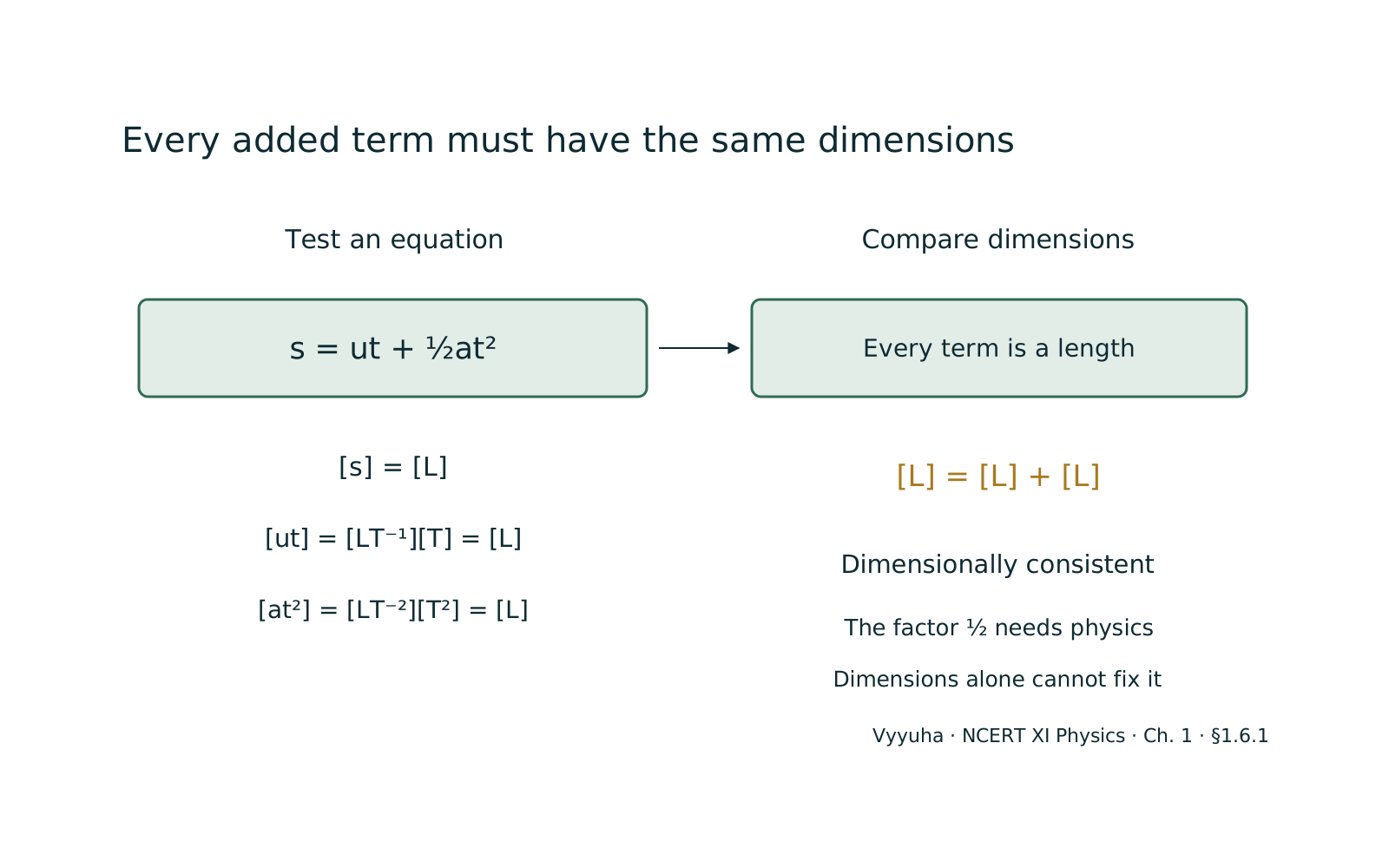
The entire edifice of dimensional analysis rests on one crucial principle: the Principle of Homogeneity of Dimensions. This principle states that a physical equation is dimensionally correct if and only if the dimensions of all the terms on both sides of the equation are identical. This applies to every term in an equation, especially when terms are added or subtracted. For example, in the equation , where and are velocities, is acceleration, and is time:
- Dimension of :
- Dimension of :
- Dimension of :
Since all terms have the dimension , the equation is dimensionally homogeneous and thus potentially correct. If any term had a different dimension, the equation would be fundamentally flawed.
3. Uses of Dimensional Analysis
Dimensional analysis serves three primary purposes in physics:
- a) Checking the Dimensional Consistency of Equations: — This is the most straightforward application. Any derived formula or given equation can be quickly checked for dimensional correctness. If an equation fails the dimensional homogeneity test, it is definitely wrong. However, if it passes, it is only dimensionally correct, not necessarily physically correct (e.g., it might be missing a dimensionless constant like or ).
* Example: Check . * Dimensions of (Energy): * Dimensions of (Mass): * Dimensions of (Speed of light): * Dimensions of : . Since LHS = RHS dimensions, the equation is dimensionally consistent.
- b) Deriving Relationships Between Physical Quantities: — If we know that a physical quantity depends on several other quantities, dimensional analysis can help us determine the form of the relationship. This is particularly useful when the exact physical laws are complex or unknown.
* *Example: Time period of a simple pendulum ()* Assume depends on mass (), length (), and acceleration due to gravity (). So, . Comparing powers of M, L, T: For M: For L: For T: Substituting into : Thus, .
The actual formula is , where is a dimensionless constant that cannot be determined by dimensional analysis.
- c) Converting Units from One System to Another: — Dimensional analysis provides a systematic way to convert a physical quantity's value from one system of units to another.
* Example: Convert 1 Joule to ergs. Joule is the SI unit of energy. Erg is the CGS unit of energy. Dimension of Energy: Let be the numerical value in System 1 (SI) and be its units.
Let be the numerical value in System 2 (CGS) and be its units. For 1 Joule: System 1 (SI): , , System 2 (CGS): , , So, 1 Joule = ergs.
4. Limitations of Dimensional Analysis
While powerful, dimensional analysis has certain limitations:
- Dimensionless Constants: — It cannot determine the value of dimensionless constants (like , , etc.) that may appear in an equation.
- Trigonometric, Logarithmic, Exponential Functions: — It cannot be used for equations involving trigonometric, logarithmic, or exponential functions, as the arguments of these functions must be dimensionless.
- Sum/Difference of Quantities: — It cannot distinguish between physical quantities that have the same dimensions (e.g., work and torque both have dimensions ). It also cannot determine if a quantity is a sum or difference of terms with the same dimensions (e.g., is dimensionally correct, but would also appear dimensionally correct if we only checked the terms individually).
- Number of Variables: — If a physical quantity depends on more than three or four fundamental quantities (depending on the number of fundamental dimensions used), dimensional analysis becomes complex or insufficient to derive a unique relationship.
5. Common Misconceptions
- Dimensions vs. Units: — Students often confuse dimensions with units. Dimensions are the fundamental nature (e.g., Length), while units are specific standards of measurement (e.g., meter, foot). A quantity has one dimension but can be expressed in many units.
- Dimensional Correctness implies Physical Correctness: — As discussed, dimensional correctness is a necessary condition for an equation to be physically correct, but not a sufficient one. An equation can be dimensionally correct but still physically wrong (e.g., is dimensionally correct but numerically wrong).
- Arguments of Functions: — For functions like , , , , the arguments (, , ) must always be dimensionless. This is a crucial check for complex equations.
6. NEET-Specific Angle
For NEET aspirants, dimensional analysis is a high-yield topic because:
- Quick Checks: — It allows for rapid verification of formulas in MCQs, saving time. If an option is dimensionally incorrect, it can be immediately eliminated.
- Derivation of Unknown Formulas: — Sometimes, questions ask for the dimensions of a new or unfamiliar quantity, or to derive a relationship. Dimensional analysis is the primary tool for this.
- Unit Conversion: — Questions involving conversion between different unit systems (e.g., SI to CGS or a new arbitrary system) are directly solvable using dimensional analysis principles.
- Conceptual Understanding: — It reinforces the understanding of fundamental physical quantities and their interdependencies, which is vital for deeper physics comprehension. Mastering this topic provides a strong foundation for other chapters involving formulas and units.
Often confused with
Side-by-side differences the NEET paper likes to test.
| Aspect | Dimensional Analysis | Units |
|---|---|---|
| Definition | Dimension: The fundamental physical nature or 'type' of a quantity (e.g., Length, Mass, Time). | Unit: A specific, standardized measure used to quantify a dimension (e.g., meter, kilogram, second). |
| Representation | Dimension: Represented by symbols like [L], [M], [T] in square brackets. | Unit: Represented by symbols like m, kg, s, or words like 'meter', 'kilogram'. |
| Universality | Dimension: Universal and independent of the system of measurement. The dimension of speed is always [L T^-1]. | Unit: System-dependent. The unit of speed can be m/s (SI), cm/s (CGS), or mph (FPS). |
| Purpose in Analysis | Dimension: Used to check consistency of equations, derive relationships, and understand physical nature. | Unit: Used to assign a numerical value to a measurement and for practical calculations. |
| Mathematical Operations | Dimension: Can be multiplied, divided, and raised to powers in dimensional formulas. | Unit: Can be multiplied, divided, and converted using conversion factors. |
Dimensions and units are closely related but distinct concepts. Dimensions describe the fundamental physical characteristic of a quantity (e.g., length), while units provide a specific standard for measuring that characteristic (e.
g., meter). Dimensions are universal and independent of the measurement system, whereas units are system-specific (SI, CGS, etc.). Dimensional analysis uses dimensions to check equation consistency and derive relationships, while units are used for practical measurement and numerical calculations.
Understanding this distinction is crucial for accurate physical analysis.
Why it is tested: NEET relevance: Differentiating between dimensions and units is fundamental. Questions often test the understanding of dimensional formulas and how they differ from unit conversions. A clear grasp prevents common errors in problem-solving and conceptual questions related to physical quantities and their measurement systems.
Questions students ask
5 answered on this topic.
What is the difference between dimensions and units?
Dimensions refer to the fundamental physical nature of a quantity, such as length, mass, or time. They represent the 'type' of the physical quantity. For example, the dimension of speed is length divided by time, denoted as .
Units, on the other hand, are specific, standardized measures of these dimensions. For instance, the unit of length can be meters, centimeters, or feet, while the unit of time can be seconds, minutes, or hours.
So, while speed always has the dimension , its units could be meters per second (), kilometers per hour (), or miles per hour (). Dimensions are universal, while units are system-dependent.
What is the Principle of Homogeneity of Dimensions?
The Principle of Homogeneity of Dimensions states that for any physically correct equation, the dimensions of all the terms on both sides of the equation must be identical. This means you can only add or subtract quantities that have the same dimensions.
For example, in the equation , every term (, , and ) must have the dimension of length . If any term had a different dimension, the equation would be fundamentally incorrect.
This principle serves as a powerful tool for checking the consistency of physical formulas.
Can dimensional analysis determine the value of dimensionless constants?
No, dimensional analysis cannot determine the value of dimensionless constants. These are pure numbers that have no dimensions, such as , , , or any other numerical factor. For example, the formula for the time period of a simple pendulum is .
Dimensional analysis can correctly predict that , but it cannot tell us that the constant of proportionality is . These constants must be determined through experimental measurements or more rigorous theoretical derivations.
Why must the arguments of trigonometric, exponential, or logarithmic functions be dimensionless?
The arguments of trigonometric functions (like , ), exponential functions (like ), and logarithmic functions (like ) must always be dimensionless. This is because these functions are defined by their series expansions, which involve adding terms with different powers of the argument.
For example, . For this sum to be dimensionally homogeneous, each term (, , , etc.) must have the same dimension.
This is only possible if itself is dimensionless. If had dimensions, say length, then would have dimensions of length cubed, making the sum dimensionally inconsistent. The same logic applies to exponential and logarithmic series expansions.
What are the limitations of dimensional analysis?
While powerful, dimensional analysis has several limitations. It cannot determine dimensionless constants in an equation. It cannot be used for equations involving trigonometric, exponential, or logarithmic functions, as their arguments must be dimensionless.
It cannot distinguish between physical quantities that have the same dimensions (e.g., work and torque). It also cannot determine if a quantity is a sum or difference of terms with the same dimensions, nor can it derive formulas if a quantity depends on more than the number of fundamental dimensions used (typically 3 for mechanics: M, L, T).
It only checks for dimensional consistency, not physical correctness.