Projectile Motion
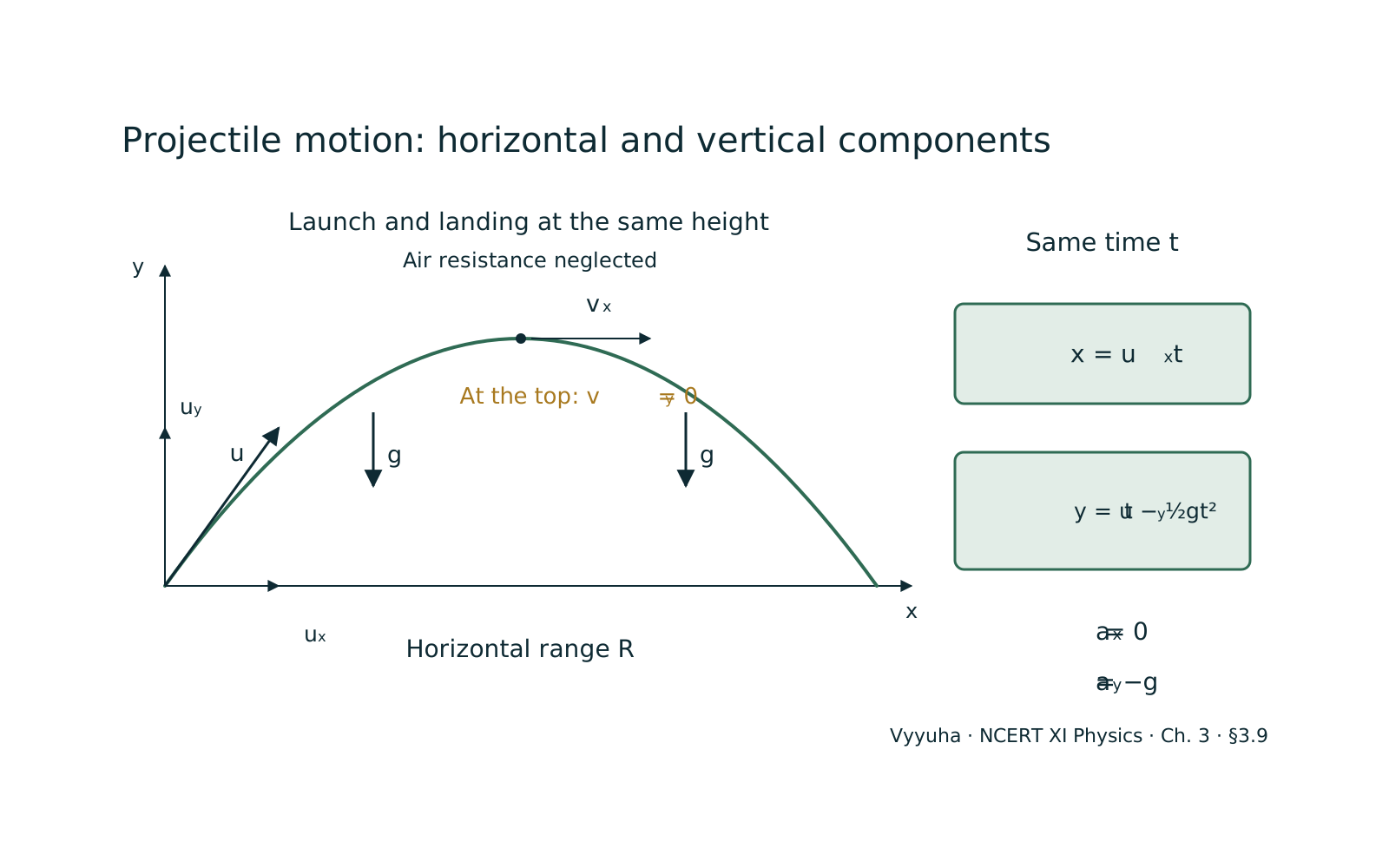
Projectile motion describes the path taken by an object, known as a projectile, when it is thrown or projected into the air and is subsequently influenced only by the force of gravity and air resistance (which is often neglected for simplified analysis). This motion is typically observed in two dimensions, where the horizontal component of velocity remains constant (assuming no air resistance), an…
Quick Summary
Projectile motion describes the two-dimensional movement of an object launched into the air, influenced solely by gravity, with air resistance typically ignored. The object, called a projectile, follows a characteristic parabolic path known as its trajectory.
This motion is understood by separating it into independent horizontal and vertical components. Horizontally, the velocity remains constant because no forces act in that direction (). Vertically, the object experiences constant downward acceleration due to gravity (), causing its vertical velocity to change uniformly.
Key parameters include the initial velocity and angle of projection . From these, we derive the time of flight (), the maximum height reached (), and the horizontal range ().
The maximum range is achieved when . At the maximum height, the vertical velocity is zero, but the horizontal velocity remains constant. Understanding these principles is vital for solving problems related to thrown objects, sports, and artillery.
Full explanation
Projectile motion is a fundamental concept in classical mechanics that describes the motion of an object launched into the air and subject only to the acceleration of gravity. For simplified analysis, air resistance is typically neglected, allowing us to focus on the core principles governing this two-dimensional motion.
Conceptual Foundation
A projectile is any object that is given an initial velocity and then follows a path determined by the influence of gravity alone. Examples include a ball thrown in the air, a bullet fired from a gun, or a javelin launched by an athlete. The path traced by a projectile is called its trajectory.
The key to understanding projectile motion lies in the principle of independence of motion. This principle states that the horizontal and vertical components of a projectile's motion are entirely independent of each other. This means:
- Horizontal Motion: — In the absence of air resistance, there are no horizontal forces acting on the projectile. Consequently, its horizontal acceleration is zero (). This implies that the horizontal component of its velocity () remains constant throughout the flight. The horizontal distance covered is simply the product of this constant horizontal velocity and the time of flight.
- Vertical Motion: — The only force acting vertically on the projectile is gravity, which causes a constant downward acceleration (, where is the acceleration due to gravity, approximately or ). This means the vertical component of its velocity () changes uniformly with time, similar to free fall. If the projectile is moving upwards, gravity slows it down; if it's moving downwards, gravity speeds it up.
The combination of constant horizontal velocity and uniformly changing vertical velocity results in a parabolic trajectory. This is a crucial characteristic of projectile motion under constant gravity.
Key Principles and Laws
- Independence of Motion: — As discussed, horizontal and vertical motions are analyzed separately.
- Constant Horizontal Velocity: — (where is initial speed, is angle of projection).
- Constant Vertical Acceleration: — .
- Equations of Motion: — The standard kinematic equations can be applied independently to the horizontal and vertical components:
* Horizontal: , * Vertical: , ,
Derivations of Key Parameters
Consider a projectile launched with an initial velocity at an angle with the horizontal from the origin .
Initial velocity components:
Acceleration components:
1. Equation of Trajectory:
From horizontal motion: (Equation 1)
From vertical motion: (Equation 2)
Substitute Equation 1 into Equation 2: y = (u sin\theta) left(\frac{x}{u cos\theta}\right) - \frac{1}{2}g left(\frac{x}{u cos\theta}\right)^2 This is the equation of the trajectory, which is a parabola.
2. Time of Flight ($T$):
This is the total time the projectile remains in the air. At the end of the flight, the vertical displacement . Using : T left(u sin\theta - \frac{1}{2}g T\right) = 0 Two solutions: (initial launch point) or . For the time of flight, we take the non-zero solution:
3. Maximum Height ($H$):
At the maximum height, the vertical component of velocity . Using :
4. Horizontal Range ($R$):
This is the total horizontal distance covered during the time of flight . Using : Substitute : R = (u cos\theta) left(\frac{2u sin\theta}{g}\right) = \frac{u^2 (2 sin\theta cos\theta)}{g} Using the trigonometric identity :
Special Cases:
- Maximum Range: — Range is maximum when , which means . So, for a given initial speed, the maximum range is achieved at a projection angle of , and .
- Complementary Angles: — For angles and , the range is the same. For example, and will yield the same range for the same initial speed.
5. Velocity at any instant ($t$):
Horizontal velocity: (constant) Vertical velocity:
The magnitude of the resultant velocity . Its direction with the horizontal is given by .
Real-World Applications
Projectile motion is ubiquitous in our daily lives and various fields:
- Sports: — The trajectory of a basketball shot, a football punt, a golf drive, a javelin throw, or a long jump. Athletes and coaches use these principles to optimize performance.
- Military and Artillery: — Calculating the trajectory of shells, missiles, and bullets to hit targets accurately.
- Engineering: — Designing water fountains, irrigation systems, or even roller coasters where objects follow predictable paths.
- Astronomy: — Understanding the paths of celestial bodies in a simplified gravitational field (though often more complex due to multiple gravitational influences).
Common Misconceptions
- Horizontal velocity changes: — Many students mistakenly believe that the horizontal velocity decreases as the projectile moves upwards and increases as it falls. This is incorrect; in the absence of air resistance, horizontal velocity remains constant.
- Gravity only acts when falling: — Gravity acts throughout the entire flight of the projectile, pulling it downwards, whether it's moving up, at its peak, or falling down.
- Velocity is zero at maximum height: — Only the vertical component of velocity is zero at the maximum height. The horizontal component of velocity is still present, allowing the projectile to continue moving forward.
- Air resistance is negligible in all cases: — While often neglected for introductory problems, air resistance can significantly alter the trajectory, especially for light objects or high speeds. It generally reduces both range and height.
NEET-Specific Angle
For NEET, projectile motion is a high-yield topic. Questions often involve:
- Direct application of formulas: — Calculating given and .
- Finding initial conditions: — Given or , find or .
- Motion from a height: — Projectile launched horizontally from a tower or at an angle from a height. Here, the landing point is below the launch point, so will be negative in the vertical displacement equation.
- Relative projectile motion: — Analyzing the motion of one projectile as observed from another. If two projectiles are launched simultaneously with the same vertical acceleration (i.e., both under gravity), their relative acceleration is zero, and their relative velocity remains constant. This means one projectile appears to move in a straight line relative to the other.
- Impact velocity and angle: — Calculating the velocity vector (magnitude and direction) just before the projectile hits the ground.
- Graphical analysis: — Interpreting graphs for horizontal and vertical components.
- Conceptual questions: — Testing understanding of independence of motion, effect of air resistance, or conditions for maximum range.
Mastering the derivations and understanding the physical significance of each term is crucial. Practice with a variety of problems, especially those involving projection from a height and relative motion, to build confidence for the NEET exam.
Key Concepts
This is the cornerstone of projectile motion analysis. It means we can treat the horizontal movement and the…
The initial angle at which a projectile is launched significantly dictates its trajectory's characteristics.…
At any point during its flight, the projectile has both a horizontal and a vertical velocity component. The…
Often confused with
Side-by-side differences the NEET paper likes to test.
| Aspect | Projectile Motion | Free Fall |
|---|---|---|
| Dimensions of Motion | Projectile Motion: Two-dimensional (horizontal and vertical). | Free Fall: One-dimensional (purely vertical). |
| Initial Velocity | Projectile Motion: Has both horizontal and vertical components (or purely horizontal). | Free Fall: Can be zero (dropped) or purely vertical (thrown up/down). |
| Horizontal Velocity | Projectile Motion: Constant (assuming no air resistance). | Free Fall: Not applicable (no horizontal motion). |
| Vertical Acceleration | Projectile Motion: Constant, $g$ downwards. | Free Fall: Constant, $g$ downwards. |
| Trajectory | Projectile Motion: Parabolic path. | Free Fall: Straight line (vertical). |
| Forces Acting | Projectile Motion: Only gravity (neglecting air resistance). | Free Fall: Only gravity (neglecting air resistance). |
While both projectile motion and free fall are governed by the constant acceleration due to gravity, their fundamental difference lies in the dimensionality of their motion. Free fall is a purely one-dimensional vertical motion, where an object moves straight up or down.
Projectile motion, on the other hand, is a two-dimensional motion involving both horizontal and vertical components. The key distinction is the presence of a constant horizontal velocity in projectile motion, which is absent in pure free fall, leading to a curved, parabolic trajectory instead of a straight vertical line.
Why it is tested: For NEET, understanding the distinctions between projectile motion and free fall is crucial for correctly applying kinematic equations. Students often confuse the conditions, particularly regarding initial velocity components and the role of horizontal motion. Questions might test the ability to identify when a problem is a simple free fall versus a more complex projectile motion scenario, or to isolate the vertical component of projectile motion as essentially a free-fall problem.
Questions students ask
6 answered on this topic.
What is the primary assumption made when studying projectile motion?
The primary assumption in idealized projectile motion is that air resistance is negligible. This simplification allows us to consider only the force of gravity acting on the projectile. While air resistance is present in reality and affects the trajectory, neglecting it simplifies the mathematical analysis significantly, making it easier to derive fundamental equations and understand the core principles. For NEET, unless explicitly stated, you should always assume air resistance is absent.
Does the horizontal velocity of a projectile ever change?
No, in the absence of air resistance, the horizontal velocity of a projectile remains constant throughout its flight. This is because there are no horizontal forces acting on the projectile to cause any acceleration or deceleration in that direction. The initial horizontal component of velocity, , is maintained from launch until impact. This independence of horizontal motion is a cornerstone of projectile motion analysis.
What is the velocity of a projectile at its maximum height?
At its maximum height, the vertical component of the projectile's velocity () becomes momentarily zero. However, the horizontal component of velocity () remains constant and non-zero (unless projected vertically upwards). Therefore, the projectile still possesses a horizontal velocity at its peak. Its overall velocity at the maximum height is simply equal to its constant horizontal velocity, .
Why is the trajectory of a projectile a parabola?
The trajectory of a projectile is parabolic because of the combination of two independent motions: uniform horizontal motion and uniformly accelerated vertical motion. The horizontal displacement () is directly proportional to time (), while the vertical displacement () is a quadratic function of time () due to constant gravitational acceleration.
When time is eliminated from these two equations, the resulting equation relating and is of the form , which is the general equation of a parabola.
How does the angle of projection affect the range of a projectile?
The horizontal range () of a projectile is given by the formula . This formula shows that the range depends on the initial speed () and the angle of projection ().
For a fixed initial speed, the range is maximum when , which occurs at . Interestingly, for any two complementary angles (angles that add up to , like and ), the range will be the same, although the time of flight and maximum height will differ.
What happens to the time of flight and maximum height if the angle of projection increases from $0^circ$ to $90^circ$?
As the angle of projection () increases from to (for a fixed initial speed ):
- Time of Flight ($T = rac{2u sin heta}{g}$): — Since increases from to as goes from to , the time of flight will continuously increase. It is zero at (horizontal projection, no flight time if launched from ground) and maximum at (vertical projection, maximum time in air).
- Maximum Height ($H = rac{u^2 sin^2 heta}{2g}$): — Similarly, also increases from to as goes from to . Therefore, the maximum height reached by the projectile will also continuously increase, being zero at and maximum at .
Revise in 30 seconds
- Horizontal Motion: — (constant), ,
- Vertical Motion: — , , ,
- Time of Flight (T): —
- Maximum Height (H): —
- Horizontal Range (R): —
- Max Range Angle: — ,
- Complementary Angles: — and give same .
- Velocity at Max Height: — (vertical component is zero).
- Trajectory Equation: — (parabolic)
To remember the key formulas for Projectile Motion:
Time: Two Under Sin Gravity () Height: Half Under Sin Square Gravity () Range: Really Under Sin Two Gravity ()
(Think of 'Under' as division, 'Sin Square' as , 'Sin Two' as )