Circular Motion
Circular motion describes the movement of an object along the circumference of a circle or a circular path. It is a fundamental concept in classical mechanics, often encountered in various physical phenomena from planetary orbits to the spinning of a top. A key characteristic of circular motion is that even if the speed of the object remains constant (uniform circular motion), its velocity is cont…
Quick Summary
Circular motion describes an object's movement along a circular path. It's characterized by a constant radius from a central point. Key concepts include angular displacement (angle swept), angular velocity (rate of change of angular displacement, ), and angular acceleration (rate of change of angular velocity).
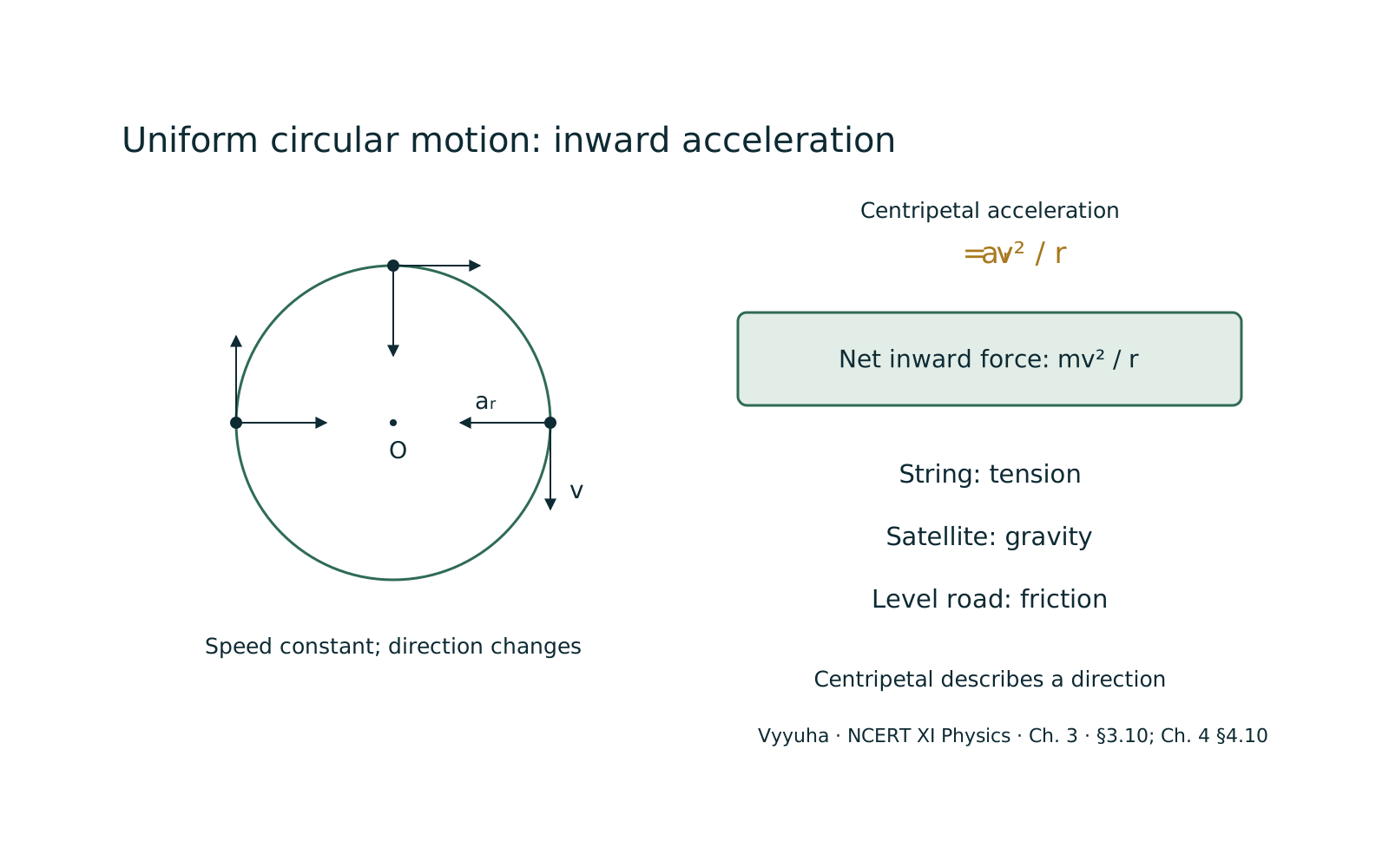
Even if an object moves at a constant speed (uniform circular motion), its velocity continuously changes direction, necessitating a centripetal acceleration () directed towards the center.
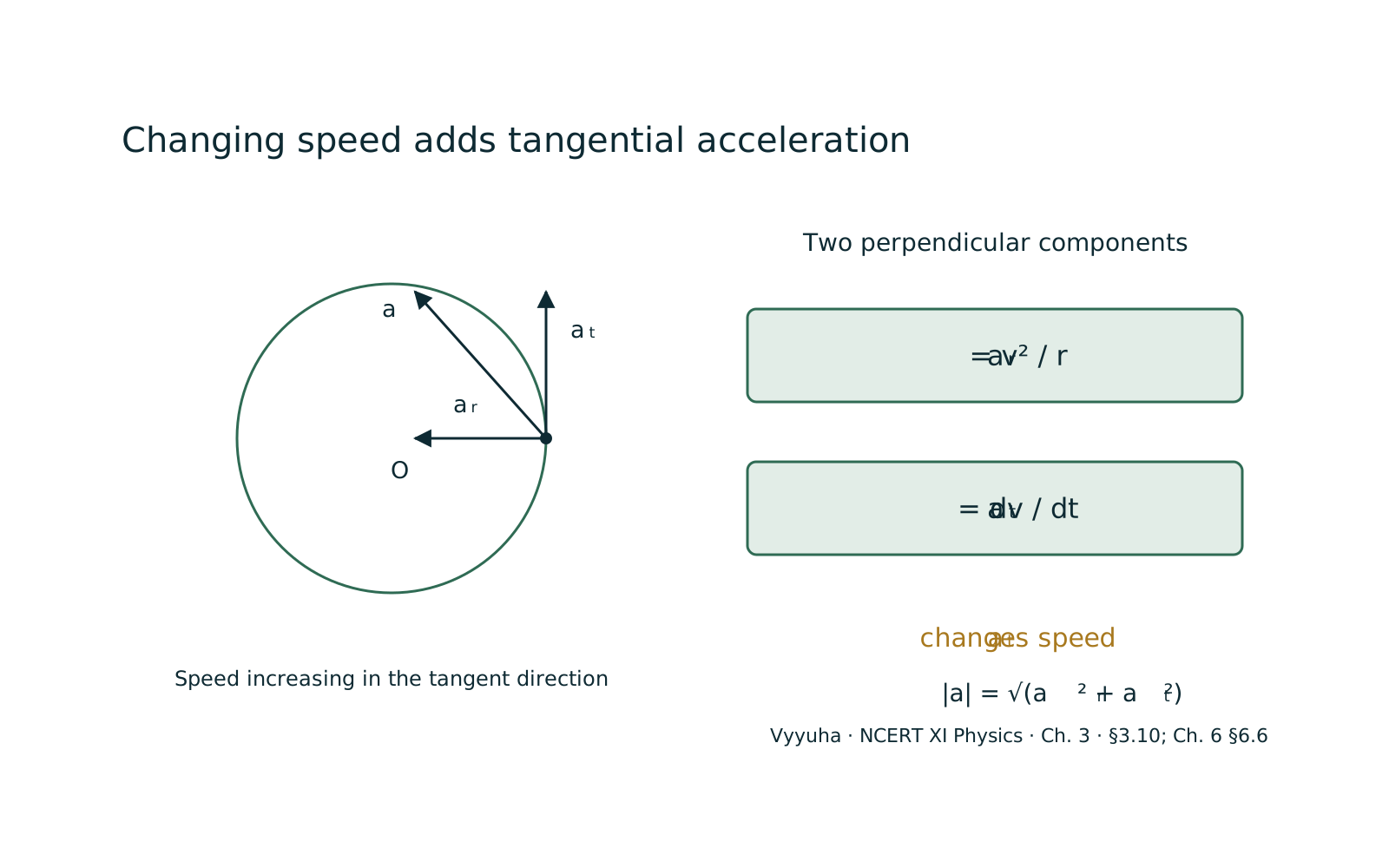
This acceleration is caused by a centripetal force (), which is always provided by other physical forces like tension, friction, or gravity. In non-uniform circular motion, the speed also changes, introducing a tangential acceleration () along the path.
The total acceleration is the vector sum of centripetal and tangential components. Applications include banking of roads, conical pendulums, and vertical circular motion, where understanding force balance and energy conservation is crucial.
Full explanation
Circular motion is a fascinating and fundamental aspect of classical mechanics, describing the movement of an object along a circular path. While seemingly simple, it introduces several critical concepts that are essential for understanding a vast array of physical phenomena. Let's delve deeper into its conceptual foundation, key principles, derivations, applications, and common pitfalls.
Conceptual Foundation
At its heart, circular motion is a special case of two-dimensional motion where the object's distance from a fixed point (the center) remains constant. This constant radius () is the defining characteristic.
The object's position can be described by its angular displacement () from a reference direction. As the object moves, its linear velocity vector is always tangent to the circular path at any given instant.
This means the direction of the velocity is continuously changing, even if the magnitude (speed) remains constant. This continuous change in direction is the key to understanding acceleration in circular motion.
Key Principles and Laws
- Angular Displacement ($\Delta\theta$): — The angle swept by the radius vector of the moving particle about the center of the circle. It's a vector quantity, with direction given by the right-hand thumb rule. Its unit is radians (rad).
- Angular Velocity ($\omega$): — The rate of change of angular displacement. For uniform circular motion, . For non-uniform motion, . Its unit is rad/s. It's also a vector quantity, directed along the axis of rotation.
* Relationship with linear speed (): . This is a crucial link between linear and angular kinematics.
- Angular Acceleration ($\alpha$): — The rate of change of angular velocity. . Its unit is rad/s. It's also a vector quantity, directed along the axis of rotation. If is increasing, is in the same direction as ; if is decreasing, is opposite to .
- Centripetal Acceleration ($a_c$): — This acceleration is always directed towards the center of the circular path and is responsible for changing the direction of the linear velocity vector. It exists even in uniform circular motion where speed is constant. Its magnitude is given by:
- Tangential Acceleration ($a_t$): — This acceleration component is tangent to the circular path and is responsible for changing the magnitude (speed) of the linear velocity. It exists only in non-uniform circular motion. Its magnitude is given by:
- Centripetal Force ($F_c$): — According to Newton's second law, an acceleration must be caused by a net force. The centripetal acceleration is caused by a centripetal force, which is also directed towards the center of the circle. This force is not a new type of force; rather, it's the net force acting towards the center, provided by existing forces like tension, friction, gravity, or normal force. Its magnitude is:
Derivations (Key Relations)
- Relation between linear and angular velocity:
Consider a particle moving in a circle of radius . In a small time interval , it covers a small angular displacement and a small arc length . The arc length is given by . Dividing by :
- **Derivation of Centripetal Acceleration ():**
Consider a particle moving with constant speed in a circle of radius . Let its velocity at time be and at time be . Both and have magnitude .
The change in velocity is . Geometrically, if we place the tails of and at a common point, the vector points towards the center of the circle.
For a very small , the angle between and is . The magnitude of is approximately . The acceleration is .
So, .
Real-World Applications
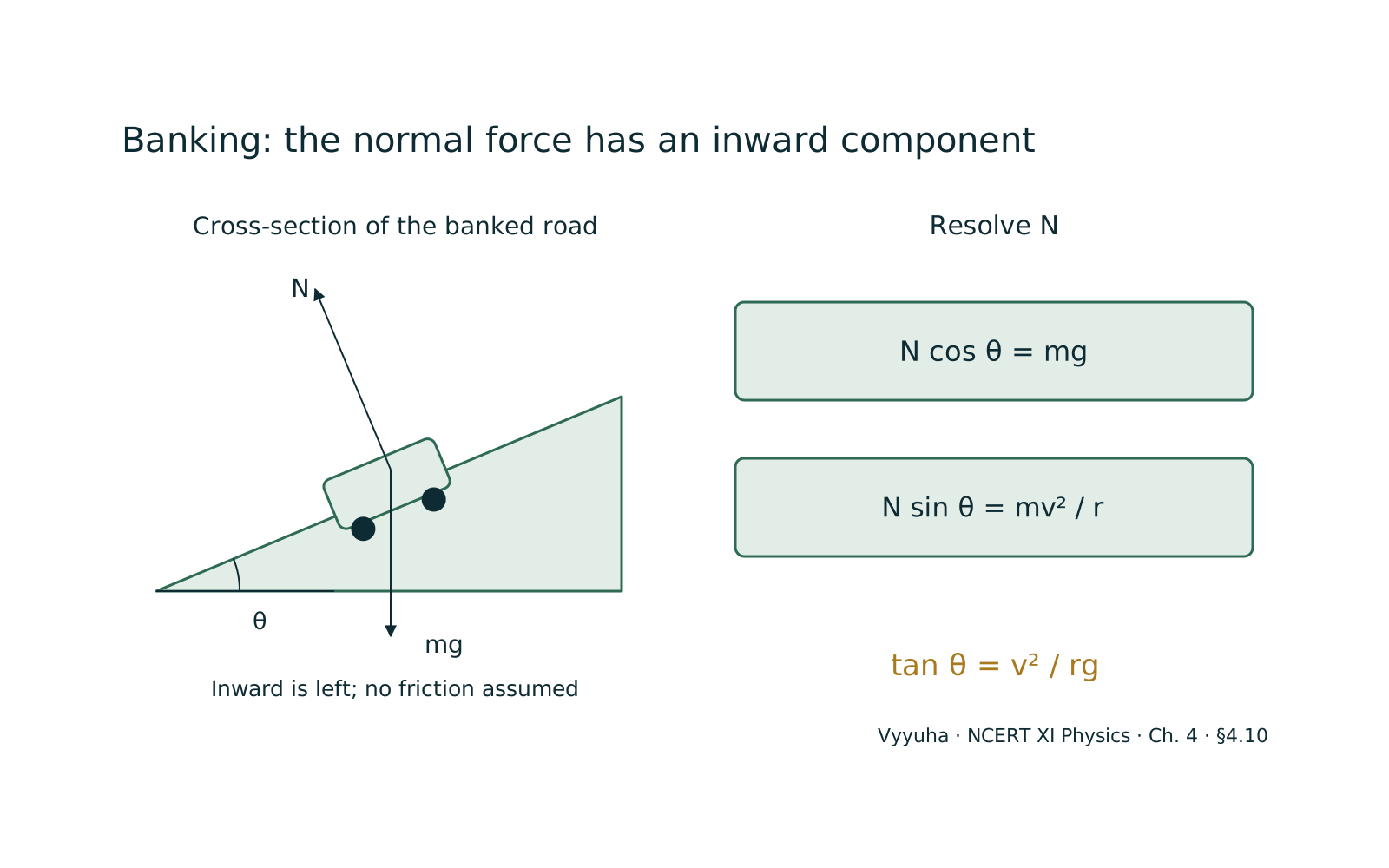
- Banking of Roads: — When a vehicle takes a turn on a flat road, the necessary centripetal force is provided by the friction between the tires and the road. However, friction has limits. To allow for higher speeds and prevent skidding, roads are often 'banked' (tilted inwards). The normal force from the road then has a horizontal component that contributes to the centripetal force, reducing the reliance on friction. For an ideal banking angle , .
- Conical Pendulum: — A mass attached to a string, moving in a horizontal circle such that the string makes a constant angle with the vertical. The tension in the string provides both the vertical component to balance gravity and the horizontal component for the centripetal force. The period of a conical pendulum is .
- Motion in a Vertical Circle: — This is a classic example of non-uniform circular motion. A particle attached to a string or rod moving in a vertical circle. The speed of the particle changes due to gravity. The tension in the string (or normal force from the rod) varies throughout the motion. At the lowest point, tension is maximum (), and at the highest point, it's minimum (). For the particle to complete the circle, the minimum speed at the highest point must be (for a string) or (for a rod).
- Centrifuges: — These devices use centripetal force to separate substances of different densities. For example, in a laboratory centrifuge, samples are spun at high speeds, and the denser components experience a larger 'effective' outward force (due to inertia) and move away from the center, while lighter components stay closer.
Common Misconceptions
- Centrifugal Force as a Real Force: — This is perhaps the most common misconception. Centrifugal force is often described as an outward force experienced by an object in circular motion. However, it is a fictitious or pseudo force that arises only in a rotating (non-inertial) frame of reference. In an inertial frame, there is only the centripetal force acting inwards, which causes the object to accelerate towards the center. The 'outward push' felt is simply the object's inertia trying to continue in a straight line (tangent to the circle) as the frame of reference (or the object providing the centripetal force) turns it inwards.
- Constant Speed Implies No Acceleration: — In linear motion, constant speed means zero acceleration. However, in circular motion, even with constant speed (UCM), the velocity is continuously changing direction. Since acceleration is the rate of change of velocity (a vector), a change in direction alone is sufficient to produce acceleration (centripetal acceleration).
- Centripetal Force is a Separate Force: — Centripetal force is not a new fundamental force like gravity or electromagnetism. Instead, it is the net force that acts towards the center and is provided by other existing forces. For example, in a satellite orbit, gravity provides the centripetal force. For a car turning, friction provides it. For a stone on a string, tension provides it.
NEET-Specific Angle
For NEET, a strong grasp of both conceptual understanding and problem-solving skills related to circular motion is vital. Questions often involve:
- Relating linear and angular quantities: — , .
- Calculating centripetal acceleration and force: — , .
- Applications: — Banking of roads (calculating angle, speed limits), conical pendulum (tension, period), and especially motion in a vertical circle (minimum speeds, tension variation, conditions for completing the loop).
- Distinguishing between uniform and non-uniform circular motion: — Understanding when tangential acceleration is present and how to calculate total acceleration.
- Identifying the source of centripetal force: — Recognizing which physical force (tension, friction, gravity, normal force) provides the necessary centripetal force in a given scenario.
- Energy conservation: — Often combined with circular motion, particularly in vertical circles, to find speeds at different points.
Mastering these aspects through practice with diverse problems will ensure success in NEET.
Key Concepts
In circular motion, an object's position, velocity, and acceleration can be described using both linear…
Centripetal force is the net force required to keep an object moving in a circular path. It is always…
Motion in a vertical circle is a classic example of non-uniform circular motion because gravity continuously…
Often confused with
Side-by-side differences the NEET paper likes to test.
| Aspect | Circular Motion | Uniform Circular Motion vs. Non-Uniform Circular Motion |
|---|---|---|
| Speed | Constant | Varies (changes) |
| Linear Velocity | Magnitude constant, direction changes | Both magnitude and direction change |
| Angular Velocity (Magnitude) | Constant | Varies (changes) |
| Centripetal Acceleration ($a_c$) | Present and constant in magnitude ($v^2/r$) | Present, but magnitude varies ($v^2/r$ changes as $v$ changes) |
| Tangential Acceleration ($a_t$) | Zero | Present and non-zero ($dv/dt$) |
| Angular Acceleration ($\alpha$) | Zero | Present and non-zero ($d\omega/dt$) |
| Total Acceleration | Equals centripetal acceleration ($a_c$) | Vector sum of $a_c$ and $a_t$ ($ \sqrt{a_c^2 + a_t^2} $) |
| Net Force | Only centripetal force ($F_c$) towards center | Net force has both radial ($F_c$) and tangential ($F_t$) components |
The fundamental distinction between uniform and non-uniform circular motion lies in the constancy of speed. Uniform circular motion maintains a constant speed, meaning only the direction of velocity changes, leading solely to centripetal acceleration.
In contrast, non-uniform circular motion involves a changing speed, which introduces an additional tangential acceleration component. This difference impacts the total acceleration, the net force, and the energy considerations, making non-uniform motion generally more complex to analyze due to the varying magnitudes of velocity and acceleration components.
Why it is tested: NEET relevance: Understanding this distinction is crucial for correctly identifying which acceleration components are present in a given problem and applying the appropriate formulas. Many NEET questions test this conceptual understanding, especially in scenarios like vertical circular motion where speed is not constant.
Questions students ask
5 answered on this topic.
What is the difference between uniform and non-uniform circular motion?
In uniform circular motion (UCM), an object moves along a circular path at a constant speed. While its speed is constant, its velocity is continuously changing direction, leading to a centripetal acceleration directed towards the center.
In contrast, non-uniform circular motion (NUCM) involves an object moving along a circular path with a changing speed. This means that in NUCM, there is not only a centripetal acceleration (due to change in direction) but also a tangential acceleration (due to change in speed), which acts along the tangent to the path.
The total acceleration in NUCM is the vector sum of these two components.
Is centrifugal force a real force?
No, centrifugal force is not a real force in an inertial (non-accelerating) frame of reference. It is a fictitious or pseudo force that appears only when analyzing motion from a non-inertial (rotating) frame of reference.
In an inertial frame, the only real force acting on an object undergoing circular motion is the centripetal force, which is directed towards the center of the circle and is responsible for continuously changing the object's direction.
The 'outward push' felt is simply the object's inertia trying to move in a straight line, while the centripetal force pulls it inwards.
What provides the centripetal force in different scenarios?
The centripetal force is not a new fundamental force but rather the net force acting towards the center, provided by existing physical forces. For example, when a car takes a turn on a flat road, the static friction between the tires and the road provides the necessary centripetal force.
For a satellite orbiting Earth, the gravitational force between the satellite and Earth acts as the centripetal force. When a stone is whirled on a string, the tension in the string provides the centripetal force.
In the case of a charged particle moving in a magnetic field, the magnetic Lorentz force acts as the centripetal force.
Why is an object accelerating even if its speed is constant in circular motion?
Acceleration is defined as the rate of change of velocity. Velocity is a vector quantity, meaning it has both magnitude (speed) and direction. In uniform circular motion, even though the speed of the object remains constant, its direction of motion is continuously changing.
Since the direction component of velocity is changing, the velocity vector itself is changing. Any change in velocity, whether in magnitude or direction, constitutes acceleration. This acceleration, responsible for the change in direction, is called centripetal acceleration and is always directed towards the center of the circular path.
What is the minimum speed required to complete a vertical circle when an object is attached to a string?
For an object attached to a string to complete a full vertical circle, the tension in the string must remain non-negative throughout the motion. The critical point is the highest point of the circle. At this point, the centripetal force is provided by the sum of tension and gravity ().
For the string not to slacken (i.e., ), the minimum speed at the top must be . Using conservation of energy, the minimum speed at the lowest point required to achieve this is .
Revise in 30 seconds
- Angular Velocity: — (rad/s)
- Angular Acceleration: — (rad/s)
- Centripetal Acceleration: — (towards center)
- Tangential Acceleration: — (tangent to path)
- Total Acceleration (NUCM): —
- Centripetal Force: — (towards center)
- Banking of Roads: —
- Vertical Circle (String): — ,
- Work by Centripetal Force: — (always perpendicular to displacement)
Can My Velocity Always Change For Radius?
- Centripetal Motion: Circular Motion
- Velocity: Direction always changes (even if speed is constant)
- Always Change: Implies Centripetal Acceleration ()
- For Radius: This acceleration needs a Force (Centripetal Force, ) directed towards the Radius (center).