Kinematics — Explained
Detailed Explanation
Kinematics, derived from the Greek word 'kinema' meaning motion, is the fundamental branch of mechanics dedicated to describing motion. Unlike dynamics, which delves into the causes of motion (forces), kinematics focuses solely on 'how' objects move, quantifying their position, velocity, and acceleration over time. This distinction is crucial for NEET aspirants, as many problems test the ability to apply kinematic equations without needing to consider Newton's laws of motion directly.
Conceptual Foundation
- Reference Frame: — To describe motion, we first need a reference point or a coordinate system. This is called a reference frame. For instance, if you're in a moving train, a person standing on the platform is moving relative to you, but stationary relative to the platform. Most NEET problems assume an inertial reference frame, where Newton's first law holds true.
- Point Mass: — Often, objects are treated as point masses (or particles) in kinematics. This simplification is valid when the size and shape of the object are negligible compared to the distance it travels or when we are only interested in the motion of its center of mass. For example, a car traveling a long distance can be treated as a point mass.
- Position Vector ($vec{r}$): — This vector specifies the location of a particle with respect to the origin of a chosen coordinate system. In 1D, it's simply ; in 2D, ; and in 3D, . Its magnitude is the distance from the origin.
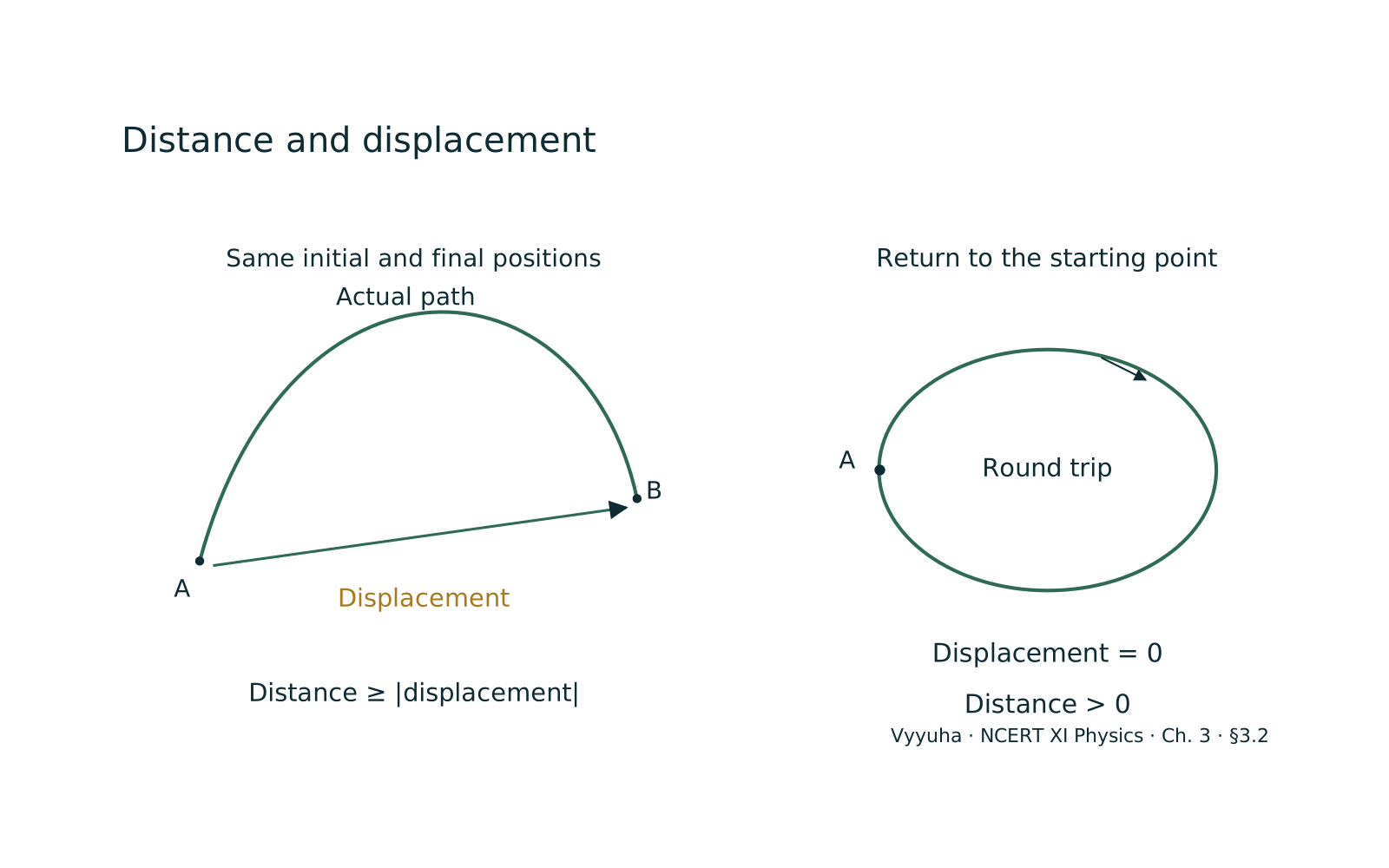
- Path Length (Distance): — The total length of the actual path traversed by a particle, irrespective of its direction. It is a scalar quantity and is always positive or zero. For example, if a particle moves from A to B along a curved path, the length of that curve is the path length.
- Displacement Vector ($Deltavec{r}$): — The change in position vector of a particle. It is the straight-line vector drawn from the initial position to the final position. . Displacement is a vector quantity, can be positive, negative, or zero, and its magnitude is the shortest distance between the initial and final points.
Key Principles and Laws (Equations of Motion)
Kinematics primarily relies on the definitions of velocity and acceleration. For motion with constant acceleration, a set of powerful equations simplifies problem-solving:
For One-Dimensional Motion (along x-axis):
Let be the initial velocity, be the final velocity, be the constant acceleration, be the time interval, and be the displacement.
- Velocity-Time Relation: —
* This equation directly relates the final velocity to the initial velocity, acceleration, and time. It's derived from the definition of acceleration as the rate of change of velocity: .
- Position-Time Relation: —
* This equation helps find the displacement given initial velocity, acceleration, and time. It's derived from the definition of velocity as the rate of change of position: . Substituting , we get .
- Velocity-Displacement Relation: —
* This equation is useful when time is not given or not required. It can be derived by eliminating from the first two equations, or by using .
- Displacement in $n^{ ext{th}}$ second: —
* This gives the displacement covered specifically during the second of motion, not the total displacement after seconds.
For Two-Dimensional Motion (Projectile Motion):
Projectile motion is a classic example of 2D kinematics, where an object is launched into the air and moves under the sole influence of gravity (neglecting air resistance). It's analyzed by resolving motion into two independent 1D motions:
- Horizontal Motion: — Uniform velocity (constant , ).
* *
- Vertical Motion: — Uniform acceleration (constant , where is acceleration due to gravity, taken as positive downwards or negative upwards).
* * *
Key parameters for projectile motion:
- Time of Flight (T): — The total time the projectile remains in the air.
- Maximum Height (H): — The highest vertical position reached.
- Horizontal Range (R): — The total horizontal distance covered.
Relative Motion:
Relative motion describes the motion of an object as observed from a moving reference frame. If object A has velocity and object B has velocity (both relative to the ground), then:
- Velocity of A relative to B: —
- Velocity of B relative to A: —
This concept is crucial for problems involving boats in rivers, airplanes in wind, or two moving vehicles.
Derivations (Brief Overview)
As shown above, the kinematic equations for constant acceleration are derived from the fundamental definitions of average velocity () and average acceleration (), extended to instantaneous values using calculus (, ). For constant acceleration, the average acceleration equals the instantaneous acceleration. The integral forms lead directly to the equations of motion.
Real-World Applications
Kinematics is not just theoretical; it underpins many everyday phenomena and engineering applications:
- Sports: — Analyzing the trajectory of a thrown ball (baseball, basketball), a long jump, or a high jump. Coaches use kinematic principles to optimize athlete performance.
- Automotive Industry: — Designing braking systems, understanding collision dynamics (simplified), and optimizing vehicle performance.
- Aerospace: — Calculating rocket trajectories, satellite orbits (initial phase), and aircraft flight paths.
- Forensics: — Reconstructing accident scenes by analyzing skid marks and impact points to determine initial velocities and accelerations.
- Amusement Parks: — Designing roller coasters and other rides to ensure safety and thrill by controlling accelerations and velocities.
Common Misconceptions
- Distance vs. Displacement: — Students often confuse these. Distance is total path; displacement is net change in position. A round trip has zero displacement but non-zero distance.
- Speed vs. Velocity: — Speed is scalar (magnitude only); velocity is vector (magnitude and direction). An object can have constant speed but changing velocity (e.g., uniform circular motion).
- Average vs. Instantaneous: — Average velocity/speed is over a time interval; instantaneous is at a specific moment. For constant velocity, average and instantaneous are the same.
- Zero Velocity vs. Zero Acceleration: — An object can momentarily have zero velocity but non-zero acceleration (e.g., at the peak of its trajectory in projectile motion). Conversely, an object can have constant velocity but zero acceleration.
- Direction of Acceleration: — Acceleration is not always in the direction of motion. If an object is slowing down, acceleration is opposite to velocity. In projectile motion, acceleration (gravity) is always downwards, even when the object is moving upwards.
- Ignoring Vector Nature: — For 2D and 3D motion, treating velocity and acceleration as scalars leads to errors. Vector addition and subtraction are essential for relative motion and projectile motion.
NEET-Specific Angle
For NEET, kinematics is a high-yield topic, forming the basis for subsequent chapters like Laws of Motion and Work, Energy & Power. Key areas to focus on:
- Graphical Analysis: — Interpreting position-time (), velocity-time (), and acceleration-time () graphs. Understanding that the slope of an graph gives velocity, the slope of a graph gives acceleration, and the area under a graph gives displacement. The area under an graph gives change in velocity.
- Projectile Motion: — Mastering the equations for time of flight, maximum height, and range. Understanding the symmetry of projectile motion and the independence of horizontal and vertical components. Questions often involve finding initial velocity, angle, or landing point.
- Relative Motion: — Problems involving boats crossing rivers (shortest time vs. shortest path), rain falling on a moving person, or two vehicles moving relative to each other. Vector addition/subtraction is critical here.
- Motion under Gravity: — This is a special case of 1D motion with constant acceleration (). Pay attention to sign conventions (upwards positive, downwards negative, or vice-versa, consistently).
- Problem-Solving Strategy: — Always identify the given quantities, the unknown quantity, choose a consistent coordinate system and sign convention, select the appropriate kinematic equation, and solve. For complex problems, break them into simpler parts.
Often confused with
Side-by-side differences the NEET paper likes to test.
| Aspect | Kinematics | Dynamics |
|---|---|---|
| Focus | Describes motion (how objects move) | Explains motion (why objects move) |
| Consideration of Forces | Does NOT consider forces | Considers forces as the cause of motion |
| Primary Quantities | Position, velocity, acceleration, time, displacement | Force, mass, momentum, energy, work |
| Governing Principles | Definitions of velocity and acceleration, kinematic equations | Newton's Laws of Motion |
| Mathematical Tools | Calculus (derivatives, integrals), vector algebra | Vector algebra, calculus, free-body diagrams |
Kinematics and Dynamics are two fundamental branches of mechanics, often studied sequentially. Kinematics provides the descriptive language for motion, quantifying 'how' an object moves using concepts like position, velocity, and acceleration, without delving into the forces involved.
It's about the geometry of motion. Dynamics, on the other hand, builds upon kinematics by introducing the concept of force and mass, explaining 'why' objects move or change their motion. It uses Newton's laws to relate forces to the resulting acceleration.
Understanding kinematics is a prerequisite for grasping dynamics, as the acceleration calculated in kinematics is directly linked to the net force in dynamics.
Why it is tested: NEET relevance: This distinction is critical for problem-solving. Kinematics problems require applying kinematic equations and definitions, while dynamics problems require identifying forces, drawing free-body diagrams, and applying Newton's laws. Confusing the two can lead to incorrect approaches. Many NEET questions combine elements, where kinematic results (like acceleration) are then used in dynamics, or vice-versa.
Questions students ask
6 answered on this topic.
What is the difference between distance and displacement?
Distance is a scalar quantity representing the total path length covered by an object, irrespective of its direction. It is always positive. Displacement, on the other hand, is a vector quantity representing the shortest straight-line path from the initial to the final position, including direction.
It can be positive, negative, or zero. For example, if you walk 5 meters east and then 5 meters west, your total distance is 10 meters, but your displacement is 0 meters because you returned to your starting point.
Can an object have zero velocity but non-zero acceleration?
Yes, absolutely. A classic example is an object thrown vertically upwards. At the very peak of its trajectory, just before it starts falling back down, its instantaneous vertical velocity is momentarily zero. However, the acceleration due to gravity () is still acting downwards throughout its flight, including at the peak. So, at that instant, velocity is zero, but acceleration is downwards.
How do I interpret a velocity-time graph?
A velocity-time () graph provides a wealth of information. The slope of the graph gives the acceleration of the object. A positive slope means positive acceleration (speeding up if velocity is positive, slowing down if velocity is negative). A negative slope means negative acceleration. A zero slope means constant velocity (zero acceleration). The area under the graph (between the curve and the time axis) represents the displacement of the object during that time interval.
What is projectile motion, and what are its key assumptions?
Projectile motion describes the motion of an object thrown or projected into the air, subject only to the acceleration of gravity. It's a 2D motion. The key assumptions are: 1) Air resistance is negligible.
2) The acceleration due to gravity () is constant in magnitude and direction throughout the motion. 3) The Earth's rotation and curvature are ignored. Under these assumptions, the horizontal motion is uniform (constant velocity), and the vertical motion is uniformly accelerated (due to gravity).
When do we use relative velocity concepts?
Relative velocity is used when describing the motion of an object as observed from a moving reference frame. Common scenarios include: a boat moving in a river with a current, an airplane flying in windy conditions, or two vehicles moving with respect to each other. It helps determine how fast one object appears to move to an observer on another moving object, or to find the actual velocity needed to achieve a certain path in a moving medium.
Is it possible for an object to have constant speed but changing velocity?
Yes, this is a very important concept. Uniform circular motion is the perfect example. An object moving in a circle at a constant speed has a velocity whose magnitude is constant, but its direction is continuously changing. Since velocity is a vector quantity (magnitude + direction), a change in direction alone means the velocity is changing. And if velocity is changing, there must be an acceleration (centripetal acceleration in this case), even if the speed remains constant.