Force and Acceleration
Newton's Second Law of Motion fundamentally establishes the quantitative relationship between the net force acting on an object, its mass, and the resulting acceleration. It states that the rate of change of momentum of a body is directly proportional to the applied net force and takes place in the direction in which the force acts. Mathematically, this is most commonly expressed as …
Quick Summary
The core relationship between force and acceleration is encapsulated by Newton's Second Law of Motion, . Here, represents the vector sum of all external forces acting on an object, is the object's inertial mass, and is the resulting acceleration.
This law signifies that a net force is required to change an object's state of motion (i.e., to cause acceleration). The acceleration produced is directly proportional to the net force applied and inversely proportional to the object's mass.
Both force and acceleration are vector quantities, meaning they have both magnitude and direction, and the direction of acceleration is always the same as the direction of the net force. Understanding free-body diagrams, resolving forces into components, and correctly identifying all forces (gravitational, normal, tension, friction, etc.
) are crucial for applying this law in problem-solving. It's important to distinguish mass (a measure of inertia) from weight (the force of gravity) and to remember that a constant force causes constant acceleration, not constant velocity.
Full explanation
The relationship between force and acceleration is one of the foundational pillars of classical mechanics, primarily articulated through Newton's Second Law of Motion. To truly grasp this concept, we must first establish a clear understanding of its constituent parts: force, mass, and acceleration.
Conceptual Foundation:
- Force: — In physics, a force is an interaction that, when unopposed, will change the motion of an object. It is a vector quantity, meaning it has both magnitude and direction. Forces can manifest in various forms: gravitational force, electromagnetic force, normal force, tension, friction, and applied force, among others. The SI unit of force is the Newton (N), defined as the force required to accelerate a mass of one kilogram by one meter per second squared ().
- Mass: — Mass is an intrinsic property of an object that quantifies its resistance to acceleration (inertia) and its gravitational attraction to other objects. It is a scalar quantity, measured in kilograms (kg) in the SI system. It's crucial to distinguish mass from weight; weight is the force of gravity acting on a mass (), whereas mass is a fundamental measure of the amount of matter and inertia.
- Acceleration: — Acceleration is the rate of change of velocity. Since velocity is a vector (having both magnitude and direction), acceleration is also a vector. An object accelerates if its speed changes, its direction changes, or both. The SI unit of acceleration is meters per second squared (). Mathematically, average acceleration is given by and instantaneous acceleration by .
Key Principles/Laws: Newton's Laws of Motion
While our focus is on the Second Law, understanding its context within Newton's three laws is vital:
- Newton's First Law (Law of Inertia): — An object at rest stays at rest, and an object in motion stays in motion with the same speed and in the same direction unless acted upon by an unbalanced external force. This law defines inertia and establishes that a net force is required to change an object's state of motion.
- Newton's Second Law (Law of Acceleration): — This is the quantitative relationship. It states that the acceleration of an object is directly proportional to the net force acting on it, inversely proportional to its mass, and in the direction of the net force. The most common mathematical expression is .
- Newton's Third Law (Law of Action-Reaction): — For every action, there is an equal and opposite reaction. When object A exerts a force on object B, object B simultaneously exerts an equal and opposite force on object A. This law is crucial for identifying force pairs in systems.
Derivation of $F_{net} = ma$ from Momentum:
Newton's original formulation of the Second Law was in terms of momentum. Momentum () is defined as the product of an object's mass () and its velocity (): . It is a vector quantity. Newton's Second Law states that the net external force () acting on an object is equal to the rate of change of its linear momentum with respect to time:
Therefore:
Vector Nature of Force and Acceleration:
Both force and acceleration are vector quantities. This means their direction is as important as their magnitude. The equation implies that the direction of the net force is always the same as the direction of the acceleration.
If multiple forces act on an object, we must find the vector sum (resultant) of these forces to determine . This often involves resolving forces into components along perpendicular axes (e.g., x and y axes) and then summing the components independently.
For example, if forces and act on an object, the net force is . Then, .
Real-World Applications:
- Automobiles: — When a car accelerates, the engine generates a force that propels it forward, overcoming friction and air resistance. The greater the net forward force, the greater the acceleration. When brakes are applied, a backward frictional force causes negative acceleration (deceleration).
- Sports: — A cricketer hitting a ball applies a large force over a short time, imparting a significant acceleration to the ball. A weightlifter applies an upward force greater than the weight of the barbell to accelerate it upwards.
- Rocket Propulsion: — Rockets work on the principle of expelling high-velocity gases downward, creating an upward thrust (force) that accelerates the rocket upwards. This is a classic example where the mass of the rocket changes over time.
- Everyday Objects: — Pushing a swing, pulling a trolley, or even walking involves applying forces to produce acceleration or overcome existing forces.
Common Misconceptions:
- Force causes velocity: — A common error is to think that force directly causes velocity. Instead, force causes acceleration (change in velocity). A constant force produces a constant acceleration, leading to a continuously changing velocity. If an object moves at a constant velocity, the net force on it is zero.
- Mass vs. Weight: — These terms are often used interchangeably in everyday language but are distinct in physics. Mass is an intrinsic property (amount of matter/inertia), while weight is a force (gravitational pull). Your mass is the same on Earth and the Moon, but your weight is different.
- Action-reaction forces cancel out: — Newton's Third Law states that action and reaction forces are equal and opposite. However, they act on different objects, so they cannot cancel each other out to determine the net force on a single object. For example, if you push a wall, the wall pushes back on you. The force you exert on the wall affects the wall's state, and the force the wall exerts on you affects your state.
- Ignoring Net Force: — Students often consider only the applied force and forget about other forces like friction, air resistance, or gravitational components. It's always the net force that determines acceleration.
NEET-Specific Angle:
For NEET, problems involving force and acceleration often require a systematic approach:
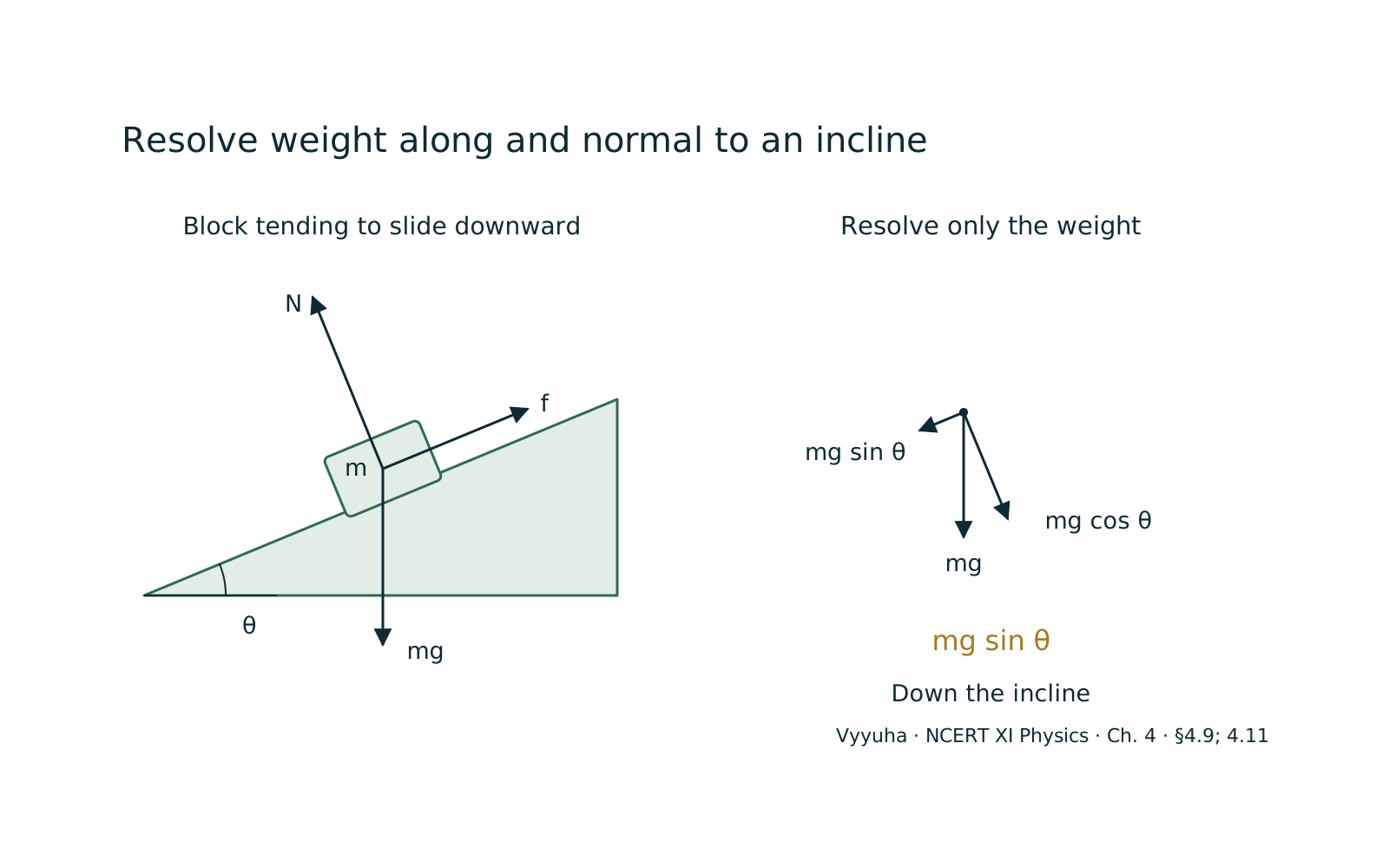
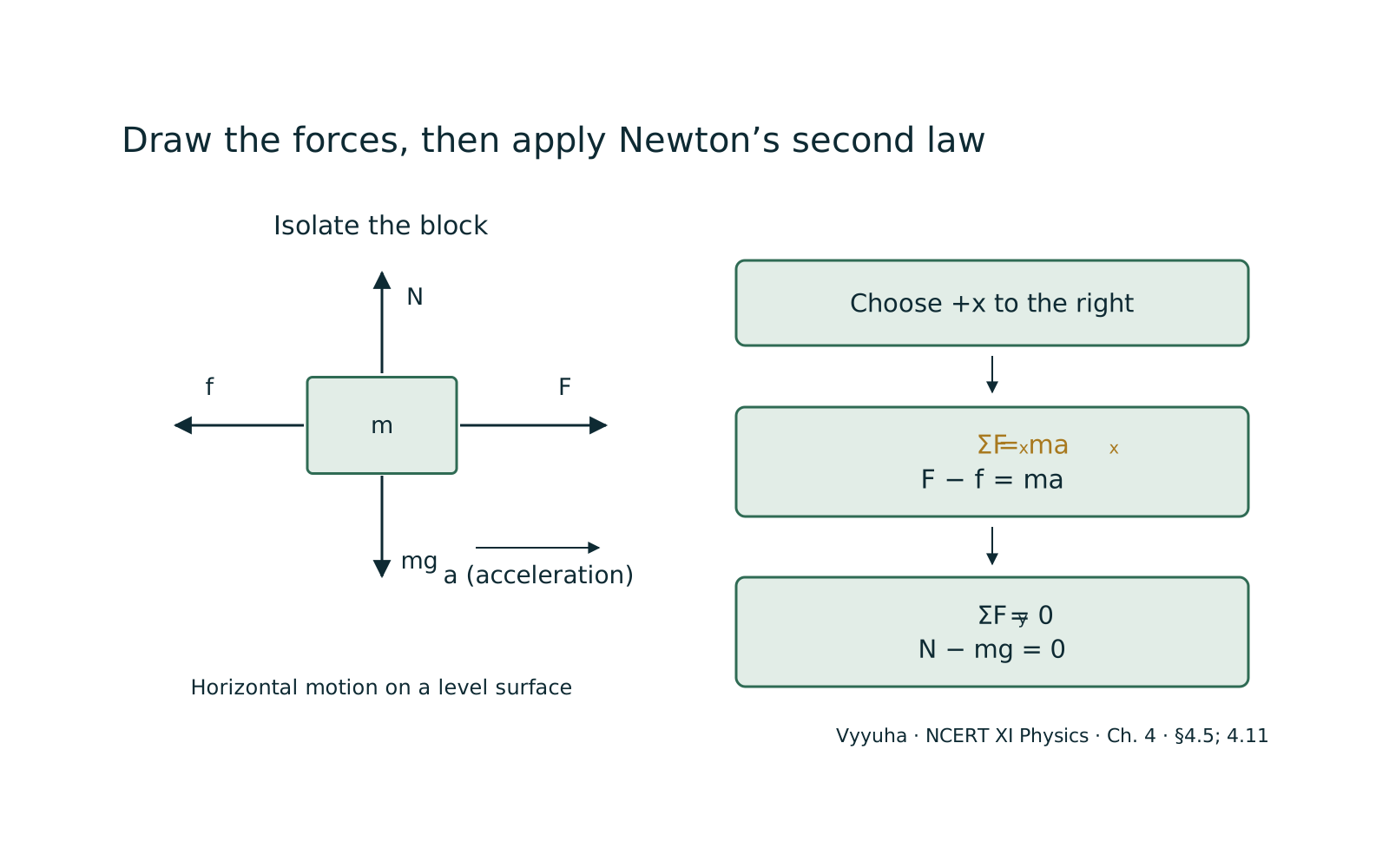
- Free-Body Diagrams (FBDs): — This is perhaps the most critical tool. Draw a diagram of the object(s) of interest, isolating it from its surroundings. Represent all external forces acting on the object as vectors originating from its center. Do not include forces exerted by the object.
- Identify All Forces: — Systematically list all forces: gravitational force (weight, ), normal force (perpendicular to surface), tension (in strings/ropes), friction (opposing relative motion), applied force, spring force, air resistance, etc.
- Choose a Coordinate System: — Select appropriate x and y axes. Often, aligning one axis with the direction of acceleration simplifies component resolution (e.g., for inclined planes, align x-axis along the incline).
- Resolve Forces: — Break down any forces not aligned with the chosen axes into their x and y components.
- Apply Newton's Second Law: — Write separate equations for the net force along each axis: and . Remember, if there's no acceleration along an axis (e.g., vertical motion on a horizontal surface), then .
- Solve the System of Equations: — Use algebraic methods to solve for the unknowns (acceleration, tension, normal force, etc.).
NEET questions frequently involve scenarios like blocks on inclined planes, connected masses (pulleys), friction, and systems with multiple forces. A strong grasp of vector addition and resolution is indispensable.
Key Concepts
This fundamental equation quantifies the relationship between force, mass, and acceleration. It states that…
Both force and acceleration are vector quantities, meaning they possess both magnitude and direction. This…
A Free-Body Diagram is an essential tool for analyzing forces and applying Newton's Second Law. It involves…
Often confused with
Side-by-side differences the NEET paper likes to test.
| Aspect | Force and Acceleration | Impulse and Momentum |
|---|---|---|
| Definition | Force: An interaction causing acceleration ($F = ma$). | Impulse: The change in momentum of an object ($J = \Delta p = F_{avg} \Delta t$). It's the effect of force over time. |
| Nature | Force: Instantaneous interaction, causes acceleration. | Impulse: A quantity that describes the effect of a force acting over a duration, causes change in momentum. |
| Units | Force: Newtons (N) or $\text{kg} \cdot \text{m/s}^2$. | Impulse: Newton-seconds ($\text{N} \cdot \text{s}$) or $\text{kg} \cdot \text{m/s}$ (same as momentum). |
| Relationship to Newton's 2nd Law | Force is directly proportional to acceleration ($F = ma$). | Impulse is directly related to the net force and the time interval over which it acts ($J = F_{net} \Delta t$). The impulse-momentum theorem ($J = \Delta p$) is an integral form of Newton's Second Law. |
While force is the instantaneous cause of acceleration, impulse describes the cumulative effect of a force acting over a period, resulting in a change in momentum. Force is about 'what' causes acceleration, while impulse is about 'how much' the motion changes due to a force's duration.
Understanding both is crucial as they are deeply interconnected through Newton's Second Law, which can be expressed as (average force) or (instantaneous force).
Impulse is particularly useful when dealing with collisions or impacts where forces are large but act for very short durations.
Why it is tested: NEET relevance: Both force and impulse are fundamental concepts in dynamics. Questions often involve calculating forces in various scenarios, but also impulse during collisions or impacts. A clear distinction helps in choosing the correct approach and formula for different problem types, particularly in questions involving conservation of momentum or impact forces.
| Aspect | Force and Acceleration | Mass and Weight |
|---|---|---|
| Definition | Mass: Measure of inertia; amount of matter. | Weight: Force of gravity acting on an object. |
| Nature | Mass: Scalar quantity. | Weight: Vector quantity (always directed towards the center of the gravitational body). |
| Units | Mass: Kilograms (kg). | Weight: Newtons (N). |
| Variability | Mass: Constant, independent of location. | Weight: Varies with gravitational acceleration ($W=mg$), thus depends on location. |
Mass is an intrinsic property of an object, quantifying its resistance to changes in motion (inertia) and the amount of substance it contains. It remains constant regardless of where the object is. Weight, on the other hand, is a force – specifically, the gravitational force exerted on an object's mass.
Because the acceleration due to gravity () varies with location (e.g., on Earth vs. on the Moon, or at different altitudes), an object's weight will also vary, even though its mass stays the same. Confusing these two terms is a common source of error in physics problems.
Why it is tested: NEET relevance: Differentiating mass and weight is crucial for correctly applying Newton's Second Law. Many problems involve calculating forces where weight is a component, and students must use $mg$ for weight, not just $m$. For instance, in elevator problems or on inclined planes, understanding the direction and magnitude of weight as a force is vital, distinct from the object's mass used in $F=ma$.
Questions students ask
5 answered on this topic.
What is the difference between mass and weight?
Mass is a fundamental scalar quantity representing the amount of matter in an object and its inertia (resistance to acceleration). It is constant regardless of location. Weight, on the other hand, is a vector quantity representing the force of gravity acting on an object's mass.
It is calculated as , where is mass and is the acceleration due to gravity. Since varies with location (e.g., Earth vs. Moon), weight also varies, while mass remains constant. The SI unit for mass is kilograms (kg), and for weight (being a force) is Newtons (N).
Can an object have force acting on it but zero acceleration?
Yes, absolutely. This occurs when multiple forces act on an object, but their vector sum (the net force) is zero. According to Newton's Second Law, . If , then . Since mass cannot be zero for a physical object, the acceleration must be zero.
This means the object is either at rest or moving with a constant velocity. A classic example is a book resting on a table: gravity pulls it down, and the normal force from the table pushes it up, with these forces being equal and opposite, resulting in zero net force and zero acceleration.
Does a constant force always produce constant velocity?
No, this is a common misconception. A constant force produces a constant acceleration, not a constant velocity. If a constant net force acts on an object, its velocity will change uniformly over time. For instance, if you push a cart with a constant force, it will continuously speed up (accelerate) at a steady rate. If an object has constant velocity, it means its acceleration is zero, which implies the net force acting on it is also zero, according to Newton's Second Law.
How do I deal with multiple forces acting on an object?
When multiple forces act on an object, the key is to find the 'net force' (). Since force is a vector, you must perform vector addition. This typically involves drawing a free-body diagram, resolving all forces into their components along chosen perpendicular axes (usually x and y), and then summing the components along each axis separately.
For example, and . Then, and its direction can be found using trigonometry. Finally, apply using the magnitude and direction of the net force.
What is the significance of the direction in $F=ma$?
The direction is paramount because both force and acceleration are vector quantities. The equation explicitly states that the direction of the net force acting on an object is precisely the same as the direction of the acceleration it experiences.
This means if you push an object to the right, it will accelerate to the right. If the net force is at an angle, the acceleration will also be at that same angle. Ignoring direction can lead to incorrect calculations, especially in problems involving inclined planes, projectile motion, or multiple forces acting at different angles.
Revise in 30 seconds
- Newton's Second Law: —
- Force ($F$): — Vector, SI unit Newton (N). .
- Mass ($m$): — Scalar, SI unit kilogram (kg). Measure of inertia.
- Acceleration ($a$): — Vector, SI unit . Rate of change of velocity.
- Weight ($W$): — Force of gravity, .
- Friction Force ($f$): — Opposes relative motion. Static friction . Kinetic friction .
- Free-Body Diagram (FBD): — Essential for visualizing and summing forces.
- Key Principle: — Net force and acceleration are always in the same direction.
For My Acceleration, Find Net Forces Thoroughly. (F=ma, Net Forces, Tension, Friction)