Impulse and Momentum
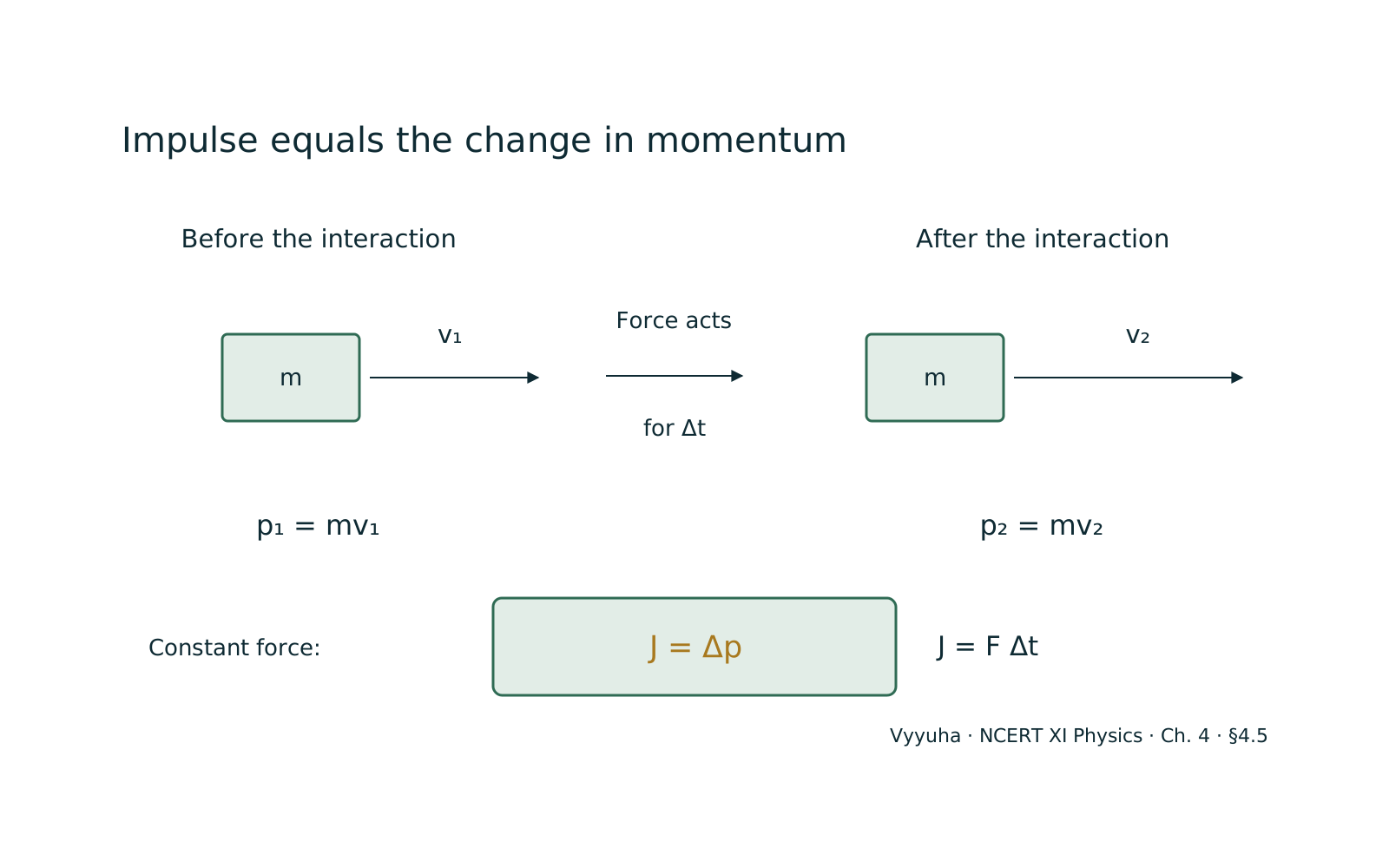
Impulse and momentum are fundamental concepts in classical mechanics that describe the dynamics of objects, particularly during interactions like collisions or impacts. Momentum, a vector quantity, quantifies the 'quantity of motion' an object possesses, directly proportional to its mass and velocity. Impulse, also a vector quantity, represents the change in momentum of an object resulting from a …
Quick Summary
Momentum () is a fundamental vector quantity in physics, defined as the product of an object's mass () and its velocity (), i.e., . It quantifies the 'quantity of motion' and has SI units of kg\cdot m/s.
Impulse () is the effect of a force () acting over a time interval (), given by or . It is also a vector quantity, with SI units of N\cdot s (equivalent to kg\cdot m/s).
The Impulse-Momentum Theorem states that the net impulse applied to an object equals the change in its momentum: . This theorem is derived directly from Newton's Second Law. A crucial consequence is the Law of Conservation of Momentum, which states that the total momentum of an isolated system (where net external force is zero) remains constant.
This principle is vital for analyzing collisions, explosions, and rocket propulsion, where the total momentum before an event equals the total momentum after the event. Understanding the vector nature of these quantities and the conditions for momentum conservation is key for NEET.
Full explanation
In the realm of classical mechanics, understanding how objects move and interact is paramount. Two fundamental concepts that provide deep insights into these dynamics, especially during interactions, are momentum and impulse. While seemingly distinct, they are intrinsically linked through Newton's laws of motion, offering powerful tools for analysis.
1. Conceptual Foundation: Momentum
Momentum, often described as the 'quantity of motion,' is a vector physical quantity representing the product of an object's mass and its velocity. Mathematically, it is expressed as:
- is the momentum (vector quantity)
- is the mass of the object (scalar quantity)
- is the velocity of the object (vector quantity)
The SI unit for momentum is kilogram-meter per second (kg\cdot m/s). Since velocity is a vector, momentum also possesses both magnitude and direction, with its direction being identical to that of the object's velocity.
A heavier object moving at the same speed as a lighter object will have greater momentum. Similarly, an object moving faster will have greater momentum than the same object moving slower. This concept is crucial because it helps us understand the 'inertia of motion' – how difficult it is to stop a moving object.
2. Conceptual Foundation: Impulse
Impulse is a measure of the effect of a force acting over a period of time. It quantifies the 'kick' or 'push' an object receives. When a force acts on an object, it causes a change in the object's momentum. The impulse () delivered by a force () over a time interval () is defined as the integral of the force with respect to time:
- is the impulse (vector quantity)
- is the average force acting on the object (vector quantity)
- is the time interval over which the force acts (scalar quantity)
The SI unit for impulse is Newton-second (N\cdot s). Dimensionally, N\cdot s is equivalent to (kg\cdot m/s) \cdot s = kg\cdot m/s, confirming its direct relationship with momentum. Impulse is also a vector quantity, and its direction is the same as the direction of the net force.
3. Key Principle: The Impulse-Momentum Theorem
The Impulse-Momentum Theorem is a direct consequence of Newton's Second Law of Motion. Newton's Second Law states that the net force acting on an object is equal to the rate of change of its momentum:
It states that the net impulse applied to an object is equal to the change in its momentum. This theorem is incredibly powerful because it allows us to analyze situations involving forces that vary with time, or forces that act for very short durations (like in collisions), without needing to know the exact instantaneous force at every moment.
Instead, we can focus on the total 'effect' of the force over time.
4. Key Principle: Conservation of Momentum
One of the most profound consequences of the Impulse-Momentum Theorem and Newton's Third Law is the principle of conservation of momentum. If the net external force acting on a system of objects is zero, then the total momentum of the system remains constant.
Consider a system of particles. The total momentum of the system is the vector sum of the individual momenta of all particles:
Since , it follows that . This means , or:
Internal forces (forces between particles within the system) do not change the total momentum of the system because they always occur in action-reaction pairs according to Newton's Third Law, and thus their impulses cancel out within the system.
Conservation of momentum is a cornerstone for analyzing collisions (elastic and inelastic), explosions, and rocket propulsion. It's a vector conservation law, meaning momentum is conserved independently along each coordinate axis (x, y, z).
5. Real-World Applications
- Collisions: — Whether it's a car crash, a billiard game, or subatomic particle interactions, conservation of momentum is the primary tool for analysis. In an elastic collision, both momentum and kinetic energy are conserved. In an inelastic collision, only momentum is conserved, while kinetic energy is not (some is converted to heat, sound, or deformation energy). Perfectly inelastic collisions involve objects sticking together after impact.
- Rocket Propulsion: — A rocket expels high-velocity exhaust gases downwards. By Newton's Third Law, the gases exert an equal and opposite force (thrust) on the rocket, propelling it upwards. This is a classic example of conservation of momentum in a variable mass system. The total momentum of the rocket-fuel system remains constant, but as fuel is expelled, the rocket's mass decreases, leading to an increase in its velocity.
- Recoil of a Gun: — When a bullet is fired from a gun, the gun recoils backward. Initially, the gun-bullet system is at rest, so its total momentum is zero. After firing, the bullet moves forward with momentum , and the gun moves backward with momentum . By conservation of momentum, , implying . The negative sign indicates the gun's velocity is opposite to the bullet's.
- Sports: — Catching a ball (extending hands to increase time of impact, reducing force), hitting a golf ball (large force for short time to impart large impulse), martial arts (delivering maximum impulse in minimum time).
6. Common Misconceptions
- Impulse vs. Force: — Students often confuse impulse with force. Impulse is the effect of force over time, leading to a change in momentum, whereas force is the cause of acceleration. A small force acting for a long time can produce the same impulse as a large force acting for a short time.
- Momentum vs. Kinetic Energy: — Both depend on mass and velocity, but momentum is a vector () and kinetic energy is a scalar (). Momentum is conserved in all types of collisions (if isolated), but kinetic energy is only conserved in elastic collisions.
- When Momentum is Conserved: — Momentum is conserved only when the net external force on the system is zero. Internal forces do not affect the total momentum of the system. Forgetting to consider external forces (like friction or gravity) can lead to incorrect application of the conservation law.
- Vector Nature: — Neglecting the vector nature of momentum and impulse, especially in 2D or 3D problems, is a common error. Direction is crucial.
7. NEET-Specific Angle
For NEET, a strong grasp of both conceptual understanding and problem-solving techniques related to impulse and momentum is vital. Questions often involve:
- Direct application of formulas: — Calculating momentum, impulse, or change in momentum.
- Impulse from F-t graphs: — The area under a Force-time graph gives the impulse. This is a frequently tested concept.
- Conservation of momentum in collisions: — Solving for unknown velocities after elastic, inelastic, or perfectly inelastic collisions. Pay attention to the type of collision and whether kinetic energy is conserved.
- Recoil problems: — Calculating recoil velocity of guns or other systems.
- Variable mass systems: — While less common, basic understanding of rocket propulsion can be tested.
- Vector analysis: — Problems involving objects moving in different directions, requiring vector addition/subtraction of momenta.
- Conceptual questions: — Distinguishing between impulse and force, momentum and kinetic energy, and understanding the conditions for momentum conservation. Always consider the system carefully and identify external forces.
Key Concepts
Momentum is not just about 'how much' motion, but also 'in what direction'. Since velocity is a vector,…
When a force is not constant, calculating impulse using can be tricky because finding…
This principle is the cornerstone for analyzing collisions. For an isolated system of two colliding objects,…
Often confused with
Side-by-side differences the NEET paper likes to test.
| Aspect | Impulse and Momentum | Kinetic Energy |
|---|---|---|
| Definition | Momentum ($p = mv$): Quantity of motion, product of mass and velocity. | Kinetic Energy ($K = \frac{1}{2}mv^2$): Energy due to motion, half the product of mass and square of velocity. |
| Nature | Vector quantity (has magnitude and direction). | Scalar quantity (has only magnitude). |
| Conservation in Collisions | Always conserved in an isolated system for all types of collisions (elastic, inelastic, perfectly inelastic). | Conserved only in perfectly elastic collisions. Not conserved in inelastic collisions (converted to other forms of energy). |
| Units | kg\cdot m/s or N\cdot s. | Joules (J). |
| Dependence on Velocity | Linearly dependent on velocity ($p \propto v$). | Quadratically dependent on velocity ($K \propto v^2$). This means doubling velocity quadruples kinetic energy but only doubles momentum. |
While both momentum and kinetic energy are fundamental concepts describing motion and depend on mass and velocity, they are distinct physical quantities. Momentum is a vector that is universally conserved in isolated systems during collisions, reflecting the 'quantity' and 'direction' of motion.
Kinetic energy, a scalar, represents the 'energy' of motion and is only conserved in ideal elastic collisions, as it can be transformed into other energy forms. Understanding their differences, especially their vector/scalar nature and conservation conditions, is crucial for accurately analyzing physical interactions in NEET problems.
Why it is tested: For NEET, distinguishing between momentum and kinetic energy is critical. Many questions test the conditions under which each is conserved, particularly in collision scenarios. Students often confuse the two, leading to errors in problem-solving. A clear understanding of their definitions, vector/scalar nature, and conservation laws is essential for both conceptual and numerical problems.
Questions students ask
5 answered on this topic.
What is the primary difference between momentum and kinetic energy?
Momentum () is a vector quantity, meaning it has both magnitude and direction. It represents the 'quantity of motion' and is conserved in all types of collisions within an isolated system. Kinetic energy () is a scalar quantity, possessing only magnitude.
It represents the energy an object possesses due to its motion. While momentum is always conserved in an isolated system, kinetic energy is only conserved in perfectly elastic collisions; in inelastic collisions, some kinetic energy is converted into other forms like heat or sound.
How can a small force produce a large change in momentum?
According to the Impulse-Momentum Theorem (), the change in momentum (impulse) is directly proportional to both the average force applied and the time duration over which it acts.
Therefore, a small force can produce a large change in momentum if it acts for a sufficiently long time. Conversely, a very large force acting for a very short time can produce the same change in momentum.
This principle is used in safety features like airbags, which increase the impact time to reduce the average force experienced by occupants.
Is momentum always conserved?
Momentum is conserved only when the net external force acting on a system is zero. This means the system must be isolated. Internal forces within the system (like forces between colliding objects) do not change the total momentum of the system because they are action-reaction pairs and cancel each other out.
If there are external forces, such as friction, air resistance, or gravity (unless accounted for as part of the system or cancelled out), the total momentum of the system will not be conserved.
What does the area under a Force-time graph represent?
The area under a Force-time () graph represents the impulse delivered to the object. Since impulse is equal to the change in momentum (Impulse-Momentum Theorem), the area under the graph also represents the change in momentum of the object. This is a very useful graphical interpretation, especially when the force is not constant but varies with time, as is often the case in real-world impacts and collisions.
How does impulse relate to safety in everyday situations?
Impulse plays a critical role in safety design by manipulating the time over which a force acts. For a given change in momentum (which is often unavoidable in an impact), increasing the time duration of the impact will decrease the average force experienced.
This is why cars have crumple zones, airbags, and seatbelts. Crumple zones extend the collision time, airbags spread the impact force over a larger area and increase impact time, and seatbelts restrain occupants, allowing them to decelerate over a longer distance and time, thereby reducing the peak force on the body.
Revise in 30 seconds
- Momentum: — (vector), SI unit: kg\cdot m/s.
- Impulse: — (vector), SI unit: N\cdot s.
- Impulse-Momentum Theorem: — .
- Conservation of Momentum: — For an isolated system, . (Net external force = 0).
- Collisions:
* Elastic: Momentum conserved, Kinetic Energy conserved. * Inelastic: Momentum conserved, Kinetic Energy NOT conserved. * Perfectly Inelastic: Momentum conserved, objects stick together, maximum KE loss.
- Area under F-t graph: — Represents Impulse ().
- Relation between K and p: — or .
My Impulse Changes Perfectly: Momentum, Impulse, Conservation, Perfectly Inelastic. (Remember: Impulse = Change in Momentum, and Conservation is key for collisions, especially Perfectly Inelastic ones where objects stick.)