Laws of Motion — Explained
Detailed Explanation
The Laws of Motion are the cornerstone of classical mechanics, providing a robust framework for understanding the dynamics of objects. Developed primarily by Sir Isaac Newton, these laws describe the intricate relationship between forces and the resulting motion of bodies. To truly grasp these laws, we must first establish a conceptual foundation.
Conceptual Foundation: Force, Inertia, and Mass
- Force: — In physics, a force is defined as an interaction that, when unopposed, will change the motion of an object. It is a vector quantity, possessing both magnitude and direction. Forces can be broadly categorized into:
* Contact Forces: These require direct physical contact between interacting objects. Examples include normal force, tension, friction, and applied push/pull forces. * Non-Contact (Field) Forces: These act over a distance without physical contact. Examples include gravitational force, electromagnetic force, and nuclear forces. For NEET, gravity is the most prominent non-contact force.
- Inertia: — Inertia is the inherent property of an object to resist changes in its state of motion. An object at rest tends to stay at rest, and an object in motion tends to stay in motion with the same speed and in the same direction. The measure of an object's inertia is its mass.
- Mass ($m$): — Mass is a scalar quantity representing the amount of matter in an object. It is also a measure of an object's inertia. The greater the mass, the greater its inertia, and thus the harder it is to change its state of motion. The SI unit of mass is the kilogram (kg).
Key Principles and Laws
Newton's First Law of Motion (Law of Inertia):
This law states: 'An object at rest stays at rest and an object in motion stays in motion with the same speed and in the same direction unless acted upon by an unbalanced force.'
- Implication: — If the net external force () acting on an object is zero, its acceleration () is zero. This means its velocity () remains constant. If , it stays at rest. If , it continues moving with constant velocity.
- Inertial Frames of Reference: — Newton's laws are valid only in inertial frames of reference. An inertial frame is one that is either at rest or moving with constant velocity. Any frame accelerating with respect to an inertial frame is a non-inertial frame, where fictitious forces (like centrifugal force) must be introduced to apply Newton's laws.
Newton's Second Law of Motion (Law of Acceleration):
This law states: 'The rate of change of momentum of a body is directly proportional to the applied force and takes place in the direction in which the force acts.'
- Mathematical Formulation: — Let be the linear momentum of an object, defined as the product of its mass and velocity (). Newton's Second Law can be written as:
- Units: — The SI unit of force is the Newton (N). From , .
- Impulse ($J$): — Impulse is the change in momentum of an object. It is also defined as the product of the average force acting on an object and the time interval over which it acts:
Newton's Third Law of Motion (Law of Action-Reaction):
This law states: 'To every action, there is always an equal and opposite reaction.'
- Implication: — When object A exerts a force on object B (), object B simultaneously exerts an equal and opposite force on object A (). Mathematically:
- Key Characteristics:
* Action and reaction forces always act on different bodies. This is crucial because they do not cancel each other out. If they acted on the same body, there would be no net force and thus no acceleration, which contradicts observation. They are simultaneous. There is no time delay between action and reaction. They are always of the same type (e.g., if action is gravitational, reaction is gravitational).
Derivations and Applications
- Derivation of $F=ma$ from Momentum: — As shown above, if mass is constant, . This derivation highlights that force is fundamentally linked to the rate of change of momentum, not just velocity.
- Conservation of Linear Momentum: — In an isolated system (where no external forces act), the total linear momentum remains constant. This is a direct consequence of Newton's Third Law. Consider two objects A and B colliding. During the collision, . Integrating over the collision time , we get , which means . Therefore, , implying that the total momentum of the system () is conserved.
- Real-World Applications:
* Friction: A force that opposes relative motion or attempted motion between surfaces in contact. It can be static (preventing motion) or kinetic (opposing existing motion). Understanding friction is vital for analyzing braking systems, walking, and the movement of objects on surfaces.
* Pulleys and Connected Bodies: These systems involve multiple objects connected by strings, often passing over pulleys. Applying Newton's Second Law to each body separately, along with constraints (like constant string length), allows us to solve for accelerations and tensions.
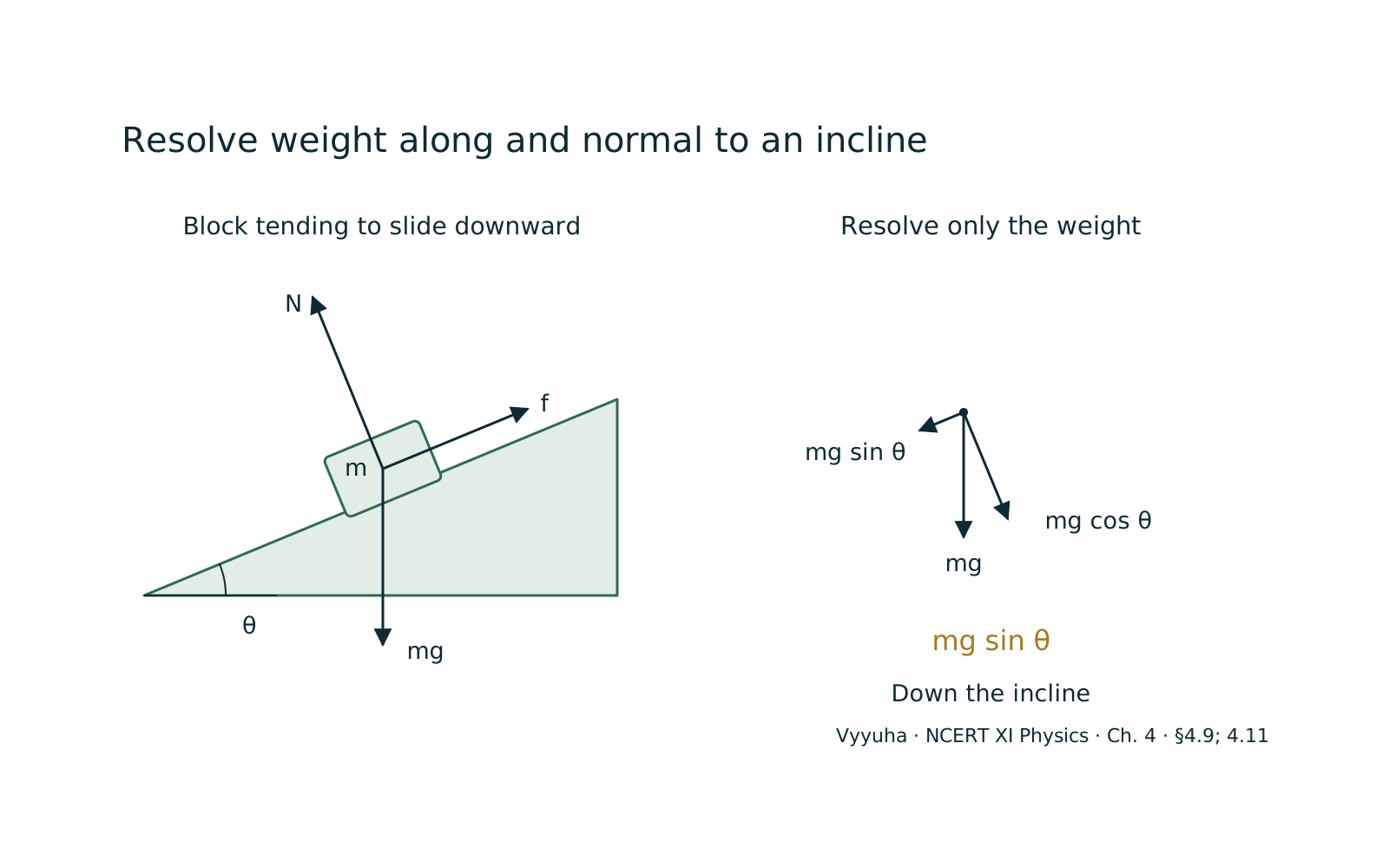
* Inclined Planes: Objects on inclined planes experience components of gravitational force parallel and perpendicular to the plane, requiring careful resolution of forces. * Apparent Weight in Lifts: When a lift accelerates, the normal force exerted by the floor on a person changes, leading to an 'apparent' change in weight.
If the lift accelerates upwards, apparent weight increases; if downwards, it decreases. * Rocket Propulsion: Based on Newton's Third Law and conservation of momentum. Expelling high-velocity exhaust gases downwards creates an equal and opposite thrust force upwards.
Common Misconceptions:
- Action-Reaction Forces Cancel Out: — This is incorrect. Action and reaction forces act on different bodies, so they cannot cancel each other out to determine the net force on a single body. For example, when you push a wall, the wall pushes back on you. Your push on the wall affects the wall's state, and the wall's push on you affects your state.
- Inertia is a Force: — Inertia is a property of matter, not a force. It's the resistance to change in motion, quantified by mass.
- Force is Required to Maintain Motion: — This is true only if there are opposing forces (like friction or air resistance). In the absence of such forces (e.g., in space), an object in motion will continue moving indefinitely at a constant velocity without any applied force, as per Newton's First Law.
- Mass vs. Weight: — Mass is an intrinsic property of an object (amount of matter, measure of inertia), constant everywhere. Weight is the gravitational force acting on an object (), which varies with the local gravitational field strength ().
NEET-Specific Angle:
NEET questions on Laws of Motion frequently test your ability to apply Newton's Second Law () in various scenarios. Key skills include:
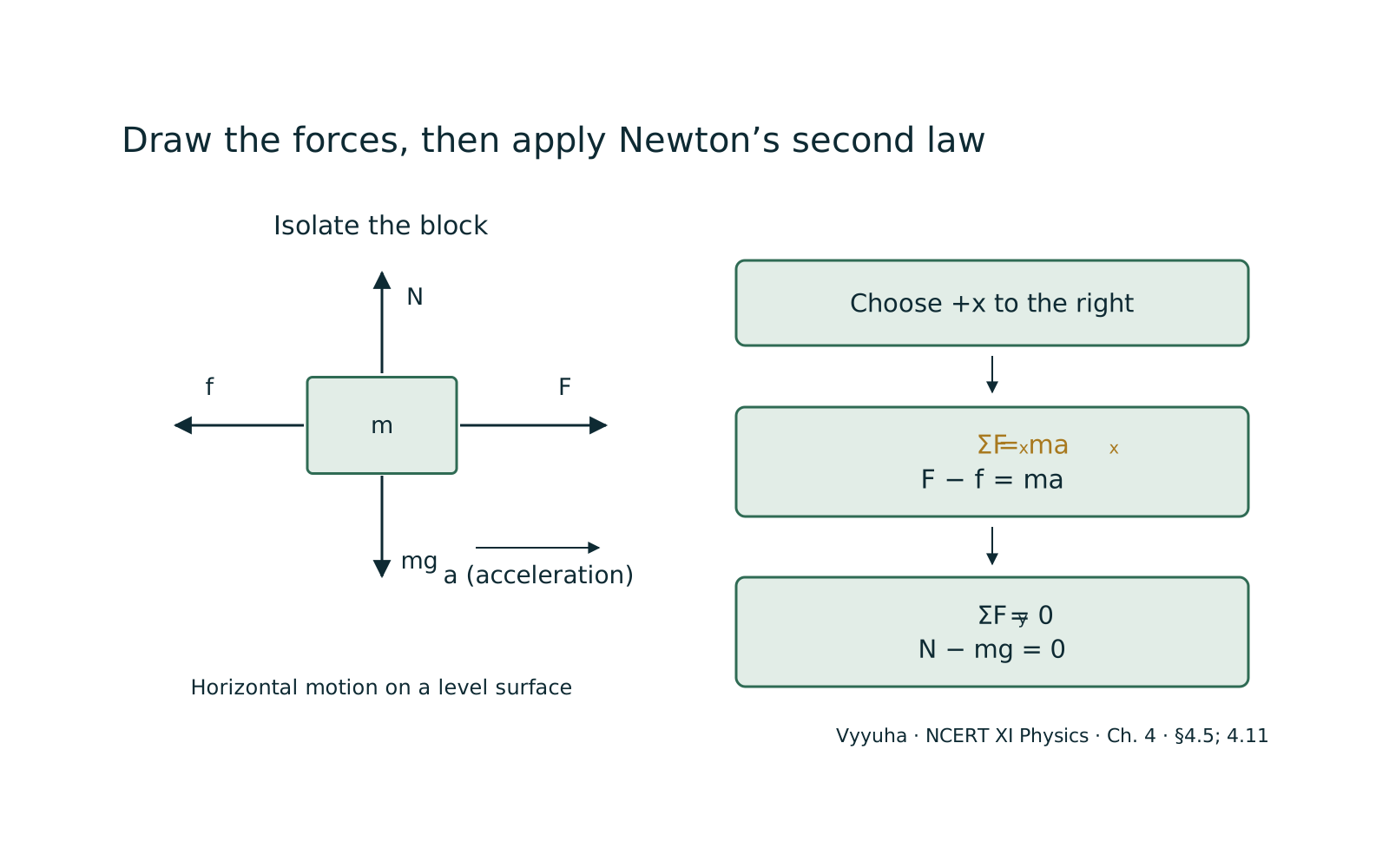
- Drawing Free-Body Diagrams (FBDs): — This is the most critical step. Isolate each object in the system and draw all external forces acting on that object. Do not include forces exerted by the object.
- Resolving Forces: — Break down forces (especially weight on inclined planes) into components along chosen coordinate axes (usually parallel and perpendicular to the direction of motion or acceleration).
- Applying Newton's Second Law to Each Body: — Write and for each object.
- Identifying Constraints: — For connected bodies, the acceleration of all connected parts might be the same, or related by a simple factor. For strings, tension is uniform along an ideal string.
- Understanding Friction: — Knowing when to use static friction () and kinetic friction () and their directions.
- Conservation of Momentum: — Applying this principle for collision problems or recoil scenarios where external forces are negligible.
Mastering these techniques and avoiding common pitfalls will be crucial for success in NEET physics.
Often confused with
Side-by-side differences the NEET paper likes to test.
| Aspect | Laws of Motion | Mass vs. Weight |
|---|---|---|
| Definition | Mass: A measure of the amount of matter in an object and its inertia. | Weight: The force exerted on an object due to gravity. |
| Nature | Mass: Scalar quantity. | Weight: Vector quantity (has magnitude and direction). |
| Units (SI) | Mass: Kilogram (kg). | Weight: Newton (N). |
| Dependence | Mass: Intrinsic property, constant everywhere. | Weight: Varies with the local gravitational field strength ($g$). $W = mg$. |
| Measurement | Mass: Measured using an inertial balance or by comparing with known masses. | Weight: Measured using a spring balance. |
While often used interchangeably in common language, mass and weight are distinct physical quantities. Mass is an intrinsic property of an object, representing its resistance to acceleration (inertia) and the quantity of matter it contains, remaining constant regardless of location.
Weight, conversely, is a force arising from gravitational attraction, directly proportional to mass but dependent on the local gravitational field strength. Understanding this distinction is fundamental for correctly applying Newton's laws, especially in problems involving varying gravitational environments or accelerating frames.
Why it is tested: For NEET, distinguishing between mass and weight is crucial for solving problems involving gravitational forces, apparent weight in lifts, and understanding how objects behave in different gravitational fields. Misconceptions can lead to incorrect calculations of forces and accelerations.
Questions students ask
5 answered on this topic.
What is the difference between mass and weight?
Mass is a fundamental property of an object, representing the amount of matter it contains and its inertia – its resistance to changes in motion. It is a scalar quantity and is constant regardless of location.
The SI unit is the kilogram (kg). Weight, on the other hand, is the force exerted on an object due to gravity. It is a vector quantity, directed towards the center of the gravitational source, and its magnitude depends on both the object's mass and the local gravitational field strength ().
Thus, an object's weight can change depending on its location (e.g., on Earth vs. on the Moon), while its mass remains the same.
Do action and reaction forces cancel each other out?
No, action and reaction forces do not cancel each other out because they always act on different objects. Newton's Third Law states that if object A exerts a force on object B, then object B exerts an equal and opposite force on object A.
For example, when you push a wall, your hand exerts a force on the wall, and the wall exerts an equal and opposite force on your hand. To determine the motion of your hand, you consider the force exerted on your hand.
To determine the motion of the wall, you consider the force exerted on the wall. Since these forces act on separate entities, they cannot be summed to find the net force on a single object.
What is an inertial frame of reference?
An inertial frame of reference is a coordinate system in which Newton's First Law of Motion holds true. This means that an object at rest remains at rest, and an object in motion continues with constant velocity, unless acted upon by a net external force.
Essentially, an inertial frame is either at rest or moving with a constant velocity (i.e., zero acceleration). Any frame that is accelerating with respect to an inertial frame is considered a non-inertial frame.
In non-inertial frames, fictitious forces (like centrifugal force or Coriolis force) must be introduced to make Newton's laws appear to hold.
How is impulse related to momentum?
Impulse is directly related to the change in an object's linear momentum. According to the impulse-momentum theorem, the impulse () applied to an object is equal to the change in its linear momentum ().
Mathematically, . Impulse can also be defined as the product of the average force () acting on an object and the time interval () over which the force acts: .
This relationship is particularly useful in analyzing collisions or impacts where large forces act for very short durations, making it difficult to measure the force directly but easier to measure the change in momentum.
Why does a rocket move forward when it expels gases backward?
Rocket propulsion is a classic example of Newton's Third Law of Motion and the principle of conservation of momentum. When a rocket expels hot gases at high velocity backward (action), the gases exert an equal and opposite force on the rocket, pushing it forward (reaction).
The total momentum of the rocket-gas system remains conserved. Before ignition, both rocket and fuel are at rest (zero momentum). As fuel is expelled backward, it gains backward momentum. To conserve the total momentum, the rocket must gain an equal amount of forward momentum, causing it to accelerate in the opposite direction to the expelled gases.
This forward force is known as thrust.