Work-Energy Theorem — Explained
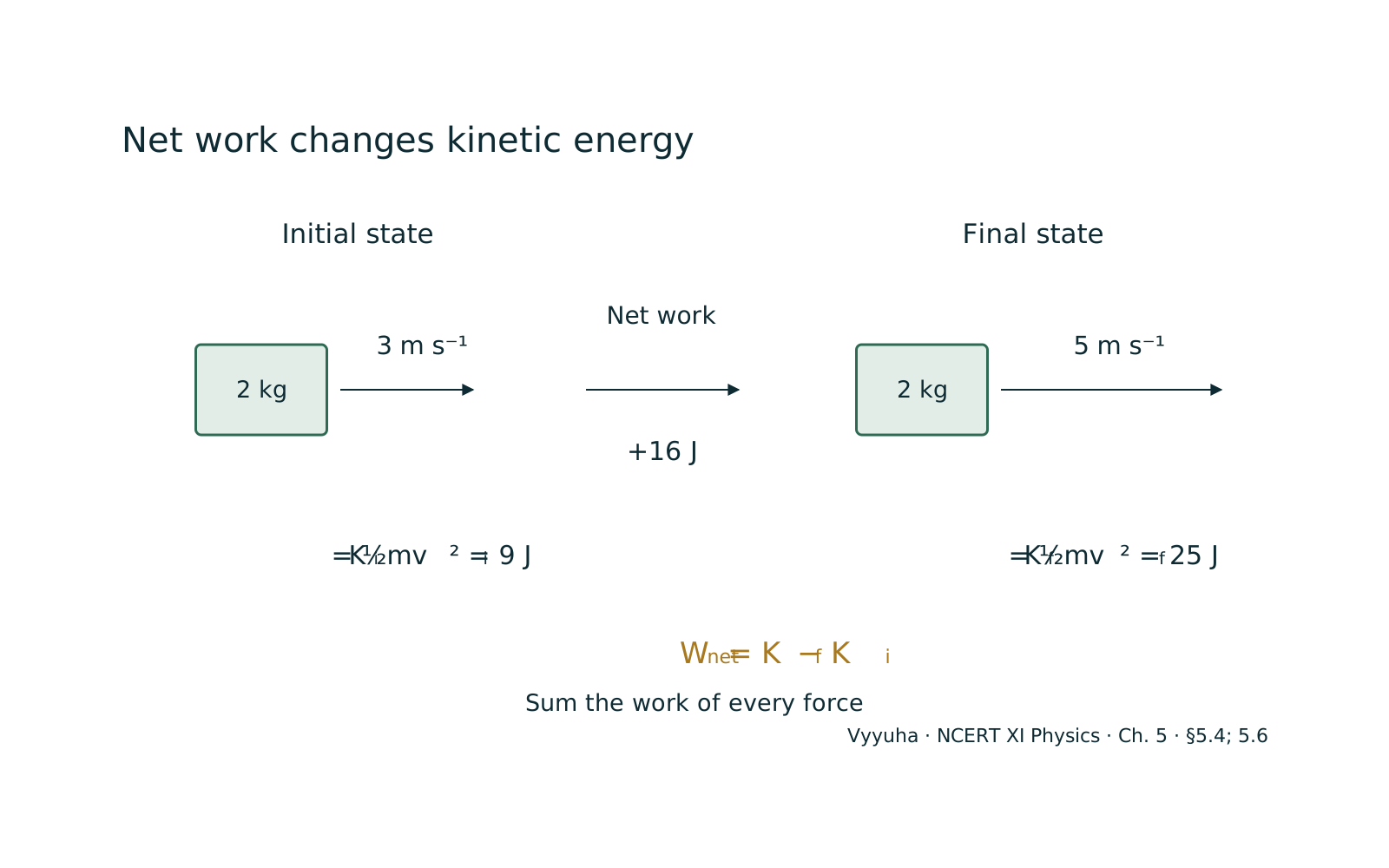
Detailed Explanation
The Work-Energy Theorem is a fundamental principle in classical mechanics that establishes a direct relationship between the work done on an object and its change in kinetic energy. It serves as a powerful alternative to Newton's second law for solving problems involving motion, especially when forces are variable or the path of motion is complex.
Conceptual Foundation
At its core, the Work-Energy Theorem builds upon two primary concepts: work and kinetic energy.
- Work Done by a Force ($W$): — In physics, work is done when a force causes a displacement of an object. It is a scalar quantity and is defined as the dot product of the force vector () and the displacement vector (). For a constant force, work is given by , where is the angle between the force and displacement vectors. If the force is variable, work is calculated by integrating the force over the displacement: . Work can be positive (force in the direction of motion, increasing speed), negative (force opposite to motion, decreasing speed), or zero (force perpendicular to motion, not affecting speed). The SI unit of work is the Joule (J).
- Kinetic Energy ($K$): — Kinetic energy is the energy an object possesses due to its motion. It is also a scalar quantity and depends on the object's mass () and speed (). The formula for kinetic energy is . The SI unit of kinetic energy is also the Joule (J). A change in an object's speed directly implies a change in its kinetic energy.
Key Principles/Laws: The Work-Energy Theorem
The Work-Energy Theorem states that the net work done by all forces acting on a particle is equal to the change in the particle's kinetic energy. Mathematically, this is expressed as:
- is the total (or net) work done by all forces acting on the object.
- is the change in kinetic energy.
- is the final kinetic energy of the object.
- is the initial kinetic energy of the object.
This theorem holds true regardless of whether the forces are conservative (like gravity or spring force) or non-conservative (like friction or air resistance). It applies to the net work done by all forces.
Derivations
1. Derivation for a Constant Force in One Dimension
Consider an object of mass moving along the x-axis under the influence of a constant net force . According to Newton's second law, . If the object undergoes a displacement , its acceleration is constant.
We can use the kinematic equation:
Substituting the expression for :
2. Derivation for a Variable Force (General Case)
For a variable force, we must use calculus. Consider a particle of mass moving along a path. The net work done is given by:
So,
Real-World Applications
The Work-Energy Theorem is incredibly versatile and finds applications in numerous scenarios:
- Braking a Vehicle: — When a car brakes, friction does negative work on the car, reducing its kinetic energy and bringing it to a stop. The work done by friction is equal to the initial kinetic energy of the car.
- Projectile Motion: — While gravity does work on a projectile, changing its vertical kinetic energy, the horizontal component of velocity (and thus horizontal kinetic energy) remains constant if air resistance is ignored, as no horizontal forces do work.
- Roller Coasters: — As a roller coaster moves down a hill, gravity does positive work, increasing its kinetic energy. As it goes up, gravity does negative work, decreasing its kinetic energy. The total work done by all forces (including friction) determines the change in speed.
- Impact Problems: — In collisions, the work done by impact forces (often internal) leads to changes in kinetic energy, which can be analyzed using the theorem, especially when considering deformation and energy loss.
- Spring-Mass Systems: — When a spring is compressed or stretched, it does work on an attached mass, converting potential energy into kinetic energy and vice versa.
Common Misconceptions
- Confusing Net Work with Work by a Single Force: — Students often mistakenly equate the work done by a single force (e.g., gravity) to the change in kinetic energy, when the theorem explicitly refers to the net work done by all forces. If only one force is doing work, then that force's work equals . But if multiple forces are acting, all must be considered.
- Applying it to Non-Conservative Forces Incorrectly: — While the theorem applies to non-conservative forces, it doesn't imply conservation of mechanical energy. If non-conservative forces (like friction) do work, mechanical energy is not conserved, but the Work-Energy Theorem still holds for the total work done.
- Ignoring Initial/Final Kinetic Energy: — Sometimes, students forget to account for the initial or final kinetic energy if the object is not starting from rest or coming to a complete stop.
- Using Speed vs. Velocity: — Kinetic energy depends on speed (), not velocity (). Therefore, the Work-Energy Theorem deals with changes in speed, not necessarily changes in velocity direction alone (unless speed also changes).
- Work Done by Internal Forces: — For a system of particles, the Work-Energy Theorem applies to the net work done by external forces and internal non-conservative forces. Internal conservative forces (like spring forces between particles in a system) are often accounted for as changes in potential energy within the system's total mechanical energy, but for the theorem, it's the net work on the system's center of mass that relates to the change in its kinetic energy.
NEET-Specific Angle
For NEET aspirants, the Work-Energy Theorem is a crucial problem-solving tool due to its ability to simplify complex mechanics problems. Here's why:
- Avoids Vector Analysis: — Unlike Newton's laws which often require resolving forces into components and dealing with vector addition, the Work-Energy Theorem deals with scalar quantities (work and kinetic energy). This significantly reduces the mathematical complexity, especially in 2D or 3D problems.
- Path Independence (for Conservative Forces): — While the theorem itself is path-dependent (as work is path-dependent for non-conservative forces), when only conservative forces are doing work, the work done is path-independent. This simplifies calculations for problems involving gravity or springs.
- Direct Link to Speed: — Many NEET problems ask for the final speed of an object. The Work-Energy Theorem directly provides this link without needing to calculate intermediate accelerations or times.
- Variable Forces: — When forces are not constant (e.g., spring force, air resistance varying with speed), applying Newton's second law requires integration to find acceleration and then velocity. The Work-Energy Theorem, by definition, incorporates this integration into the work calculation, making it more direct.
- Conservation of Mechanical Energy as a Special Case: — The principle of conservation of mechanical energy () is a special case of the Work-Energy Theorem where only conservative forces do work, or where the net work done by non-conservative forces is zero. Understanding the Work-Energy Theorem provides a broader framework.
Mastering the Work-Energy Theorem allows students to tackle problems involving inclined planes with friction, objects connected by strings over pulleys, and situations where objects are brought to rest by resistive forces, often with fewer steps and less chance of algebraic error than a purely kinematic approach.
Often confused with
Side-by-side differences the NEET paper likes to test.
| Aspect | Work-Energy Theorem | Newton's Second Law |
|---|---|---|
| Nature of Quantity | Scalar (Work, Energy) | Vector (Force, Acceleration) |
| Focus | Change in kinetic energy due to net work over a displacement | Instantaneous relationship between net force and acceleration |
| Mathematical Form | $W_{ ext{net}} = Delta K$ | $vec{F}_{ ext{net}} = mvec{a}$ |
| Ease of Use (Variable Forces) | Often simpler, involves integration of force over displacement | Requires integration of acceleration to find velocity/displacement, can be complex |
| Information Provided | Directly relates to change in speed/kinetic energy, independent of time | Relates to instantaneous acceleration, can be used to find velocity/position over time |
While both the Work-Energy Theorem and Newton's Second Law are fundamental to mechanics and are, in fact, derivable from each other, they offer different perspectives and tools for problem-solving. Newton's Second Law () is a vector equation that describes the instantaneous cause-and-effect relationship between force and acceleration.
It's excellent for analyzing forces and motion at a specific instant. The Work-Energy Theorem (), on the other hand, is a scalar equation that relates the total work done over a displacement to the change in an object's kinetic energy.
It's often more convenient for problems where forces are variable, paths are complex, or when the final speed is required without needing to know the time taken or intermediate accelerations. It provides an 'overall' view of energy transfer rather than an instantaneous one.
Why it is tested: For NEET, understanding the distinction and knowing when to apply each principle is crucial. The Work-Energy Theorem often simplifies problems that would be algebraically intensive using Newton's laws, especially those involving non-constant forces (like springs) or friction over a distance. Questions frequently test the ability to choose the most efficient method. For instance, finding the final speed after a certain displacement is often quicker with the Work-Energy Theorem, while finding instantaneous acceleration requires Newton's Second Law.
Questions students ask
6 answered on this topic.
What is the difference between the Work-Energy Theorem and the Conservation of Mechanical Energy?
The Work-Energy Theorem is a more general principle stating that the net work done by all forces (conservative and non-conservative) on an object equals its change in kinetic energy ().
The Conservation of Mechanical Energy is a special case that applies only when conservative forces do work, or when the net work done by non-conservative forces is zero. In such cases, the total mechanical energy (sum of kinetic and potential energy) remains constant ().
If non-conservative forces like friction are present and do work, mechanical energy is not conserved, but the Work-Energy Theorem still holds.
Does the Work-Energy Theorem apply to non-conservative forces?
Yes, absolutely. The Work-Energy Theorem states that the net work done by all forces acting on an object is equal to the change in its kinetic energy. This 'net work' includes the work done by conservative forces (like gravity, spring force) and non-conservative forces (like friction, air resistance, applied force).
When non-conservative forces do work, mechanical energy is not conserved, but the Work-Energy Theorem remains valid, providing a way to quantify the energy transfer or transformation due to these forces.
Can the Work-Energy Theorem be used for systems of particles?
Yes, the Work-Energy Theorem can be extended to systems of particles. For a system, the net work done by all external forces and all internal non-conservative forces equals the change in the total kinetic energy of the system.
Internal conservative forces (like spring forces between particles within the system) are typically accounted for as changes in the system's internal potential energy. When applied to the center of mass of a system, the net work done by external forces equals the change in the kinetic energy of the center of mass.
What is the significance of 'net work' in the Work-Energy Theorem?
The term 'net work' is crucial because it emphasizes that the theorem considers the cumulative effect of all forces acting on an object. It's not just the work done by one specific force, but the algebraic sum of work done by every single force (gravity, normal force, friction, applied force, etc.
). Only the total work done by all these forces determines the overall change in the object's kinetic energy. If you only consider the work of a single force, you might get an incorrect result unless that single force is the only one doing work.
When is the Work-Energy Theorem most useful in problem-solving?
The Work-Energy Theorem is particularly useful in situations where: 1) Forces are variable, making direct application of Newton's laws and kinematics difficult (e.g., spring forces). 2) The path of motion is curved or complex, and calculating acceleration at every point is cumbersome.
3) The problem asks for a change in speed or final speed, and time is not a factor. 4) Non-conservative forces like friction are present, and you need to account for their effect on energy without explicitly calculating acceleration.
It often provides a more direct and scalar approach compared to vector-based force analysis.
Does the Work-Energy Theorem apply if the object is moving in a circle?
Yes, the Work-Energy Theorem applies to circular motion as well. For an object moving in a circle, the centripetal force (which keeps it in the circle) always acts perpendicular to the displacement (which is tangential).
Therefore, the centripetal force does no work. Any change in the object's kinetic energy (i.e., its speed) in circular motion must be due to the work done by tangential forces. The net work done by all forces, including any tangential forces, will still equal the change in kinetic energy.