Kinetic Energy
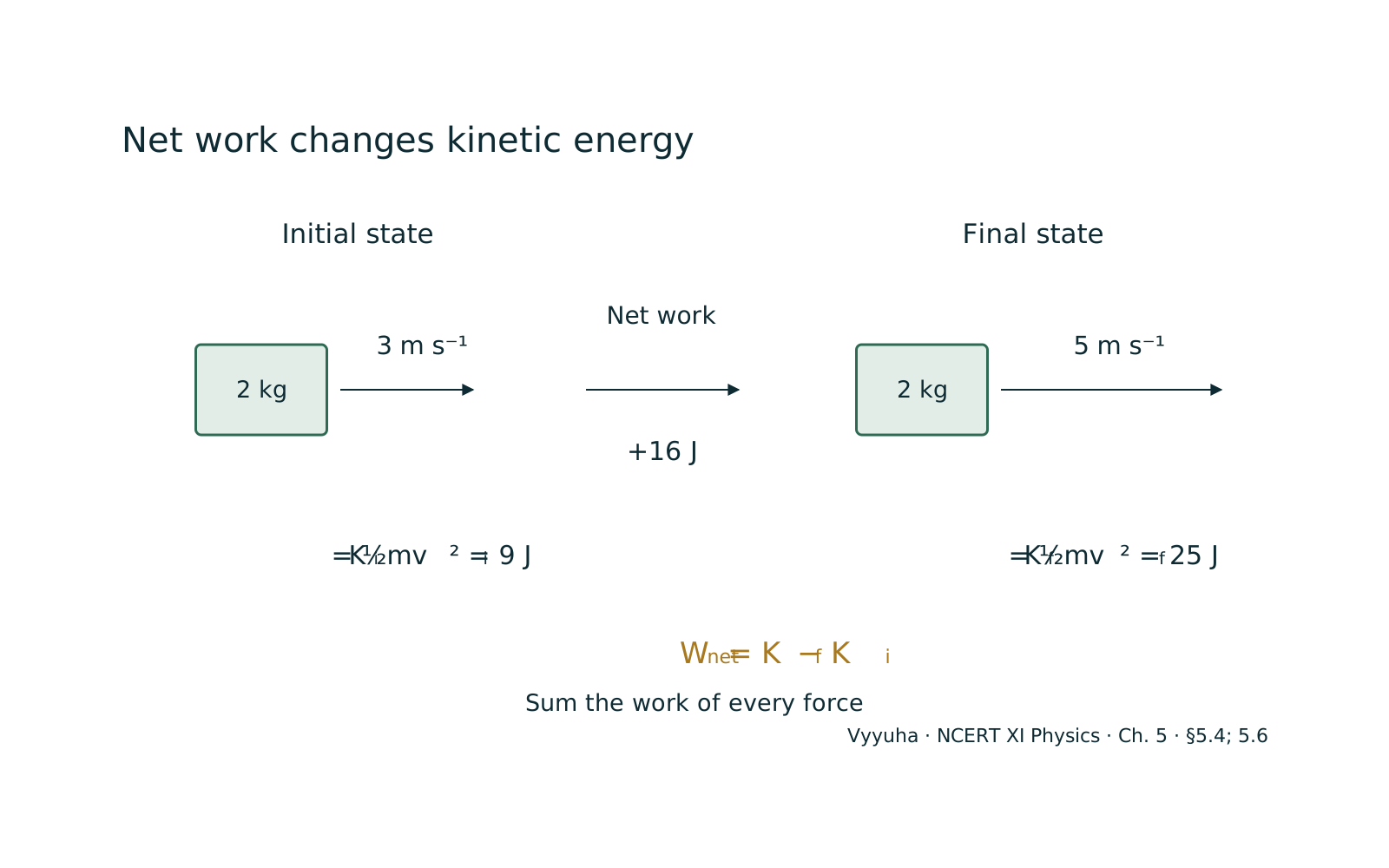
Kinetic energy is the energy possessed by an object due to its motion. It is a scalar quantity, meaning it has magnitude but no direction. The magnitude of an object's kinetic energy depends on both its mass and its speed. Specifically, it is directly proportional to the mass of the object and directly proportional to the square of its speed. This fundamental concept is crucial in understanding ho…
Quick Summary
Kinetic energy is the energy an object possesses due to its motion. It is a scalar quantity, always positive or zero, and is measured in Joules (J). The fundamental formula for translational kinetic energy is , where is the mass in kilograms and is the speed in meters per second.
This formula highlights that kinetic energy is directly proportional to mass and to the square of the speed, meaning speed has a much greater impact on kinetic energy than mass. The Work-Energy Theorem is a crucial principle stating that the net work done on an object equals the change in its kinetic energy ().
Kinetic energy can also be expressed in terms of linear momentum () as . While total energy is always conserved, kinetic energy itself is only conserved in perfectly elastic collisions or in systems where only conservative forces do work.
Understanding these basics is essential for solving problems related to motion, work, and energy transformations in NEET physics.
Full explanation
Kinetic energy, at its core, is the energy an object possesses purely by virtue of its motion. It is one of the most fundamental forms of energy in classical mechanics, alongside potential energy. The concept of kinetic energy allows us to quantify the 'liveliness' or 'activity' of a moving object and provides a crucial link to the work-energy theorem, which is a powerful tool for analyzing dynamic systems without directly dealing with forces and accelerations.
\n\nConceptual Foundation:\nEnergy, in physics, is defined as the capacity to do work. An object in motion can certainly do work. For instance, a moving hammer can drive a nail into wood, a moving car can deform another object in a collision, or moving air (wind) can turn a turbine.
The amount of work an object can do solely due to its motion is precisely what its kinetic energy represents. It's important to distinguish kinetic energy from momentum (). While both depend on mass and velocity, momentum is a vector quantity (has direction) and is conserved in isolated systems, whereas kinetic energy is a scalar quantity and is conserved only in elastic collisions.
\n\nKey Principles and Laws:\n1. Dependence on Mass and Speed: The kinetic energy of a point mass (or the translational kinetic energy of a rigid body) is directly proportional to its mass () and the square of its speed ().
This relationship is encapsulated in the formula:
The squaring of speed implies that small changes in speed lead to significant changes in kinetic energy. For example, doubling the speed quadruples the kinetic energy. \n * Units: The SI unit for kinetic energy is the Joule (J), where .
\n\n2. Scalar Nature: Kinetic energy is a scalar quantity. Its value does not depend on the direction of motion, only on the magnitude of the velocity (speed). This means an object moving at north has the same kinetic energy as an identical object moving at south.
\n\n3. Work-Energy Theorem: This is perhaps the most profound principle involving kinetic energy. It states that the net work done on an object by all forces acting on it is equal to the change in its kinetic energy.
\n
\n\n**Derivation of (from Work-Energy Theorem for constant force):**\nConsider an object of mass initially moving with speed . A constant net force acts on it, causing it to accelerate uniformly to a final speed over a displacement .
\nFrom kinematics, for constant acceleration : \n
\nSubstituting : \n
This derivation shows that the form of kinetic energy naturally emerges from the definition of work and Newton's laws. \n\nRelation to Momentum:\nKinetic energy can also be expressed in terms of linear momentum ().
\nWe know . \nMultiply and divide by : \n
\n\nTypes of Kinetic Energy (Briefly for NEET UG):\nWhile the primary focus for NEET UG is translational kinetic energy (), it's worth noting that objects can also possess rotational kinetic energy if they are rotating about an axis.
For a rigid body rotating with angular velocity and moment of inertia , its rotational kinetic energy is . The total kinetic energy of a rolling object, for example, is the sum of its translational and rotational kinetic energies.
However, for most NEET problems, 'kinetic energy' refers to translational kinetic energy unless specified otherwise. \n\nReal-World Applications:\n* Automotive Safety: Understanding kinetic energy is crucial for designing car safety features.
The energy dissipated in a crash is directly related to the kinetic energy of the vehicles involved. The dependence explains why high-speed collisions are far more dangerous. \n* Sports: Athletes utilize kinetic energy.
A sprinter's speed translates to kinetic energy, which can then be converted into other forms, like potential energy during a jump. \n* Renewable Energy: Wind turbines convert the kinetic energy of wind into electrical energy.
Hydroelectric power plants convert the kinetic energy of flowing water into electricity. \n* Projectile Motion: The kinetic energy of a projectile changes throughout its trajectory, being maximum at the launch point and minimum at the highest point (where vertical velocity is zero, but horizontal velocity remains).
\n\nCommon Misconceptions:\n* Kinetic Energy vs. Velocity: Students often confuse kinetic energy with velocity. Kinetic energy is a scalar, always positive (or zero), and depends on speed squared.
Velocity is a vector and can be positive or negative. \n* Negative Kinetic Energy: Kinetic energy can never be negative because mass () is always positive, and speed squared () is always positive (or zero).
\n* Kinetic Energy and Momentum: While related, they are distinct. Two objects can have the same kinetic energy but different momenta (e.g., a heavy, slow object vs. a light, fast object). Similarly, two objects can have the same momentum but different kinetic energies.
\n* Conservation: Kinetic energy is not always conserved. It is conserved only in perfectly elastic collisions. In inelastic collisions, some kinetic energy is converted into other forms (heat, sound, deformation).
The total mechanical energy (kinetic + potential) is conserved only if only conservative forces (like gravity, spring force) do work. \n\nNEET-Specific Angle:\nNEET questions on kinetic energy often involve: \n1.
**Direct application of : Calculating KE given mass and speed, or finding speed given KE and mass. \n2. Work-Energy Theorem**: Problems where work done by a force (or net force) leads to a change in kinetic energy.
This can involve friction, variable forces, or gravitational forces. \n3. Relation to Momentum: Using to solve problems, especially those involving ratios of KE or momentum for different objects or before/after collisions.
\n4. Conservation of Mechanical Energy: In situations where only conservative forces are at play, . This often involves converting potential energy to kinetic energy (e.g., a falling object).
\n5. Graphical Problems: Interpreting graphs of force vs. displacement to find work done (area under the curve) and then relating it to change in kinetic energy. \n6. Collisions: Analyzing changes in kinetic energy during elastic and inelastic collisions.
Remember, total kinetic energy is conserved only in elastic collisions. \nMastering these applications and understanding the underlying principles is key to excelling in NEET physics.
Key Concepts
The formula shows that kinetic energy is proportional to the square of the speed. This…
The Work-Energy Theorem () is a powerful tool. It allows us to calculate the change in an…
The relationship is extremely useful, especially when dealing with problems where…
Often confused with
Side-by-side differences the NEET paper likes to test.
| Aspect | Kinetic Energy | Potential Energy |
|---|---|---|
| Definition | Energy possessed by an object due to its motion. | Energy possessed by an object due to its position or configuration. |
| Formula (Gravitational/Translational) | $K = \frac{1}{2}mv^2$ | $U_g = mgh$ (gravitational), $U_s = \frac{1}{2}kx^2$ (elastic) |
| Dependence | Depends on mass and speed. | Depends on mass, height (for gravity), or spring constant and compression/extension (for elastic). |
| Nature | Scalar quantity, always positive or zero. | Scalar quantity, can be positive, negative, or zero (relative to a reference point). |
| Conservation | Not always conserved; only in elastic collisions or absence of non-conservative forces. | Can be converted to kinetic energy; total mechanical energy ($K+U$) is conserved if only conservative forces do work. |
| Example | A car moving on a road, a ball falling. | A book on a shelf, a stretched spring, water stored in a dam. |
Kinetic energy is the energy of motion, directly proportional to mass and the square of speed, always positive. Potential energy, on the other hand, is stored energy due to an object's position or configuration, such as gravitational potential energy (due to height) or elastic potential energy (due to deformation).
While kinetic energy is associated with 'doing work' through movement, potential energy represents the 'potential' to do work when converted into another form, often kinetic energy. Both are scalar quantities, but potential energy's value depends on a chosen reference point and can be negative, unlike kinetic energy.
Why it is tested: NEET relevance
Questions students ask
6 answered on this topic.
Can kinetic energy ever be negative?
No, kinetic energy can never be negative. The formula for kinetic energy is . Mass () is always a positive quantity. The speed () is squared (), which means even if the velocity were negative (indicating direction), its square would always be positive.
Therefore, the product of a positive mass and a positive square of speed will always result in a positive or zero value for kinetic energy. An object at rest has zero kinetic energy, but it cannot have negative kinetic energy.
What is the difference between kinetic energy and momentum?
While both kinetic energy and momentum describe aspects of an object's motion and depend on its mass and velocity, they are fundamentally different. Kinetic energy () is a scalar quantity, meaning it only has magnitude and is always positive.
It represents the capacity to do work due to motion. Momentum () is a vector quantity, meaning it has both magnitude and direction. It represents the 'quantity of motion' and is conserved in isolated systems.
Two objects can have the same kinetic energy but different momenta, or vice versa.
How does kinetic energy change if the speed of an object is doubled?
If the speed of an object is doubled, its kinetic energy will quadruple. This is because kinetic energy is proportional to the square of the speed (). Let the initial speed be and initial kinetic energy be .
If the speed is doubled to , the new kinetic energy will be . This quadratic dependence makes speed a very significant factor in determining kinetic energy.
Is kinetic energy conserved in all physical processes?
No, kinetic energy is not conserved in all physical processes. Total energy (including all forms like heat, sound, light, chemical, nuclear, etc.) is always conserved in an isolated system. However, kinetic energy alone is conserved only in perfectly elastic collisions.
In inelastic collisions, some kinetic energy is converted into other forms of energy, such as heat, sound, or deformation energy, leading to a loss of mechanical kinetic energy. Similarly, if non-conservative forces like friction or air resistance do work, mechanical energy (and thus kinetic energy) is not conserved.
What is the Work-Energy Theorem and why is it important?
The Work-Energy Theorem states that the net work done on an object by all forces acting on it is equal to the change in its kinetic energy (). It's important because it provides a powerful alternative to Newton's laws for solving problems involving motion and forces.
Instead of analyzing forces and accelerations directly, one can calculate the work done and relate it to the change in an object's speed. This is particularly useful when forces are variable or when dealing with complex paths, simplifying many problems in mechanics.
Does kinetic energy depend on the reference frame?
Yes, kinetic energy does depend on the chosen reference frame. Since velocity is relative to a reference frame, and kinetic energy depends on velocity (specifically, speed), the kinetic energy of an object will appear different to observers in different frames of reference.
For example, a person sitting in a moving train has zero kinetic energy relative to the train, but a significant amount of kinetic energy relative to an observer standing on the ground. This relativity is a key aspect of understanding energy in different contexts.
Revise in 30 seconds
- Definition: — Energy due to motion.\n- Formula: \n- Units: Joules (J), \n- Scalar: Has magnitude only, always .\n- Relation to Momentum: or \n- Work-Energy Theorem: \n- Dependence: Proportional to mass, proportional to square of speed ().
Kinetic Energy is Half Mass Velocity Squared. (K = 1/2 mv^2)