Collisions
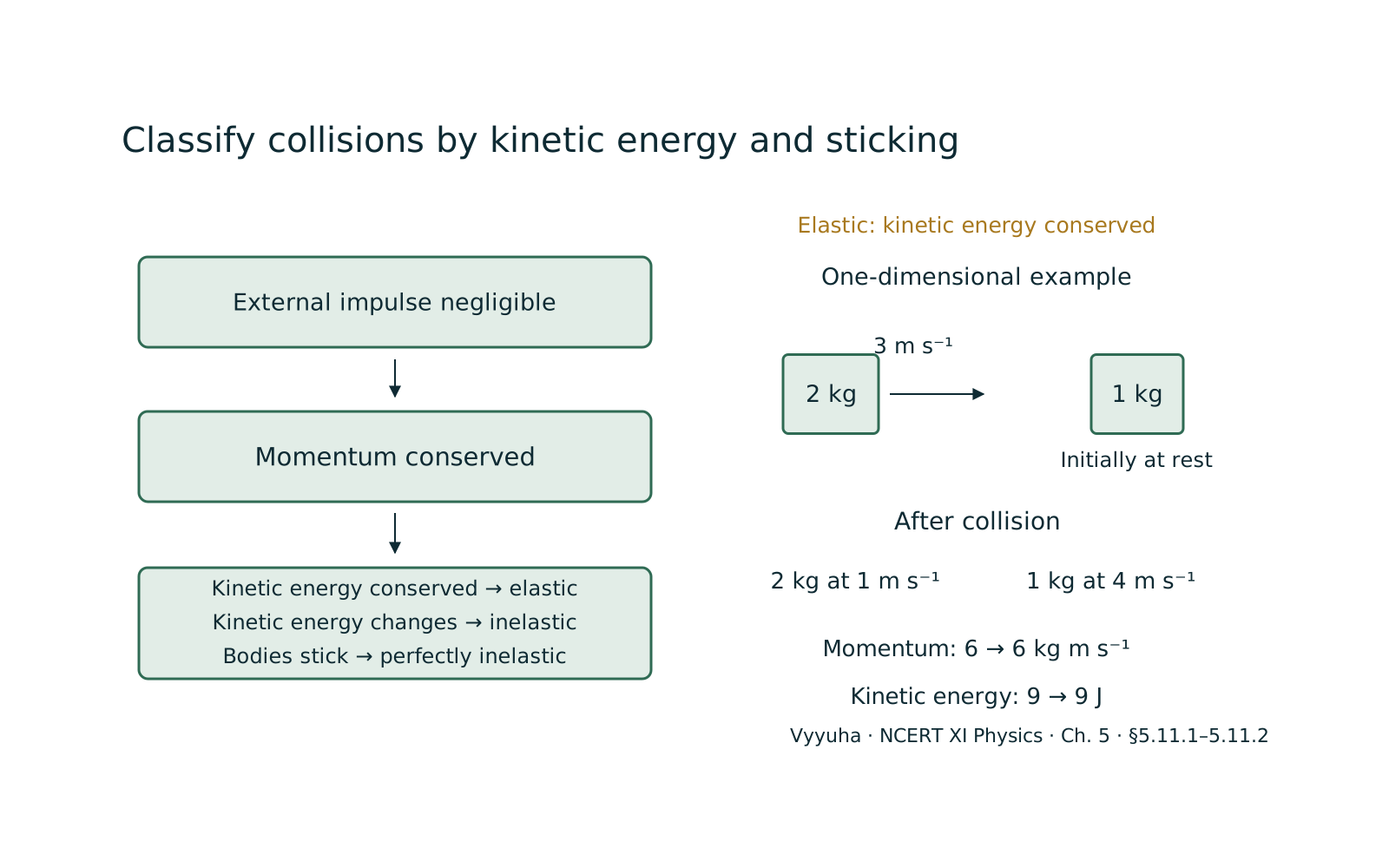
In physics, a collision is defined as a strong interaction between two or more bodies that occurs over a relatively short period, during which the interacting bodies exert forces on each other that are significantly larger than any other external forces present. This intense interaction leads to an abrupt change in the momentum and kinetic energy of the colliding bodies. Crucially, during a collis…
Quick Summary
Collisions are brief, intense interactions between objects leading to changes in their motion. The fundamental principle governing all collisions, provided no net external force acts on the system, is the conservation of linear momentum.
This means the total momentum before the collision equals the total momentum after. Collisions are categorized based on the conservation of kinetic energy. In an elastic collision, both linear momentum and kinetic energy are conserved.
These are idealized and often involve hard, non-deforming objects. In an inelastic collision, linear momentum is conserved, but kinetic energy is not; some kinetic energy is transformed into other forms like heat or sound.
A special case is a perfectly inelastic collision, where objects stick together after impact, resulting in the maximum possible loss of kinetic energy. The coefficient of restitution (e) quantifies the 'bounciness' of a collision: for elastic, for perfectly inelastic, and for general inelastic collisions.
Understanding these types and applying the conservation laws, along with the concept of impulse, is key to solving collision problems.
Full explanation
Collisions are ubiquitous phenomena in the physical world, ranging from the microscopic interactions of subatomic particles to the macroscopic impacts of vehicles. From a physics standpoint, a collision is a transient event characterized by strong interaction forces between two or more bodies over a short duration, leading to significant changes in their respective momenta and kinetic energies.
The study of collisions is fundamentally rooted in the principles of conservation of linear momentum and, in specific cases, conservation of kinetic energy.
Conceptual Foundation: Impulse and Momentum
Before delving into the types of collisions, it's essential to understand the concepts of impulse and momentum. Linear momentum () of an object is defined as the product of its mass () and its velocity (), i.e., . It is a vector quantity, having both magnitude and direction. The total linear momentum of a system of particles is the vector sum of the individual momenta.
When objects collide, they exert forces on each other. According to Newton's third law, these forces are equal in magnitude and opposite in direction. The effect of a force acting over a period of time is quantified by 'impulse' ().
Impulse is defined as the integral of force over time: . From Newton's second law, , so integrating this over time yields the 'impulse-momentum theorem':
During a collision, the forces are typically very large, but the time duration () is very small. The impulse-momentum theorem is crucial because it allows us to analyze the effect of these large, short-duration forces without needing to know the exact time-varying force function.
Key Principles: Conservation Laws
- Conservation of Linear Momentum: — This is the most fundamental principle applied to collisions. For a system of colliding bodies, if no net external force acts on the system during the collision, the total linear momentum of the system remains conserved. This means the vector sum of the momenta of all objects before the collision is equal to the vector sum of their momenta after the collision.
- Conservation of Kinetic Energy: — Unlike momentum, kinetic energy is not always conserved in a collision. Kinetic energy () is a scalar quantity. Its conservation depends on the nature of the collision.
Types of Collisions
Collisions are primarily classified based on whether kinetic energy is conserved.
1. Elastic Collisions
An elastic collision is an idealized collision in which both linear momentum and kinetic energy are conserved. There is no loss of kinetic energy; it is merely redistributed among the colliding bodies. These collisions are rare in the macroscopic world but are a good approximation for interactions between hard, non-deforming objects (like billiard balls) or at the atomic/subatomic level.
Characteristics:
- Linear momentum is conserved:
- Kinetic energy is conserved:
- Total energy is conserved.
- Forces involved are conservative (e.g., elastic potential energy temporarily stored and released).
One-Dimensional Elastic Collision:
Consider two masses and moving along a straight line with initial velocities and (positive for rightward motion, negative for leftward). After the collision, their velocities are and .
From momentum conservation:
This is also related to the coefficient of restitution, for elastic collisions.
Solving for and (after some algebraic manipulation):
Special Cases of 1D Elastic Collisions:
- Equal Masses ($m_1 = m_2$): — and . The bodies exchange velocities. (e.g., billiard balls)
- **Target at Rest ():**
* If (light body hits heavy body at rest), then and . The light body rebounds with nearly its initial speed, and the heavy body remains almost at rest. (e.
g., tennis ball hitting a wall) * If (heavy body hits light body at rest), then and . The heavy body continues with almost its initial speed, and the light body moves with nearly twice the initial speed of the heavy body.
(e.g.
2. Inelastic Collisions
In an inelastic collision, linear momentum is conserved, but kinetic energy is not conserved. Some kinetic energy is lost, typically converted into other forms of energy such as heat, sound, or energy used to deform the colliding objects. Most real-world collisions are inelastic to some degree.
Characteristics:
- Linear momentum is conserved:
- Kinetic energy is not conserved: .
- Total energy is conserved (including all forms of energy).
- Forces involved may be non-conservative (e.g., friction, deformation).
Perfectly Inelastic Collisions:
This is a special case of inelastic collision where the colliding objects stick together after impact and move as a single combined mass. This results in the maximum possible loss of kinetic energy consistent with momentum conservation.
One-Dimensional Perfectly Inelastic Collision:
If and collide and stick together, they move with a common final velocity . From momentum conservation:
Loss of Kinetic Energy in Perfectly Inelastic Collision:
The initial kinetic energy is . The final kinetic energy is . The loss in kinetic energy is . This loss is always positive (or zero if ), indicating that kinetic energy is always lost or converted in perfectly inelastic collisions.
Coefficient of Restitution ($e$)
The coefficient of restitution is a dimensionless quantity that quantifies the 'bounciness' of a collision. It is defined as the ratio of the relative speed of separation after the collision to the relative speed of approach before the collision, along the common normal to the surfaces at the point of impact.
Values of $e$:
- $e = 1$: — For a perfectly elastic collision. Relative speed of separation equals relative speed of approach.
- $e = 0$: — For a perfectly inelastic collision. The objects stick together, so their relative speed of separation is zero ().
- $0 < e < 1$: — For an inelastic collision. Some kinetic energy is lost, but the objects do not stick together.
This coefficient provides a convenient way to analyze collisions without explicitly dealing with kinetic energy conservation equations, especially when the collision is not perfectly elastic or inelastic.
Two-Dimensional Collisions
When objects collide and move in different directions after impact, the collision is two-dimensional. The principle of conservation of linear momentum still applies, but it must be applied vectorially, meaning separately for the components along the x-axis and y-axis.
For 2D elastic collisions, kinetic energy is also conserved, but this often leads to complex equations. For 2D inelastic collisions, kinetic energy is not conserved. The coefficient of restitution can also be applied, usually along the line of impact.
Real-World Applications and NEET-Specific Angle
- Billiards/Pool: — Excellent examples of nearly elastic collisions where momentum and kinetic energy conservation (approximately) dictate the outcome.
- Car Crashes: — Highly inelastic collisions where significant kinetic energy is converted into deformation, heat, and sound. Safety features like crumple zones are designed to increase the collision time, thereby reducing the impact force (Impulse = F ).
- Rocket Propulsion: — While not a direct collision, it's a classic example of momentum conservation. The expulsion of high-velocity exhaust gases in one direction results in the rocket gaining momentum in the opposite direction.
- Ballistic Pendulum: — A common experimental setup to determine the speed of a bullet, involving a perfectly inelastic collision followed by conservation of mechanical energy.
Common Misconceptions:
- Momentum is always conserved, kinetic energy is always conserved: — While momentum is always conserved in an isolated system, kinetic energy is only conserved in elastic collisions. This is a frequent trap.
- Perfectly inelastic means total energy is lost: — No, only kinetic energy is lost (transformed). Total energy (including heat, sound, deformation energy) is always conserved.
- Coefficient of restitution is only for 1D collisions: — While often introduced in 1D, it can be applied to 2D collisions along the line of impact.
- Impulse is just force: — Impulse is force multiplied by time, representing the effect of force over time, which is the change in momentum. A large force for a short time can have the same impulse as a small force for a long time.
For NEET, a strong grasp of 1D elastic and perfectly inelastic collisions is paramount. Questions often involve calculating final velocities, kinetic energy loss, or applying the coefficient of restitution. Two-dimensional collisions are less frequent but require careful vector component analysis. Practice with various scenarios, especially those involving objects at rest or equal masses, will solidify understanding.
Key Concepts
This principle states that for an isolated system (one not subject to external forces), the total vector sum…
The coefficient of restitution provides a practical way to analyze collisions, especially when an object…
In a perfectly inelastic collision, objects stick together, and kinetic energy is always lost. This lost…
Often confused with
Side-by-side differences the NEET paper likes to test.
| Aspect | Collisions | Inelastic Collisions |
|---|---|---|
| Conservation of Linear Momentum | Always conserved (in an isolated system). | Always conserved (in an isolated system). |
| Conservation of Kinetic Energy | Conserved. Total KE before = Total KE after. | Not conserved. Total KE before > Total KE after (some KE is lost/transformed). |
| Coefficient of Restitution (e) | $e = 1$ | $0 \le e < 1$ (specifically $e=0$ for perfectly inelastic). |
| Deformation/Heat/Sound | Minimal or no deformation; negligible conversion to heat/sound. | Significant deformation; kinetic energy converted to heat, sound, and internal energy. |
| Relative Speed | Relative speed of approach = Relative speed of separation. | Relative speed of approach > Relative speed of separation. |
| Objects After Collision | Objects separate after collision. | Objects may separate or stick together (perfectly inelastic). |
| Examples | Collisions between subatomic particles, ideal billiard ball collisions. | Car crashes, bullet embedding in a block, dropping a clay ball. |
The fundamental distinction between elastic and inelastic collisions lies in the conservation of kinetic energy. While linear momentum is conserved in both types (for an isolated system), kinetic energy is only conserved in elastic collisions.
In inelastic collisions, a portion of the initial kinetic energy is transformed into other forms, such as heat, sound, or internal energy causing deformation. This difference is quantitatively captured by the coefficient of restitution, which is 1 for elastic collisions and less than 1 (including 0 for perfectly inelastic) for inelastic collisions.
Understanding this distinction is critical for correctly analyzing collision scenarios.
Why it is tested: For NEET, understanding the differences between elastic and inelastic collisions is paramount. Questions frequently test the application of conservation laws, calculation of energy loss, and the interpretation of the coefficient of restitution for various collision types. Distinguishing between these collision types is a core conceptual requirement for problem-solving.
Questions students ask
5 answered on this topic.
Is linear momentum always conserved in a collision?
Yes, linear momentum is always conserved in any type of collision, provided the system of colliding objects is isolated, meaning no net external force acts on it during the collision. This is a direct consequence of Newton's third law and the impulse-momentum theorem.
While the momentum of individual objects may change drastically, the vector sum of their momenta before the collision will be equal to the vector sum of their momenta after the collision. This fundamental principle holds true for elastic, inelastic, and perfectly inelastic collisions alike.
What is the primary difference between an elastic and an inelastic collision?
The primary difference lies in the conservation of kinetic energy. In an elastic collision, both linear momentum and kinetic energy are conserved. This means the total kinetic energy of the system before and after the collision remains the same.
In contrast, in an inelastic collision, linear momentum is conserved, but kinetic energy is not conserved. Some amount of kinetic energy is lost, typically converted into other forms of energy such as heat, sound, or energy used for deformation of the colliding bodies.
Most real-world collisions are inelastic.
What is the coefficient of restitution and what do its values signify?
The coefficient of restitution (e) is a dimensionless quantity that describes the 'bounciness' of a collision. It is defined as the ratio of the relative speed of separation of the objects after collision to their relative speed of approach before collision.
Its value ranges from 0 to 1. If e=1, the collision is perfectly elastic, meaning relative speed of separation equals relative speed of approach. If e=0, the collision is perfectly inelastic, meaning the objects stick together and have zero relative speed of separation.
For inelastic collisions where objects don't stick, .
Can kinetic energy ever increase in a collision?
In a standard collision where only mechanical forces are at play, the total kinetic energy of the system cannot increase. It can either be conserved (elastic collision) or decrease (inelastic collision, where energy is converted to heat, sound, deformation).
However, if there are internal energy sources within the system that are released during the collision (e.g., an explosion), then the kinetic energy of the system can increase. But for typical collision problems in NEET, assume kinetic energy either stays the same or decreases.
How does impulse relate to collisions?
Impulse is a measure of the change in momentum of an object. During a collision, objects exert large forces on each other over a very short time interval. The product of the average force and this time interval is the impulse.
According to the impulse-momentum theorem, the impulse acting on an object is equal to the change in its linear momentum (). This concept is crucial for understanding how forces during a collision affect the motion of objects, even when the exact force-time profile is unknown.
Revise in 30 seconds
- Linear Momentum: — (vector quantity)
- Impulse: —
- Conservation of Momentum: — (Always conserved in isolated system)
- Kinetic Energy: —
- Elastic Collision: — Momentum conserved, KE conserved, .
- 1D: (Relative speed of approach = Relative speed of separation)
- Inelastic Collision: — Momentum conserved, KE not conserved, .
- Perfectly Inelastic Collision: — Objects stick together, . Max KE loss.
- 1D:
- Coefficient of Restitution (e): — (Ratio of relative speed of separation to approach)
- Rebound Height: — (for a ball dropped from H)
MICE KEPT: Momentum Is Conserved for Every collision. Kinetic Energy Preserves Totally (only for Elastic).