Elastic Collisions
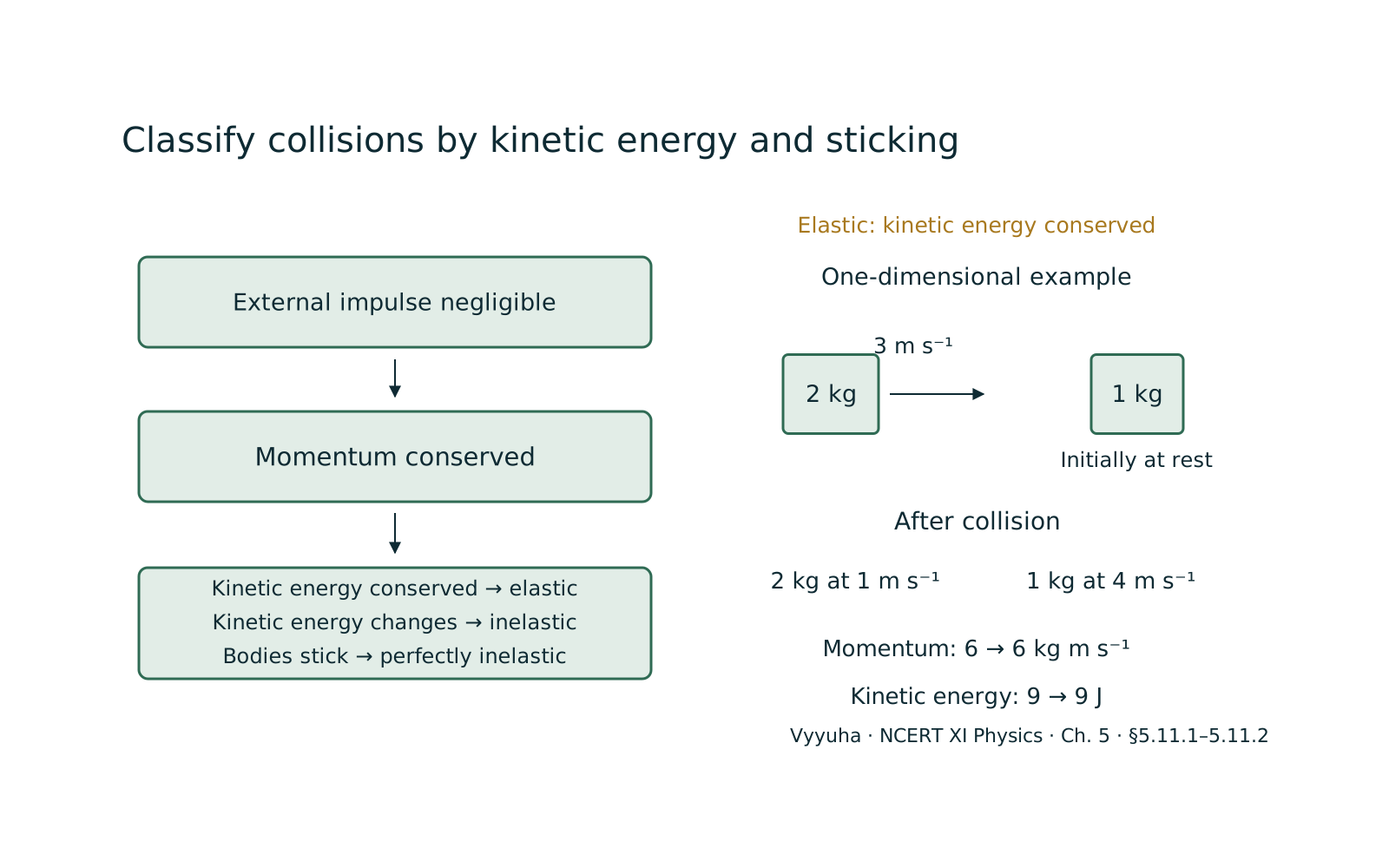
An elastic collision is a type of collision in which the total kinetic energy of the system of colliding bodies is conserved, in addition to the conservation of total linear momentum. This implies that there is no net loss of kinetic energy in the form of heat, sound, or permanent deformation during the collision process. While kinetic energy may temporarily convert into potential energy of deform…
Quick Summary
Elastic collisions are fundamental interactions where two key quantities are conserved: total linear momentum and total kinetic energy. This means that the 'push' and the 'energy of motion' of the system remain unchanged before and after the collision.
While momentum conservation applies to all collisions (elastic or inelastic), kinetic energy conservation is the defining characteristic of an elastic collision. In such collisions, objects deform temporarily during contact but fully regain their original shape, ensuring no permanent energy loss to heat, sound, or deformation.
The coefficient of restitution, a measure of 'bounciness', is exactly 1 for elastic collisions. Key scenarios include one-dimensional head-on collisions, where specific formulas predict final velocities based on masses and initial velocities.
Special cases, like equal masses exchanging velocities or a light object bouncing off a heavy one, are particularly important for NEET. Though idealizations in the macroscopic world, elastic collisions are crucial models in microscopic physics.
Full explanation
Elastic collisions represent an idealized scenario in physics where both linear momentum and kinetic energy are conserved. Understanding these collisions is crucial for NEET aspirants as they form the basis for many problems involving particle interactions.
Conceptual Foundation
At its core, an elastic collision is defined by two fundamental conservation laws:
- Conservation of Linear Momentum: — The total linear momentum of the system of colliding bodies remains constant before and after the collision, provided no external forces act on the system. Mathematically, for two bodies and with initial velocities and and final velocities and respectively:
- Conservation of Kinetic Energy: — This is the defining characteristic of an elastic collision. The total kinetic energy of the system remains constant before and after the collision. Mathematically:
Key Principles and Derivations (One-Dimensional Elastic Collisions)
For a one-dimensional (head-on) elastic collision, we have two equations and two unknowns ( and ). We can solve these simultaneously to find the final velocities.
From momentum conservation: (Equation 1)
From kinetic energy conservation: (Equation 2)
Dividing Equation 2 by Equation 1 (assuming and , which is true unless one object is infinitely massive or the collision is trivial): Rearranging this gives a crucial relationship for elastic collisions: This equation states that the relative speed of approach before the collision is equal to the relative speed of separation after the collision.
This is also directly related to the coefficient of restitution, , for elastic collisions.
Now, we can use this relationship to find and : From , we get . Substitute this into the momentum conservation equation:
Special Cases of 1D Elastic Collisions
These general equations simplify significantly under certain conditions, which are frequently tested in NEET:
- **Second body initially at rest ():**
* *
- **Equal masses () and :**
* * * Result: The first body comes to rest, and the second body moves with the initial velocity of the first. This is a classic case, often seen with billiard balls (though not perfectly elastic).
- **Equal masses () and both moving:**
* * * Result: The bodies exchange their velocities. This is a very important result.
- **Light body collides with a massive body at rest (, ):**
* * * Result: The light body bounces back with nearly the same speed, and the massive body remains almost at rest. (e.g., a tennis ball hitting a wall).
- **Massive body collides with a light body at rest (, ):**
* * * Result: The massive body continues almost unaffected, and the light body moves forward with approximately twice the initial speed of the massive body. (e.g., a car hitting a stationary bicycle).
Two-Dimensional Elastic Collisions
In two-dimensional elastic collisions, both momentum and kinetic energy are conserved, but momentum conservation must be applied vectorially along two perpendicular axes (e.g., x and y axes). The equations become more complex, involving angles. For NEET, 1D collisions are far more common, but understanding the principles for 2D is important:
- Momentum Conservation:
* *
- Kinetic Energy Conservation:
*
Coefficient of Restitution ($e$)
For an elastic collision, the coefficient of restitution () is defined as the ratio of the relative speed of separation to the relative speed of approach. For a perfectly elastic collision, . This is consistent with the derived relationship , which can be written as .
Real-World Applications and NEET-Specific Angle
While perfectly elastic collisions are an idealization, the principles are applied in various fields:
- Nuclear Physics: — Collisions between subatomic particles (e.g., alpha particles scattering off nuclei, neutron moderation) are often treated as elastic collisions to analyze energy and momentum transfer.
- Gas Dynamics: — The kinetic theory of gases models gas molecules as undergoing elastic collisions with each other and with the container walls.
- Sports: — While not perfectly elastic, the bounce of a tennis ball or a basketball involves a high coefficient of restitution, and the principles of elastic collisions help understand the mechanics.
For NEET, the focus is primarily on 1D elastic collisions. Students must be proficient in:
- Applying the conservation laws of momentum and kinetic energy.
- Using the derived formulas for final velocities, especially for the special cases.
- Understanding the concept of the coefficient of restitution ().
- Solving problems involving objects colliding and then moving together (inelastic collision) versus bouncing off (elastic collision). The distinction is crucial.
Common Misconceptions
- Conservation of kinetic energy means no energy transformation: — While the total kinetic energy of the system is conserved, during the very brief moment of contact, kinetic energy is temporarily converted into elastic potential energy as the bodies deform. This potential energy is then fully converted back into kinetic energy as the bodies regain their original shape and separate. The key is that there's no net loss or permanent conversion.
- Elastic collision means objects don't deform: — Objects do deform during an elastic collision, but this deformation is entirely temporary and reversible. They return to their original shape without any permanent change.
- Momentum is conserved only in elastic collisions: — Linear momentum is conserved in all collisions (elastic, inelastic, perfectly inelastic) as long as the system is isolated from external forces. Kinetic energy conservation is what distinguishes elastic collisions.
- Always use the general formulas: — While the general formulas are powerful, for special cases (like equal masses or one body at rest), using the simplified results can save significant time in NEET. It's often quicker to apply the relative velocity concept () along with momentum conservation rather than memorizing the full derivations for and .
Mastering elastic collisions requires a strong grasp of both the underlying principles and their mathematical application, particularly in the context of one-dimensional scenarios and their special cases.
Key Concepts
In a one-dimensional elastic collision between two bodies, say and , with initial velocities …
When two bodies of equal mass () undergo a 1D elastic collision, and one of them is initially…
Consider a very light body () colliding elastically with a much heavier body () that is initially…
Often confused with
Side-by-side differences the NEET paper likes to test.
| Aspect | Elastic Collisions | Inelastic Collisions |
|---|---|---|
| Conservation of Linear Momentum | Always conserved (if isolated system) | Always conserved (if isolated system) |
| Conservation of Kinetic Energy | Conserved (total kinetic energy before = total kinetic energy after) | Not conserved (total kinetic energy before > total kinetic energy after) |
| Energy Loss | No net loss of kinetic energy to other forms (heat, sound, deformation) | Kinetic energy is lost/converted to heat, sound, and/or permanent deformation |
| Coefficient of Restitution ($e$) | $e = 1$ | $0 \le e < 1$ (for perfectly inelastic, $e=0$) |
| Deformation | Temporary and reversible deformation; objects regain original shape | Permanent deformation often occurs; objects do not fully regain original shape |
| Relative Velocity | Relative speed of approach = Relative speed of separation | Relative speed of approach > Relative speed of separation |
| Example | Collisions between subatomic particles, ideal billiard ball collisions | Car crashes, a bullet embedding in a block of wood, a ball of clay hitting a wall |
The fundamental distinction between elastic and inelastic collisions lies in the conservation of kinetic energy. While linear momentum is conserved in both types of collisions (assuming an isolated system), only elastic collisions conserve the total kinetic energy of the system.
In inelastic collisions, some kinetic energy is always transformed into other forms of energy, such as heat, sound, or energy of deformation. This difference is quantitatively captured by the coefficient of restitution (), which is 1 for elastic collisions and less than 1 for inelastic collisions.
Why it is tested: For NEET, understanding these differences is crucial for correctly identifying the type of collision described in a problem and applying the appropriate conservation laws. Questions often test the ability to differentiate between these collision types based on given conditions or to calculate energy loss in inelastic scenarios versus zero loss in elastic ones.
Questions students ask
5 answered on this topic.
What is the primary difference between an elastic and an inelastic collision?
The primary difference lies in the conservation of kinetic energy. In an elastic collision, both linear momentum and kinetic energy are conserved. This means the total kinetic energy of the system before the collision is exactly equal to the total kinetic energy after the collision.
In contrast, in an inelastic collision, while linear momentum is still conserved (assuming no external forces), kinetic energy is not conserved. Some kinetic energy is converted into other forms, such as heat, sound, or permanent deformation of the colliding objects.
Are perfectly elastic collisions possible in the real world?
Perfectly elastic collisions are an idealization and are very rare in the macroscopic world. In reality, some amount of kinetic energy is always lost to heat, sound, or permanent deformation during any collision between macroscopic objects. However, at the atomic and subatomic levels, collisions between particles like electrons, protons, or gas molecules can be very close to perfectly elastic, making the model highly useful in fields like nuclear physics and kinetic theory of gases.
What is the role of the coefficient of restitution in elastic collisions?
The coefficient of restitution () quantifies the 'bounciness' of a collision. It is defined as the ratio of the relative speed of separation after the collision to the relative speed of approach before the collision. For a perfectly elastic collision, the relative speed of separation is equal to the relative speed of approach, meaning . This value of 1 signifies that there is no net loss of kinetic energy during the collision, and the objects rebound with maximum possible relative speed.
Is momentum always conserved in an elastic collision?
Yes, linear momentum is always conserved in an elastic collision, provided the system of colliding bodies is isolated, meaning no external forces act on it. In fact, the conservation of linear momentum is a fundamental principle that applies to all types of collisions (elastic, inelastic, and perfectly inelastic) under isolated conditions. The conservation of kinetic energy is the additional condition that specifically defines an elastic collision.
What happens if a light body collides elastically with a much heavier body at rest?
If a light body () collides elastically with a much heavier body () that is initially at rest (), the light body will bounce back with nearly the same speed it had initially, but in the opposite direction (). The heavy body will remain almost at rest (). Think of a tennis ball hitting a massive wall; the wall barely moves, and the ball rebounds with almost its original speed.
Revise in 30 seconds
- Definition: — Total linear momentum and total kinetic energy are conserved.
- Coefficient of Restitution: — .
- 1D Momentum Conservation: —
- 1D Kinetic Energy Conservation: —
- Relative Velocity Relation: — (relative speed of approach = relative speed of separation)
- Final Velocities (General 1D):
- -
- Special Case ($m_1=m_2, u_2=0$): — (velocities exchange)
- Special Case ($m_1 \ll m_2, u_2=0$): — (light body bounces back, heavy body at rest)
- Special Case ($m_1 \gg m_2, u_2=0$): — (heavy body continues, light body moves with double speed)
For Elastic Collisions, remember 'MKE': Momentum is conserved. Kinetic energy is conserved. Equals 1 (Coefficient of Restitution, ).
And for the relative velocities: 'Approach = Separation' ().
For equal masses, 'Swap Speeds!'